Judaism / The Man Who Never Saw the Land
Appendices
Glossary
Terms used in the book, with brief definitions keyed to how they appear in the text. Most are archaeological, historical, or biblical-studies terms that a general reader may meet for the first time. A few are defined because the book uses them in a specific way.
Apiru / Habiru: A term that appears in Egyptian, Akkadian, and other Near Eastern documents from the second millennium BCE to describe a socially marginal class of people — refugees, fugitives, mercenaries, labourers, bandits — without a single ethnic identity. In the Amarna letters, the term (often spelled Habiru) refers to people moving through the region who are not attached to a state. The relationship between the Apiru and the Hebrews is debated; the book treats the term as useful background for the status of Semitic-speaking populations in the Delta, not as evidence that the Hebrews were the Apiru. The distinction matters: the Hebrews may have been among the Apiru, but the word does not mean "Israelite."
Shasu: A group of Semitic-speaking nomadic or semi-nomadic peoples in the late second millennium BCE, recorded in Egyptian documents, including Papyrus Anastasi VI, as moving through the frontier regions east of the Delta. The Shasu are the closest Egyptian textual referent to the kind of population the Exodus story describes at its margins. The book treats the Shasu as context for the texture of the borderlands, not as proof that the Shasu were the Israelites. Several Shasu groups are later associated with the worship of YHWH in topographical lists, which is relevant to the question of where the god came from.
Hyksos: A term for the rulers of the Fifteenth Dynasty of Egypt, of Semitic origin, who controlled the eastern Delta and much of Egypt from about 1650 to 1550 BCE before being expelled by Ahmose I. The Hyksos period is the most visible episode of Semitic rule in Egypt, and the memory of it — or the memory of people like them — is plausibly in the background of the Exodus story. The book does not claim the Hyksos were the Hebrews, but notes that the expulsion of the Hyksos is one of the events that could have generated a story about Semitic people leaving Egypt.
Pi-Ramesses: The capital built by Ramesses II in the eastern Delta, on the site of the former Hyksos capital Avaris (modern Tell el-Dab'a). The city is named in Exodus 1:11 as one of the store cities the Hebrews built — "Pithom and Ramesses." Pi-Ramesses is the strongest archaeological anchor in the Exodus story: the city existed, it was a major building project, it was built with organised labour, and it is in the right region. The book treats Pi-Ramesses as the one place where the story's details ring true, while being clear that the story's detail is not the same as the story's truth.
Aten: The sun-disk deity elevated by the pharaoh Akhenaten in the Amarna period (c. 1350 BCE) to a position of near-monopoly in Egyptian religion, and the centre of the brief experiment in what looks like a form of monotheism. The Aten episode is relevant to the question of where the idea of a single supreme god came from, and to the argument in the book that Moses' god has a backstory in the Egyptian religious world. The book is careful: Akhenaten's Atenism was not the same as Israelite monotheism, and the connection is suggestive rather than direct.
Yahweh / YHWH: The name of the god of Israel. The name appears in the Hebrew Bible as the four-letter sequence YHWH (the Tetragrammaton), which is not pronounced as written in Jewish tradition, where it is replaced by Adonai ("Lord") in reading. The book uses "Yahweh" as the standard scholarly convention for the god's name, and "the LORD" only where it is quoting or closely following the biblical text. The origin of the name is debated; the book follows the account that YHWH was originally a deity associated with the regions south and east of Canaan (the Shasu, Midian, the Sinai) before becoming the god of Israel, and that the name entered Israelite religion in a specific historical moment.
Tetragrammaton: The four-letter name of God in the Hebrew Bible — YHWH — written as a proper name and treated as a name that should not be spoken in Jewish tradition. The book uses the term to refer to the written form of the name and the questions it raises: the name's origin, the reason it is not pronounced, and the difference between the name and the title "the LORD."
Covenant / suzerainty treaty: A covenant in the biblical sense is a binding agreement, usually between God and Israel, that sets out obligations, blessings, and curses. The book argues that the form of the covenant at Sinai — its structure, its list of stipulations, its blessings and curses — resembles the suzerainty treaties of the Hittite diplomatic tradition, in which a great king sets terms with a lesser one. The resemblance is one of the genuinely useful pieces of evidence for dating and understanding the biblical text, and it is the kind of detail the book means by "the world behind the story."
JEDP: The standard abbreviation for the four-source model of the composition of the Torah: J (the Yahwist), E (the Elohist), D (the Deuteronomist), and P (the Priestly source). The model holds that the Torah is a composite of originally independent documents that were edited together over centuries, with the final form taking shape in the exile or after. The book explains the model in Chapter 24 and uses it as the tool for hearing the seams in the text. The book is fair to the model and honest about its limits: it is the best available tool, and it has been refined and challenged, and it is not a complete account of the composition. The model is a tool for reading, not a claim about the authors as individual people.
Midian: A region and a people in the northwestern Arabian peninsula, east of the Gulf of Aqaba, whose priests, according to the biblical story, knew Yahweh before Israel did. Midian is where Moses fled after the murder of the Egyptian, where he met Jethro (also called Reuel), the priest of Midian, who became his father-in-law, and where he spent forty years as a shepherd before the call. The book treats Midian as the setting for the second act of Moses' life and as the place where the story introduces the idea that Yahweh was already worshipped outside Israel.
Horeb / Sinai: The name of the mountain of God in the biblical text. The same mountain is called Horeb in some passages (especially in the Elohist and Deuteronomist sources) and Sinai in others (especially in the Priestly source and in later tradition). The book uses "Sinai" as the common name and notes the Horeb/Sinai alternation as one of the seams a reader can hear once the source divisions are explained. The location of the mountain is debated; the book describes the main candidates — Jebel Musa in the southern Sinai, the alternatives in the Transjordan, and the proposals in northern Arabia — and says that none is certain.
Meribah: The place where Moses struck the rock and was disqualified from entering the land. The name means "contention" or "strife," and the episode is recorded in Numbers 20. The book treats the rock at Meribah as the one disqualifying failure in Moses' life — the failure that is oddly small for the punishment attached, and the failure that the book argues is worth a whole chapter because the tradition punishing its own hero is one of the things that makes the portrait believable.
Kadesh-barnea: A site in the southern Negev, at the head of the Gulf of Aqaba, that is the staging point for the Israelites' attempts to enter Canaan and the base from which the spies were sent into the land. Kadesh is the place where the generation that left Egypt is told it will die in the wilderness, and the place where Moses strikes the rock at Meribah. The book treats Kadesh as one of the fixed geographic points in the wilderness narrative and notes that the thirty-eight years are mostly empty in the biblical text.
Exodus: The departure of the Israelites from Egypt, as told in the book of Exodus. The book uses "Exodus" for the story and the book, and notes the distinction between the historical question (did a group of people leave Egypt, and if so how many and when?) and the narrative question (what does the story mean and why has it lasted?). The book's argument is that a small group of Semitic-speaking people got out of Egypt, or remembered getting out, and that around that memory grew the story.
Torah: The five books of Moses — Genesis, Exodus, Leviticus, Numbers, Deuteronomy — also called the Pentateuch. The book uses "Torah" as the standard name for the five-book unit and notes that the word means "instruction" or "teaching" rather than "law" in the narrow sense. The book argues that the Torah in its final form was assembled in Babylon, during or after the exile, by a community that had lost the land and needed a portable story. The ending of the Torah — the death of Moses on the mountain, with the land in sight but not entered — is the ending that speaks to that community and that the book makes the argument of the whole book.
Pentateuch: The five books of Moses. A Greek term (from pentē "five" and tekhnē "books") used interchangeably with "Torah" in critical scholarship. The book uses "Pentateuch" when it is discussing the formation of the five-book unit as a literary and historical object.
Documentary hypothesis: The theory that the Torah is a composite of originally independent sources, edited together over centuries. The term is often used interchangeably with "JEDP model," and the book uses both. The book explains the hypothesis in Chapter 24 and is honest about what it can and cannot do.
Deuteronomy: The fifth book of the Torah, the book of the law that, according to the story in 2 Kings 22, was found in the temple during the reign of Josiah and used to drive the reform of 622 BCE. The book argues that Deuteronomy was either produced or rediscovered at that moment, and that the book's political use by Josiah is one of the key moments in the making of the portrait of Moses. Deuteronomy is also the book that contains the conquest ideology — the language of destruction that the book treats as one of the things that cannot be skipped.
Josiah: The king of Judah who ruled from about 640 to 609 BCE and who, according to the biblical story, carried out a major religious reform in 622 BCE after the book of Deuteronomy was found in the temple. Josiah is the king the book treats as the first political user of the Moses story as it has come down to us, and the reform of 622 BCE is the first of the two key moments in the making of the portrait — the other being the exile in Babylon.
Babylonian exile: The deportation of the elite of Judah to Babylon after the fall of Jerusalem in 586 BCE, and the community's life in exile until the return under Cyrus of Persia in 538 BCE. The book argues that the exile is the moment at which the Torah was assembled into its final form, and that the portrait of Moses in its final form is a portrait made by exiles — a community that had lost the land and needed a portable identity. The book treats the exile as the turn of the whole book.
Philo of Alexandria: A Jewish philosopher of the first century CE, writing in Greek in Alexandria, who produced the first major philosophical reading of Moses in The Life of Moses and other works. Philo reads Moses as the philosopher-lawgiver, the man who received the true philosophy from God, and the portrait he builds is one of the earliest versions of the Moses that belongs to everyone. The book treats Philo as the first of the reception-history chapters in Chapter 28.
Josephus: Flavius Josephus, the first-century Jewish historian who wrote Antiquities of the Jews for a Roman audience. Josephus reshapes the biblical story of Moses to meet the needs of his Roman readers — to make Moses a statesman and a lawgiver and a wonder-worker whose story will read well in the imperial capital. The book treats Josephus as a case study in the making of the portrait, and as the fullest ancient Jewish account of Moses.
Freud / Moses and Monotheism: Sigmund Freud's 1939 book Moses and Monotheism, in which Freud argues that Moses was an Egyptian and that the Moses story is the story of the suppression of a primal religious trauma. The book treats Freud as reception history only, and says so plainly. Freud's book is included because it is one of the most brilliant and most wrong attempts to solve the Moses problem, and because it shows what happens when a great mind tries to make the historian's uncertainty go away.
Liberation movements / Exodus as master text: The use of the Exodus story as the master text of political liberation, from the African-American spirituals through Harriet Tubman (who was called Moses in her lifetime) to Martin Luther King Jr. (whose final speech, "I've Been to the Mountaintop," turns on the Moses story). The book treats this use in Chapter 29 and is honest about the same story being used for conquest — the American West, Zionism — and about the violence the story carries.
Further Reading
The sources below are the works that shaped the book, listed by the question they help answer. A few are primary texts; most are secondary. The list is selective rather than exhaustive — a reader who works through these will have the same landscape the book was written inside.
The sources below are the works that shaped the book, listed by the question they help answer. A few are primary texts; most are secondary. The list is selective rather than exhaustive — a reader who works through these will have the same landscape the book was written inside.
The archaeological and historical baseline
Israel Finkelstein & Neil Asher Silberman, The Bible Unearthed: Archaeology's New Vision of Ancient Israel and the Origin of Its Sacred Texts (2001) The most widely read archaeological account of the Hebrew Bible. The baseline critical position — most of the narrative does not correspond to the material record, and Israel emerged from within Canaan. Read alongside Dever and Hoffmeier for balance; the book can be schematic.
William Dever, Who Were the Early Israelites and Where Did They Come From? (2003) The Canaanite-origins model, argued with archaeological evidence. Dever is hostile to the minimalist position that doubts the Exodus entirely while agreeing that the biblical account is not history as written. Useful for the middle ground the book needs.
James Hoffmeier, Israel in Egypt: The Evidence for the Authenticity of the Exodus Tradition (1996) The serious conservative case for the historicity of the Exodus. Argues that the biblical account preserves genuine historical memory of Semitic populations in the Delta, Egyptian place names in the Exodus narrative, and the plausibility of the journey. Cautious on the scale of the Exodus.
Kenneth Kitchen, On the Reliability of the Old Testament: A Response to Hegemonic Fictions (2003) The most substantial conservative defence of the biblical historical record. Read properly, not as a straw man. The book is stronger for representing this case fairly.
Donald B. Redford, Egypt, Canaan, and Israel in Ancient Times (1992) The standard archaeological-historical account of the region in the second millennium BCE. Essential background for the world the story is set in.
The world of Egypt and the Delta
Jan Assmann, Moses the Egyptian: The Memory of Egypt in Western Monotheism (1997; English trans. 2001) The deepest study of what Moses means across two millennia. Slow going, worth every hour. Also his The Price of Monotheism (2001) on the Axial Age turn in religion.
The Amarna Letters (eng. trans. William L. Moran, 1992) Correspondence between Egyptian pharaohs and Canaanite vassals in the 14th century BCE. The letters mention "Habiru" and give the texture of who was moving through the region.
Papyrus Anastasi VI An Egyptian border inscription from the late 13th century BCE that records Shasu bedouin requesting entry past the frontier forts. One of the few Egyptian texts that mentions groups in the region the Exodus story describes.
The Merneptah Stele (c. 1207 BCE) The earliest extra-biblical mention of Israel. The key document for the chronology problem. The Stele is in the Egyptian Museum in Cairo; a copy is in the Israel Museum in Jerusalem.
The biblical text — translations and commentaries
Robert Alter, The Five Books of Moses: A Translation with Commentary (2004) The best literary translation of the Torah for an English reader. Alter reads the text as literature first, and the book needs that kind of reading.
Nahum Sarna, Exploring Exodus (1986) and JPS Torah Commentary: Exodus (1991) Humane, learned, readable. Sarna represents the midcentury American Jewish commentary tradition well and is one of the most balanced of the older generation of biblical scholars.
Carol Meyers, Exodus (Cambridge Bible Commentary, 2005) A solid, current critical commentary. Useful for the legal and narrative chapters.
Source theory — who wrote the Torah
Richard Elliott Friedman, Who Wrote the Bible? (1987; revised editions) The single clearest popular explanation of the JEPD model for a lay reader. Steal its clarity, not its text.
Richard Elliott Friedman, The Exodus: How It Happened and What It Means (2017) A more recent argument that a small Levite group really did leave Egypt and brought Yahwistic religion with them. Worth reading as a serious attempt to reconcile the archaeological and textual evidence.
Joel Baden, The Composition of the Pentateuch: Renewing and Refining the Documentary Hypothesis (2012) The most rigorous recent statement of the documentary hypothesis. Honest about what the theory cannot do.
Frank Moore Cross, The Documentary Origins of the Pentateuch (various editions) and Canaanite Myth and Hebrew Epic (1973) The classic formulation of the four-source model, and on the poetic texts (Song of the Sea, Song of Deborah) as the oldest material in the Hebrew Bible.
Thomas Römer, The Invention of God (2015; English trans. 2017) The most accessible recent account of where YHWH came from. Useful for the argument that Moses' god has a backstory.
John Day, God's Conflict with the Dragon and the Sea (1985) On the chaos-myth background of biblical language. Useful for reading the plagues and the sea crossing in a larger cosmological frame.
Konrad Schmid, A Philosophy of Old Testament Theology (2012) Part of the broader "Israelite history as memory" turn in recent scholarship. Useful for the argument of Part Five.
The interior man — psychology and literary reading
Avivah Gottlieb Zornberg, The Particulars of Rapture: A Literary Midrash of Exodus (2005) Extraordinary on the psychology of the text. Zornberg reads Exodus as the record of a mental life. The best single source for the interior Moses the book tries to recover. Worth reading cover to cover, even the parts the project does not use directly.
Meir Sternberg, The Poetics of Biblical Narrative (1985) and Biblical Storytelling: Figures of Speech in the Bible (1996) The classic literary study of how the biblical text works as narrative. The analysis of gaps, omissions, and the way the text hides as much as it reveals is directly relevant to the book's method.
The reception — how Moses has meant what he meant
Philo of Alexandria, Life of Moses (Loeb, or various translations) The first major philosophical reading of Moses, from the first century CE. The account of Moses as philosopher and lawgiver. Useful for Chapter 28.
Flavius Josephus, Antiquities of the Jews (Loeb, various) The fullest ancient Jewish account of Moses. Josephus reshapes the biblical story to meet the needs of his Roman readers. Useful for Chapter 28 and to see what a first-century Jewish apologetic does with the Moses story.
Rabbinic midrash on Moses — especially Midrash Rabbah and the commentaries that preserve rabbinic tradition (Maimonides' commentary on the Mishnah, Rashi, the later commentators). The rabbinic tradition reads Moses as teacher, lawgiver, and the man who spoke with God "face to face."
Sigmund Freud, Moses and Monotheism (1939) A book that is partly psychoanalysis and partly a historical hypothesis. Read as reception history only, and the book must say so plainly. Useful for Chapter 28 and for showing what happens when a great mind tries to solve the Moses problem.
The Qur'an — the Musa cycle (Surahs 7, 10, 17, 20, 28, and others) Moses is the most-mentioned prophet in the Qur'an. The account follows the biblical story closely in outline but with significant theological differences. Useful for Chapter 28, handled in its own terms.
Bruce Feiler, America's Prophet: Moses and the American Story (2007) A popular account of how the Exodus story has functioned in American history. Useful for Chapter 29, with the caveat that it is popular history.
Michael Walzer, Exodus and Revolution (1986) The best book on Exodus as the master text of political liberation. Essential for Chapter 29.
Catherine Clinton, Harriet Tubman: The Road to Freedom (2004) A biography of the woman who was called Moses in her lifetime. Useful for the material on Tubman and the Underground Railroad in Chapter 29.
Martin Luther King Jr., "I've Been to the Mountaintop" (1968) The final speech, which turns on the Moses story. Essential primary source for Chapter 29. The text is widely available; the speech was delivered in Memphis on April 3, 1968, the night before King's assassination.
The theological and philosophical background
Gerhard von Rad, Old Testament Theology (in English, various editions) The classic midcentury theology of the Old Testament. Useful for the argument about the covenant and the law in Chapters 17 and 19.
Moshe Weinfeld, Deuteronomy and the Deuteronomic School (1972) The essential study of Deuteronomy as a composition in its own right, which predates the Josiah rediscovery. Useful for Chapter 25.
Jonathan Kirsch, Moses: A Life (1998) A popular predecessor. The book knows what Kirsch does and does it differently. Read to see the shape of the problem from the outside before writing the inside of it.
Appendix C — Further Reading
Maps
The maps in this book are guides to the geography the story moves through. None of them is definitive; where the evidence is thin, the map is provisional, and the caption says so. All images are drawn from Wikimedia Commons and are used under the licence noted in each entry (one exception, noted below, is a custom diagram made for this book). Licences range from public domain through CC-BY and CC-BY-SA; attribution is given where required.
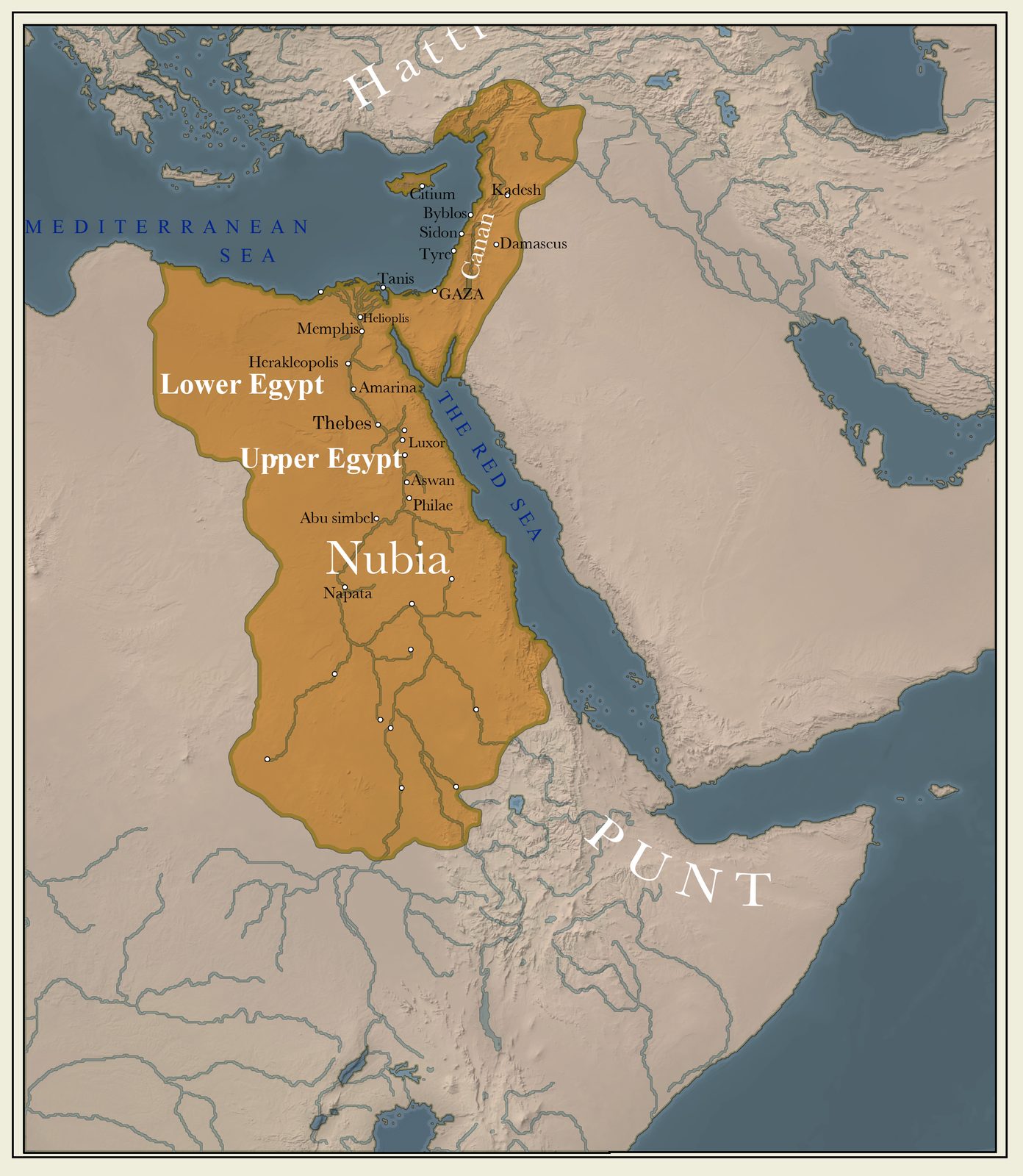
1. New Kingdom Egypt and its empire. The canvas the story is set against — New Kingdom Egypt at its greatest extent, from the Nile Valley and Nubia to the Delta and Egypt's sphere of control in the Levant.
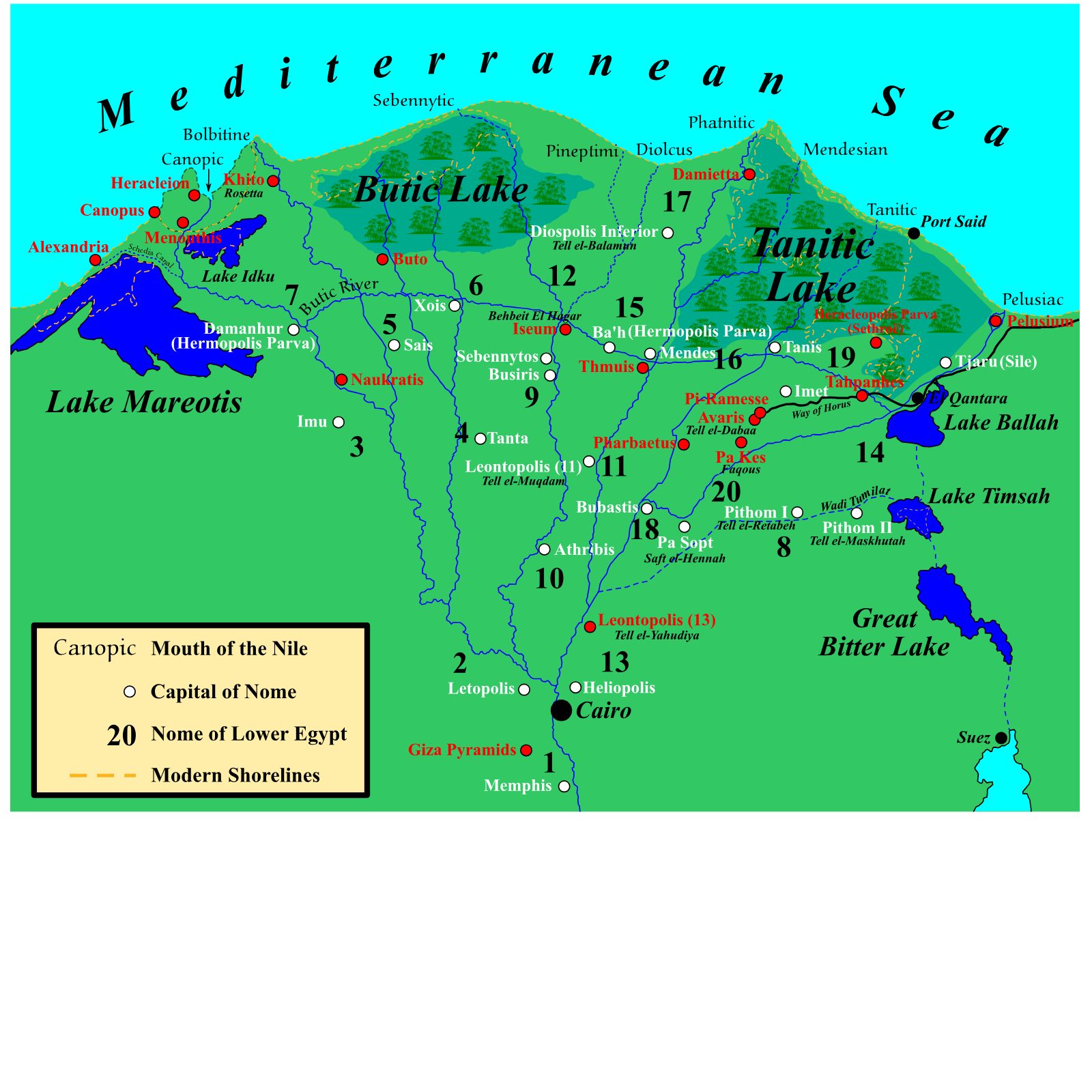
2. The eastern Delta and the Levantine borderlands. Where the Hebrews are said to have lived — the site of Avaris/Pi-Ramesses, the Way of Horus, and Egypt's frontier with Canaan.
A second image for this entry: a reconstruction of the landscape at ground level.
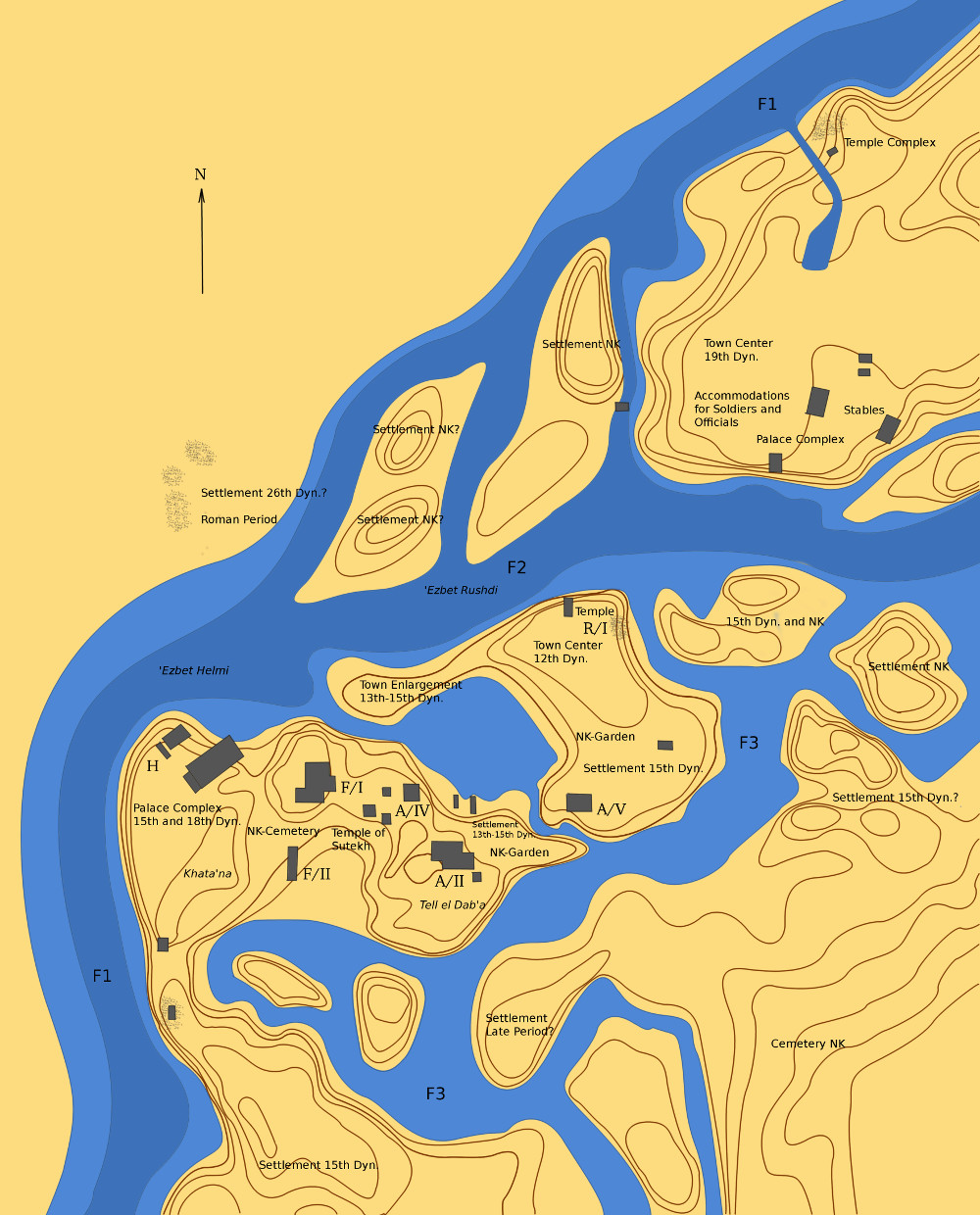
3. Pi-Ramesses and the building programme. The one place the Exodus story's details ring true — the capital Ramesses II built on the site of the former Hyksos capital Avaris.
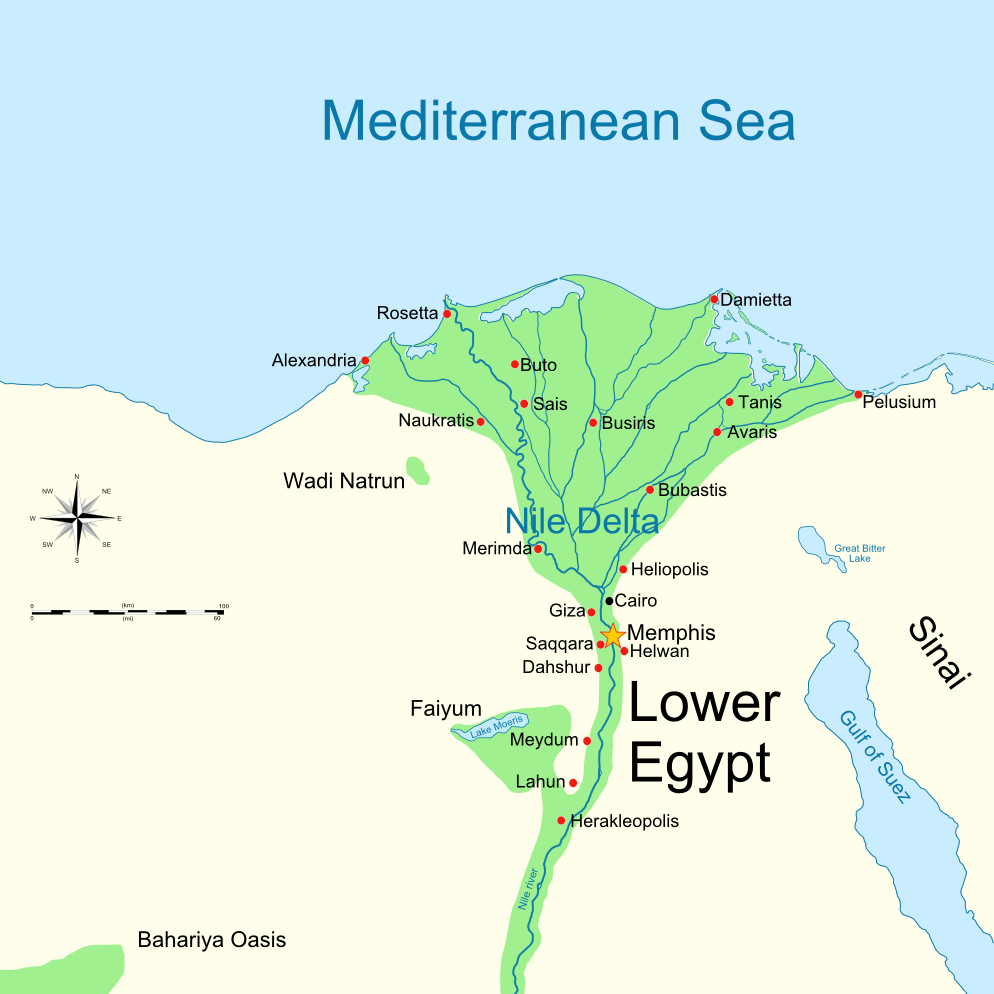
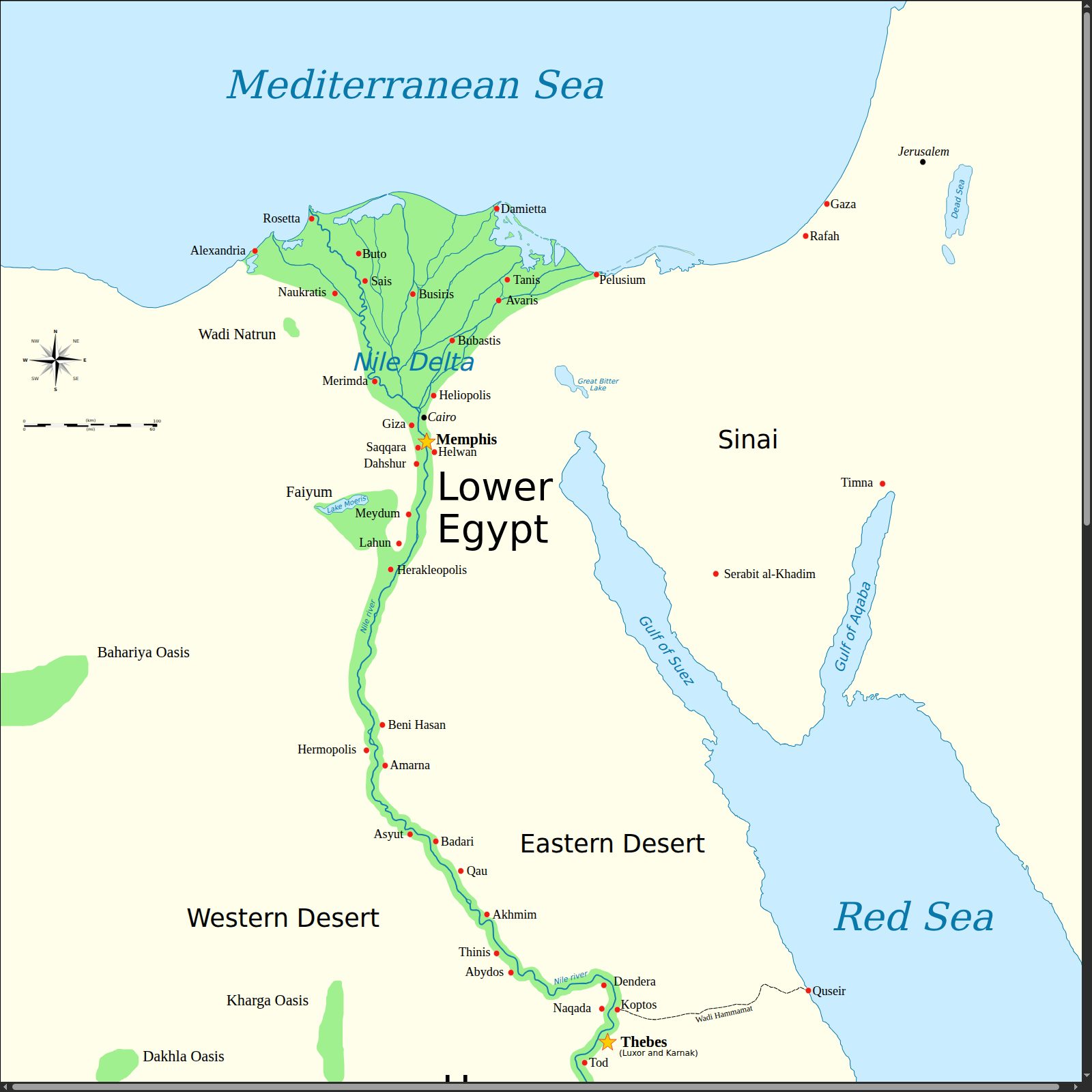
A second image for this entry, zooming in on Lower Egypt and the Delta branches.
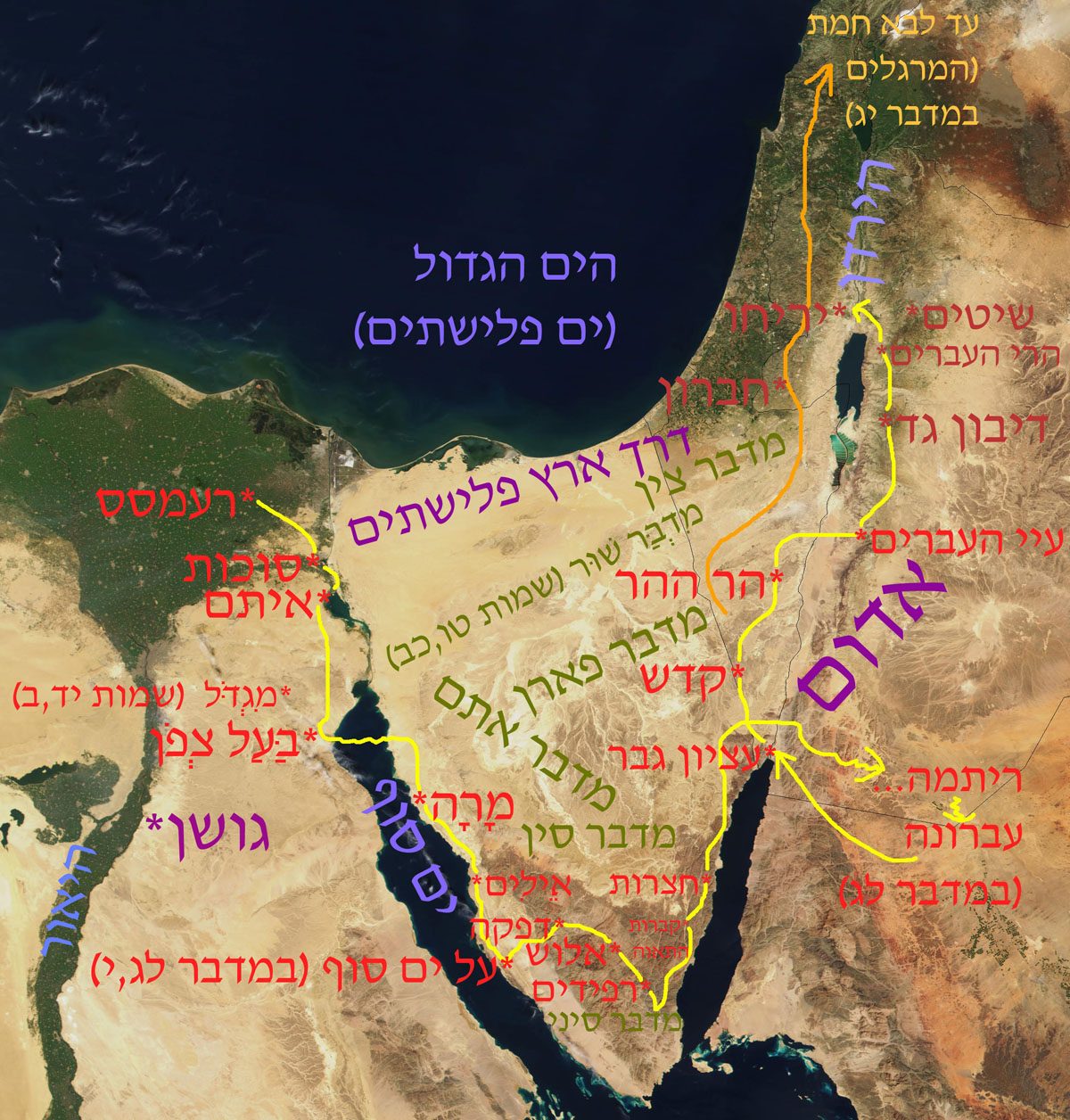
4. The route of the Exodus. The road the story says the Israelites took, from the eastern Delta into the Sinai and toward Canaan. The geography is debated and no candidate crossing site is certain.
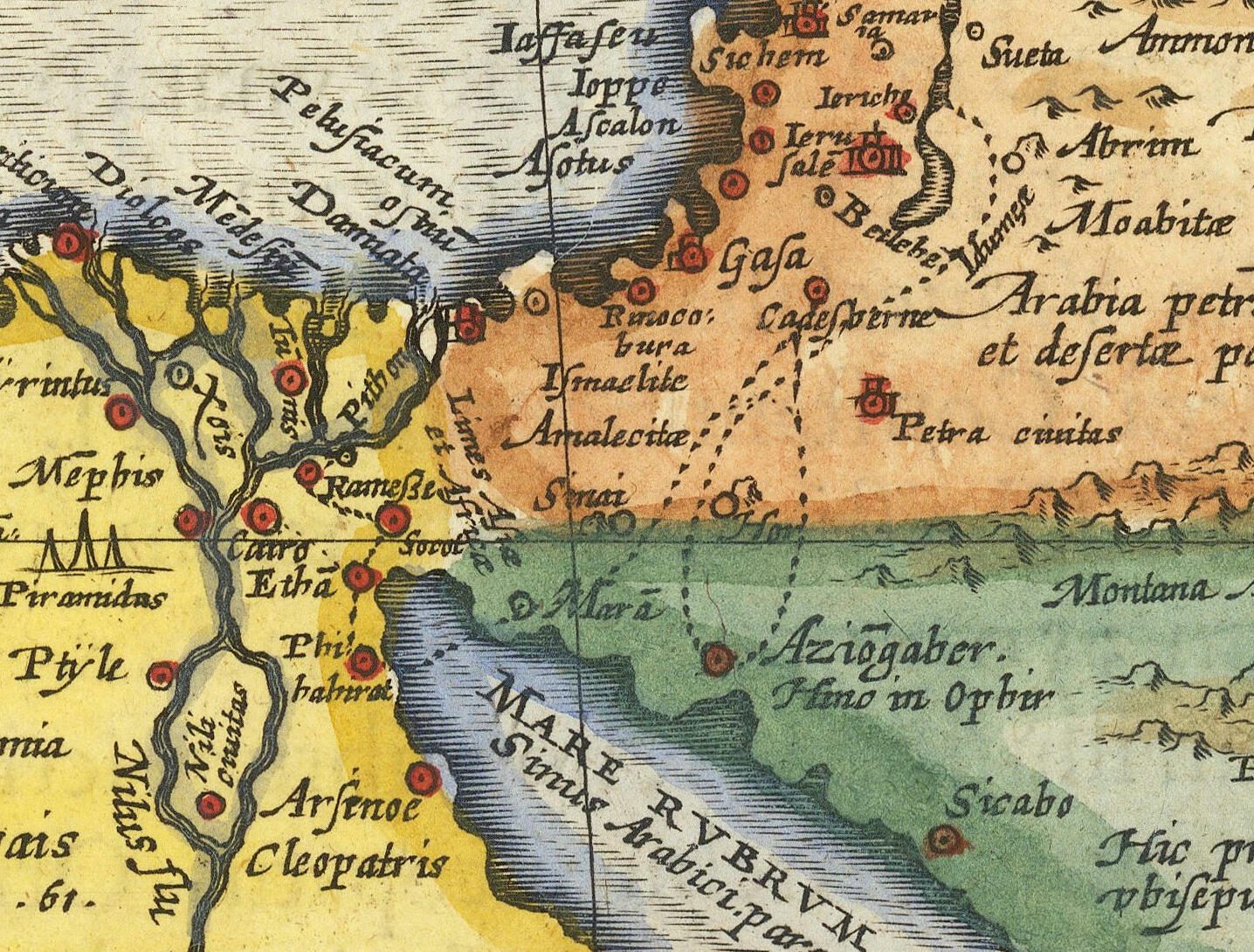
A second image for this entry, showing how the route was drawn in an earlier century.
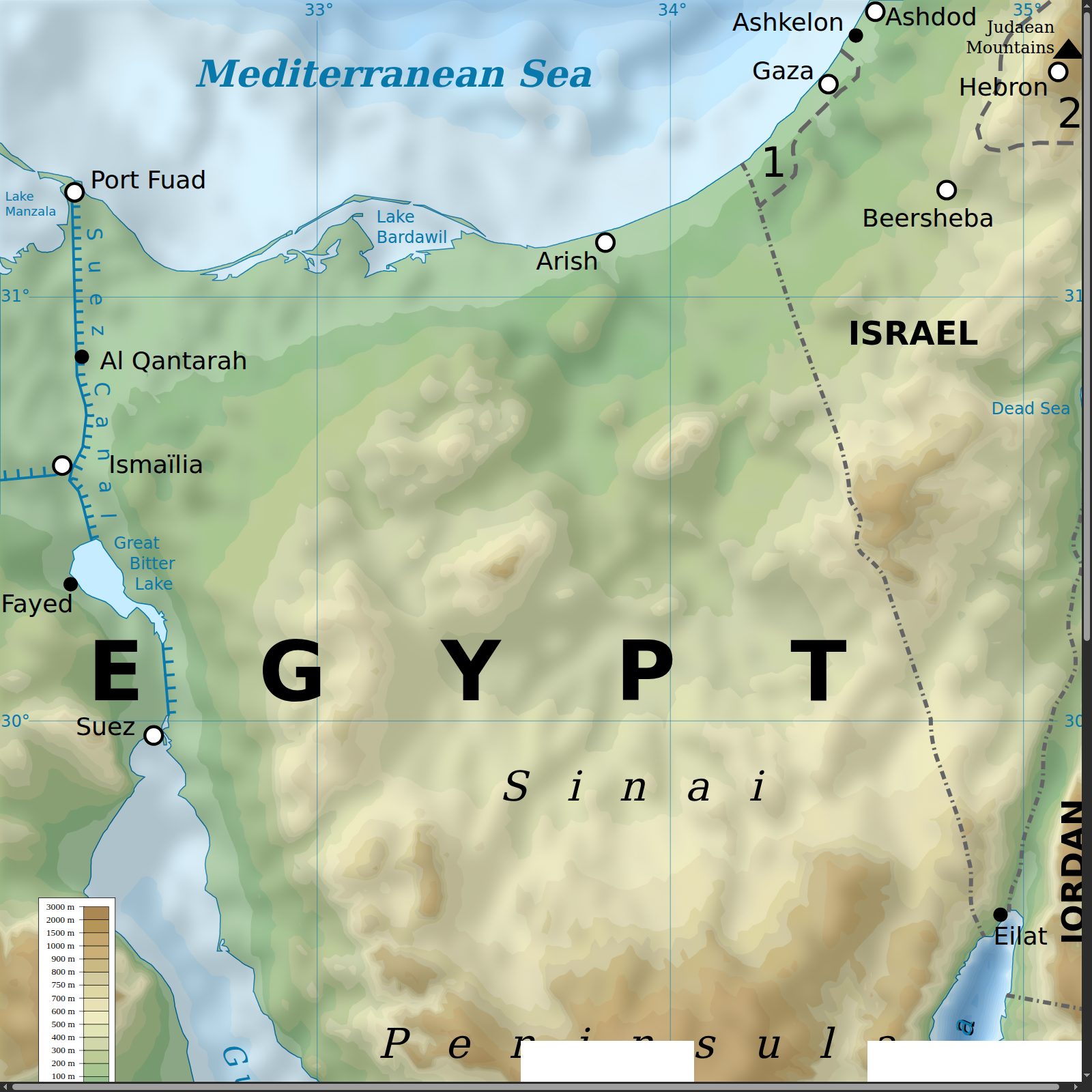
5. Sinai geography. Where the law was given — the Sinai peninsula and the candidate locations for the mountain of God.
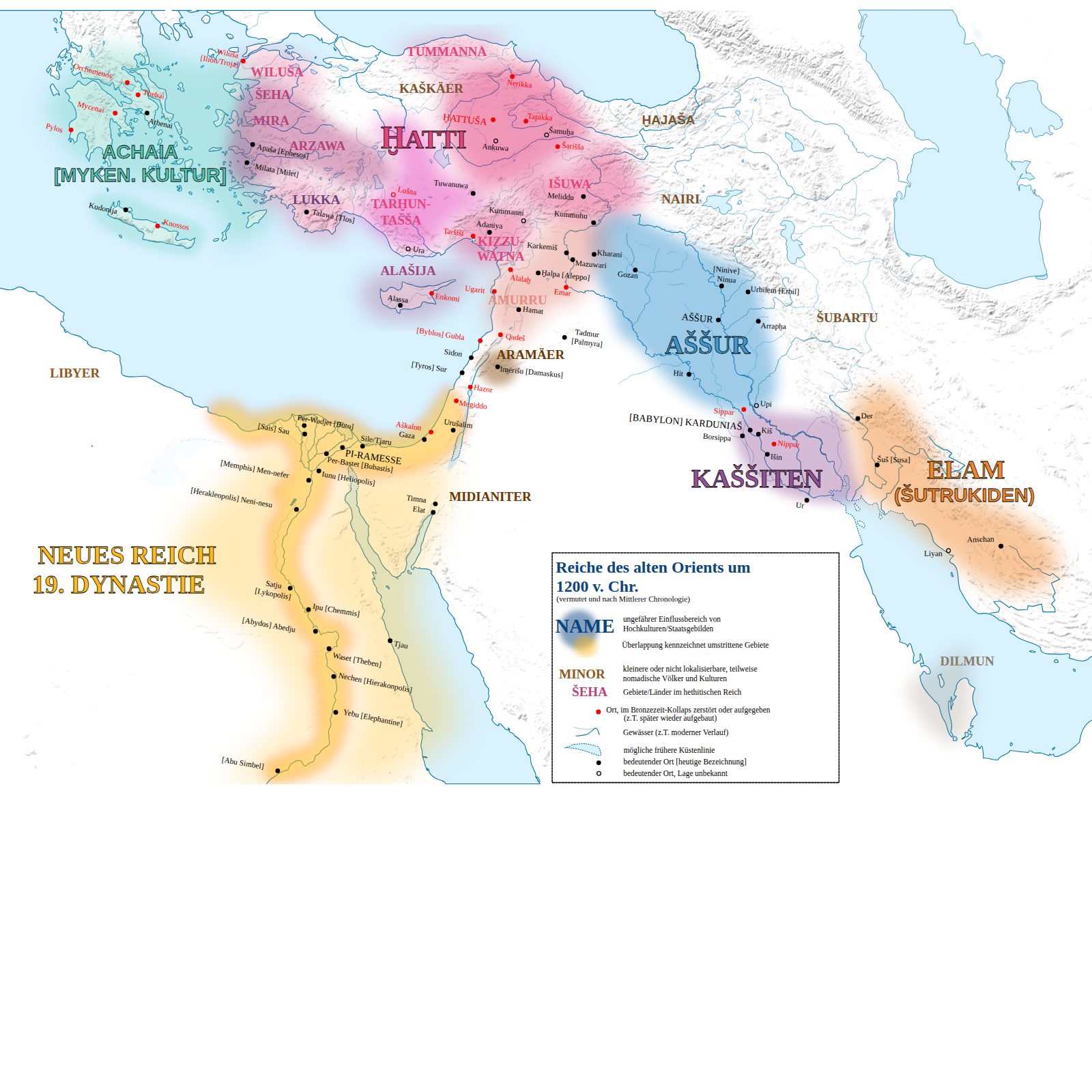
6. Midian and the northwestern Arabian peninsula. Where Moses waited — the region east of the Gulf of Aqaba whose priests, the story says, knew Yahweh before Israel did.
7. The eastern Delta for the birth narrative. The geography of the basket — the river branch where the story places the infant Moses among the reeds.
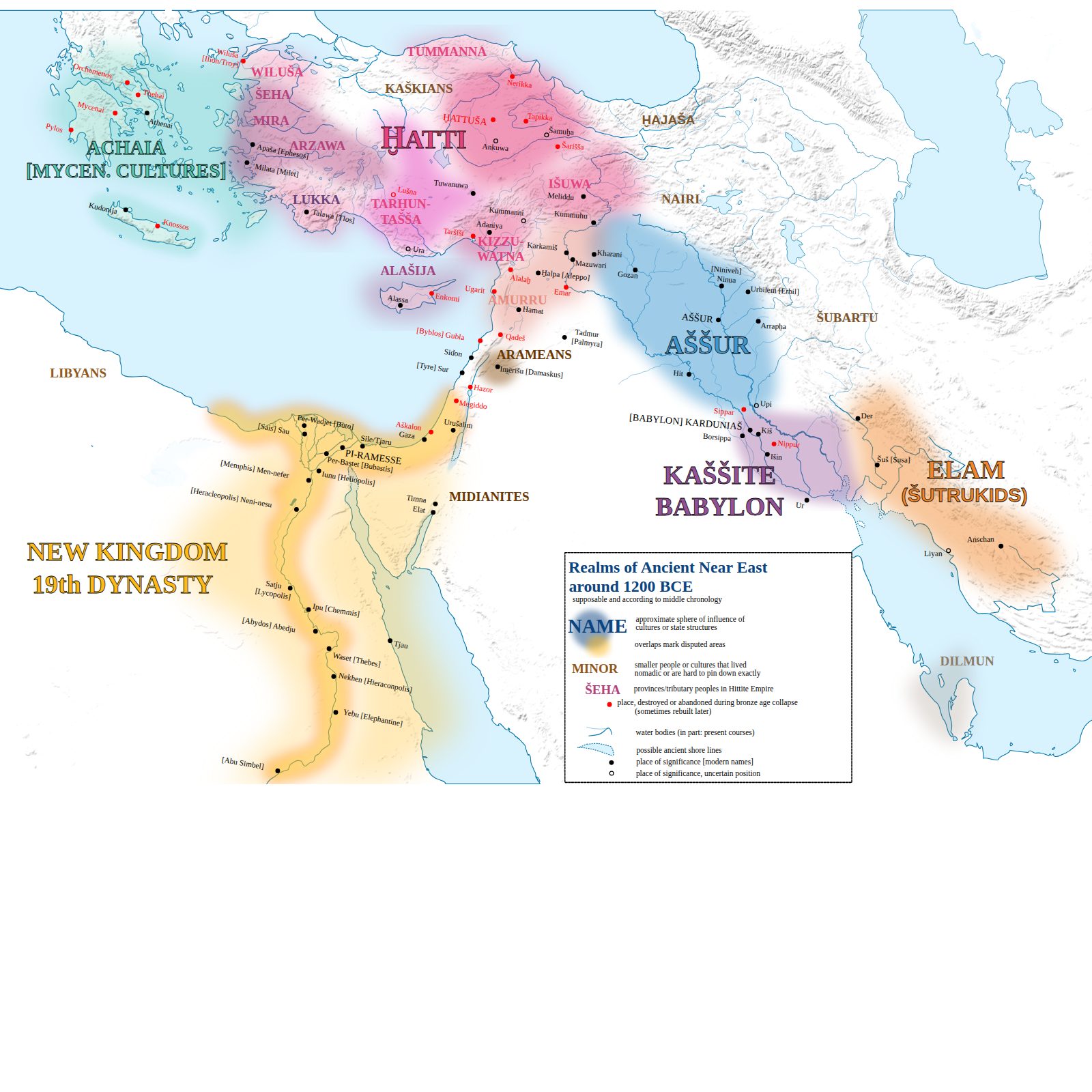
8. Babylon and the routes of the deportation. Where the Torah was assembled — the world of the Babylonian exile, into which the final portrait of Moses was completed.
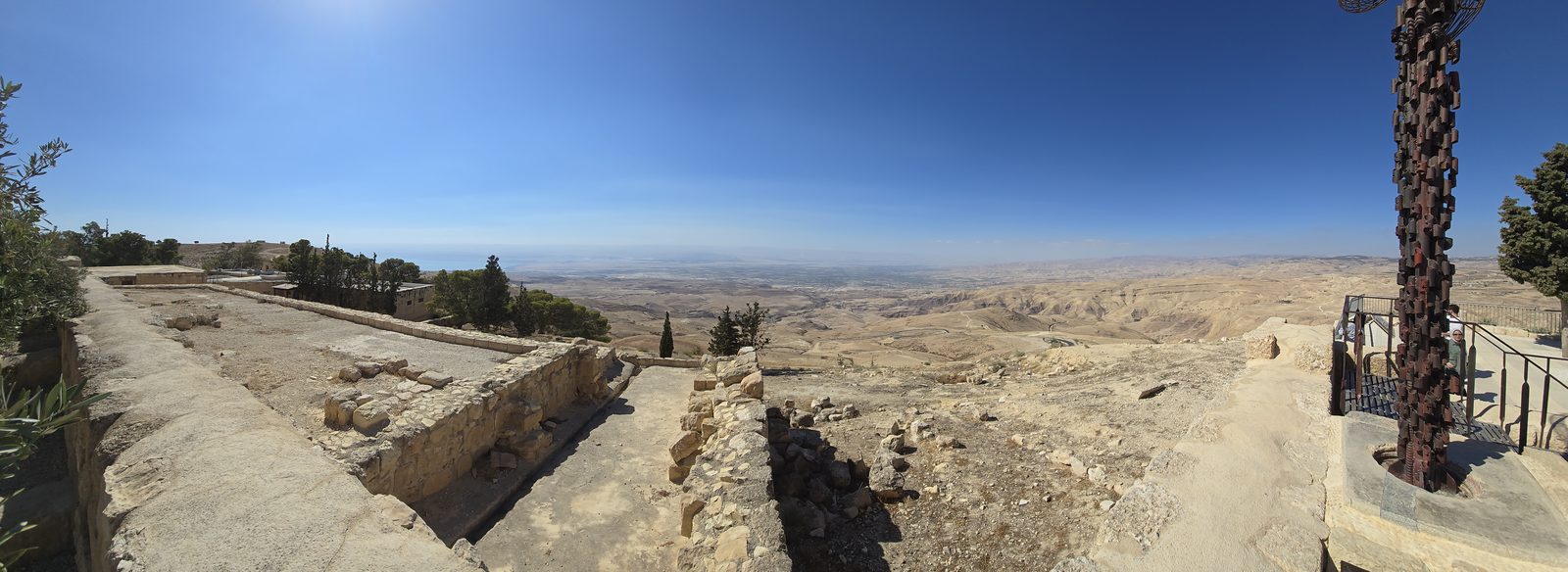
9. Mount Nebo and the promised land. The mountain of the ending — where Moses is said to have looked out over the land and died.
10. The Merneptah Stele and the Egyptian campaign in Canaan. The earliest mention of Israel outside the Bible, in an Egyptian victory inscription from around 1207 BCE.

11. The New Kingdom pharaohs and the Exodus chronology. The timeline the question runs against — since the biblical text never names the pharaoh of the Exodus.
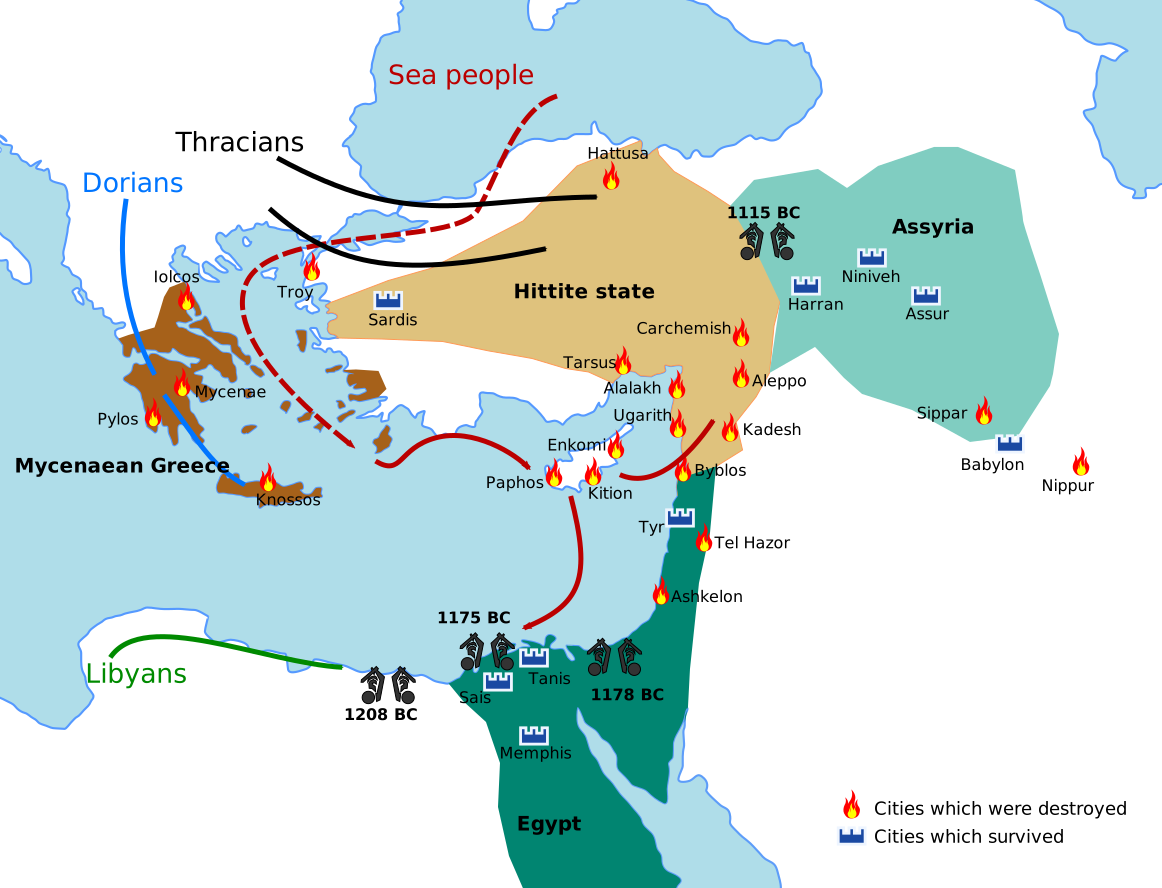
12. Canaan in the Bronze Age collapse. The land they were supposed to enter — the hill country of Ephraim and Judah, and the archaeological picture of an Israel that grew up within Canaan rather than arriving from outside it.
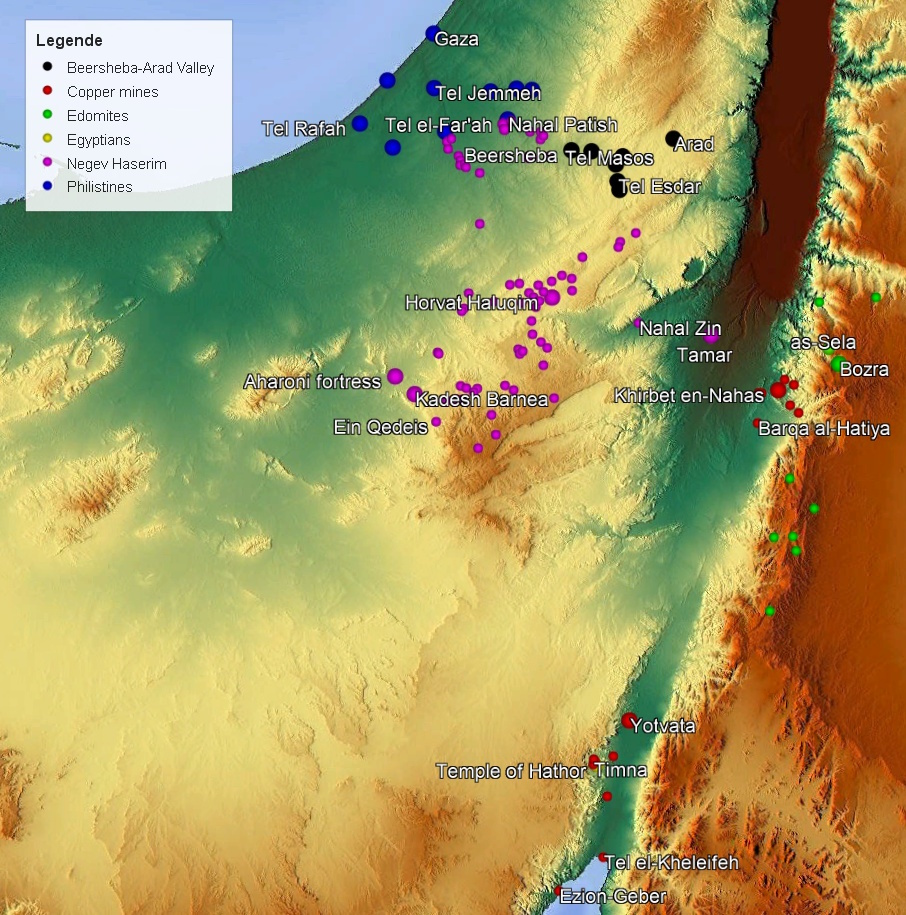
A second image for this entry, focused on the Negev and the Iron Age I settlement pattern.