Part One: Arabia Before
Preface
We do not know most of what happened to him. We know the outline, and we know some of the inside. This book is an attempt to tell what can be told, in the space between the outline and the inside.
A man came down from a cave outside his town, shaking, and told his wife he thought he had lost his mind.
That is the beginning of the story I wanted to tell. Not the beginning of Islam, which is a different story and a larger one. Not the beginning of a religion, or a civilization, or an empire. The beginning of a man's life as it changed beneath him, in a single night, and the beginning of the long, difficult, extraordinary effort to understand what that change meant.
The controlling question of this book is not whether Muhammad was a prophet. The question is what it was like to be a man who believed, against his own initial conviction that he was mad, that God was speaking through him — and who then had to be a husband, a general, a judge, and a head of state while it kept happening.
To answer that question, I have tried to hold two things together that are often separated: the life as it is remembered in the tradition, and the life as it can be reconstructed from the sources with the critical care that the sources deserve. These are not the same thing, and the book does not pretend they are. The tradition preserves a life, and a rich and vivid and human life it is. The sources are late, in ways that matter, and the book does not hide that. The Qur'an is the only source contemporary with Muhammad's lifetime, and the book uses it as such — not as a biography, because it is not one, but as the most secure access we have to what Muhammad was saying at the moments when he was saying it, and as the source that gives us the interiority that nothing else in the sources provides.
The book is built around the sources in four tiers. The Qur'an is the first tier, and it is the tier the book relies on most heavily for the interior moments. The sira — the early biographies of Ibn Ishaq, preserved mainly through Ibn Hisham, and the histories of al-Tabari — is the second tier, and it is the source of the vivid, detailed, human parts of the life. The hadith — the reports of what Muhammad said and did, transmitted in short units with chains of transmission — is the third tier, and it is the source of the small, textured moments of daily life. The outside witnesses — the Doctrina Iacobi, Thomas the Presbyter, Sebeos — are the fourth tier, and they are the sources that confirm the outline of the story from outside.
These sources are late, in ways that matter. The sira was written more than a century after Muhammad's death. The hadith were compiled two centuries after that. The outside witnesses are brief and sparse. The book does not hide any of this. It registers it, and then it asks what can be told anyway, and tells it.
The result is a life of a man who was an orphan, a husband, a trader, a preacher, a persecuted leader, a migrant, a statesman, a judge, a general, a head of state, and a man who died in the room of his wife, tired and ill, in the presence of the people who loved him. It is a life of a man who was respected in his own town for his trustworthiness before the revelation ever came, and who was then rejected by that same town for the message that came to him. It is a life of a man who was stoned at Ta'if, who survived the boycott, who lost his wife and his protector in the same year, who negotiated a treaty that his own followers thought was a defeat and that turned out to be the turning point, who conquered his hometown and forgave the people who had tried to kill him, who died without a clear successor named, and whose death the community could not at first believe.
It is a life of a man who changed the world. It is also a life of a man who was a human being, with the full, complicated, often difficult humanity that the sources preserve — grieving, joking, mending his own sandals, being wrong about pollinating date palms, losing his temper, frowning at a blind man and being rebuked for it. The humanity is the point, and it is also, in the tradition itself, entirely orthodox. The sources preserve it, and the book tries to preserve it too.
The book is not a defense of Islam. It is not a prosecution of Muhammad. It is not a comparative religion essay. It is an attempt to tell what can be told, plainly, about a man who changed the world, using the sources that exist, with all the honesty the sources allow and all the honesty they do not.
The chapters on the Jewish tribes of Medina and on Muhammad's household — on the expulsion of the tribes and the killing of the men of the Qurayza, and on the later marriages and the age question surrounding Aisha — have been written with the greatest care the book could muster. They are the chapters most likely to be quoted against this book, and they have been written for the reader who is a devout Muslim and for the reader who is a hostile critic, and they have been written so that both should find them fair, and neither should find them useful as a weapon. The reader will judge whether the care was enough. The author hopes it was.
The book does not settle the questions that the sources cannot settle. It does not decide whether the revelations were from God. It does not decide the exact age of Aisha at the time of her marriage. It does not decide the exact number of men killed at the Qurayza. It does not decide whether the night journey was physical or spiritual. It presents the traditions, and the debates, and the limits of what can be known, and it asks the reader to sit with the uncertainty.
The uncertainty is part of the story. The silence between the first and the second revelation is the silence that shaped Muhammad more than any single moment of the early life. The years of pressure in Mecca, the boycott, the emigration to Abyssinia, the deaths of Khadija and Abu Talib, the stoning at Ta'if, the assassination plot, the night journey, the hijra — these are the years that the triumphal story skips, and these are the years that the book has tried to stay with.
The book has stayed with the years of pressure because they are the years in which the man who would become the Prophet had to become the man who would become the Prophet. They are the years in which the interiority of the life — the thing that the book identifies as its best single move — is most visible. The Qur'an gives Muhammad words to say when he was afraid. The tradition remembered that he thought he was mad. The silence between the first and the second revelation is the space in which Muhammad had to live with his own uncertainty, and it is the space that made the first public words — the first warnings, the first suras — the words of a man who had been through something and was now, after a period of doubt about what it meant, beginning to act on it.
The book is arranged in six parts. The first part sets the scene — the sources, the town of Mecca, the tribe, the empires, the religious landscape before Muhammad. The second part tells the story of the orphan — the birth, the childhood, the marriage to Khadija, the reputation, the cave. The third part tells the story of the first words — the silence, the early suras, the Meccan reaction, the first believers. The fourth part tells the story of the persecution and the exile — the boycott, the emigration to Abyssinia, the Year of Sorrow, the stoning at Ta'if, the night journey, the hijra. The fifth part tells the story of the Medina period — the Constitution, the statesman, the battles, the Jewish tribes, the household. The sixth part tells the story of the return and the farewell — the treaty, the conquest of Mecca, the last year, the death.
The book ends on the man, not on the empire. The empire that Muhammad had built, or that the community had built under his leadership, was already there at the moment of his death. It would grow in the years after his death, under Abu Bakr and Umar and the Rashidun, and then under the Umayyads and the Abbasids, and then across the world. But the book has not been the story of the empire. It has been the story of the man. The death is where the story of the man ends, and where the book ends — on the man, in the room of Aisha, dead, and with the community outside, in denial, and with the speech of Abu Bakr that broke the denial.
Muhammad was mortal. The empire he left behind was not. The book closes on the man, and with the man's death the closing is complete.
I am grateful to the sources that made the book possible, and to the scholars who have spent their careers trying to understand them. The books that were most useful are listed in the appendix on further reading. The reader who wants to go further will find plenty more. The books listed are the books that the biographer read, and the books that shaped the book. They are the books that the reader should read first, and the books that the reader should read again, and the books that the reader should keep on the shelf.
I am also grateful to the people who have read parts of this book in draft and have saved me from errors I would otherwise have published. Any remaining errors are my own.
The life of Muhammad is a life that has been told many times, in many ways, by many people, and for many reasons. This book is one more telling, and it is a telling that hopes to be honest, and respectful, and human. It is a telling that hopes to give the reader a sense of a life — not a saintly life, not a sinful life, not a life smoothed of its edges, and not a life treated as a prosecution brief or a defense brief. A life.
The life of a man who believed, with his own initial terror, that God was speaking to him, and who then had to be a husband, a general, a judge, and a head of state while it kept happening, and who did all of it, and who died.
That is the life this book has tried to tell.
Author's Note
A few words about how this book was written, and the choices that shaped it.
On naming
I have not used the phrase "peace be upon him" after mentions of Muhammad in the text. That phrase — salallahu alayhi wa sallam — is a mark of religious respect in Muslim usage, and readers who are Muslim will notice its absence. It is not used here because this is a general-audience biography, not a devotional text, and because the phrase would, if used throughout, read as a claim about the book's religious stance that the book does not intend to make.
What the phrase is — a traditional formula of respect, used by Muslims when speaking of the Prophet — is explained, and the choice not to use it is explained, here. The explanation is warm, not defensive. The respect intended is in the care taken with the life, not in a formula repeated tens of thousands of times.
On images
No images of Muhammad appear in this book. No illustrations, no cover art depicting him, no AI-generated visuals of any kind. This is not a stylistic preference. It is a production rule, and it reflects the fact that visual depictions of the Prophet are forbidden in Islamic tradition and would be inappropriate in a book addressed to readers of many backgrounds.
The book that follows is a life — not a defense, not a prosecution, not a comparison with any other religious figure.
On comparisons
This book does not compare Muhammad to Jesus or Moses. These are three separate books. Where the traditions themselves invoke other figures — where, for example, the tradition remembers Waraqa ibn Nawfal, Khadija's cousin, telling Muhammad that what had come to him was of the kind the great prophetic traditions of the region knew — the text reports that tradition without making the comparison itself.
On sources
The book is built from four tiers of source:
- The Qur'an — contemporary with Muhammad's lifetime. Not a biography, but bedrock.
- The sira — Ibn Ishaq (via Ibn Hisham), al-Waqidi, Ibn Sa'd, al-Tabari. Written 130–250 years after the events.
- The hadith — Bukhari and Muslim, ninth century, with chain-of-transmission critical method.
- Outside witnesses — the Doctrina Iacobi, Thomas the Presbyter, Sebeos. Sparse but real.
The source tiers are explained in Chapter 1. They matter throughout, because they tell us what can be known and what can only be remembered.
On the difficult chapters
Chapters 25 and 26 — the Jewish tribes and Muhammad's household — are the chapters most likely to be quoted against this book. They were drafted last, with the most source material, on the principle that the reader who is a devout Muslim and the reader who is a hostile critic should both find them fair, and neither should find them useful as a weapon.
On the controlling question
The controlling question of the book is not whether the revelations were from God. That question cannot be answered from these sources, and it is not the one this book is built to answer. The question is: what was it like to be a man who believed, against his own initial conviction that he was mad, that God was speaking through him — and who then had to be a husband, a general, a judge, and a head of state while it kept happening?
How We Know What We Know
The first thing to say about the life of Muhammad is that almost none of it was written down by him, and almost none of what was written down by anyone who knew him has survived in its original form. What we have instead is a stack of texts written decades and then centuries after the events, each one produced by someone with reasons to remember the story in a particular way. A biography built out of these sources is, from the first page, a detective problem. Not a methodology lecture — a detective problem. Here is the evidence. Here are the reasons each piece of evidence might lead us astray. Let us see what holds up.
There are four tiers of source, and it helps to know them before reading anything else, because they answer different questions and they carry different weights.
The Qur'an
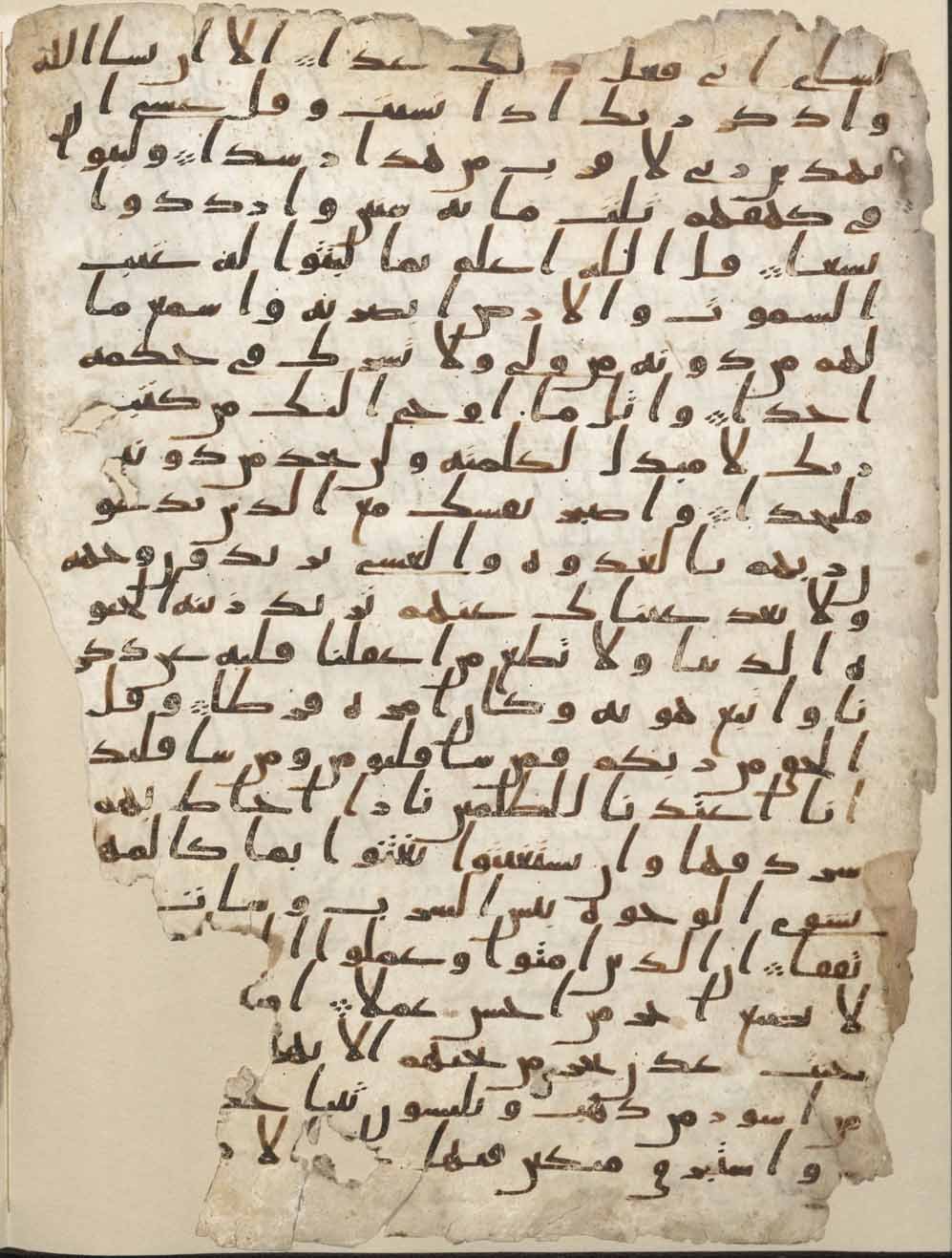
The Qur'an is the only source contemporary with Muhammad's lifetime. It is not, in any ordinary sense, a biography. It does not tell his story. It assumes a story it never narrates — a man, a city, a movement, a struggle — and speaks from inside it. But that is precisely why it is bedrock. When the Qur'an says, in the earliest Meccan suras, that a warning has come to a people who have become complacent, or that orphans have rights, or that a man has been chosen as a warner, these are not later legends dressed up as scripture. They are the words of the movement at the moment it was happening, or close to it, addressed to the people of Mecca while Muhammad was still among them.
The Qur'an also gives us something no other source can: access to what Muhammad himself said when he was under pressure. There are verses where he is comforted after a difficult period. There are verses where he is told off — famously, for turning away from a blind man who came to him seeking counsel. There are verses where his enemies are answered, sometimes sharply, sometimes with patient argument. These are not the polished pronouncements of a statesman with a prepared text. They are reactive, sometimes emotional, occasionally irritable. They give us interiority that nothing else in the source material provides.
There are limits. The Qur'an does not narrate Muhammad's birth, his marriage, his campaigns, or his death. It does not try to. The reader who expects a life story from it will be disappointed and should not be surprised. Its value for a biography is indirect but substantial: it establishes the earliest layer of what he was saying, and it does so at a remove of only a few decades at most from the events, far closer than anything else we have.
The arrangement of the Qur'an in the standard text is not chronological. The suras are ordered roughly by length, longest to shortest, with the opening chapter as an exception. The earliest revelations — short, intense, focused on judgment, the vulnerable, and the coming reckoning — are mostly at the end of the book. The Medinan suras, longer and more concerned with law, community, and the conduct of a state, are mostly at the beginning. A reader who goes through the book from page one to page end will not encounter the story in the order it happened. This is worth knowing before drawing conclusions from any single passage about when it was said.
The Sira
The next tier is the sira — the prophetic biography, in the technical sense. The word literally means "biography" or "life," and in Islamic literary tradition it refers specifically to the life of Muhammad, told as a continuous narrative.
The earliest and most important sira was written by Ibn Ishaq, who died in Baghdad in 767 CE — more than a century after Muhammad's death in 632. Ibn Ishaq was an 8th-century scholar who collected oral traditions about the Prophet's life and wove them into a narrative. He did not, by the account of those who knew his methods, invent much; he compiled, organized, and transmitted. But compilation is not the same as eyewitness report, and the distance in time matters.
Ibn Ishaq's original text does not survive intact. What we have comes mainly through a later editor, Ibn Hisham, who died in 833 — a hundred and sixty years after Muhammad, and nearly seventy years after Ibn Ishaq. Ibn Hisham revised, abbreviated, and in his own words, removed "things which it is disgraceful to discuss; matters which would distress certain people." He also left out material that his teacher had included. The result is a text that is partly Ibn Ishaq and partly Ibn Hisham, and it requires some judgment to know which is which.
A second survival route for Ibn Ishaq's work is the great history of al-Tabari, writing in the early tenth century and drawing on Ibn Ishaq as a source. Al-Tabari includes some material — notably a controversial episode known as the Satanic Verses — that Ibn Hisham chose to omit. Whether al-Tabari preserved Ibn Ishaq faithfully or reshaped him in the process is a matter of scholarly debate. The honest answer is that we can never be fully certain.
Why does this matter for a reader? Because the sira is where the vivid, human, detailed parts of Muhammad's life come from — his birth, his weaning by a Bedouin woman, the story of the black stone and the Kaaba's rebuilding, the psychological terror of the first revelation, the boy who believed himself possessed. These are the passages that make the biography feel like a life, and they are also the passages furthest from contemporary evidence. They are not invented, in the sense that later tradition did not simply make them up wholesale — they rest on chains of transmission that go back through teachers and students to people who may have heard the stories from participants. But the further back you cannot see, the more room there is for the story to have taken shape in the retelling. The sira is indispensable; it is also a hundred and thirty to two hundred and fifty years late, written by people with theological and political stakes that the original participants did not have. Read it for what it is, not for what it pretends to be.
The other major early sira writers are al-Waqidi, whose Maghazi (Book of Military Expeditions) focuses on the campaigns; Ibn Sa'd, whose Tabaqat (Book of Generations) is a biographical dictionary reaching back through the Prophet's companions and their generations; and al-Tabari, whose history is the broadest and most ambitious of the early works. These are all written in the late 8th and early 9th centuries, in a period when the Islamic scholarly tradition was actively systematizing what it knew and what it had inherited. They are rich, detailed, and fascinating. They are also not contemporaneous. The gap is real.
The Hadith
The third tier is the hadith — the reports of what Muhammad said and did, transmitted in short, discrete units rather than in continuous narrative. The hadith literature is enormous and it was built over several centuries by scholars who developed a genuinely sophisticated method for assessing reliability: the chain of transmission, or isnad, which traces each report back through its narrators to someone who might have heard it from someone who was there.
Two collections stand out: those of Bukhari and Muslim, both compiled in the ninth century, more than two hundred years after the fact. They are not the earliest hadith collections, but they are the ones that came to be trusted most, and their compilers applied real critical judgment, accepting some reports and rejecting others on the basis of the chain and the content. The hadith as a body of literature contains a great deal of material — legal, theological, personal, anecdotal — and it ranges in reliability from well-attested to clearly late. It is not a single thing.
For a biography, the hadith is useful for the small, human moments: how Muhammad ate, how he treated a servant, what he said on particular occasions, the texture of daily life. It is less useful for the broad shape of events, which the sira handles. And it is, like the sira, late — late enough that the earliest reliable material has passed through at least two or three generations of transmission before being written down. The method of the hadith scholars was serious and it did real work, but even the best-attested report in Bukhari is, in historical terms, removed from the event by a distance that no careful historian would ignore.
Outside Witnesses
The fourth tier is the one that surprises most readers, because it is so small: the outside witnesses. The earliest contemporary or near-contemporary non-Muslim references to what became Islam are sparse but they exist, and they do something no Islamic source can do — they confirm the basic outline of the story from outside.
A Greek manuscript known as the Doctrina Iacobi, probably written around 634, mentions a prophet who has appeared among the Saracens and is named Muhammad. A Syriac document attributed to a Thomas the Presbyter, dated to around 640, records a battle between the Romans and the Arabs of Muḥammad in Palestine. An Armenian chronicle by Sebeos, writing in the 660s, gives a more detailed account of Muhammad's preaching, his followers' flight to Medina, and the military campaigns that followed. These are not biographies. They are brief, sometimes confused, written by people who were not participants but who were near enough to see something happening. They confirm, in rough terms, that a prophet named Muhammad was active in the Arabian peninsula in the early decades of the seventh century, that his followers were a distinct group, and that they fought the Byzantine Empire within a very few years of his death. That is not a great deal of detail, but it is the difference between a story told entirely by its own side and one that can be checked against witnesses who had no reason to tell it the way the tradition wanted.
How a Biographer Uses This
A biography of Muhammad built from these sources is, in one sense, in better shape than many ancient lives. We have a text — the Qur'an — from the period itself. We have a narrative tradition that reaches back through named transmitters to named participants. We have brief outside corroboration from people who were not telling the story from inside it. And we have a secondary scholarly tradition, in English and other languages, that has spent a century arguing about what the sources do and do not support.
The controlling question for this book is not whether the revelations were from God. That question cannot be answered from these sources, and it is not the one this book is built to answer. The question is: what was it like to be a man who believed, against his own initial conviction that he was mad, that God was speaking through him — and who then had to be a husband, a general, a judge, and a head of state while it kept happening?
To answer that, we read the Qur'an as a record of what he was saying at various moments. We read the sira for the story that surrounds those words. We read the hadith for texture. We read the outside witnesses to check that the story's outline is not purely imaginary. And we read modern scholars — Watt, who still provides the spine of the Western account; Lings, whose version is traditional and beautifully written but uncritical by design, to be read for texture and checked against the skeptical scholars; Anthony, who represents the current state of the evidence on what the earliest sources can and cannot support; Donner, who reframes the early community in a way that changes how Part Five needs to be written; and the revisionists, Crone and Cook and Crone alone, whose challenge has mostly not held up but who still must be engaged because the questions they raised about the traditional narrative are real.
None of this resolves the central difficulty. The sources are late in ways that matter. The sira wants to tell a coherent, instructive story; the hadith wants to establish doctrine; the Qur'an, for all its value, does not tell the story at all. But the difficulty is not hopeless. It is the difficulty of almost every life from before the modern period that we cannot know directly. The biographer's job is to know what each source can do, to know what it cannot do, and to build a story that is honest about the gaps.
A Note on Two Decisions
Two decisions govern how this book is written, and they should be stated plainly at the outset, since they will be noticed.
First, this book does not use the honorific "peace be upon him" after mentions of Muhammad. That phrase is a mark of religious respect in Muslim usage, and readers who are Muslim will notice its absence. It is not used here because this is a general-audience biography, not a devotional text, and because the phrase would, if used throughout, read as a claim about the book's religious stance that the book does not intend to make. What the phrase is — a traditional formula of respect, used by Muslims when speaking of the Prophet — is explained, and the choice not to use it is explained, in the author's note. The explanation there is warm, not defensive.
Second, and more absolute: no images of Muhammad appear in this book, and no illustrations, cover art, or AI-generated visuals depicting him are used at any stage of its production. This is not a stylistic preference. It is a production rule, and it reflects the fact that visual depictions of the Prophet are forbidden in Islamic tradition and would be inappropriate in a book addressed to readers of many backgrounds.
The book that follows is a life — not a defense, not a prosecution, not a comparison with any other religious figure. It is an attempt to tell what can be told, plainly, about a man who changed the world, using the sources that exist, with all the honesty the sources allow and all the honesty they do not.
A Town Built Around a Well
Mecca in the sixth century was a town that should not have existed — and the reason it existed at all is the reason it mattered.
It sat in a valley with no river, no rainfall worth counting, and no agriculture of its own. The soil around it would not support crops. The valley's main reliable resource was a well, the Zamzam, whose water was not abundant but was dependable enough to keep people alive if they were careful with it. Everything else had to come in, or was scarcely there at all. If you looked at a map and asked what was sensible about locating a settlement in this valley, the honest answer was: nothing, unless the settlement had a reason to be there that had nothing to do with farming.
The reason was the Kaaba.
The Kaaba is a cube-shaped stone building at the center of a sacred precinct, and long before Muhammad was born it was already the religious and economic center of the town. It housed, in the pre-Islamic period, a large collection of idols — statues of the gods of the Meccan tribes and of neighboring groups, each with its own shrine and its own following. The main gods included Hubal, the chief deity of the Kaaba in the Meccan tradition; al-Lat, al-Uzza, and al-Manat, three goddesses who were widely venerated across the Hijaz; and a number of others. Pilgrims came from the surrounding tribes to venerate their gods at the sanctuary, and the season of pilgrimage brought travelers, traders, and ritual specialists through the valley in numbers that a town of Mecca's physical limitations should not have been able to support.
This is the central fact about pre-Islamic Mecca: it was not a town that prospered because it produced anything. It prospered because it was a place where other people came, and where, once they were there, they spent money.
The pilgrimage economy worked through several overlapping functions. The sanctuary was a haram — a sacred zone in which violence was forbidden. That prohibition was not a minor feature. It made Mecca one of the few places in a violent region where caravans could arrive and depart without being attacked, where tribes could meet and trade without the constant threat of blood feud, and where the pilgrimage season created a predictable, protected window for commerce. The haram was not simply a religious boundary. It was an economic institution.
The caravans that brought the trade are the other half of the story. Mecca's location in the Hijaz gave it access to two seasonal trade routes: a winter route south toward Yemen, and a summer route north toward Syria. The caravans carried spices, leather, cloth, and other goods between the southern and northern ends of the Arabian Peninsula and points beyond, and Mecca sat at a point where the routes came near the sanctuary. The Quraysh — the dominant tribe of the town, to which Muhammad's family belonged — organized and profited from the caravan trade, and they also controlled the Kaaba and the pilgrimage. The same people who guarded the idols also guarded the customs revenues, the supplies to pilgrims, and the commercial infrastructure of the season. Religion and commerce were not separate spheres in Mecca. They were interdependent, and the town's whole reason for being was the fact that it had managed to fuse them.
The Zamzam fits into this picture as the practical foundation. A settlement in a waterless valley cannot survive on reputation alone. The well provided enough water to keep the population going and enough, in the pilgrimage season, to support the influx of visitors. Its importance was both real and legendary: the traditions associate it with Hagar and Ishmael, making it sacred in origin as well as useful in practice. Whether the story goes back to pre-Islamic tradition or is a later religious aura placed around a useful water source is not something we can settle. What matters for understanding the town is that the well was there, that it worked, and that it made the sanctuary viable.
How large was Mecca? The traditional Islamic sources later describe it as a significant town, and the Qur'an itself treats it as a place of some standing. But historians have argued about this. The revisionist scholar Patricia Crone argued, in Meccan Trade and the Rise of Islam, that the traditional picture of Mecca as a major trading entrepôt was an exaggeration that grew up after the fact, once the Islamic tradition was trying to explain how the Quraysh could have been wealthy enough to oppose Muhammad for years. She suggested that Mecca may have been a smaller, more modest settlement than the later tradition claimed, and that the caravan trade through it was less centralized and less dominant than the sira implies. The counter-argument, from scholars who defend the traditional picture, is that the sanctuary's pilgrimage economy and the haram's protected trade were enough to give Mecca importance disproportionate to its own agriculture or industry, and that the later sources exaggerate some details without inventing the basic shape of the town.
Where does the truth sit? Probably in between. Mecca was not a great city by the standards of Damascus or Ctesiphon. It was a town whose significance came entirely from its sanctuary and its position on the caravan routes, and that significance was real but specialized. It was a pilgrimage town, a caravan town, and a neutral zone, and the Quraysh had built their wealth and status on holding those three things together. If that is a modest kind of wealth, it was still enough.
This is worth understanding clearly, because it shapes everything about Muhammad's early life. A man born into this town in the late sixth century was born into a place where:
- the only reliable water came from one well;
- the main reason anyone visited was a religious sanctuary full of idols;
- the dominant family, the Quraysh, made their living from the pilgrimage and the caravans;
- the town was not itself a producer but a middleman and a host;
- violence within the sacred precinct was forbidden, which made the place safer for visitors than for anyone trying to make a living by force elsewhere.
And also: the sanctuary's protection had limits. The haram kept the peace inside its bounds, but it did not extend to the surrounding valley in the same way, and it did not prevent the kind of localized raids and feuds that were normal in Arabian society. The Meccan environment was a mixture of protected commerce and the normal roughness of tribal life, with the protected zone concentrated around the Kaaba.
Muhammad was born into this. He came from the Banu Hashim, a clan of the Quraysh whose status was respectable but not wealthy — his grandfather Abd al-Muttalib was an important figure, respected and influential, but the clan had lost ground economically by the time Muhammad was born, and his own father Abd Allah had died before he was born. The orphanhood that defined his early life was not simply a personal tragedy. It was also a fact about his place in a town whose whole structure was built around clan standing, trade connections, and the networks that came through the sanctuary. A boy without a father in Mecca was a boy without a voice in the negotiations of the town, without access to the caravan opportunities that shaped advancement, and without the protection that a strong adult male gave within the kinship system. That fact, which Chapter 6 will return to, is already visible in the kind of town this was.
The town itself, then, is not a backdrop in the neutral sense. It is an active piece of the story. A town built around a well and a sanctuary, kept alive by pilgrimage and trade, governed by a tribe that controlled both, and marked by a sacred zone that made it different from every other town in the Hijaz — this is the world that Muhammad entered, and the world that shaped him before he said his first word.
The Tribe Is Everything
The most important fact about pre-Islamic Arabia, and the one that is hardest for a modern reader to absorb, is that the tribe was the only law.
There was no state, no police, no court system with enforceable authority, no institution that could oblige someone to do what the law required. What existed instead was kinship — the web of relationships through which a person could be protected, avenged, married, supported, and constrained. A man's safety, his livelihood, his honor, his marriage prospects, and his ability to get justice when he was wronged all flowed from his clan. If he had a strong clan behind him, he could survive injuries that would destroy a man without one. If he had no clan, or a weak one, he was exposed to everything the world could do to him.
This is not a picturesque or romantic fact. It is a brutal one. The same system that gave a man protection also bound him to vengeance. If a man from one clan killed a man from another, there was no neutral force to stop the killing from becoming a cycle. The obligation was blood vengeance — tha'r — the duty of the victim's kin to exact retribution from the killer's kin. The response did not have to be equal in every case; there were negotiations, compensations, and settlements, and not every killing produced a war. But the underlying logic was violence and the tribe was the unit through which it was organized. Blood vengeance was not an individual act in the modern sense. It was a collective obligation, and it pulled the whole clan into the consequences of what one member had done.
This is the shape of law in Arabia before Islam, and it explains a great deal about the society that Muhammad was born into. The law was kinship. The enforcement of the law was kinship. The failure of the law, when kinship could not agree, was violence.
Protection worked through the same channels. A person who had no clan of his own — an orphan, a slave, a refugee, someone whose tribe had collapsed, someone who had somehow fallen outside — was in a position of extreme vulnerability. The tribe provided a framework for manumission of slaves, for the protection of clients (mawali), and for the absorption of outsiders into the kinship web, but these processes were real and important and also limited. A freed slave who became a client of his former master entered a relationship that was recognizable and sometimes generous, but it was still a relationship of dependence. The master's clan remained his master's clan. The freedman did not become a full equal. The structure had room for generosity, but the structure was also a hierarchy.
The status of women in this system was shaped by the same logic. Marriage was a transaction between clans: a woman was given in marriage by her family, and the marriage brought the two families into a relationship of obligations and potential alliance. Widows sometimes retained a degree of independence and even property — high-status women like Khadija, who will appear later, could own wealth and run businesses — but a woman's position generally depended on the standing of her clan and the protection she could command through her male relatives. The Qur'an's later concern with inheritance rights, marriage consent, and the treatment of orphans and women reflects, in part, what the existing system did and did not provide. It is easier to see what the Qur'an changed when you understand what came before.
Slavery was present and well established. Slaves came from raiding, from war captives, from debt, and from trade. They were held by households and by clans, and they occupied the bottom of the social structure. The tradition that developed from this society came to place real emphasis on manumission as a virtuous act — freeing a slave was, in the later Islamic ethic, one of the conspicuous good deeds — and the practice of freeing slaves existed before Islam too. But the system itself was not abolished, and the moral emphasis on freeing slaves coexisted with a world in which slavery was normal and enormous numbers of people lived without freedom. Neither the pre-Islamic world nor the early Islamic world solved this. Both acknowledged it and lived within it. The honest account does not pretend that things were otherwise.
All of this matters directly for Muhammad's life, and not only as background. His orphanhood is the defining fact of his early years, and it only matters because the tribe was everything. A boy whose father had died before his birth and whose mother died when he was six — the traditions say she died in his childhood, and the distance of the journey to Medina for her burial is part of the story — was a boy whose protection fell to his grandfather Abd al-Muttalib, and then, when his grandfather died, to his uncle Abu Talib. He was not destitute, because the Banu Hashim were a respected clan and Abu Talib, though not wealthy, was his uncle. But he was a boy without a father of his own, without the voice that a father's position gave in the negotiations of the town, without the inheritance that a father would have provided, and without the full protection of a man who was his own. That combination of relative comfort and real vulnerability is what the orphanhood meant in this society, and it is the reason the Qur'an's repeated concern with orphans — commands to treat them justly, not to devour their property, not to marginalize them — lands with such force when it appears, decades later, in Muhammad's own words.
The kinship system also shaped the political life of Arabia at every level. Decision-making in a tribe was neither a democracy nor a tyranny in the modern sense. It was a process of discussion among the men with standing — the elders, the heads of important families, the men with eloquence and the men with influence — and the outcome depended on the balance of opinion, the weight of example, and the pressure of reputation. In Mecca, the Quraysh operated through this kind of council, and the leading clans had seats at the table that the weaker clans did not. Muhammad's own voice in his middle years came not from wealth but from a reputation for trustworthiness — a quality that in a tribal society was both moral and practical, because trustworthiness meant that a man's word carried weight in a world where promises had to be enforced by the threat of clan retaliation rather than by courts.
There is a temptation, when describing this world, to treat it as a prelude to Islam's arrival — a dark, violent, confused stage that Islam then corrected. That is one of the standard stories, and it is a mistake. The pre-Islamic tribal system gave Arabia a rough but functioning order. It held people together in small-scale societies that had no other way to survive. It produced genuine codes of honor, of hospitality, of poetic expression, of the obligations that made life bearable without a state. It also produced violence, inequality, slavery, and the grinding vulnerability of anyone without a clan. The full picture contains both. The tribal system was not a disaster waiting for Islam to rescue people from. It was the system that people lived in, that had advantages and costs, and that Islam in some ways inherited, in some ways modified, and in some ways refused.
A word, then, about how Part Five will be read if this chapter is not done properly. The battles that Muhammad fought after the migration to Medina — Badr, Uhud, the Trench — involved raiding and warfare that were, in their Arabian context, not exotic aberrations but normal operations of the tribal world. Raiding was a standard economic and political practice. It was brutal. It was reciprocal: the raided could raid back. The moral framework that judged it was the tribal one, not the modern one. If a reader approaches these events expecting them to look like modern war, or expecting them to be intelligible only as evidence of something uniquely violent about the men involved, the story will not land, and the reader will miss why it mattered to the people it happened to.
This is not an apology for violence. It is the establishment of context — the context in which the wars of Part Five will make sense, and the context in which the moral seriousness of what Muhammad and his followers did can be judged without a distortion that helps nobody. Context is not excuse, and it should never be presented as if it were. But a life story that leaves out the world the man lived in cannot tell the life at all.
Two Exhausted Empires
Arabia in the early seventh century sat between two empires that had spent most of the previous century trying to destroy each other.
To the northwest lay the Byzantine Empire, the eastern half of what had once been the Roman Empire, governed from Constantinople and controlling Syria, Egypt, Anatolia, and the coastal Mediterranean. To the northeast lay the Sasanian Empire, the great Persian state that had replaced the Parthians and had long competed with Rome for dominance in the Near East. These were the two great powers of the region, and they had been at one another's throats for generations. The war that matters most for Arabia's story broke out in 602, when the Byzantine emperor Maurice was overthrown and killed by his general Phocas, and the Sasanian king Khosrow II used the murder as a pretext to launch a full-scale invasion.
What followed was one of the most destructive wars of late antiquity. The Sasanians swept through Syria, Palestine, and Egypt — the richest provinces of the empire — and captured Jerusalem in 614, an event of staggering symbolic weight. They pushed the Byzantines back into Anatolia and held the eastern Mediterranean for years. Heraclius, who overthrew Phocas in 610 and took the Byzantine throne, spent the next decade rebuilding the army and the imperial administration while the Sasanians held the ground they had taken. His counter-offensive, beginning in 622, was slow and hard-fought, but it moved. By 628, after campaigns that took him to the very heart of the Persian realm, he had forced the Sasanians to surrender,return the occupied territories, and agree to terms. The war ended, in other words, when both sides were too exhausted to continue.
The cost of all this was enormous. The two empires had bleeded each other white — populations displaced, tax bases destroyed, armies depleted, provincial economies shattered. They were victors and losers at the same time: the one who won the war had lost almost as much as the one who lost it, and both emerged from the conflict weakened in ways that made the world around them more volatile, not less.
This is the larger frame for Arabia. Arabia sat between these two empires, mostly out of their direct control but not far from their orbit. The empires did not govern Arabia in the way they governed Syria or Mesopotamia, but they influenced it through trade, through alliances, through religious and cultural pressure, and through the political structures on its edges. In the northwest, the Ghassanids — an Arab confederation in Syria — served as federates of the Byzantine Empire, holding the frontier and transmitting Byzantine influence southward. In the east, the Lakhmids — another Arab confederation, based in al-Hira in lower Mesopotamia — served the Sasanians in a similar way. These were Arab client states, and they connected the Arabian interior to the imperial world both by making alliances and by passing on news, customs, and sometimes pressure.
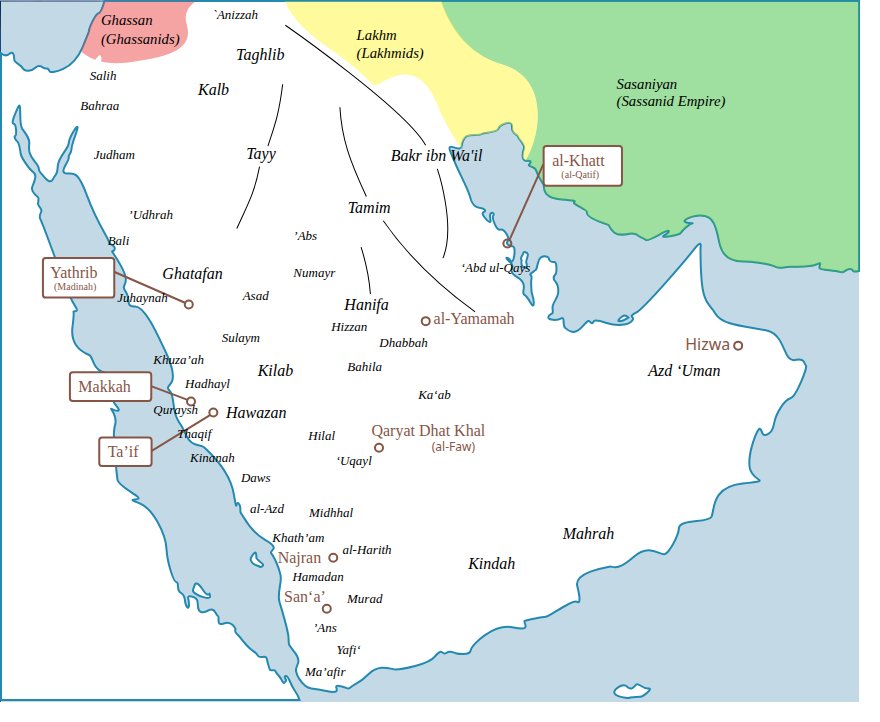
The Hejaz, where Mecca sat, was further from the imperial centers than either of these border zones, and it was not directly governed by either empire. But no one in Arabia was insulated from the war. Trade moved through the same routes that connected Arabia to Syria and Yemen and the Gulf, and the disruption of those routes mattered. The war's religious and cultural atmosphere mattered too: the Byzantine world was Christian, deeply Christian, and a Christianity of multiple forms — Chalcedonian, Monophysite, Nestorian — whose disagreements were serious and whose presence in Syria and Egypt and the countries around Arabia was constant. The Sasanian world was Zoroastrian in its official religion and included Christian, Jewish, and other communities within it.
The point is not that Arabia was about to be conquered by one or the other. The point is that Arabia existed in a world shaped by two exhausted superpowers, and that exhaustion created space — space in which smaller actors could matter more, space in which movements could grow, space in which a region that had been squeezed between giants could make its own decisions. The years after 602 were years in which the empires were fighting a war so costly that neither could spare attention for the Arabian interior. The years in which Muhammad was born and grew up — around 570 to the early 620s — were years in which the empire's direct grip on Arabia's edges was heavy but its ability to project power into the interior was limited by its own crises.
This matters for the biography in several concrete ways. It explains why the Meccan elite's response to Muhammad, when it came, was not simply a matter of local politics but took place in a world where the major powers were absorbed in their own struggle. It explains why the first Muslim emigration to Abyssinia — the Axumite kingdom across the Red Sea, itself a serious regional power with Christian roots — was possible: the Red Sea region was neither fully Byzantine nor fully Sasanian, and the Negus of Abyssinia had his own interests and his own court. It explains why, when the Muslims finally reached Medina and had to deal with surrounding tribes and the still-unoccupied Arabian interior, the imperial powers were themselves in the late stages of a war that would end in mutual exhaustion. The timing is not incidental. The expansion that followed Muhammad's death, into the Syrian and Egyptian and Persian lands, happened in the space that the war had opened.
It is also worth saying, plainly, that Arabia was not the only actor in this story and not the most powerful one. The empires were large, wealthy, and militarily formidable in ways that the Arabian interior was not. The desert tribes and the settled towns of the Hejaz were not setting the strategic order of the region. They were living inside it, responding to it, and occasionally profiting from the routes it created. When the Muslims later moved north into the empire's territories, they were moving into lands that had been shaped by centuries of Roman and Persian administration, Christenings and Zoroastrian fire-temples, tax systems and fortifications and cities that Mecca had no equivalent to. That asymmetry — the enormous difference between the Arabian interior and the imperial world — is part of what makes the story as extraordinary as it is. The Quraysh of Mecca were not men who assumed they would ever confront the empires. They were men whose world was the sanctuary, the caravan, and the tribe. The fact that their story did not end there is the fact that makes the biography worth telling.
For now, the point is simple: Muhammad was born into a Arabia that existed in the long shadow of two wars, and those wars defined the shape of the world he would later inherit, the space in which his community would grow, and the landscape into which it would eventually move. The exhaustion of the empires is not the cause of Islam. It is the condition under which Islam could become what it became.
The Gods and the Doubters
The religious landscape of pre-Islamic Arabia was diverse, and the diversity is essential to understanding what Muhammad's message did and did not break into.
The dominant form of religion was Arabian polytheism — a pattern of worship centered on a number of gods and goddesses, each with local bases of support, each associated with particular places and clans, and each recognized in different ways across different parts of Arabia. The gods were not a unified pantheon in the Greek or Roman sense. They were a patchwork of cults, shrines, and local traditions, many of them old and some of them carrying names and functions that can be traced back into the wider Semitic religious world. The most important cultic center was the Kaaba in Mecca, which housed a large number of idols representing the gods of the Meccan and surrounding tribes — Hubal, the chief idol of the Meccan sanctuary, and his associates, together with the three goddesses al-Lat, al-Uzza, and al-Manat, who were venerated across the Hijaz and beyond.
The polytheism of Arabia was not, in the simplest sense, a collection of independently imagined beings. It was embedded in the life of the tribes: a god was associated with a tribe, and a shrine was associated with a place, and worship at a shrine was associated with pilgrimage, sacrifice, oath-taking, and the practical and symbolic recognition of a tribe's place in the world. The gods were real to their worshippers — not abstract symbols but beings with whom one had a relationship, from whom one could seek help, to whom one could make offerings. The religious life was not separated from the rest of life. It was part of the same structure as the tribe, the trade route, the sanctuary, and the oath.
At the same time, monotheizing ideas were already present in Arabia before Muhammad. The word hanif — which the Qur'an uses for people who turned away from idol worship and sought the original religion of Abraham — referred to a small number of individuals who rejected the polytheism around them and sought a purer monotheism. The tradition associates some of these figures with Abraham and with a return to the worship of one God, and the Q ur'an treats the hanif ideal as a real and positive part of Arabian religious memory. The number of actual hanif s was small — the tradition does not suggest a widespread movement — but their existence shows that the ground was not uniformly polytheistic, and that some people in Arabia were already dissatisfied with the gods before Muhammad said anything at all.
Judaism was also present. Jewish communities had existed in Arabia for some time — in the northwestern oases, in parts of the Hijaz, and most significantly in the south, where the Himyarite kingdom in Yemen had, in the late centuries before Islam, moved toward Jewish religious influence at the elite level. The Himyarite ruling house had adopted a form of Judaism in the late fifth and early sixth centuries, and Jewish communities, Jewish practice, and Jewish texts were known in parts of the peninsula. Arabia was not a blank sheet with no contact with the monotheistic religions of the wider Near East. It had Jewish communities, Jewish ideas, and a Jewish past in the south that was part of the historical memory of the region.
Christianity was present too, and more visibly at the edges. In the centuries before Islam, Christian influence spread into Arabia through trade, through the Byzantine Empire's presence in Syria and the frontier zones, through the Aksumite kingdom across the Red Sea, and through the movement of monks and missionaries. The Ghassanids, the Arab clients of the Byzantine Empire, were Christian. Aksum was Christian. Monasteries and Christian communities existed in parts of the peninsula and on its edges, and Christian ideas were known in Arabia. The Christian influences that would later matter for Islam — the shared Abrahamic ground, the prophetic language, the scriptural genres — were not new to the seventh century. They were already there, in the air and in the borderlands.
The result was a religious landscape that was polytheistic in its majority but also marked by contact with and internal development of monotheistic ideas. This is a more complex picture than the simple story — Arabia was pagan until Islam came and fixed it — that the later tradition sometimes implies and that hostile critics sometimes repeat. The pre-Islamic religious world was not a uniform darkness waiting for a revelation to lift it. It was a world with gods, with shrines, with local cults, with Jewish and Christian minorities and influences, with a small number of people who had already begun to turn away from idol worship, and with a longing, in at least some minds, for the purer, older faith that Abraham was said to have practiced.
Why does this matter for Muhammad? Because his message did not arrive in a vacuum. It arrived into a society that already knew the idea of one God, already knew the stories of Abraham, already knew the tensions between tribal religion and a more universal monotheism, and already contained people who were dissatisfied with the local cults. The Qur'an's message — there is no god but God, worship Him alone, and abandon the idols — was not the introduction of an entirely alien idea. It was the forceful, uncompromising, and in some ways new articulation of an idea that some of his hearers already knew in a partial and inconsistent form, and that others held with the full seriousness of tribal cult.
The figure of Abraham is worth pausing on. Abraham is central to the Qur'an's presentation of the message, and he functions in the Qur'an as the model of the person who recognized one God, who opposed idol worship, and who built the Kaaba as a house of pure worship. The Qur'an's Abraham is not the same as the Abraham of Genesis in all details, but he is recognizably Abraham — the patriarch of the monotheistic tradition, the opponent of idolatry, the builder of the sanctuary. By invoking Abraham, the Qur'an does two things at once. It claims the deepest roots of the monotheistic tradition for the message, and it reinterprets the Kaaba — the very sanctuary around which Mecca's whole religious and economic life was organized — as something that had originally been intended for the worship of one God, not for the idols that had taken it over. The economic and religious center of the town was, in this reading, a hijacked Abrahamic monument. That is a powerful claim, and it was a claim that cut directly into the town's identity.
The response to Muhammad's message in Mecca was not simply theological. It was social and economic before it was theological, and the order matters. The Meccan elite's objection was not that they had never heard of monotheism, or that the idea was intellectually impossible. Their objection was that Muhammad's message challenged the idols that were part of the sanctuary's economy, challenged the social standing of the Quraysh, challenged the established order of the town, and did so in a way that came from a man who was, by clan standards, a person of moderate status and no independent power. When he told the town that its gods were false, he was not only making a theological claim. He was telling the Quraysh that their whole arrangement — the sanctuary, the pilgrimage, the trade, the prestige — had been built on a mistake, and that the mistake was now being exposed by a man they had known for years.
The theological part of the objection — the claim that he was a false prophet, a magician, a possessed madman, a poet imitating revelation — was real, but it was not the whole of it. And the shape of the objection, once you see it whole, tells you something important about the society Muhammad was addressing. It was a society in which religion and trade and kinship and prestige were fused, and in which a challenge to the religious core of the town was at the same time a challenge to the economic and social structure of the town. The opposition was therefore not purely intellectual. It was existential for the people whose position depended on the existing arrangement.
The diversity of the religious landscape also matters for what comes later. The monotheizing minorities — the Jewish communities, the Christian influences, the hanif s — are not just color in the background. They are part of the genetic material of the early Muslim community. The Constitution of Medina, which will appear in Part Five, brings Muslims, pagans, and Jewish tribes into a single political framework. The early community's language and concepts are heavily Abrahamic. The later Islamic claim to be restoring the original religion of Abraham makes sense only if you see that Abrahamic material as already present, in fragments and in tensions, before Muhammad. The Qur'an did not invent the Abrahamic tradition. It reappropriated it, contradicted parts of the existing Abrahamic narratives, and made them central in a way that reshaped the religious identity of the Arabian interior.
For the biographer, the point is this: when Muhammad began to preach, he was not speaking from outside the religious life of his society. He was speaking from inside it, addressing its gods, its sanctuary, its idea of Abraham, and its small number of people who had already been dissatisfied. The fact that some of his hearers already knew the idea of one God does not make his message less radical. It makes the radicalism more specific: the radicalism was in the uncompromising exclusivity of the God he preached, in the claim that the sanctuary had been corrupted, in the demand that the whole structure of Meccan religion and by extension Meccan life be reordered around a single God who had sent a warner from among themselves.
And the fact that some of his hearers were already dissatisfied with the gods is also important for the biography's human texture. It explains why the earliest believers came as they did — not as a mass conversion of a society that had no other options, but as a small, uneven group of young men, slaves, a wealthy widow who knew him, a young cousin who believed early, a freed slave who was tortured for the faith, and others who had reasons, some of them intellectual and some of them social and some of them simply the response of people who had been waiting for something like this. Those first believers are the subject of a later chapter. They are already visible here, in the religious landscape they were born into.
Next: Part Two — The Orphan begins with Chapter 6