Christianity / The Carpenter's Son
Part One: The World That Made Him
Author's Note
This is a historical biography. It is not a sermon, not a polemic, and not a contribution to the argument about whether Jesus of Nazareth is the risen Lord of the Christian church. It is an attempt to say what the historical evidence allows us to say about a man who lived and died in the first century, and what that evidence does not allow us to say.
The stance of the book is historical, warmly human, and aggressively non-partisan. It does not argue for or against the resurrection. It reports, precisely and respectfully, what people said happened, when they said it, and what historians can and cannot establish. Then it gets out of the way. Miracles receive the same treatment: something happened around this man that people described as healing, and the book describes the reports, the ancient context of healers and exorcists, and the honest limits of the evidence. It does not sneer and it does not vouch.
Jesus was a Jew who lived and died a Jew, inside Jewish arguments, and never founded a religion. This is not a conclusion the book pushes toward; it is the frame that opens it and the frame that runs through every chapter of the book's middle and end. Getting this right is most of what separates an honest popular biography from the usual one.
The Gospels are our best sources, and they are interested sources written decades later by people making a case. Both halves of that sentence stay true all book long. The book teaches the reader to read the Gospels the way a historian does — gently, as we go, never in a lecture.
The controlling question, asked in chapter one and answered by the last page, is this: how does a nobody from a village of four hundred people become the most consequential human being who ever lived — and what was it actually like to be him while it was happening?
The answer is not a single sentence, and it does not resolve itself neatly. It is a set of things the reader can say with genuine confidence, and a set of things the reader cannot. The book has tried to hold both, and to end without a bow.
No book like this is written alone. The author-reader relationship here is a covenant of honesty: the reader lends their trust, the book returns nothing but what the evidence supports. Where the evidence is thin, the book says so. Where the sources disagree, the book says so. Where the uncomfortable finding of modern scholarship is that Jesus seems to have expected God to act soon, the book says so without flinching and without editorialising.
The book's debt is to the scholars whose work made this reconstruction possible — the historians, archaeologists, and textual experts who have spent their lives recovering the world of first-century Galilee and Judea and the figure who walked through it. Their names appear in the Further Reading. Their work is the ground this book stands on, and the reader who wants to go further will find the path there.
The reader who begins this book as a believer may finish it with the ground shifted under their feet, because the book has said things that do not always fit the inherited picture. The reader who begins the book as a sceptic may finish it with the ground shifted under their feet, because the book has said things that do not always fit the dismissive picture. The book has tried to be neither a sermon nor a sceptical dismissal. It has tried to be a historical biography, honest about its limits.
The limits are not a failure. They are the condition of the subject. A historical biography of Jesus of Nazareth can do what no sermon can do and what no sceptical dismissal can do: it can say what the sources allow and what they do not, without treating the limits as a failure. The carpenter's son from Nazareth — the builder from a village of four hundred, the Jew who walked into the Judean countryside and changed the world — is worth knowing for himself, as a man, before the world organised itself around him. That is what this book has tried to give the reader.
A Village of Four Hundred
There is a parish church in Nazareth today, built over a grotto that tradition has identified as the place associated with Jesus' childhood home. Whether the identification is correct is not something the tradition settles and not something archaeology can confirm. The grotto beneath it is small enough that two people standing close together would have to turn sideways to pass. The stone walls are rough, the ceiling low, the air cool and still. If you stand in it and imagine a man who lived there, you will not imagine anything like the Jesus of the great paintings: not the golden halo, not the serene upward gaze, not the figure made of light and distance. You will imagine someone who knew the weight of a clay water-jar carried up a slope in the morning, the grit of limestone dust on a builder's hands, the smell of woodsmoke from a neighbour's chimney on a still evening, the particular exhaustion of a body that has been working since before the light changed.
The village he grew up in was smaller than that church's shadow. Almost certainly smaller. The usual estimate runs to around four hundred people — a number that carries the right feel even if the exact reckoning is impossible, and which is more useful for what it implies than for its precision. A village of four hundred is not a hamlet, but it is not a town either. Everyone knows everyone. If a stranger walks in, three people notice by lunchtime. If a family falls into debt, the whole village feels the strain by the next harvest. If a young man starts walking out of the village and not coming back, people will talk about it at the well and at the roadside and at the meal-table, and they will talk about it for the rest of their lives.
Nazareth in the middle of the first century had no synagogue we can find. That is worth sitting with for a moment, because the sentence means something different than it sounds. It does not mean there was no place of worship, and it does not mean the people of the village were without the religious life that structured everything else around them. It means that when we look for a building with a name on it, a foundation we can date, an inscription that says here the sabbath is kept, we come up empty-handed. The village was small enough that its Jewish life may have been conducted in a house, or in the open air, or in the kind of informal gathering that leaves no trace in the archaeological record and therefore no trace for us. What we can say is that the village was too small to have the kind of institutional presence that larger settlements did, and that the people in it belonged to the same world of Torah and Temple and Sabbath that every Jewish community in the region shared.
It had no pavement. The road to the village — if you can call a track a road — ran over the limestone of the region, uneven underfoot, dusty in the long dry season and sticky in the rains. The hills around it are terraced: the slope eaten into a hundred levels by generations of farmers who needed flat ground for vines and olives and the summer crops that paid the taxes. A terrace is a kind of labour that compounds across generations — your grandfather's wall holds the soil for your vines, and your children will inherit the wall as well as the vines, and a broken wall is a problem you inherit from a dead man. The village sat inside that economy of inherited labour, and everyone in it understood, without anyone needing to say it, that the ground beneath them had been worked by people they would never meet and would someday be worked by people they would never meet either.
It had no coins minted in its name. None of the small local coinage that marked a town as a place worth marking. If you paid for something in Nazareth, you paid with the currency that came through the region — the denarius or the drachma or the shekel, depending on what you were buying and who you were buying it from. No local authority had decided that this place was worth stamping into metal and passing around. This is a small fact but it is the kind of small fact that tells you something real: the village was normal in the sense that it did not insist on being noticed.
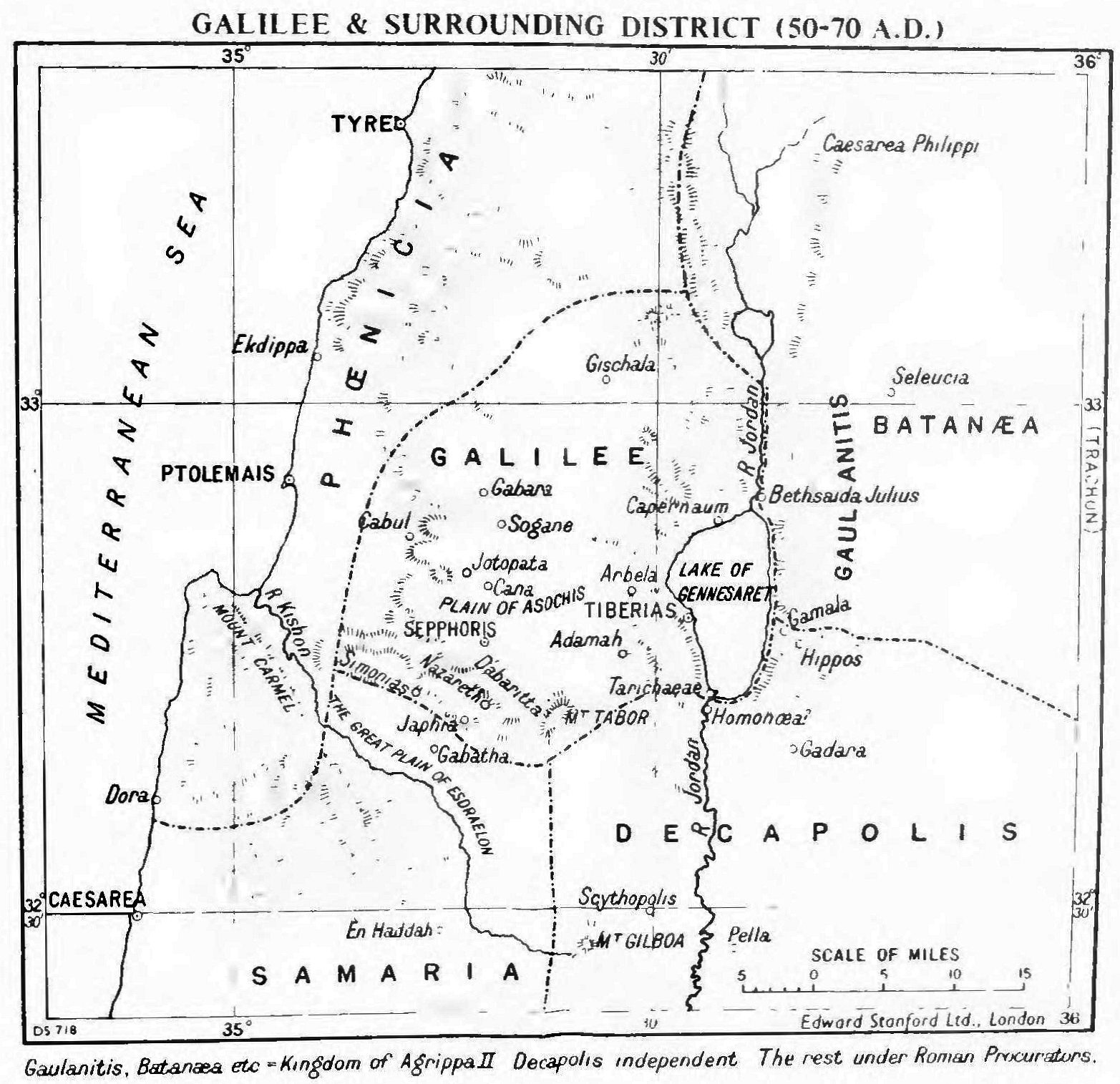
The house you might have grown up in would not have been anything the modern eye would call a house in any grand sense. One or two rooms, a courtyard, a courtyard-kitchen combination where the daily life happened — the grinding of grain, the cooking, the sorting of lentils from gravel, the mending of a neighbour's ploughshare that had bent on a rocky patch of ground. The floor would have been packed earth or rough stone. If you were a tektōn — and in this family, that seems to have been the trade — your work-space was not a workshop in the modern sense either. It was wherever the work happened: a site in the neighbouring town of Sepphoris, four miles down the road, where a landlord was building something that needed hands; a stretch of road being repaired; a threshing floor being laid; the family's own courtyard when someone had commissioned a beam, a doorframe, a trough. The word does not mean carpenter in the romantic sense that later tradition lent it, the man communing with the grain of wood in a quiet room. It means builder. It means a person who works with his hands on material that has to hold weight and take weather and not fail when someone depends on it. A tektōn could work stone or wood or both, and in a place like Galilee in the time of Herod and his successors, both were always in demand.
The economy of the village was not the economy of money in any simple sense. It was the economy of obligations, and those ran on a scale that money only partially captured. You owed your neighbour for the help with the olive harvest. You owed the landowner for the land you worked. You owed the tax collector, and the tax collector's rôle was to extract from you in a way that left the village with enough to survive the next year and not enough to thrive in it. The days were divided by the work that the seasons demanded, and the Jewish calendar that structured those seasons was not a private matter. The Sabbath was a real interruption to labour, a real claim that the week belonged to God as well as to the work that kept you alive, and a man who broke it without good reason would have been answerable to more than his own conscience. The festivals — Passover, the various pilgrimage moments — pulled people toward Jerusalem in numbers that changed the city's population and changed the political temperature of the province. If you lived in Nazareth and never went to Jerusalem, you still felt the effect of the people who did: the taxes collected for the Temple, the news that travelled back, the way a relative who had gone up for the feast came home with stories and sometimes with trouble.
If you were one of a large family in that village, and your family did not own land, your life was not the life of a peasant who watched his own olive trees grow and inherited his father's plot. It was the life of a family whose survival depended on finding daily work, on the demand from the building projects elsewhere in the region, on whether the drought came or did not come, on whether the disease that took the goats took the children as well. The brothers and sisters named in Mark's Gospel suggest a household of a size that would have been normal in Galilee and would have been a source of constant labour: several children, a mother whose work was not finished when the sun went down, a father whose hands were shaped by the work he did. Joseph is not a prominent figure in the Gospels after the early stories; he does not appear in the ministry. What that silence means is something we cannot know with certainty, and the honest answer is that it might mean he died sometime in the years between the childhood stories and the beginning of the public life, leaving the family with less security than it had before. It might mean that he had always been a day-labourer whose presence in the narratives simply faded when the story shifted to the adult Jesus. What we know is that the family was real enough to have names, and that those names belong to a time and a place where a family's survival was never far from precarious.
The grapes that grew on the terraces would have been for wine and for eating and for the raisins that kept through the summer. The olives would have been pressed for oil that cooked the food and lit the lamps and anointed skin that the dust had dried out. The grain grew in the flatter places, the wheat and the barley, and it was ground by women's hands — the two stones, the lower one fixed, the upper one turned, the grain passing through between them in a process that took time and produced the fine dust that settled somewhere in the house and somewhere on the person who tended the mill. The work of the household was slow work, repetitive work, work that left its mark on the body over years: the joints of the hands, the spine, the knees from kneeling at the mill or bending in the vineyard or standing all day at a building site carrying stone that was heavier than it looked because the quarries did not come with etiquettes.
A village of four hundred also has a particular kind of social density. If you did something notable, people knew. If you said something that changed the way people thought about a thing, they carried it to the next village and the next and the village beyond that, because the region was not cut off — it was a landscape of paths and tracks and the lake that served as a highway, and news moved through those channels in a way that is hard to measure but impossible to ignore. A teacher who attracted attention in Capernaum could be known in Nazareth by the same evening if someone walked fast enough and the message was worth carrying. A controversial figure could find the whole region talking about him before he reached the city that would eventually decide his fate. This is one of the ways the speed of the movement's spread makes sense: not through the machinery of institutions or the distribution of texts, but through the ordinary channels of a population that lived close enough to one another to carry a story from one end of the region to the other in days.
The landscape around Nazareth is the landscape of the Galilee in the first century: the low hills, the terraces, the patches of flat ground where a village could sit, the visibility of the country beyond to the west and the south. On a clear day you can see enough to know that you are not alone in the world, and you can see enough to know that the world beyond your village is larger than your village and that the people in it are living in the same material conditions you are, with the same taxes and the same labour and the same religious calendar, even if they are not the same people and do not share your family's particular troubles. The view is not panoramic in the modern sense; it is the view of a person who knows the ground he walks on and knows that it ends somewhere, and knows that the ending is not an ending but a beginning of another stretch of the same kind of ground.
This is the world Jesus was born into. A village so small it had no coins minted in its name. A family probably without land enough to live on. A trade that meant work with the hands on material that had to hold weight. A religious calendar that structured the year and took Sabbath and festival from the ordinary week. A social density in which what a person did and said would be carried beyond the village by people who had no reason to report it other than that it was worth carrying. A landscape of terraces and hills and the lake to the east, all of it real and particular and not a backdrop — it was the material condition of every day.
The first question the book asks is already sitting here, in the dust of that village: how does a nobody from a place this ordinary become the most consequential human being who ever lived? Not in the sense of doctrine, not in the sense of institution, not in the sense of the argument about whether it is true — those are not the question. The question is about the man: what he ate, who paid for his travel, what his accent gave away, what he was afraid of, why the authorities decided he was a problem, and what it cost the people who loved him. The answer will not be found in the village itself. Nazareth does not contain it. But the village is where the answer has to start, because it is the material condition from which the man emerged, and it is the scale of ordinary life against which everything that came later has to be measured.
A village of four hundred. A family of day-labourers. A trade that meant getting your hands dirty. A religious calendar that interrupted the week. A landscape that you could walk out of and into the wider country beyond. This is not where the story goes from here. This is where it starts — and it starts because a young man who was born into exactly this world walked out of it at some point and did not come back, and the reason he walked out is the reason the book is being written.
The King Who Built the Mountain
The man who ruled the world Jesus was born into was not the emperor in Rome. That man — Augustus, and after him Tiberius — lived in a city three hundred miles and a completely different world away, and his interest in the province of Judaea was the interest of a distant administrator in a thing he did not fully understand and did not much want to. The man who shaped the daily reality of the Galilee and the Judea and the Jerusalem that Jesus would walk into was Herod the Great, and Herod was not a Roman. He was an Idumean — a descendant of the people the Maccabees had conquered and forced to convert a century earlier — and whether the Jerusalem elite regarded that conversion as legitimate was a live and venomous question in his own time. He was a Jew in the political sense that mattered to Rome: he observed the Torah, he rebuilt the Temple, and he presented himself as the protector of Jewish institutions. Whether he was a Jew in the genealogical sense that the Jerusalem aristocracy cared about was the question his enemies asked and never settled. He was a client king, appointed by Rome, ruling a territory that Rome wanted quiet and revenue from and otherwise did not worry about very much. And he built.
Herod was not a modest builder. The kind of building he did was the kind that a man does when he wants to make a statement that the people living under him will feel in the stone of their lives before they hear it in any decree. He rebuilt the Temple in Jerusalem so completely that when the work was done, the place was almost unrecognisable from what had stood there before. The Temple Mount was enlarged, the platform extended over arches and fill and the labour of thousands of workers drawn from the population of the province, and the Temple itself was made into one of the wonders of the ancient world — not in the sense of the seven canonical wonders, but in the sense that a person arriving in Jerusalem for the first time, a pilgrim from the diaspora or a Galilean peasant making his first ascent, would have trouble believing a man had built it. The historian Josephus, who is the only source we have for the full scale of it and who was himself a priest of the family that had run the Temple before Herod touched it, describes the gates, the courts, the white stone, the gold that caught the sun, the sanctuary so rich it seemed to burn. This was not a building project for local use. It was a statement made in the language of stone that Herod was the man who gave God a better house than anyone before him had managed, and that Rome, which had authorised it, could feel satisfied that Jerusalem was under control and Jerusalem's God was under Herod.
The cost of all of this was paid by the people who lived in the villages of the region, and the way it was paid is part of the reason that a man like Jesus — a tektōn from a family without land — would have known Herod's reign not as a historical period but as a material fact. Taxes went up to pay for the Temple and the palace at Jerusalem and the fortress at Masada and the harbour at Caesarea and the palace-fortress at Herodium and the city of Tiberias that Herod's son would found. Labour drafts pulled men into building work that was not their own, on sites they had not chosen, doing things they would not have chosen to do. The building boom of the Herodian period was real and it was enormous, and it was also the background condition of every tektōn's life in Galilee for the better part of a century. If your family's work was building things, and you were living in the time of Herod and his sons, then the demand for your hands was not a question. The question was where the work was, and how much of it there was, and whether it would keep you alive through the year.
The building went on across the region, and not all of it was in Jerusalem. Herod built a palace at Jerusalem that was itself a small city within the city, with gardens and pools and a theatre that the Jewish population of the city — a population that at least in principle did not attend theatres — would have found either thrilling or deeply objectionable depending on which part of the religious spectrum they belonged to. He built a new city at Caesarea Maritima on the coast, a harbour that required engineering on a scale the eastern Mediterranean had rarely seen, with a mole built out into the sea and a temple to the emperor Augustus on top of it, and a city named in honour of Caesar that was as Roman in its layout and its public buildings as anything in the province could be. He built at Jericho, in the Jordan valley, a palace that turned the winter climate into a pleasure and a display of his power over the landscape itself. He built at Masada, on the desert plateau that overlooks the Dead Sea, a fortress that was at once a refuge in case things went wrong — which they eventually did — and a monument to the idea that Herod could hold any ground he chose to hold. He built at Herodium, a hill southeast of Jerusalem that he had artificially shaped into a cone and crowned with a palace, so that the view from the top would show the man who had built it and also show that he could make a mountain into something that looked like a mountain and was actually something he had done to it himself. He built in Samaria, which he renamed Sebaste in honour of Augustus, and he built in the centre of the country a Greek-style city called Antipatris, named for his father Antipater.
The point of listing all of this is not that every building matters equally to the story of Jesus. Most of them do not. The point is that the physical world Jesus was born into was a world that had been worked over, reshaped, taxed to pay for, and watched being reshaped by a man whose name was on the monuments and whose agents were at work everywhere, and that this was true in a way that a peasant family in Nazareth would have felt even if they never went to see any of it. The stone that the tektōn worked may have come from a quarry that Herod's projects had opened. The demand that kept the family employed may have come from the building activity of Herod or his sons. The taxes that left the family short in a bad year may have gone partly toward a palace in Jericho or a harbour on the coast. The whole region was being remade around them, and the remaking was paid for in the small economies of village life.
Herod died in 4 BCE, in Jericho, after an illness that his court physicians could not resolve and that the accounts describe with the kind of detail that suggests a man in physical decline for some time. The death of Herod was not a quiet moment. It was the occasion for a wave of unrest across the region — rebellions broke out in several places, among them the city of Sepphoris, which is only four miles from Nazareth, where a revolt led by one Judas son of Ezekias — a bandit chief Herod had executed years earlier — seized the armoury and held the city until the Roman governor of Syria, Varus, sent a force to suppress it. Sepphoris was burned in the suppression, and the Romans crucified roughly two thousand of the participants. The numbers are the kind of numbers that are hard to trust absolutely — Josephus reports them, and Josephus is the only source, and his numbers are often the kind of numbers that make a point rather than report a count — but the event itself is not in doubt: Sepphoris, so near to Nazareth that a man walking from one to the other would have felt the distance as something between a long walk and a short journey, was the site of a serious revolt in the year of Herod's death, and it was suppressed by Roman force, and its population lived through the consequences of that.
This is the moment at which the world that Jesus was born into changed. Herod had been a tyrant but he had been a tyrant who kept the peace, and the peace was what Rome cared about. His death introduced a brief period of chaos — the kingdom was divided among his sons, the Romans did not immediately settle on the arrangement they would keep, and there were revolts in more than one place, and crucifixions for the first time on a scale that announced what the Roman response would be when a province's population decided to make a problem of itself. Jesus was born, by the usual reckoning, somewhere near the beginning or the middle of this period — the chronology of his birth is itself uncertain, and the familiar date of 4 BCE attached to Herod's death is as good a marker as any of the period in which he was born, but the exactness of it is not something we can claim. What we can say is that Jesus grew up in a region that had just lived through a revolt in a town close to his own, a revolt that ended in crucifixion, and that the memory of that event would have been present in the region for the whole of his life, whether anyone named it to him or not.
Herod's building programme did not stop with his death. The Temple was still being built — the work on the sanctuary itself was completed, but the outbuildings and the courts continued for decades, and the work went on under the supervision of the priests and the Herodian rulers who succeeded him, and it was still not entirely finished when Jesus was in Jerusalem. The building continued under Herod Antipas in Galilee, who was the ruler of the region that included Nazareth throughout Jesus' life, and who built the city of Tiberias on the western shore of the Sea of Galilee, naming it for the emperor of the moment and making it into a capital that was as Herodian in its ambition as anything his father had done. The building continued in a way that would have mattered to a tektōn: new cities to build, new palaces to construct, ongoing work on the Temple and its surroundings. The demand for hands did not dry up when Herod died. If anything, the division of the kingdom among several rulers created more building projects competing for the same labour.
This is one of the things that makes the background of the Gospels' story legible in material terms. When the Gospels speak of Jesus as a tektōn, as a craftsman or a builder, they are attaching him to a trade that existed in a very specific historical context — the context of Herodian building, of Roman-suppressed revolt, of tax and labour and the demand that came from the reshaping of the region. A man who worked with his hands in Galilee at the beginning of the first century was not working in a vacuum. He was working in a region that had been remade by a king and was still being remade by his sons, and the work was there because the building was there. The economic life of Nazareth — a village too small to have its own coins, too small to have its own synagogue we can find, too small to be anyone's destination — was tied to the building economy of the larger towns, and that economy was a Herodian economy in its origin and for a long time afterward.
The thing to hold onto as the book moves forward is not the list of palaces and fortresses and cities. It is the material fact that the man who would walk through Galilee and Judea and Jerusalem was born into a world that Herod had made physically and economically, and that the death of Herod had introduced into the region a new and visible form of Roman power — crucifixion, used on a large scale for the first time in living memory, and used on a town that was close enough to Nazareth that it was not a distant event but a local one. Herod's building is the background of the landscape, and Herod's death and the revolt that followed it are the background of the political landscape. Both of them run through the rest of the book, and they run through it most acutely in the chapters that come later, when the man who was born into this world steps into the city that Herod had rebuilt and into the politics that Herod's death had made visible.
For the moment, the point is simple: the village of four hundred was not, in the larger sense, a village of four hundred. It was a village of four hundred inside a region that had been reshaped by a king's building, taxed for a king's purposes, and then shaken by a revolt that the Romans had answered with the kind of force that marked a man for death in public in a way that everyone in the region understood. The world was not quiet. It was not small. It was not simple. It was the specific world of a province under a client king, under Rome, under the building and the taxes and the revolt and the crucifixion, and Jesus was born into it as a child who would grow up knowing the work of his hands and the shape of the country around him and, eventually, the thing that the kingdom was asking for.
Rome's Arrangement
The empire did not run the province of Judaea the way a modern state runs a province. The modern state wants the tax and the law and the uniform administration and the record of it that survives in a bureaucracy. Rome wanted the tax and the peace and the absence of anyone making a problem of themselves, and it was prepared to accept a great deal of local variation in how those things were achieved as long as the result held. The arrangement that produced the world Jesus was born into was therefore not a single system but a patchwork of mechanisms, some of them very old, some of them improvised, all of them designed to make the province produce without producing revolt, and all of them visible in the background of what happened to Jesus in the end.
The most immediate fact of Roman rule in a province like Judaea was that the emperor did not live there and did not want to. The emperor in Rome wanted the eastern frontier quiet, and the province was quiet in the specific sense that meant it did not rebel at a scale Rome could not manage. The arrangement that achieved this was a governor — a prefect or a procurator, the title changing over time for reasons that had more to do with the internal politics of the empire than with any change in the substance of what the governor did — who was sent from the centre for a term of office and who was responsible for the army detachment that Rome kept in the province and for the collection of the taxes that kept the centre satisfied and for the suppression of any rebellion that required Roman military force to end. Pilate, who governed Judaea from 26 to 36 CE, during the part of Jesus' life when the public ministry was happening, was one of these governors. He was a Roman of the equestrian order, which is to say he was not from the senatorial class — he was from the class below the senators, the class that filled the senior administrative and military posts — and his tenure in Judaea was long enough by the standards of the job to suggest that he was at least not incompetent in the eyes of the centre, and controversial enough in the province that the sources who later wrote about him had more than one story to tell.
The governor's job was not, in the first instance, to administer justice in the way a modern judge or administrator would understand it. It was to keep the peace and to ensure the revenue came in and to be the Roman presence in the province. The army that was available to him was not a large one. Judaea was not a major military theatre; it was a back province of the empire, and the force stationed there was small by the standards of the legions that guarded the Rhine or the Euphrates. The prefect's cohort or cohorts — the unit or units that Pilate would have had available — were enough to police the province and to respond to a revolt when one broke out and to impose the Roman will when the local population made it necessary, but they were not enough to occupy the country in the sense of a standing occupation that sat on every corner. The Roman presence was concentrated in a few places: the governor's seat, which for most of the period was at Caesarea on the coast rather than in Jerusalem, and the places where the army happened to be when it was needed. When the governor visited Jerusalem, which he did at the festivals — the pilgrim crowds swelled the city, and a governor who wanted to keep the peace at Passover did not do it from the coast — he brought soldiers with him, and the soldiers were visible. The porticoes of the Temple, the spaces around the city, the entry points — these were the places where the Roman presence announced itself during the festivals, and the visibility of that presence was one of the deliberate things about the arrangement. Rome did not want the population to forget that it was there.
The tax system was the other great mechanism of Roman control, and it is worth understanding in some detail because it is one of the things that shaped the material life of everyone in the province and because it is the mechanism that most directly connected the village in Galilee to the emperor in Rome. The taxes were of more than one kind. There was the tribute that the province owed to Rome — a fixed amount that the governor was responsible for collecting and passing on. There was the Temple tax, the half-shekel that every Jewish adult male was expected to pay, which was collected locally and sent to Jerusalem and which functioned as both a religious obligation and, in practice, a significant source of revenue for the Temple authorities. There were the various local levies and the customs duties on the roads and at the ports, the taxes on goods moving through the province, the taxes on the harvest, the taxes assessed on property and on people. The system was not a single machine; it was a set of overlapping claims on the population, and the population was poor enough and the repeated demands were relentless enough that the experience of tax was one of constant pressure rather than a single annual event. A farmer or a day-labourer in Galilee was not thinking about Rome in the abstract; he was thinking about the tax collector, and the tax collector was the face of Rome in his daily life.
Tax collection in the Roman provinces was often farmed out to publicani — tax-farmers — who contracted with the state to collect a fixed amount and kept whatever they could extract above that. This is the mechanism that got a certain kind of bad reputation in the ancient sources and in the Gospels, where the tax-collectors appear as a distinctive social type, a person who has bought the right to collect from his own neighbours and whose interest is in collecting as much as possible. The publicani were not, in fact, always the villains of the piece in the way the reputation suggests; they were doing a job that the state had assigned to them, and the job was to extract revenue, and extracting revenue from a poor population was a job that tended to produce unpopular people. But the reputation is real in the sense that the experience of being taxed by someone who had purchased the right to tax you was a genuine source of grievance, and the Gospels' attention to tax-collectors as a category — the call of the tax-collector to discipleship, the complaint that Jesus ate with them, the presence of tax-collectors in the story as figures who are both hated and, in the narrative, saved — makes sense as a reflection of the fact that this was the actual face of Roman fiscal power for many people in the province.
The client-king arrangement was the third mechanism, and it is the one that Herod and his sons represent. Rome did not govern everything directly. In many places it governed through local rulers who were clients — kings or tetrarchs who were dependent on Rome for their position and who were responsible for the stability of their own territory and for delivering the revenue Rome expected from it. Herod the Great was the most prominent example in the Jewish region, but the arrangement continued under his sons, who divided his kingdom among themselves. Herod Antipas ruled Galilee and Perea — the territories that included Nazareth — throughout Jesus' life. Herod Philip ruled the territories to the north and east. Archelaus ruled Judea and Samaria until Rome removed him and took direct control of his territory, which is why Pilate was governing Judea at the time of Jesus' ministry. The division of Herod's kingdom and the Roman decision to take direct control of Judea while leaving Galilee under Antipas produced the political geography of the Gospels' story: Jesus lived and worked under Antipas in Galilee, and he died under Pilate in Judea, and the difference between the two rulers — one a tetrarch with his own building programme and his own court, the other a Roman prefect with a small army and the emperor's authority behind him — is one of the structural facts of the story.
The collaboration between the Roman governor and the local authorities — the Temple hierarchy, the high priest, the council — was the fourth mechanism, and it is the one that matters most for the end of the story. Rome did not want to govern the religious and social life of the province directly; it wanted the local authorities to do that and to keep the peace and to deliver the revenue. The high priest and the Sanhedrin — or the council that in some form existed in Jerusalem at the time — were, whatever their exact nature and authority, the local institution that Rome worked with, and the relationship between Pilate and the high priest of the moment (Caiaphas, according to the Gospel tradition, who held the office for a long period, from 18 to 36 CE, which is to say the same period as Pilate's governorship, which is not a coincidence that suggests an arrangement that held for the whole time) was the relationship on which the suppression of local trouble depended. The high priest wanted the Temple protected and the Roman presence managed and the religious obligations of the population respected. Pilate wanted the same things, in different terms: the Temple was part of what made the province stable, and the religious sensitivities of the population were a source of trouble he did not want to provoke unnecessarily, and the revenue and the peace were what he was in the province to secure. The collaboration between them was real and it was practical and it was the arrangement that produced the decision — or the series of decisions — that ended in crucifixion.
The crucifixion itself needs a word here, at the beginning, because it is the instrument of Roman policy that re-appears throughout the book and because it is the thing that most directly connects the Roman arrangement to what happened to Jesus. Crucifixion was not a Jewish form of execution. It was a Roman form, used for a specific purpose: to punish and deter people who had rebelled against Roman authority or who had become a political problem in a way that required public display of the consequences. It was not used for a dispute between Jews and Jews, or for a religious offence, or for a mere theft or a mere assault. It was used for bandits and rebels and slaves and anyone who made a problem of themselves against the order that Rome maintained. The method itself was designed to be public and extended and humiliating — not a quick death but a death that took time and was displayed and was intended to do more than end a life. It was used on the two men crucified alongside Jesus, on the rebels in Sepphoris after Herod's death, on anyone Rome wanted to make an example of. The presence of crucifixion in the story of Jesus is not, in other words, the accident of a particular trial that went wrong. It is the instrument that Rome used on people who became problems, and the decision to use it was a Roman decision — Pilate's decision, or the Roman authority's decision — and it was the decision that the authorities in Jerusalem could not make themselves.
The crucifixion of Jesus in the end was a Roman execution, carried out by Roman authority, using a Roman method, for a reason that was ultimately Roman: the decision that this man had become a political problem. The Gospels frame the trial in terms that put the Jewish authorities in the foreground and Pilate in the background, and they do so for reasons that make sense in the context of the people who wrote them and the communities they wrote for. But the historical reality is that the Jewish authorities could not crucify anyone, and that the decision to crucify was the Roman decision, and that Pilate was the Roman authority in the province at the time. The archaeology and the inscriptions and the other evidence we have about Pilate — the Pilate Stone found at Caesarea, which names him as the prefect of Judaea, the references in Philo and Josephus that describe him as inflexible, angry, and infuriating to the Jewish population — do not give us the full picture of what he was like or what he decided about Jesus in the specific moment. But they do give us the context: a governor who had the power to crucify, who used it on others, who was not popular with the Jewish population, and who was in the province at the time that Jesus was brought to him. The Roman arrangement was the machinery that ran underneath the whole story, and crucifixion was the instrument it used when the machinery decided someone had to be removed.
This is the arrangement in broad outline: a province governed by a governor who wanted peace and revenue and used a small army to secure them; a tax system that extracted from the population and produced in the population the experience of being taxed by publicani and tax-collectors; a client-king arrangement that had shaped the region under Herod and continued under his sons; a collaboration between the Roman governor and the local religious authorities that kept the province stable; and the instrument of crucifixion that Rome used on people who became problems. The arrangement is not the story of Jesus. The arrangement is the background of the story — the machinery that was running in the background when Jesus was born in Nazareth, when he walked through Galilee, when he went up to Jerusalem, when he was brought to Pilate and crucified. The machinery did not make him. The machinery made the conditions in which his life happened, and it made the conditions in which his death happened, and it made the conditions in which the story of his life and death was recorded and transmitted and eventually read.
The next chapter moves into the world that this machinery was built around and within: the world of Jewish belief and practice in Galilee, the world of Temple and Torah and Sabbath and the hope for God's kingdom that structured the life of the people who lived in the villages of the region, including the village of four hundred where Jesus was raised. The machinery of Rome is the outer frame. The life inside the frame is what the next chapter is about.
What a Jew Believed in Galilee
The day starts before it looks like a day. In a Galilean village in the first century, the hour is still dark when the woman at the mortar begins the work of turning grain into something the family can eat, and the man who slept on the floor because there was no bed that belonged to him wakes to the sound of it and knows, before he has opened his eyes, what day it is. It is Sabbath. The week has arrived at its appointed end, and the day that follows is not, in the way that matters, a continuation of the week. It is the day that interrupts the week and says that the week belongs to God as much as it belongs to the work that keeps a body alive.
This is not a rule handed down at a distance and obeyed because a person has been told to obey. It is a rhythm that has shaped the life of the village from the time anyone in it can remember, and the rhythm is one that every family feels in the body. The work that would have happened on any other day — the field that would have been checked, the stone that would have been lifted, the olive that would have been picked — does not happen. The food for the day was prepared before the Sabbath began, because cooking on the Sabbath is one of the things the Sabbath says no to. The fire is already lit, or left hot enough from the evening before, and the meal is made from what was ready. A person who lives inside this rhythm does not wake on a Sabbath and ask what to do. The day has a shape before the person wakes into it, and the shape is rest that is also an obligation: a day given to God that is also a day given to the family, to the walk to the neighbour's house, to the conversation that does not rush because there is no work waiting.
The village has no synagogue we can find. That fact, which mattered enough to mention when the book opened in Nazareth, matters here too, but for a different reason. It does not mean the people of the village had no religious life. It means their religious life was carried in the week and in the festivals and in the home and in the talk that happened at the well and at the meal-table and on the paths between the terraces, rather than in a building with a name over the door. The life of Torah was real in the village. The Torah was the inherited instruction of the people — the law and the story and the commandments that structured what a Jew did and did not do, what a Jew owed to God and to the neighbour whose ox had fallen into a pit. It was not a single book held in a library. It was a living tradition that lived in the arguments people had about what it meant and in the daily decisions people made about what to eat and whom to touch and when to rest and when to work, carried in the memory of the community the way a song is carried in the memory of the people who sing it together.
The Temple in Jerusalem was the centre of the Jewish world in a way no building in Galilee could be, and the village had no direct access to it, but the Temple was nevertheless present in the life of the village in more ways than one. The half-shekel Temple tax was paid once a year by every Jewish adult male, and the coin made its way from the village to Jerusalem and into the economy of the Temple and the people who ran it. The pilgrimage festivals — Passover above all, but also the harvest festivals — drew people up to Jerusalem in numbers that changed the city and changed the province, and a Galilean family that could afford the journey went up at Passover and came back with stories and sometimes with trouble, and a family that could not afford the journey still felt the pull of the feast and the news that travelled back. The Temple was in Jerusalem and the village was in Galilee and the distance between them was several days' walk at least, but the Temple was not a distant thing in the sense of being irrelevant. It was a distant thing in the sense of being the centre of a world that the village belonged to without being at the centre of.
This is the shared world — the world that almost every Jew in the region moved inside, whatever their differences on the details. The Temple was the place where God's presence dwelt in a particular and concentrated way. The Torah was the instruction that structured the life of the people. The Sabbath was the weekly interruption that said the world was not only the world of work and that the people belonged to God as well as to their labour. The festivals were the moments when the whole people, insofar as they could be the whole people, gathered and remembered and celebrated and — at Passover above all — remembered an escape from Egypt and told the story of it as if it had happened to them, because the telling was a way of making it present. These were not beliefs in the sense of propositions someone assented to and then moved on. They were the fabric of life, the things that shaped what a person did on a given day and what a person expected from the year and what a person feared and hoped for.
Within that shared world there were differences — real ones, genuine disagreement about what the Torah meant and how it should be kept and what the religious life of the people was actually for. The differences were carried by people who had names for themselves and names for one another, and the names are the ones the reader has probably already heard, though maybe not with the understanding that they were real groups of real people and not just furniture in the Gospel stories.
The Pharisees were one of these groups. By the account of the historian Josephus, who wrote about them later, they had become significant in the time of the Hasmonean rulers and held to a particular way of reading and keeping the Torah — a way that gave weight to the oral traditions that had grown up around the written law and that paid attention to the details of purity and the obligations of daily life in a way that the other groups did not. The Pharisees are the group that appears most often in the Gospels as a disputant, and the pattern of the disputes — over Sabbath, over eating, over the details of Torah observance — tells us what they were actually concerned with, which was exactly those things. The Gospels present them as the people who cared about the same things Jesus cared about — the law of God, the purity of the people, the relationship between Israel and God — and who disagreed with him about what that meant in practice. The Pharisees were a piety movement within Judaism, not an antagonist faction, and the arguments with Jesus were intra-Jewish arguments between people who cared about the same things. Reading them as hypocrites is a habit the tradition baked in for its own reasons, and the book will have to undo it later, but it begins here, with the reader understanding who they actually were.
The Sadducees were another group, and they were different enough from the Pharisees that the difference was genuine. The Sadducees were associated with the Temple hierarchy and the priestly families and the wealthy and the politically connected, and they appear to have been less interested in the oral traditions than the Pharisees were and more interested in the written Torah taken by itself. They did not believe in the resurrection of the dead, which is one of the few things we can say with reasonable confidence about the difference between the groups, because it is reported by Josephus and by the New Testament and it is a difference that would have mattered enormously to people who thought about what happened after death. The Sadducees held power in Jerusalem, and the power was connected to the Temple, and the Temple was the institution that Rome was willing to work with because it was an institution that wanted to keep the peace and deliver the revenue and not provoke trouble. The collaboration between the Temple hierarchy and Rome is one of the structural facts of the story, and it begins here, in the landscape of Jerusalem politics, before it becomes a problem in the story of Jesus.
The Essenes were a third group, less present in the Gospels and more present in Josephus and in the documents found at Qumran — the Dead Sea Scrolls — which give us a window into one community's version of the Jewish world at this time. They were a community that had withdrawn from the main Temple in Jerusalem because they believed it had been corrupted, and formed their own community with its own rules of purity and its own reading of the Torah and its own expectation that God would soon act against the forces of darkness and establish the kingdom. They are useful for the book because they show one end of the spectrum of what Jewish belief could look like — polarised, communal, apocalyptic — and because they remind the reader that the kingdom hope was not a single thing and that different people who used the same language meant different things by it. How far the Essenes extended into Galilee is not something we can say with confidence. They should be understood as present in the landscape of Jewish belief at this time, not as a major presence in the Galilean villages.
What tied these groups together, underneath the differences, was the shared world described above: the Temple, the Torah, the Sabbath, the festivals, the hope that God was acting in the history of the people and would act again. A Pharisee and a Sadducee and an Essene might have disagreed about resurrection and about the oral traditions and about the purity of the Temple, but they would all have agreed that the Torah mattered and that the Sabbath mattered and that God had made a claim on the people of Israel and that the claim was still in force.
The hope that ran through all of this — the hope that is the emotional core of the chapter, the thing that makes the world of Jewish belief matter to a person whose life is shaped by debt and labour and the sense that the world is not as it should be — is the hope for the kingdom of God. This is one of the phrases that Jesus uses most often and that the Gospels attribute most densely to him, and it is a phrase that the reader has probably encountered in some form, but the form the reader has encountered may not be the form it had in the mouth of a first-century Galilean Jew.
The kingdom of God, in its first-century meaning, is the rule of God. It is not primarily a place you go when you die, and it is not primarily a state of soul or a condition of the afterlife. It is the moment when God's will is done on earth as it is in heaven, and the hope is that this moment is coming — that the world as it is, with its oppressors and its poverty and its injustice and its taxes and its crucifixions and its people who die without land and without security, is not the final state of the world, and that God will intervene in history in a way that sets things right.
To a farmer in debt, this hope was not abstract. It was about the debt. It was about the land that someone else's ancestors had taken and that the farmer's family had worked for generations without owning. It was about the tax collector who took from the farmer in a way that left the farmer with enough to survive the next year and not enough to thrive in it. It was about the year when the drought came and the goats died and the children went hungry, and the sense that this was not how the world was meant to be and that the God of Israel, the God who had brought the people out of Egypt and given them the land and the law, would someday make it otherwise. The kingdom hope was the hope that the world would be set right — the poor lifted up, the oppressor brought down, the people restored to what they were meant to be.
This hope took different forms in different people's mouths. Some heard it as apocalyptic: the end is coming, the world as we know it will be destroyed and replaced, and God's kingdom will arrive in a moment of decisive action. Some heard it as present-tense: the kingdom is breaking into the world now, in the ministry of a teacher and a healer, a person who announces that the rule of God is near, and the invitation is to live inside that now. The Gospels are full of both strands, and the reason they are full of both strands is that the hope itself was not a single, tidy thing. The language of the kingdom was language that a first-century Jew would have understood as a claim about God acting in history and about the world being set right, and the different versions of the claim were versions of the same hope, argued over and varied in and made specific to particular communities.
The kingdom hope is what connects the rest of this chapter — the Temple, the Torah, the Sabbath, the factions — to the person of Jesus. He moves inside this world. He argues within it. He uses the language of it. When he announces the kingdom of God, he is not announcing something foreign to the Jewish world of the first century; he is making a claim inside that world, using language his audience would have understood, about a hope they would have carried in them whether they were Pharisees or Sadducees or Essenes or simply Jews who went to the synagogue when they could, paid the Temple tax, kept the Sabbath, and hoped that God would act.
The disputes he has with the Pharisees — the disputes that will run through the later chapters of the book — are disputes about the right keeping of the Torah in this shared world, and the disputes are real and the disagreement is real, but the two sides are not opponents from different planets. They are people who care about the same things — the law of God, the purity of the people, the relationship between Israel and God — and who disagree about what that means in practice. The Pharisees are not the villains of a morality play. They are a Jewish movement concerned with the same things Jesus is concerned with, and the argument between them is an argument inside a shared world.
The machinery of Rome is running in the background — the governor and the tax and the crucifixion that was used on Sepphoris and the soldiers on the porticoes of the Temple. The Herodian building programme has left its mark on the landscape. The village of four hundred is waiting for the young man who will walk out of it. And inside all of that, there is a world of Jewish belief and practice, rich and contested and real, in which Jesus was born and grew up and learned to argue and eventually began to speak. The machinery of Rome is the outer frame, as the last chapter said. The life inside the frame — the life of Torah and Temple and Sabbath and the hope for the kingdom — is the world the reader now has enough of to understand what Jesus was doing when he started doing it.
The Family Trade
Picture it this way, though no one wrote it down: the day started before the sun was up, the way the days started for men who worked with their hands and had no choice about when the work found them. In a village on a ridge north of the Lake of Galilee, the tektōn woke before the light was useful and made ready in the dark. The image of Jesus with a workbench and a set of tools arranged beside it belongs to later centuries and to Christian art that wanted him to look like a craftsman with a practice, not a labourer who took work where he could get it. What he had was his hands and the work his hands could do and, when the work ran out, the walk to where it might be found.
The word that Mark uses for him — the only place the Gospels explicitly name his trade — is tektōn. The Gospels were written in Greek, and the word in Greek is not, in the narrow sense, "carpenter." It means a maker, a builder, someone who works material into something that holds together. The range of the word is wide enough to include the man who framed a wall of stone and the man who notched timber and the man who repaired a roof that had started to leak and the man who shaped a door that would not sag. It leans in the direction of wood — the material of furniture and doorframes and yokes and plough-handles — but the word does not itself choose between wood and stone, and a listener in the first century would not have pictured a specialist woodworker. Stone was the material of walls and foundations; the tektōn worked whichever material the job required. If you told a listener in the first century that Jesus was a tektōn, the listener did not picture a man with a workshop. The listener pictured a man who made things with his hands, and who made them for wages.
That the word survives at all in the Gospel tradition is worth a moment of attention. Mark says Jesus is "the carpenter" — or, in Greek, "the tektōn" — and adds that he is the son of Mary and the brother of James and Joses and Judas and Simon, and that he has sisters in the village. Matthew preserves the same scene but shifts the wording in a small and telling way: in Matthew, Jesus is "the carpenter's son," and Joseph is the carpenter. The difference is this: Mark identifies Jesus by the trade; Matthew identifies Jesus by his father's trade. Both attest the same thing, which is that the family was known for work of the building kind, and that the work was attached to the man's own name as much as to his father's. The tradition is not free of ambiguity — we cannot say whether Jesus learned the trade from Joseph, or whether Joseph was dead by the time Jesus took it up himself, or whether the trade was shared across the family in a way that made the label stick regardless of who was doing the work. What we can say is that the family of Joseph and Mary and their named children was a tektōn family, and that this mattered to the people who knew them.
The family was large enough to be an economic fact. Mark names at least four brothers — James, Joses, Judas, and Simon — and mentions sisters without saying how many. A household of this size, in the economy of a Galilean village, was not a small family. It was a family with mouths that multiplied faster than its wages did, with children who grew into workers who needed to be put to work, with a mother who managed what could be managed and a father whose absence from the adult Jesus story — the Gospels mention Joseph in the infancy narratives and then not again — either means he had died sometime in Jesus' youth or means something about the Gospel writers' interest that it is hard to untangle. The silence about Joseph after childhood is not a fact about his death; it is a fact about what the Gospels chose to record. But the reasonable reading of the silence, for a family of this size, is that the household lost its main earner at some point and that the sons picked up the work, and that by the time the adult Jesus is visible in the story the family is being carried by the work of the sons and the economy of the village and the occasional help of neighbours who had enough to share and not enough to spare.
The work was not in the village. Nazareth was small — the book opened on that, a village of four hundred, a place without a synagogue we can find and without the kind of road traffic that made a town into a site of wages — and the wages available inside the village were the wages of subsistence: the terraces that produced what they produced, the olive groves, the vines, the small grain fields, the daily work that neighbours traded with neighbours and that was never quite enough. The work that paid — the work that put a tektōn in a position to support six children and a mother and himself — was the work that was happening four miles to the north, in the city that Herod Antipas was building.
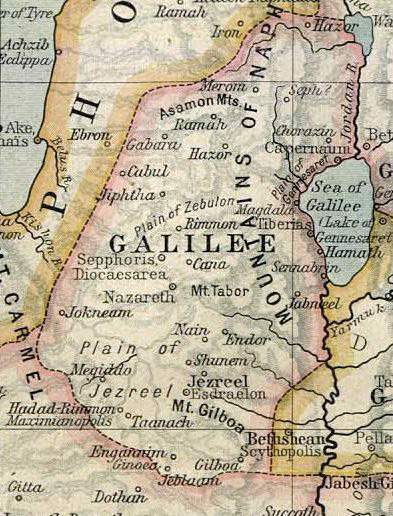
Sepphoris was rebuilt after the revolt that burned it in the year Herod the Great died. That was the year 4 BCE, when, after Herod's death, a man from Galilee named Judas rallied the city to revolt in the power vacuum that followed; the Roman legate Varus, in the region to impose order on the succession, sent a legion to suppress it. Sepphoris was taken, burned, and laid flat. The revolt itself was one of several that broke out across the territory in the power vacuum after Herod's death; the suppression of it is the background for what came next. Herod Antipas, the son of Herod the Great and the tetrarch who ruled Galilee for the rest of the century, made Sepphoris his capital and rebuilt it as a city on the Roman model: a colonnaded street, a theatre, public buildings, a garrison, walls. The work started soon after he took power and ran for years — a colonnaded street that required masons and labourers, a theatre that required skilled builders and stone-cutters, walls that required the same, a city that took a workforce and kept it busy. It was four miles from Nazareth. A tektōn could walk there in the morning and back in the evening, and some of the men from the village no doubt did.
When Antipas later built Tiberias, on the western shore of the lake, the work moved closer to the lake and farther from Nazareth. Tiberias was founded in the years around 20 CE, named after the emperor, built on ground that had been a burial ground and so stirred opposition from residents who held the soil unclean — Josephus notes the point — and laid out as a planned city with a stadium and a basilica and a palace. The distances from Nazareth to Tiberias were greater, a two-day walk round trip by the routes of the period, and so less likely to be the daily site of work for a tektōn from the village. But the building of Tiberias and the ongoing work of the city — its maintenance, its expansion, the construction around it — added to the zone of demand for builders in Galilee as a whole. Between the rebuilding of Sepphoris and the founding of Tiberias, and the ongoing projects of Herod and his successors elsewhere in the region, there was work for builders for as long as a man who could do the work could find it and walk to it.
This is the economic context the reader needs and that the sources allow: a tektōn from Nazareth walking four miles to Sepphoris in the morning, carrying his tools or having them carried by a boy from the family, working on the city that Herod Antipas was building, coming home at evening when the work was done and the wages were paid, and doing it again the next day if the work was there. The wages were not recorded in any surviving document — no wage tables survive from first-century Galilee — and the chapter cannot say how much a tektōn was paid in a given year. It can say that the work existed, that it was close enough to be real, and that the work was the difference between a family that lived and a family that did not.
The family that Jesus belonged to, in this reconstruction, was a family that worked for wages and lived inside the margin of those wages. The men of the family — Joseph, if he lived into Jesus' adulthood, and Jesus and his brothers when they were old enough — worked the building trade if the work was in Sepphoris or in the larger building sites of the region, as the distance from Nazareth made plausible; the sources attest the building boom and the proximity, not the family's presence on any particular site. The household managed its food, its cloth, its children; the sisters that Mark mentions are not named and not counted. The household was not destitute in the sense of that word carrying its modern weight, but it was not secure in any way that would have made a season of bad work or a year of drought survivable without difficulty. A family of this size, if it held no land of its own — and the tradition gives us no sign that it did — was a family living hand to mouth on wages that depended on a building boom that depended on the decisions of a tetrarch and the peace of the empire.
Joseph's absence from the adult Jesus story has already been mentioned, and it is worth returning to it here, because it bears directly on the economics of the family. The Gospels say almost nothing about Joseph after the infancy narratives. He is present in Matthew's and Luke's accounts of Jesus' birth and childhood — the carpenter's son, the man who takes the child and his mother and flees to Egypt in one account, the man who receives the angel's word in the other — and then he is gone. In Mark's Gospel, he is not named at all in the adult Jesus story, and the family appears without reference to a living father. The reasonable inference — not a fact, an inference — is that Joseph died sometime before Jesus began his public work and left the household to be carried by the sons, and that by the time the adult Jesus is visible in the story the family is being carried by the work of the sons. The inference is reasonable; it is not in the text. The chapter should say that the text does not tell us what happened to Joseph and that the reasonable reading of the silence is that he was gone. (James' later role in the Jerusalem community — a figure the reader will meet in chapter 29 — is consistent with this reading but belongs to a later chapter's sources.)
The work shaped the man. A man who grew up in a tektōn family and worked the building trade in his youth had the body of a builder: the hands, the back, the walking, the carrying of stone and timber and tools, the soreness that came from work that was physical in a way that seated work was not. He knew the distances between Nazareth and Sepphoris by walking them. He knew the roads that ran between the ridge and the lake and the valley behind the ridge. He knew the kind of work that had to be done well and the kind of work that could be done poorly and still hold. He knew the wages and the walk and the morning start and the evening stop. When he later left the village and began to travel, he was not a man who had to learn to walk roads — he had walked them for years. When he later had no home and depended on others for shelter, he was not a man accustomed to comfort in a roof — he had grown up in a house that was not luxurious and that had to be made to serve a large family on wages that were not secure. The body of a tektōn became the body of a teacher and a healer, and the material life of the former shaped the movements of the latter in ways that are hard to measure but easy to recognise when the sources describe a man who walked, who ate what was given, who had no place to lay his head, who moved from village to village without a base that belonged to him.
The specific work Jesus did — the things he built, the things he fixed, the things he made — is not recoverable from the sources. We cannot say whether he worked stone or timber more, whether he framed walls or shaped yokes or repaired roofs, whether he was the skilled end of the trade or the general end. The Markan word allows all of these; it commits to none. The chapter should not assert that Jesus was a "carpenter" in the narrow sense of a woodworker with a specialist practice, because the word does not carry that meaning with the necessary precision. It should use the word tektōn and give the reader the range: a builder, a maker, a man who worked material with his hands for wages. If it places the reader in a scene — a man at work on a wall or a roof or a door-frame in Sepphoris in the morning — the scene should be flagged as constructed, not reported.
The brothers named in Mark 6 — James, Joses, Judas, Simon — and the unnamed sisters are themselves the evidence of a family that was large enough to matter. The reader does not yet know what James will become; the reader only knows that he is one of the children in a tektōn household, one of several, and that his family's economics were the same as the family's. (James' later role in the Jerusalem community is a chapter-29 question, not a chapter-5 source.)
The household economy of a large tektōn family in a Galilean village in the first century was an economy of wages and margin and walking and work and the constant calculation of what the work would bring in and what the family needed and how the difference would be managed. It was an economy that Herod Antipas' building boom had put within reach and that Herod's death and the Roman tax system and the possibility of bad years kept from being secure. It was an economy that left a man with the body of a builder and the knowledge of roads and the experience of work before he ever began to speak about the kingdom of God.
What connects this chapter to the next is the family and the trade, and what connects this chapter to the book as a whole is the body of the man who carried the trade into the years when the text goes silent. The chapter that follows — chapter 6 — will turn to those thirty years, the years that the Gospels pass over and that the book must handle honestly rather than fill with invented scene. Before the silence, there is the work, and during the work there is a man with a body shaped by building, a family shaped by wages, and a village four miles from a city that was being built. The silence starts after the work. Before it, there is the man as he was when the work still defined him.