Judaism / The Man Who Never Saw the Land
Part One: The Problem
A Man With No Grave
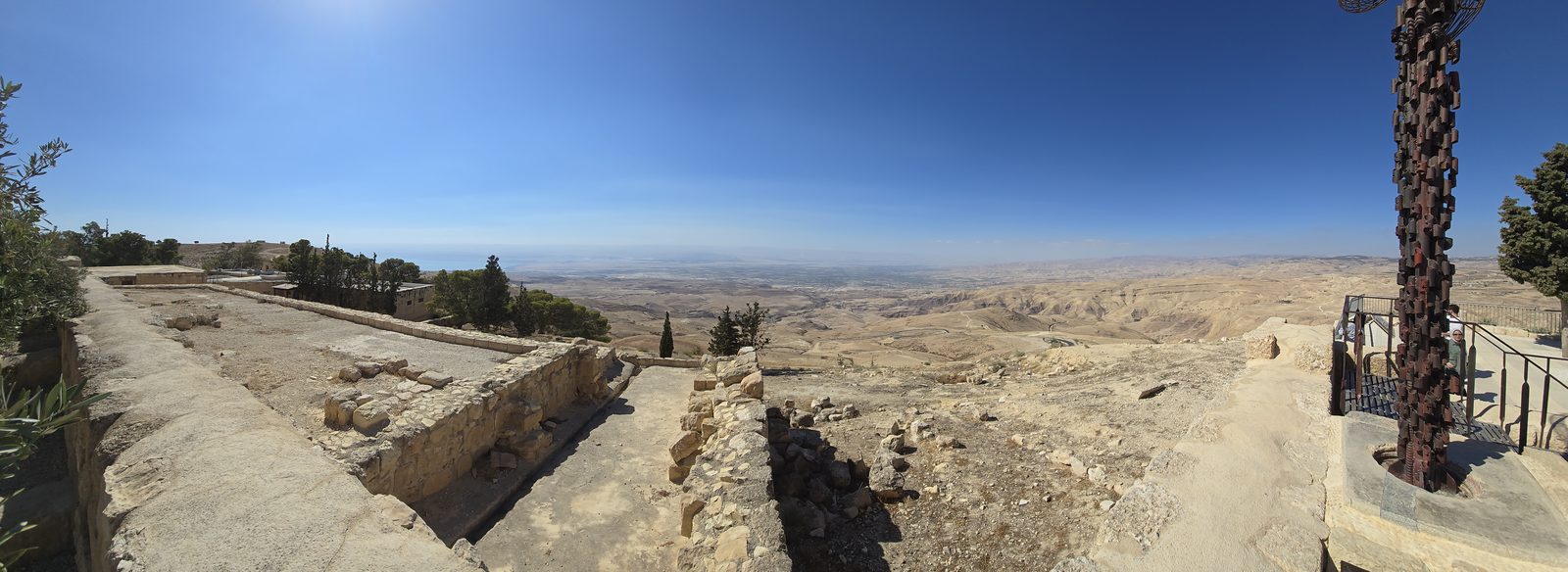
If you go looking for Moses' tomb, you will not find it. This is not an accident of archaeology. It is the ending the story gives him.
Deuteronomy 34 is one of the strangest final scenes in all of religious literature. Moses climbs a mountain — Nebo, in Moab, on the eastern side of the Jordan — and from its summit he sees the whole land. The text names it in painstaking detail: Gilead as far as Dan, Naphtali, Ephraim, Manasseh, all of Judah to the Mediterranean, the Negev, the Valley of Jericho, the town called Zoar. He sees it all. And then he dies.
And he buried him in a valley in the land of Moab, over against Beth-peor: but no man knoweth of his sepulchre unto this day. (Deuteronomy 34:6)
The Hebrew is even more peculiar than the King James. God buries him. No one knows where. Unto this day — the phrase the biblical writers use when they are writing from a later time and pointing back at something lost.
Think about what this means. The man is the foundational lawgiver of an entire civilization. He has spoken with God face to face, the text says, "as a man speaketh unto his friend." He has led a nation out of slavery, received their constitution on a mountain, and walked with them for forty years through a wilderness that killed an entire generation. And when he dies, he is buried by God alone, in an unmarked grave, and the tradition itself insists that the location is unknown.
This is not how founders are treated. This is not how any culture treats its most important figure. When nations want to anchor themselves to a person, they give him a tomb. It becomes a shrine. A pilgrimage site. A political asset. Herod built a monumental tomb for John the Baptist — even though he had ordered the man's execution. The Romans built Augustus' mausoleum bigger than any building in Rome. The Egyptians built pyramids. Every empire preserves its founders in stone.
Israel preserves its founder in a mystery.
And that is where this book begins, because that mystery is not an embarrassing gap to be apologised for. It is the first clue and it points somewhere important.
The view from the mountain
Stand on Mount Nebo today and the view is still extraordinary. The mountain rises to about 810 metres, on the ridge that runs down the eastern side of the Dead Sea. From the top you can see, on a clear day, across the Jordan Valley and the Dead Sea to the hills of Judea. Jericho glints in the distance. You can make out the hazy shape of Jerusalem on the horizon, forty kilometres away. Looking north, the land unfurls — the hills of Samaria, the plain of Jezreel, the long line of hills that run down toward Lebanon.
This is the land Moses is given. He does not enter it. He dies on the other side of the Jordan, in what is now Jordan, and the text says that Joshua led the people across after him. He spends his entire adult life moving toward a destination he will see but never touch, and the story says this is deliberate — God's decision, not an accident of geography.
There is something almost unbearable in that image. The leader who dies just short of the promise. The man who walks a whole life toward a horizon he is not permitted to reach. Read it as narrative, straight, and it is devastating. The old man climbs the mountain, takes in the whole view he has been walking toward for decades, and dies before he can take one more step.
This is the first thing to hold onto, because this ending tells us something about the story and the people who told it. A nation that invents a founder will give him everything — birth, triumph, victory, rest. A nation that preserves a founder it actually remembers gives him the scars. The question is which kind of nation is telling this story.
The man in the story
What do we actually know about Moses, from the text itself, before we add any argument about sources or history?
He is born during a time when the Israelites are oppressed in Egypt. A pharaoh — the text never names him — has ordered all newborn Hebrew boys to be killed. His mother hides him for three months, then places him in a basket among the reeds of the Nile. Pharaoh's daughter finds him, takes pity on him, and adopts him. He is raised in the Egyptian court.
As an adult, he kills an Egyptian who is beating a Hebrew slave. The act is discovered. He flees to Midian, in what is now northwestern Arabia, and lives there as a shepherd for forty years. He marries the daughter of a priest named Jethro — called Reuel in some passages — who worships a god called Yahweh, but who is not an Israelite. In Midian he has a family, and he lives quietly.
Then, at a bush that burns without being consumed, a voice calls his name and gives him an impossible assignment: go back to Egypt, confront the pharaoh, and lead the Israelites out. Moses resists. This is important — much of what we think we know about Moses from sermons and paintings is wrong. He does not stride forward eagerly. The text gives him five separate objections: Who am I? What if the people don't believe me? I am not a man of words. Send someone else. He argues. He loses. He is sent.
The rest of the story — the confrontation with Pharaoh, the plagues, the Passover night, the departure, the crossing of the Red Sea, the journey to Sinai, the law, the golden calf, the wilderness years, the rebellions, the long walk east toward the Jordan — is the story of a man who argues with God and wins sometimes, who loses his temper and pays for it, who leads a people that constantly threatens to abandon him, and who finally dies before he reaches the land he spent his whole life trying to reach.
This is not a flat heroic portrait. It is layered, contradictory, and stubbornly human. And the strangest thing about it is that it stays that way. Later traditions try to sand some of the edges down — Philo reads him as a philosopher, the rabbis read him as the perfect teacher, the Sufis read him as a mystic. But the core text never lets him become a saint. He stammers. He kills a man. He disobeys a specific instruction at a place called Meribah and is told, with stunning severity, that for this single failure he will not enter the land. He stands up for the people after they have sinned so badly that God offers to destroy them and start again. He is tired. He says so in the most human sentence in the whole Pentateuch: I am not able to carry all this people alone, the weight is too heavy for me. (Numbers 11:14)
Read the text with no theology, no commitment to whether it happened literally, and you find a character so specific that it is hard to imagine him made up from nothing. Which is the claim this book wants to think through, carefully, with full intellectual honesty.
The silence of the evidence
Now we turn to the other side of the story, and this is where the book's central tension lives.
If the Exodus happened as described — two million people, or even a substantial group, leaving Egypt in a single dramatic departure, crossing the Sinai, receiving law at a mountain, wandering for forty years — we would expect evidence for it. The absence of evidence is not the same as evidence of absence, and this book will not make that amateur error. But the specific character of the silence is striking and it deserves to be described accurately.
First: Egyptian records. Egypt was a bureaucratic society that documented everything. We have tax records, court documents, letters, building inscriptions, grain inventories, diplomatic correspondence. We have records of Semitic-speaking people in the Delta — the Hyksos, who ruled parts of Egypt for a period in the Second Intermediate Period; the Apiru or Habiru, a class of people mentioned in Egyptian and Near Eastern texts who may or may not be connected to the Hebrews; the Shasu nomads, who appear in Egyptian inscriptions as enemies or subjects at the frontier forts of the Transjordan. We have Papyrus Anastasi VI, which records the passing of Shasu through a Egyptian frontier checkpoint. We have the Merneptah Stele, a victory inscription of the pharaoh Merneptah from about 1207 BCE, which contains the earliest known reference to Israel as a people or kingdom — in Egypt, mocking them as a people already in Canaan: Israel is laid waste, his seed is not.
What we do not have is an Egyptian record of an Exodus. No record of the departure of a large Israelite population. No record of the ten plagues. No record of the destruction of an Egyptian army in a body of water. No reference to the Israelites as slaves in the Delta in the relevant period.
This is not a surprise in itself — empires do not typically record their own defeats, and a dramatic slave departure might not have shown up in the archives the way a victory does. But it places an honest historian in a difficult position: the story is too large to have left no trace, and the Egyptians documented things that were far smaller.
Second: Sinai. The forty-year wandering is supposed to have left traces. A population large enough to have fought the battles described in Numbers — the Amalekites, the Canaanites at Hormah, the kings Sihon and Og — would have left archaeological traces in the Sinai peninsula. Systematic surveys of the southern Sinai have found little that corresponds to a large nomadic population in the Late Bronze Age. The standard picture that emerges from the archaeology is of a much smaller phenomenon, possibly a group of Semitic-speaking slaves or freed people who made their way out of Egypt by some route, and whose story was later expanded into the national epic of a people who were not yet a nation.
Third: Canaan. When the Israelites appear in the archaeological record, in the highlands of Canaan in the late Iron Age I period (roughly the eleventh and tenth centuries BCE), they look like they emerged from within Canaanite society, not like a new population arriving from outside. The settlements in the central highlands — Shiloh, Shechem, Bethel, and the scores of small sites — show material culture that is continuous with Canaanite culture in many ways but distinct in others. The pottery is different. The settlements are unfortified. The pig bones disappear from the archaeological record in these sites in a way that suggests a new dietary identity. The people seem to have formed themselves into a distinct group inside Canaan, not to have arrived from outside it. This is the model proposed forcefully by William Dever and others: the early Israelites were, in significant part, Canaanites — peasants, escaped slaves, and fringe-dwellers — who reorganised themselves around a new identity.
This does not mean the Exodus story is fiction. It means the Exodus story, as it has come down to us, is a memory enlarged by time and shaped by theology. Something happened. A group got out of Egypt, or escaped the Delta, or remembered getting out, and around that memory grew a story so large and so specific that it became the founding narrative of a civilisation.
The archaeologist Israel Finkelstein and the historian Neil Asher Silberman put it plainly in The Bible Unearthed: the Exodus narrative as we have it cannot be read as history in the modern sense. It has the shape of a founding myth, composed and edited over centuries, reaching its current form long after the supposed events. They are right about this, and any honest book about Moses has to say so.
But saying so is not the end of the story, because there is a second question that matters just as much: why this story? Why this man? Why does a story with this shape, this specificity, this unflattering portrait of its central character, survive and spread and shape two major religions and a thousand liberation movements?
That is the question this book spends its energy on. The evidence problem is the opening argument, chapter 3 makes it explicitly, and then the book trusts the reader to remember it while the story unfolds.
An unflattering hero
The most striking thing about the Moses of the text is how unflattered he is by his own story.
Consider what the tradition does with him. It could have made him presidential — the noble lawgiver, the wise old man, the steady hand guiding a nation. It could have made him mystical — the prophet who communes so fully with God that he glows, the man who reads the divine mind. Later tradition does both of these things, and does them powerfully. But the story as we have it is more complicated.
Moses' first act in the narrative — the act that sends him into exile — is an act of violence born of anger, with no plan behind it. He sees an Egyptian beating a Hebrew, looks around, sees no one watching, and kills the Egyptian, burying him in the sand. The next day, he tries to mediate a fight between two Hebrews. One of them says: Who made you a prince and a judge over us? And Moses realises his secret is out. He flees.
This is not the portrait of a man born to leadership. This is the portrait of a man with a temper and no strategic sense. The text is honest about it. The murder is not glossed over; it is the reason he leaves everything he knows and spends four decades in the desert.
Then there is his reluctance. Moses does not accept the call. He argues with God, five separate times, and the arguments are specific and human: Who am I that I should go to Pharaoh? The people won't believe me. I have never been a man of words — the text actually says this, and the tradition preserves it as a fact about him, a fact that some have tried to read as a stammer, some as a general inarticulateness, some as the portrait of a man who knows he is not an orator and has to be pushed past his own assessment of himself.
Then there is the failure at Meribah, which is small and strange and disproportionately punished. The people are thirsty. God tells Moses to take his rod, gather the people, and speak to a rock, and water will come out of it. Moses gathers the people, but he is angry — the people are testing him, challenging him, and he says: Hear now, you rebels; must we bring you water out of this rock? He strikes the rock twice with his rod, and water comes out. And God tells him: because you did not believe in me to sanctify me in the eyes of the people, you will not bring this people into the land. For one moment of anger, one deviation from the specific instruction, the man who has carried this people for forty years is told he will not see what he has spent his whole life moving toward.
The punishment is severe. The crime is small. The disproportion is the point. The tradition is punishing its own hero, and it does so publicly, in the text, for everyone to read. This is not the behaviour of a legend that exists to flatter. It is the behaviour of a narrative that has a complicated relationship with its central character and refuses to simplify him.
And then there is the ending — the grave no one knows. We come back to it. Why would a nation tell the story this way? Why not give him a tomb, a shrine, a place for pilgrims? The answer may be that the story of his burial — buried by God, unmarked, unknown — was the tradition's way of saying: this man belongs to history, not to a place. He cannot be claimed by any party, any kingdom, any later generation that wants to build him into whatever it needs. He dies on a mountain in Moab, outside the land, and the land itself keeps his secret.
The long afterlife
The story of Moses, as it left the pages of the Pentateuch, did not stop there. It went everywhere.
Philo of Alexandria, writing in the first century CE in Greek, read Moses as a philosopher — the man who received the true philosophy directly from God, superior to Plato because it preceded Plato. He filled in the silences of the biblical text with an elaborate metaphysics. Where the Bible says Moses spoke to God face to face, Philo explains what that means in terms of the soul's ascent to the intelligible realm. The mountain is the soul. The tabernacle is the cosmos. Every detail is symbolic.
The rabbis of the Talmud and Midrash read him differently — as teacher, as the humblest of men, as the one who spoke with God and bore the burden of the people. The midrashic tradition is enormously creative; it fills gaps, answers questions, wrestles with contradictions. It often softens the text's sharper edges — Moses' anger, his doubt — but it never erases them. The man of the text survives in the midrash.
Jesus speaks of Moses constantly. The Sermon on the Mount is, among other things, a deliberate echo and intensification of Sinai. You have heard that it was said... but I say to you. The structure is Mosaic. Jesus is positioning himself in the Moses lineage — the new lawgiver on a new mountain. He is also careful to say that he comes not to abolish the law but to fulfil it. The Moses story is the framework within which much of the New Testament operates.
In the Qur'an, Moses — Musa — is the most-mentioned prophet, appearing in more suras than any other figure. The Qur'anic Musa story covers much of the same ground: the Nile, the basket, Pharaoh's daughter, the killing, the exile, the burning bush, the confrontation with Pharaoh, the Exodus, the law. But the Qur'an reads it with a different emphasis — Musa as messenger, as a man sent to a specific people at a specific time, as an example of the pattern that recurs throughout prophetic history. The Qur'an also tells the story of Musa and Khidr, the mysterious wise man who teaches him patience, in a passage that is itself one of the most beautiful and puzzling in the scripture.
And then there is Freud, who in 1939 published Moses and Monotheism — a book that is partly psychoanalysis and partly a historical hypothesis. Freud argued that Moses was an Egyptian, that his name is Egyptian, that he brought monotheism to the Israelites from Egyptian sources, and that the story of his death — the lost grave — was the Jewish people' unconscious memory of a murder they committed against him and then forgot, a memory so traumatic it survived only as the story of his disappearance. The book was written in the last year of Freud's life, in Vienna, as the Nazis were closing in. It is a strange, brave, difficult book. It is also reception history, not evidence about Moses himself, and it should be read that way.
Every major civilisation that encountered the Moses story has taken it and made it its own. The abolitionists in America made him the hero of liberation — "Go down, Moses" was a spiritual sung by enslaved people who identified themselves with the Israelites and their oppressors with Pharaoh. Harriet Tubman was called Moses in her lifetime. Martin Luther King, in his final speech on the evening before his assassination, invoked the mountaintop — I may not get there with you, but I want you to know tonight that we as a people will get to the promised land — and the image is unmistakably Mosaic. He knew he was dying. He said so in the same speech. The story had given him the language to say it.
And the Exodus story has also been used for conquest. The same book that gave the slaves their freedom song gave the settlers their claim to the land — a people delivered from bondage, promised a land, commanded to take it. The book has served the slave and the settler. It is not possible to tell the story of Moses without telling this too.
The controlling question
So here is what this book is trying to do, and it should be honest about it from the start.
We have a story about a man: born in Egypt, raised in Pharaoh's court, killed a man, fled to Midian, heard a voice from a bush, went back, confronted Pharaoh, led a people out of slavery, received a law on a mountain, wandered in the wilderness for forty years, and died on a mountain in Moab, looking at a land he would never enter, buried by God in an unmarked grave.
We have evidence that something like the story's background really existed — Semitic-speaking people in the Egyptian Delta, forced labour on building projects, the real geography of the region, the real Egyptian pharaohs of the relevant period. We have evidence that the Israelites, when they appear in the archaeological record, emerged from within Canaanite society rather than arriving from outside it. We have evidence that the text was composed and edited over centuries by multiple hands, and that much of what it describes in its present form did not happen the way it is written.
And we have, despite all of this, a story that is specific, layered, unflattering, and psychologically true in ways that suggest it grew around something that actually happened — something small, perhaps, something at the scale of a group rather than a nation, something that was enlarged by time and shaped by the needs of the people who told it, but something real enough that a man like this — a man with a temper, a stammer, a failure at Meribah, a death outside the promised land, a grave no one knows — could have lived.
This book is an attempt to tell that story honestly and completely. It will tell the story as it is in the text, in full narrative mode, for the parts where the story is at its most powerful. It will tell the world that story emerged from, the Egypt and the Sinai and the Canaan of the relevant time. And it will tell the story of the story itself — who wrote it, when, why, and what they needed Moses to be.
The reader will finish knowing three things they did not know before. What the evidence actually supports. What the story says, with astonishing psychological precision. And why a story about a man who died in sight of a land he never entered has fuelled every liberation movement since it was first told.
That is the book. Let us begin.
The Silence of Egypt
In the previous chapter we stood on Mount Nebo and looked at the view Moses is given but not permitted to enter. We ended on an unexpected detail: the man who gives a nation its law is buried by God in an unmarked grave, and the tradition itself insists that no one knows where.
That is a strange way to treat a founder. It is not how empires preserve theirs. It is the first clue that this story is not the kind of story a nation tells when it is inventing itself from whole cloth. Something about the shape of it — the unflattering portrait, the failure at Meribah, the death outside the land — points toward a memory that grew around something that actually happened, rather than a fiction designed to make a man look like a hero.
But before we can say anything useful about what that memory might be, we need to be honest about what we would expect to find if the Exodus happened as it is written, and what we actually find instead. This chapter is the fullest treatment of that question in the book, because it matters and because it should be done once, carefully, well. The reader who understands this chapter has the tools for everything that follows.
What the story actually claims
The Exodus narrative, in its final form, describes a set of events of a specific scale. It is worth pausing over the scale before asking what evidence it would leave, because the scale is what makes the silence so striking.
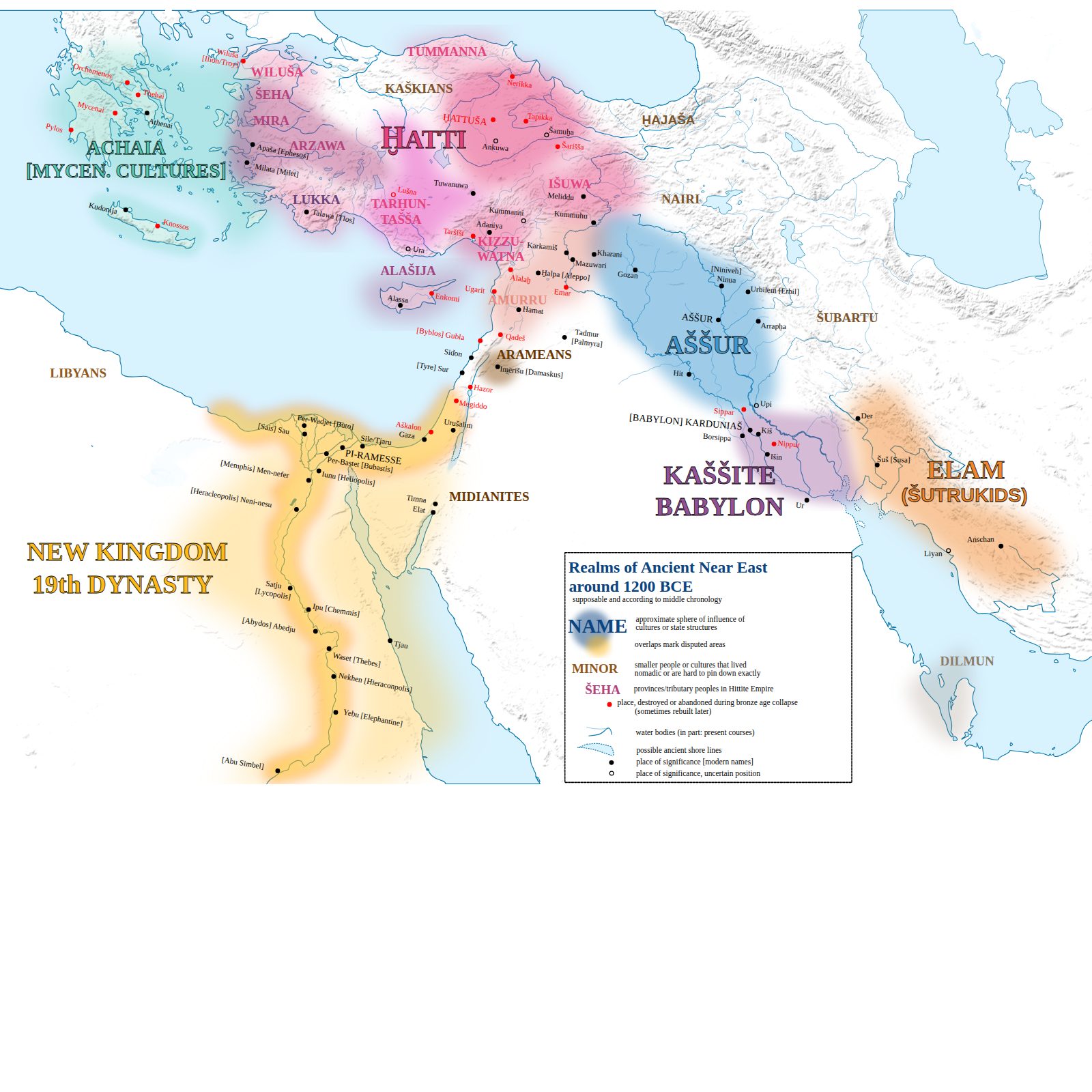
The story says that the Israelites — a population already in Egypt, already numerous enough to be feared by the Egyptians as a demographic threat — were reduced to forced labour on building projects in the Delta, and that a pharaoh ordered the killing of all newborn Hebrew boys. It says that one infant, Moses, was preserved in a basket, raised in the Egyptian court, fled to Midian after killing an Egyptian, returned forty years later with a divine commission, and confronted the pharaoh with a series of ten disasters that culminated in the death of every Egyptian firstborn and the release of the Israelites. It says that the Israelites left in such numbers — the text says 600,000 men on foot, which implies two million people altogether — that they could not be stopped, and that the Egyptian army pursued them and was destroyed in the waters of the Red Sea or the Reed Sea. It says that a population of that size then wandered the Sinai desert for forty years, receiving law at a mountain, and that they later conquered Canaan, destroying or displacing the populations there.
That is a large story. Two million people wandering for forty years is not a small event. It is not something that leaves no trace. It is, in scale, comparable to the migration of a substantial nation. If it happened, the evidence for it would be significant and varied. The question is what the evidence actually shows.
What Egypt would be expected to record
If two million people left Egypt in a single dramatic departure, with the destruction of the Egyptian army, the death of the firstborn throughout the land, and the overthrow of a pharaoh's policy — if all of that happened within the memory of Egyptian administration — we would expect some trace of it in the Egyptian record. Egypt in the Late Bronze Age was a bureaucracy that documented everything. Tax records, court proceedings, letters, grain accounts, workmen's diaries, diplomatic correspondence, boundary stelae, temple inscriptions. We have a remarkable volume of this material, and more keeps turning up.
What we do not have is an Egyptian record of the Exodus.
This is not, by itself, a decisive argument against the Exodus, because empires do not typically record their own defeats in a straightforward way. A slave departure, even a dramatic one, might not have been the kind of event that made it into the official annals in the way a victory did. But the silence is specific and it is worth describing accurately.
There is no Egyptian text that mentions the departure of a large Hebrew population. There is no record of the ten plagues. There is no Egyptian account of the destruction of an army in a body of water. There is no record of a pharaoh losing his army and his slave population in the same period.
Contrast this with what Egyptian records do preserve. We have records of the Hyksos — a Semitic-speaking people who ruled parts of Egypt during the Second Intermediate Period (roughly 1650–1550 BCE) and were later expelled, an event that is described in Egyptian terms and preserved in Egyptian records. We have the campaign records of pharaohs like Thutmose III, who left a detailed chronicle of his military expeditions. We have the temple inscriptions of Ramesses II, one of the most prolific builders in Egyptian history, who documented his construction projects and his campaigns in enormous detail. We have the Merneptah Stele, a victory inscription listing defeated enemies in Canaan. We even have records of grain shipments, workmen's attendance at Deir el-Medina, legal disputes over property, and the private letters of officials and courtiers.
Ancient Egypt documented itself abundantly. The Exodus is not in the record.
What Egypt does say about Semitic people
What Egypt does record, and what is directly relevant to the question of Semitic-speaking people in the Delta, is a whole history of such people in the region. The Egyptians knew about, fought, employed, and sometimes ruled Semitic-speaking populations. Several groups appear in the texts.
The Hyksos — the name is Greek, from an Egyptian term meaning "rulers of foreign lands" — were a Semitic-speaking population that dominated northern Egypt during the Second Intermediate Period, establishing their capital at Avaris in the eastern Delta. They ruled for roughly a century and a half before being expelled by a Theban pharaoh, and the expulsion became part of Egyptian historical memory. The Hyksos are earlier than the Exodus narrative by centuries, but they are part of the broader picture of Semitic people in the Delta, and the memory of their presence and expulsion probably shaped the biblical story's setting even if the story itself is much later.
The Apiru or Habiru — the spelling varies in the sources — appear in Egyptian, Hittite, and Akkadian texts from the Late Bronze Age as a class of people, not an ethnic group. They are described variously as mercenaries, fugitives, escaped slaves, labourers, and outlaws. The term appears in the Amarna letters (the correspondence between Egyptian pharaohs and their vassals in Canaan during the fourteenth century BCE) and in other Near Eastern sources. Whether the Habiru are connected to the Hebrews is a matter of long debate; the similarity of the names is suggestive but not definitive, and the Habiru seem to be a social category that caught many different kinds of marginal people rather than a specific tribal group. The term's presence in the texts, however, shows that Semitic-speaking marginal populations were a feature of the Egyptian and Canaanite world in exactly the period that matters.
The Shasu — a nomadic or semi-nomadic population — appear in Egyptian inscriptions in the Late Bronze Age. They are associated with the Transjordan and the Sinai frontier, and they appear as enemies or as subjects at the Egyptian frontier forts. Papyrus Anastasi VI, a letter from a Egyptian official dating to the reign of Merneptah (roughly 1213–1203 BCE), records the movement of Shasu through an Egyptian border checkpoint. The text is prosaic and administrative:
Let the Shasu of Edona pass the fortress of Merneptah-Content-with Amun... to the place where there is water for them, for there is a complete lack of water in the land of Edona.
The papyrus describes Shasu coming through the frontier, some of them in search of water, some of them on the move for other reasons, and the Egyptian official authorising their passage through a fortress. It is not an Exodus narrative. It is a document about nomadic pastoralists moving through a border zone during a dry period. But it shows the Egyptian administration dealing with these populations at the frontier in the relevant period, and it gives us a sense of the texture of the region — the lack of water, the movement of people, the presence of Egyptian forts.
The Amarna letters, for their part, show a different picture: the Canaanite city-states of the fourteenth century BCE, ruled by local rulers who wrote to the Egyptian pharaoh in Akkadian (the diplomatic language of the time), many of them Semitic-speaking, some of them called "Habiru" in the correspondence. The letters describe warfare, diplomacy, tribute, rebellion, and the breakdown of the Egyptian-dominated order in Canaan. Scholars have long noted that the Amarna letters depict a world that is in some ways similar to the world the biblical narrative describes — a region of small city-states and marginal populations, all under the formal suzerainty of Egypt, all living in a texture of conflict and negotiation.
The Merneptah Stele and the first mention of Israel
The most important Egyptian document for the question of Israel's origins is the Merneptah Stele, a victory inscription of the pharaoh Merneptah, dated by most scholars to approximately 1207 BCE. The stele is a large slab of black granite, originally set up in a temple in Thebes, and it lists the peoples and places Merneptah claims to have defeated in a campaign in Canaan. Most of the list is conventional — various city-states and peoples that had rebelled or that Merneptah wanted to claim to have subdued. Then comes a passage that has no parallel in any other known Egyptian text. It names a people called Israel, and it says of them:
Israel is laid waste, his seed is not.
The phrase is a standard Egyptian cursing formula applied to enemies — it means, roughly, that the people have been destroyed and will have no descendants. What is extraordinary about the passage is not the curse but the fact that Israel is named at all. This is the earliest known reference to Israel in any source outside the Bible. It is the first external mention of the people who would become the subject of the Exodus story.
And it is significant for what it does not say. The Stele does not describe Israel as living in Egypt. It does not describe Israel as having been in Egypt and recently departed. It does not describe Israel as a people crossing the desert. It describes Israel as a people in Canaan — already there, already a people whose destruction the pharaoh is claiming. Israel is laid waste, his seed is not — as if the pharaoh has campaigned against them in Canaan and wants posterity to know that he has ruined them.
This is a great deal of significance to place on a single passage, and we should be careful not to overread it. The Stele is a victory inscription, and victory inscriptions are propaganda, not dispassionate history. The claim that Israel was "laid waste" may be Merneptah's boast, not a fact. But the name is there, in Egypt, in 1207 BCE or thereabouts, and it places Israel in Canaan, not in Egypt.
This is one of the main reasons that the archaeology of Israel's origins has turned out the way it has. If Israel was already a named entity in Canaan by 1207 BCE, then the Exodus story — if it is historical at all — must be earlier than that, and the people who became "Israel" must have arrived in Canaan before Merneptah's campaign. The question is whether they arrived as the Exodus describes (a mass departure from Egypt followed by a wandering and then a conquest) or whether they emerged in Canaan itself.
The archaeology, as we will see, favours the latter.
The Sinai and what it should contain
The forty-year wandering is the part of the Exodus story that most directly confronts the archaeological record, because a population of the size described would have left traces, and the Sinai is not the kind of place where traces disappear without a trace.
The narrative says that the Israelites encamped at specific locations — the biblical text lists them, in Numbers 33, in what appears to be an itinerary, a list of campsites from Egypt to the plains of Moab. The main campsite is Kadesh Barnea, a place in the northern Negev, near the Sinai border, that is associated with the story of the spies, the rebellion, and the long period of waiting before the journey east toward the Jordan. If a population of two million people camped there, moved from there, and lived there for extended periods over forty years, we would expect substantial archaeological remains: pottery from the Late Bronze Age, hearths, possible structures, the debris of a large population over a long period.
Systematic surveys of the southern Sinai and the surrounding regions have been carried out since the 1970s. The surveys have found very little that corresponds to a large population in the Late Bronze Age. The southern Sinai is a region of low population density in any period; the archaeological record from the Late Bronze Age is sparse. But the specific absence is notable. Kadesh Barnea, the main campsite in the narrative, shows essentially no Late Bronze Age occupation. The material culture appears in the Iron Age, centuries later, and in much smaller quantities than the narrative would predict.
This does not mean that no one ever crossed the Sinai. It does not mean that small groups of Semitic-speaking people, or escaped slaves, or pastoralists, could not have moved through the region. The Sinai is a difficult place but it has been crossed by small groups many times in history. The absence of evidence is consistent with a small group, or no group at all, but not with the narrative's scale.
What the archaeology of the Sinai shows, in short, is that if the Exodus happened, it did not happen on the scale the narrative describes. The text has been enlarged.
Where the Israelites actually appear
When the Israelites appear in the archaeological record, they appear in the highlands of Canaan, in the late Iron Age I period, roughly the eleventh and tenth centuries BCE. They do not appear in the Delta. They do not appear in Sinai. They appear, suddenly, in the central hill country of Canaan, in a set of small settlements — Shiloh, Shechem, Bethel, Ai (a site whose identification is complicated), and the scores of small villages that dot the central highlands.
The archaeological picture of these settlements is distinctive and important. They are unfortified. They are on the edges of the settled land, in places that had not been occupied before. They have a distinctive material culture: a particular type of pottery (what archaeologists call the collar-rim jar and the four-room house) that distinguishes them from the Canaanite lowland sites. And perhaps most significantly, they show a striking pattern in the animal bone assemblages: pig bones, common in Canaanite sites throughout the Bronze Age and in the lowland sites of the Iron Age, are essentially absent from these highland settlements.
The disappearance of pig bones has been one of the most debated pieces of evidence in the archaeology of ancient Israel. The reason it matters is that it suggests a new dietary identity. If the people of these highland settlements had always eaten pork, like their Canaanite neighbours, we would expect pig bones in their refuse. If they had just arrived from Egypt and had no established dietary practice, the absence of pig bones might be a matter of circumstance rather than identity. But the pattern is strong and consistent across many sites, and it strongly suggests that these people were differentiating themselves from the Canaanites around them by a new food practice — a practice that, in the biblical tradition, becomes one of the most marked signifiers of Israelite identity.
The standard archaeological interpretation of this picture — forcefully argued by William Dever in Who Were the Early Israelites and Where Did They Come From? — is that the early Israelites emerged from within Canaanite society. They were not invaders from outside. They were not a new population arriving from Egypt. They were, in large part, Canaanites — peasants, marginal people, some escaped slaves or freed labour — who reorganised themselves around a new identity in the highlands, in reaction to the political and economic conditions of the late Bronze Age collapse.
This does not mean the Exodus story is false. It means the Exodus story, as preserved, does not describe the origins of the early Israelites as the archaeological record shows them. Something else happened, or something happened and was remembered differently, or something happened and was enlarged into a national epic.
The conservative response
The honest book has to represent the conservative case fairly, because the issue is not as simple as the sceptical reading sometimes makes it sound. The argument for a minimalist Exodus — the claim that the story is entirely a late invented narrative with no historical base — is not the same as the argument that something happened. And the counterarguments are worth stating plainly.
James Hoffmeier, in Israel in Egypt, argues that the Exodus story preserves genuine historical memory of Semitic-speaking people in the Delta, and that the specific details of the story — the brickmaking, the building of store cities, the route of the Exodus, the place names — ring true in ways that a pure invention would not. He argues that the Israelites were likely a group of Semitic-speaking people, possibly pastoralists or escaped slaves, who left Egypt by some route and whose story was later expanded. He engages seriously with the archaeology of Sinai and argues that it is not as empty as the sceptical reading suggests; there are traces of Late Bronze Age occupation in parts of the Sinai, though not at Kadesh Barnea on the scale the narrative implies. He is careful, and his argument deserves to be read by anyone who wants to understand the question on both sides.
Kenneth Kitchen, in On the Reliability of the Old Testament, mounts a broader attack on what he perceives as the fashionable tendency to dismiss the biblical narrative as unhistorical on the basis of negative archaeological evidence. He argues that the absence of evidence is not evidence of absence, that the Egyptian record is incomplete in ways that make it unreasonable to demand direct attestation of everything the Bible describes, and that the archaeological record is often consistent with the biblical picture in ways that the sceptical scholarship ignores or minimises. Kitchen is an experienced assyriologist and Egyptologist, and his arguments have technical force. The book is not, for a non-specialist, an easy read, but it is a serious attempt to defend the historical reliability of the Old Testament against what its author sees as tendentious minimalism.
Both of these writers are worth taking seriously. Neither of them succeeds in making the Exodus narrative, as written, straightforwardly historical. Neither of them needs to, because the more interesting position is the one in the middle: that something happened, that the evidence for it is limited and ambiguous, and that the story we have is a memory enlarged by time and shaped by theology.
What the evidence supports
So where does this leave us, before we move to the next chapter and the story itself?
The evidence does not support the Exodus as a large-scale historical event. There is no Egyptian record of it. The Sinai archaeology does not show a population of the size described. The Israelite emergence in Canaan looks like it happened within Canaan, not from outside.
The evidence does support a smaller and more ambiguous reality. There were Semitic-speaking people in the Delta — Hyksos, Apiru, Shasu, and others. There were Egyptian building projects that involved forced labour, including brickmaking, in the relevant period. There were Semitic-speaking populations at the Egyptian frontier, as the Papyrus Anastasi VI and other texts show. There was a period in the fourteenth century BCE — the Amarna period — when the Egyptian order in Canaan was in crisis, and when the city-states of Canaan were ruled by local Semitic-speaking elites who wrote to the pharaoh in a language that was clearly related to Hebrew. There was a people called Israel in Canaan by 1207 BCE, already a named entity.
And the evidence supports the possibility that a small group of Semitic-speaking people — a group within the range that the Sinai archaeology could accommodate, a group within the range of what a single family or clan or small tribal unit might be — got out of Egypt, or escaped the Delta, or remembered getting out, and that their story became, over centuries, the founding narrative of a people who were not yet a nation when the story began.
This is not a dramatic discovery. It is a modest position, and it is the one that the best historians on both sides of the question converge toward, even if they describe it differently. Hoffmeier wants to say that the Exodus story is largely historical, but he is forced by the evidence to admit a smaller scale than the text describes. Finkelstein and Silberman want to say that the story is largely a late invention, but they are forced by the text to admit a kernel of historical memory. The middle is where the book lives.
Because the middle is where the interesting questions are. If the Exodus story is not a literal history of two million people leaving Egypt, what is it? Why did it take the shape it took? Why is it so specific, so detailed, so unflattering to its own hero? Why did it survive? Why did it become the master story of two major religions and a thousand liberation movements?
And most of all: why does a story about a stammering runaway murderer who died in sight of a land he never entered have the power it has?
That is the question this book is really about. The evidence problem is the door into it, and we have walked through it. Next chapter, we will take the book's method out of the backpack and lay it on the table. Then we will begin the story.
How to Read a Man Like This
This is the chapter where the book tells you what it is doing.
It is not a methodological detour. It is not an academic appendix moved to the front. It is one of the thirty chapters, and it matters as much as any other, because the reader who understands it will be able to follow the rest of the book the way the author intends. The reader who does not understand it will likely get the wrong impression about what the book is arguing at various points, and especially about the parts where the story runs as narrative and the parts where the analysis intrudes.
So here it is. The whole method, stated plainly, in a chapter the reader can return to if things get confusing.
The problem the book is solving
We have a story about a man. We have a substantial body of evidence about the world he is supposed to have lived in. The evidence does not support the story as written — not on the scale it describes, not in the form it has reached us in. And yet the story persists, has shaped two major religions, has fuelled liberations and conquests, and still exerts power over the people who tell it.
The problem the book is solving is this: how to read a story like that.
A dishonest book pretends the evidence problem away and writes the story as if it were history. A cynical book uses the evidence problem to dismiss the story as a fiction and then has nothing more to say. This book does neither. It takes the evidence problem seriously — it is the engine of the book, not a preface convenience — and it takes the story seriously too, as one of the most powerful narratives human beings have ever produced, and as something that may be true about human beings even if it is not literally true about the events it describes.
The thesis, stated in chapter one and worth repeating here: something happened. A small group of Semitic-speaking people got out of Egypt, or remembered getting out, and around that memory grew a portrait of a man so specific and so unflattering that it is hard to believe someone made him up from nothing. The rest of this book is an attempt to test that thesis, chapter by chapter, against the evidence, the text, and the history of the story's reception.
The three strands
The book is organised as a braid of three strands. You have already seen them in the chapter titles and the brief, but here they should be stated explicitly, because the reader needs to recognise them in the text and understand why they are kept distinct.
Strand 1: The story as Israel told it.
This is the narrative strand. When a chapter runs in this mode, it tells the story the way the biblical text tells it — the basket, the murder, the flight to Midian, the bush, the plagues, the sea, Sinai, the golden calf, the forty years, the failure at Meribah, the death on the mountain. It treats the story as a literary and historical document of enormous power and reads it as a narrative, scene by scene, with full attention to what it says and how it says it.
In narrative chapters, the text is treated as the text. We are not constantlyInterrupting the narrative with archaeological caveats. We are telling the story because the story deserves to be told, and because the reader needs to encounter it directly — in full, in sequence, in its own terms — before the analysis can be meaningful. The reader who skips to the analysis without having felt the story will not understand what is being analysed or why it matters.
Strand 2: The world behind the story.
This is the historical context strand. It tells the reader what Egypt was like in the New Kingdom. It tells the reader about the people in the Delta — the Hyksos, the Apiru, the Shasu, the Semitic-speaking populations that lived there and moved through the region. It tells the reader about the geography — the Delta, the Sinai options, the Negev, the Jordan valley, the places the story names. It tells the reader about the Egyptian pharaohs and the chronology and the building projects. It tells the reader about the archaeology of the Sinai and the emergence of Israel in the Canaanite highlands. It tells the reader about Hammurabi and the law codes of the ancient Near East, and about the Hittite treaty forms that may lie behind the Sinai covenant.
This strand is not a running commentary on the narrative. It is a separate body of knowledge, told in separate chapters, that gives the reader the context to understand the setting of the story and the world it emerged from. The reader will learn to feel the difference between a chapter that narrates the story and a chapter that sets the scene.
Strand 3: The making of the story.
This is the strand that tells the reader how the story came to be the way it is. It tells the reader about the source theory — the four voices (J, E, D, P) that most scholars now recognise in the Pentateuch, and the evidence for them. It tells the reader about Josiah's reform in 622 BCE and the discovery of the book of the law — almost certainly an early form of Deuteronomy — and why a king in crisis needed a lawgiver from the desert. It tells the reader about the Babylonian exile and the final assembly of the Torah, and about the people who had lost a land editing a story about a people who did not yet have one. It tells the reader, chapter by chapter, what each generation added to the portrait and what the core might be — the small, hard, unflattering residue that looks like memory.
This strand is the most technical of the three, and it is told in the most accessible way possible. The source theory is explained so that a reader with no background can follow it. The Josiah and exile contexts are explained so that the reader understands why the story was shaped the way it was. The goal is not to turn the reader into a biblical scholar but to give the reader the conceptual tools to hear the seams in the text and understand what they mean.
The rule that holds the braid together
Here is the rule, and it is absolute:
Never mix modes inside a scene.
A chapter that is running in narrative mode (strand 1) does not interrupt itself with archaeological caveats or source criticism. A chapter that is providing context (strand 2) does not drift into the narrative. A chapter that is analysing the making of the story (strand 3) does not overwrite the story with the analysis.
This rule exists for a reason. If you interrupt a scene from the narrative with parenthetical notes about which source wrote which verse, you destroy the narrative. If you pretend the archaeological context does not exist while you are telling the story, you are being dishonest. If you tell the making-of-the-story analysis as if it were the story itself, you confuse the reader about what is being described.
The three strands must remain distinct, and the reader must be able to feel the difference. That is the discipline of the braid. It is also, honestly, the discipline of honest reading. You cannot do everything at once. You have to know which mode you are in.
The reader who understands this rule will be able to follow the book as it is written. When a chapter narrates the sea crossing in full, the reader knows: this is strand 1. The archaeological context of the crossing sites, the question of reeds versus Red, the doubled sea account in the sources — that is coming in separate chapters, in strand 2 and strand 3. When a chapter analyses the source composition of the flood story, the reader knows: this is strand 3. The narrative of the flood itself will come in its own chapter, in strand 1. The reader who keeps the modes separate will not be confused by what might otherwise look like contradiction or interruption.
What the book is not
Several things the book is not, stated for clarity.
It is not a defence of biblical literalism. The evidence does not support the story as written. Chapter 2 said so, and the book will not go silent on this after chapter 2. The conservative scholars — Hoffmeier, Kitchen — are given a fair hearing, in their strongest form, but the book is not a vehicle for their argument. It is asking a different question: not did it all happen as written? but what happened, what is the story we have, and why does it matter?
It is not a debunking. A debunking writes a book that says: the Exodus never happened, Moses probably never existed, and here is why the story is a fiction. This book does not say that. It says the evidence points to a smaller reality, and it says the story is too specific and too psychologically true to be pure invention. A debunking would be simpler to write and easier to argue. This book is trying to be harder.
It is not a theological apologetic. The book is not arguing that the story is true because it is in the Bible, or that the Bible is divinely inspired, or that faith requires accepting the narrative as history. It is arguing that the story is historically interesting and psychologically true and culturally powerful, and that these things are worth understanding on their own terms. The religious reader who wants a confession of faith will not find it here. The religious reader who wants an honest account of the story and its origins, told with respect, may find that.
It is not a biography in the modern sense. We do not have enough evidence to write a biography of Moses in the way we would write a biography of a known historical figure. We have a story. The story may preserve memory, and it may not. The book treats the story as the evidence we have and analyses it as a text and as a memory, without pretending that it is a transparent window onto a historical person. The portrait of Moses that emerges is a portrait of the character the story gives us, understood as a character, and as possibly something more.
The kind of truth the book is after
Here is the hardest question, and the book should name it.
The Exodus story is not literally true, on the scale and in the form it has reached us in. We have said this. The archaeology does not support it. The Egyptian record does not mention it. The Sinai is not full of Late Bronze Age campsites. The early Israelites appear in the highlands of Canaan, not crossing the Jordan from the east after a forty-year wandering. The story, in other words, is not a documentary.
But the story is true in other ways, and the book insists on this. It is true about what a people who had been through trauma and liberation and covenant would tell about themselves. It is true about the texture of forced labour in the Delta, the memory of which is preserved in the brickmaking and store city details. It is true about the psychology of the man who resists a call he cannot handle and then carries it because he has to. It is true about the experience of leading a people that constantly threatens to abandon you. It is true about the experience of a leader who is given everything except the thing he wants most. It is true about the experience of a tradition that preserves its hero's failure because it would rather be honest than flattering.
And it is true, in a sense, about the most important thing: that a story can be shaped by time and theology and still preserve something real underneath it. Made up and shaped are not the same thing. A story that is made up from nothing has no ground to stand on. A story that is shaped has a ground — a memory, a person, an event, a feeling — that it has built a structure around. The building is not the ground, but the ground is there, and the building tells you something about it.
This is the kind of truth the book is after. Not documentary truth, and not cynical dismissal, but something in between: the truth of a memory that has become a story, and the story has become a civilisation's most important possession, and the civilisation has kept telling it for three thousand years.
That is enough truth to build a book on.
How to read the chapters that follow
A few practical notes.
Part One is done. Chapters 1 and 2 have given you the framing — the strange ending, the evidence problem, the argument that the book will make throughout. Chapter 3, the one you are reading now, has given you the method. You now have the tools. The book trusts you to remember them.
Part Two is context. Chapters 4 through 8 are all strand 2 — Egypt, the Delta, the people in it, the building projects, the chronology, Moses' Egyptian name. These chapters do not narrate the story. They set the scene. When you finish them, you will have a picture of the world the story emerged from.
Part Three is the story. Chapters 9 through 16 run in narrative mode, strand 1. These are the chapters that tell the story the way Israel told it — birth, murder, Midian, the bush, the speech impediment, the plagues, the sea, Sinai. They are written as continuous narrative, with no interruption from the analysis. The reader who wants the story should read these chapters as story. The reader who wants the analysis should wait for Parts Five and Six, where the analysis comes. Do not mix the two while reading Part Three. Let the story breathe.
Part Four is the wilderness. Chapters 17 through 23 are a mix of strand 1 and strand 2. Some of these chapters narrate episodes from the wilderness years — the golden calf, the mutiny, the loneliness — and some of them provide context — the law, the Jethro principle, the generation that had to die. The reader will feel the shift between modes within the part, because the wilderness chapters are themselves a mix of story and analysis in the text. But the rule still holds: within a given scene, do not interrupt the mode.
Part Five is the making. Chapters 24 through 27 are strand 3 — the source theory, Josiah, the exile, the portrait built by generations. This is where the book turns from telling the story and setting the scene to telling the story of the story. The reader who has not yet read Parts Three and Four may find Part Five puzzling, because the analysis presupposes familiarity with the text being analysed. The book assumes you have read—or will read—the story before the analysis. This is deliberate.
Part Six is the afterlife. Chapters 28 through 30 tell the story of what happened to Moses after the story of Moses was over. Philo, the rabbis, Jesus, Muhammad, Freud, the liberation movements, the conquest movements. The Moses who escaped the text and went into the world. This part is in a different kind of mode — reception history rather than narrative or context or analysis — and it has its own logic. But the braid still applies: within each chapter, the mode is consistent.
A note on tone
The book is writing for a reader who is intelligent and curious but not necessarily trained in biblical studies. It will not use technical jargon without explaining it. It will not say "the Yahwist source" without saying what that means. It will not assume the reader knows the structure of the Hebrew Bible. It will, where necessary, explain the relevant terms. The goal is accessibility without dumbing down.
The tone is honourable. The book is not cynical about the story's power. It is not ironic about the religious traditions that have grown around it. It takes the religious reader seriously and expects to be taken seriously by them. The standard the book holds to is this: this story is too important to lie about. It is not too important to be analysed. It is not too important to be questioned. But it is too important to be treated as safe material for a clever argument that would never survive contact with the text.
The religious reader who loves this book will be the one who can feel the difference between a book that is trying to dismiss and a book that is trying to understand. The non-religious reader who loves it will be the one who can feel the difference between a book that reduces the story to a fiction and a book that reads it as a memory.
Both readers are meant to be served.
The braid diagram
For the reader who wants it in one place:
One — The Problem — 1–3, Frame + method. The strange ending, the evidence gap, the book's rules
Two — Egypt — 4–8, Strand 2 (context). New Kingdom Egypt, Semitic populations, forced labour, the pharaoh question, Moses' name
Three — The Story — 9–16, Strand 1 (narrative). The story as Israel told it, in full
Four — The Wilderness — 17–23, Strand 1 + 2 (narrative + context). The law, the calf, the loneliness, the mutiny, Aaron and Miriam, the dying generation, the rock
Five — The Making — 24–27, Strand 3 (analysis). Sources, Josiah, the exile, the portrait built by generations
Six — The Afterlife — 28–30, Reception history. Philo, rabbis, Jesus, Muhammad, Freud, the liberation and conquest uses
The reader who keeps this in mind will not get lost.
What comes next
Chapter 4 turns to Egypt — the richest country on earth in the New Kingdom, the society that produced the pharaohs, the temples, the bureaucracy, the building programmes, the world in which a Semitic-speaking population might have lived and worked and been oppressed. The next six chapters, through Chapter 8, are all setting the scene: the country, the people in it, the building projects, the question of which pharaoh, the question of Moses' name.
If you have understood this chapter, you are ready for Chapter 4. The story has not started yet, but the stage is being built. When it is ready, the story will begin, and it will not stop until the mountain.