Judaism / The Man Who Never Saw the Land
Part Two: Egypt
The Richest Country on Earth
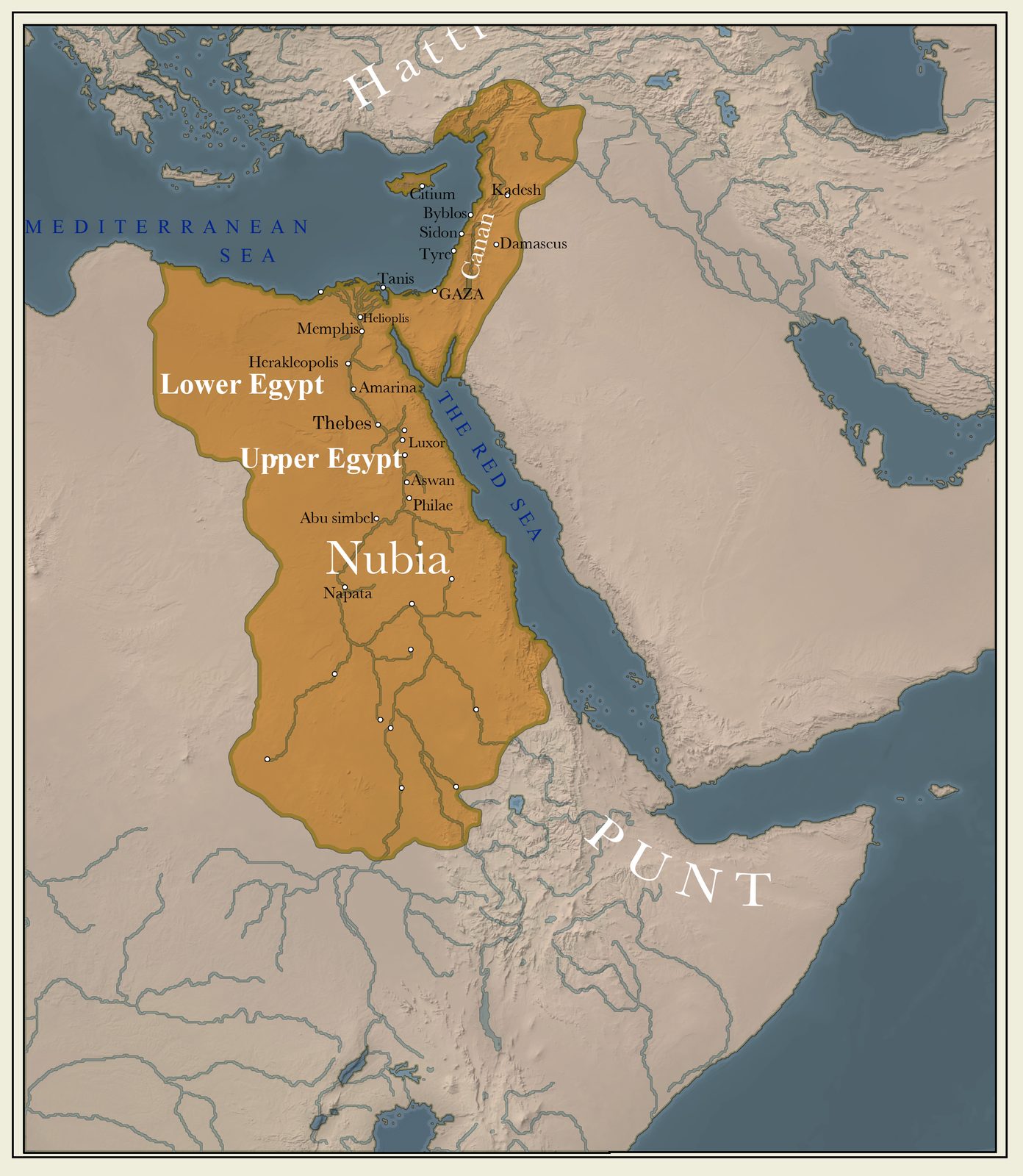
If you want to understand why the Exodus story happened the way it did — why it is a story about Egypt, about forced labour, about a pharaoh who will not let a people go, about a departure from the Delta and a journey toward a land that was always on the other side of the desert — you need to see Egypt as it actually was.
Not as a comic-book land of pyramids and mummies. Not as a mystical civilisation in the popular imagination. As a specific country, in a specific period, with a specific economy, a specific bureaucracy, a specific relationship to the people on its edges. Because the story's details — the brickmaking, the store cities, the pursuit by chariot, the route through the marshy eastern Delta — make sense only against this background. They ring true in ways they would not ring true against any other setting.
This chapter is the first of six that set the stage. It is part of the second strand of the book: the world behind the story. These chapters do not tell the story of Moses. They tell the world the story emerged from. The reader who finishes Part Two will have a picture of the landscape before the first scene begins.
The country
Stand on the west bank of the Nile at Luxor in the late afternoon and you will understand, before anyone tells you, why Egypt was the richest country on earth for most of its history.
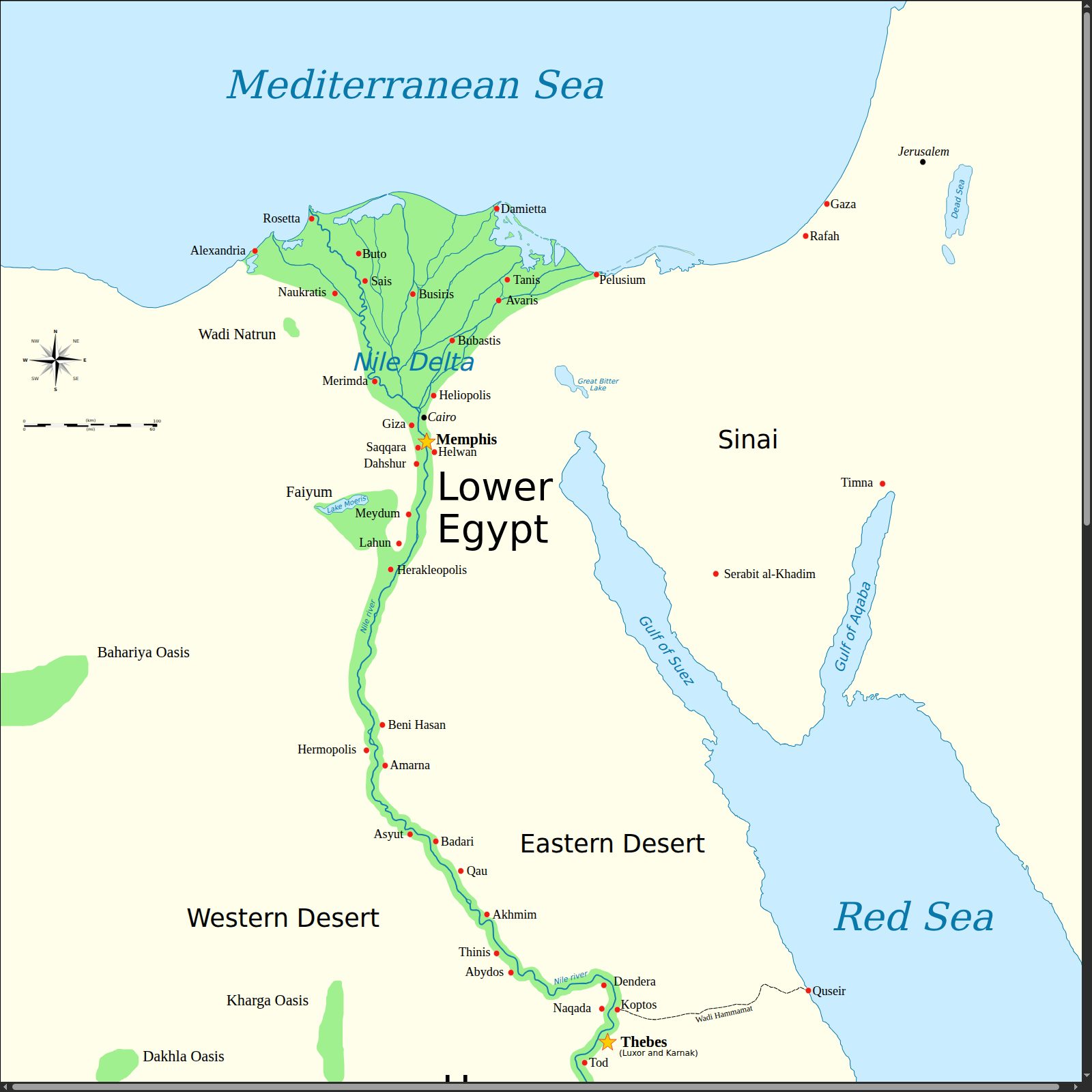
The Nile is not just a river. It is the only thing that makes the country habitable at all. The desert presses in on both sides — rocky plateaus, sand, the occasional oases, the tombs of the nobles cut into the cliffs on the west bank. The green strip of the valley is narrow, rarely more than a few kilometres wide except in the Delta. The river is the highway, the irrigation source, the agricultural base, the transportation route for everything from granite to grain. Without the Nile, Egypt is nothing. With it, Egypt is one of the most productive agricultural civilisations in human history.
The annual flood is the key. Every year, the Nile rises, floods the land, deposits a layer of rich black silt, and recedes. The ancient Egyptians called the land Kemet — the Black Land — for the colour of the soil after the flood. The desert on either side was Deshret — the Red Land. The distinction was not poetry. It was agronomy. The Black Land could grow wheat and barley and flax and vegetables and fruit in quantities that supported a large population and a state apparatus. The Red Land held nothing useful except minerals: gold in the eastern desert, granite and other stones in the quarries, semi-precious stones for jewellery.
The flood was also the basis of the Egyptian state's administrative genius. Because the flood's height varied from year to year, the state had to measure it, record it, predict its effects on the harvest, and tax accordingly. The nilometers — the structures installed at various points on the Nile to measure the water level — are among the most important pieces of infrastructure in Egyptian history, because they were the instrument through which the state knew what it could expect from the harvest. The records of the nilometer readings, maintained over centuries at places like Elephantine in the south, are among the most remarkable bureaucratic archives in the ancient world. A state that could measure its river's rise and fall in centimetres and tax peasants accordingly was a state that understood its resource with unusual precision.
The geography of the country shaped its politics. The Nile runs north — always north — so the river flows from the southern border toward the Mediterranean. The wind, on the other hand, usually blows north to south in the valley, so you could sail upriver against the current by using the wind. Movement up and down the country was relatively easy, and the monarchy, based at various times in the south (Thebes, Abydos) or the north (Memphis, the Delta), could project power along the river corridor. The uniformity of the corridor — a single river, a single agricultural strip, a single communication route — is one of the reasons Egypt achieved and maintained political unity for long stretches of its history in a way that divided civilisations did not.
The New Kingdom
The story of Moses is set, in the conventional reading, in the period when Egypt was at the height of its power as an empire. That period is the New Kingdom, roughly 1550 to 1070 BCE, and it is worth seeing what that means.
The New Kingdom began when the Theban kings of Upper Egypt defeated the Hyksos and drove them out of the Delta. The Hyksos — a Semitic-speaking people, as we will discuss in the next chapter — had ruled northern Egypt for about a century and a half, establishing their capital at Avaris in the eastern Delta, using horse-drawn chariots, and introducing military technology and tactics that changed Egyptian warfare. Their expulsion was a traumatic event in Egyptian history, and it left a memory that shaped Egyptian attitudes toward Semitic populations for centuries. The pharaohs who expelled them — Ahmose I and his successors — began the New Kingdom in a mood of revanchism, pushing the Egyptian state back into the Levant and reasserting control over territories that had been lost.
The New Kingdom pharaohs who followed — especially the great warrior pharaohs like Thutmose III (1479–1425 BCE) and Ramesses II (1279–1213 BCE) — built Egypt into the dominant power of the Near East. Thutmose III campaigned more than seventeen times in the Levant, extending Egyptian control from the Euphrates in the north to Nubia in the south. His campaign records, inscribed on the walls of the temple of Karnak at Thebes, are among the most detailed military chronicles from the ancient world. The Battle of Megiddo, one of his earliest, is the first battle in history for which we have a reasonably detailed account — the troop positions, the strategy, the outcome. The Egyptian army under Thutmose III was a professional force, well-equipped, well-organised, and backed by a state that could logistically support campaigns far from home.
By the time of Ramesses II, Egypt had been an empire for more than two centuries. Ramesses II — called Ramesses the Great, and with some justification — reigned for sixty-seven years, an extraordinarily long reign by any standard, and during it he fought the Hittites at the Battle of Kadesh (c. 1274 BCE), the largest chariot battle in history. He lost, or drew; the historiography is disputed. He then spent the rest of his reign pretending he had won decisively, erecting temples with inscriptions depicting his glorious victory. The Kadesh poems — several of them — are among the longest and most elaborate texts from the ancient Near East, and they show a pharaoh at the height of his ambition, commanding a state that could produce massive temples, enormous statues, and extensive written propaganda.
The point of all this for the Moses story is straightforward: when the narrative says that a pharaoh of Egypt refused to let the Israelites go, and that the departure involved a confrontation with Egyptian military power, it is describing a confrontation with a state that, in the New Kingdom period, was the most powerful in the Near East. This is not a weak state that could be easily overcome. It is a state with a professional army, a rich temple economy, a bureaucracy that managed forced labour, and a pharaoh who could command the resources of a river valley that was, by any standard, the richest and most productive agricultural region in the Mediterranean world.
The pharaoh
The pharaoh is the most distinctive political institution in Egyptian history, and it existed in a form unique in the ancient world.
He was not simply a king. He was a god — or more precisely, he was the representative of the gods on earth, the living embodiment of the order (maat) that held the universe together, the one who maintained the annual flood, the one whose rituals kept chaos at bay. The Egyptian word for the king was nswt and bit — "king of the south" and "king of the north," designating the unified ruler of the whole country. The king was Horus in life and Osiris in death. He was the son of Ra, the sun god. The visual language of Egyptian art — the king larger than everyone else, wearing the crown, holding the crook and flail, the nemes headcloth, the false beard — all of this expresses the same idea: the king is different from everyone else, and this difference is not political but cosmic.
The pharaoh was also, in practice, a massive employer. The temples were economic institutions of enormous scale, owning land, employing workers, managing trade, and receiving a substantial share of the agricultural surplus. The building programmes were enormous. Ramesses II built Pi-Ramesses, a new capital in the eastern Delta, with temples, palaces, and store cities. He built the Ramesseum, his massive funerary temple on the west bank at Thebes. He built Abu Simbel, the temple complex in Nubia with four colossal statues of himself at the entrance. He built extensively at Karnak, adding to the great temple complex that had been built up over centuries by successive pharaohs. If you have seen Karnak — if you have walked through the Great Hypostyle Hall with its hundred and thirty-four massive columns — you have some sense of the scale of the pharaoh's building power, and of the organised labour it required.
Forced labour in ancient Egypt was a real institution, and it was not necessarily the brutal chattel slavery of a later era. The Egyptian state conscripted labour for building projects, for agricultural work during the flood season when farmers could not work their fields, and for other state purposes. The labourers were often Egyptian peasants, conscripted for periods of service. They were paid — in rations, in grain, in beer, in cloth. They were organised. There is evidence of workmen's settlements, of organised groups, of day-to-day administration of labour forces. The workmen who built the royal tombs in the Valley of the Kings lived in a purpose-built settlement at Deir el-Medina, and we have their records: their pay, their disputes, their letters, their absences, their strikes. The first recorded labour strike in history was a sit-down strike by the tomb-builders at Deir el-Medina in the twentieth century BCE, during the reign of Ramesses III. The fact that the strike is recorded means the administration had to deal with it, which means the administration was paying attention to the workers.
This matters for the Moses story because the story's picture of forced labour — brickmaking, quotas, the refusal to reduce the workload — is consistent with what we know about Egyptian labour organisation. The story's specific detail, in Exodus 5, when the pharaoh tells the taskmasters to stop giving the Israelites straw and to make them gather it themselves while maintaining the same brick quota, is the kind of detail that reads like institutional knowledge. It is not a vague story about slaves in a distant land. It is a story about a specific kind of labour management in a specific kind of state. Whether it happened exactly this way is a different question; the fact that it could have happened this way is significant.
The Delta and the eastern frontier
The eastern Delta is the part of Egypt the Exodus story actually takes place in, and it is worth seeing what it was like.
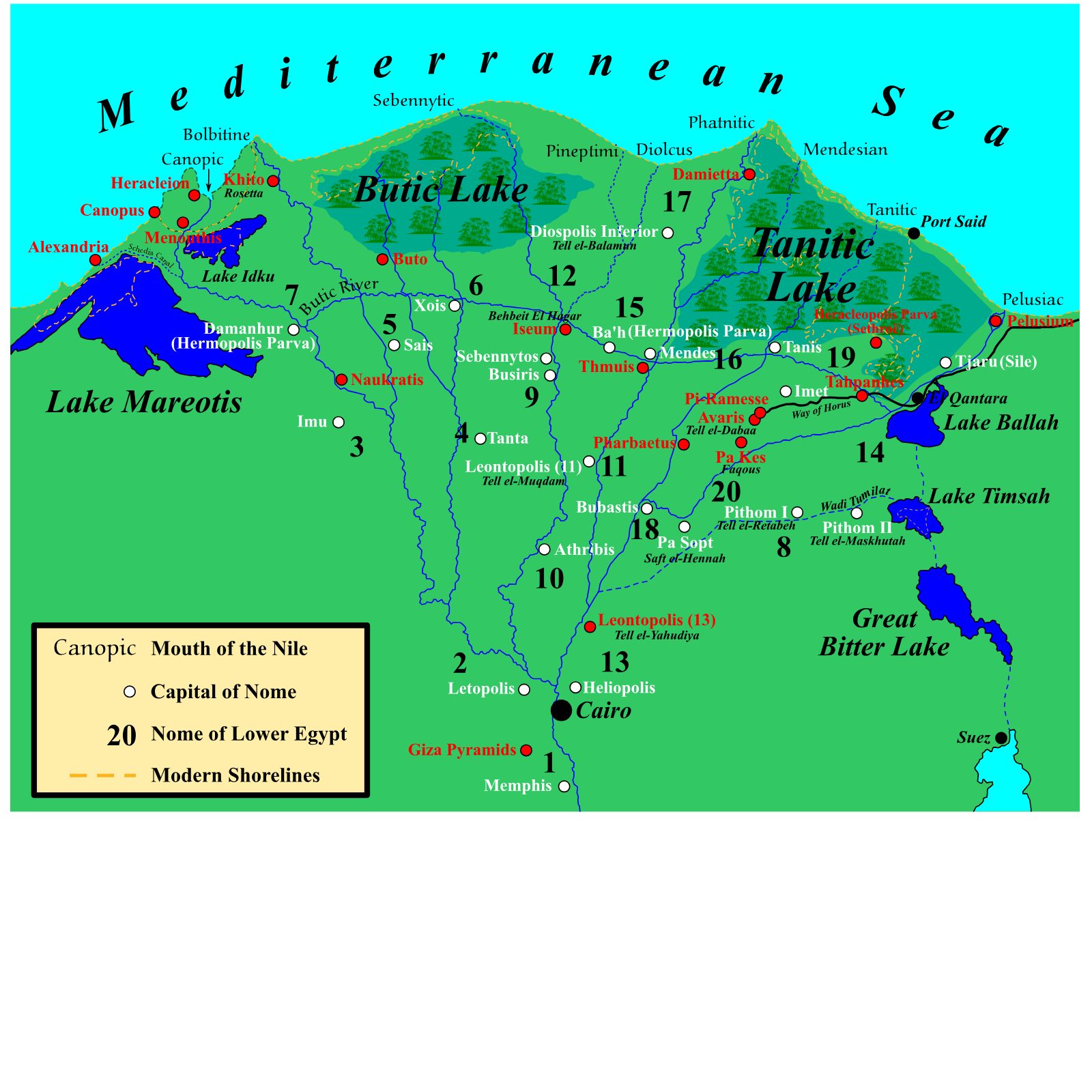
The Delta is the wide, marshy plain where the Nile spreads out into multiple branches and meets the Mediterranean. In the New Kingdom, the eastern Delta was a border zone — the land between the Egyptian heartland and the land of Canaan, the route through which armies and traders and migrants moved between the two worlds. The eastern Delta was also the centre of Egyptian power in the New Kingdom, especially after the expulsion of the Hyksos. The pharaohs of the New Kingdom wanted to keep control of the Delta because it was the entry point for military campaigns into the Levant and because it was the region where Semitic-speaking populations had historically lived.
Pi-Ramesses — the city that Ramesses II built as his capital in the eastern Delta — was situated, according to the archaeological evidence, at or near the site of Avaris, the old Hyksos capital. The city was enormous. It had canals, storehouses, palaces, temples, and a garrison. It was the base for Egyptian military operations in the Levant. It was a place where Semitic-speaking people — mercenaries, traders, labourers, slaves — lived in significant numbers. It was, in other words, exactly the kind of place where a story about Semitic-speaking slaves in the Delta would have its setting.
The eastern Delta was also marshy. The land between the Nile branches, the lake regions, the lagoons — this was the terrain through which the Israelites are supposed to have moved when they left Egypt. The biblical text mentions the "way of Horus" — the coastal road that ran from the eastern Delta into Canaan, also called the Way of the Sea in later texts — and it mentions marshy regions and bodies of water that are difficult to identify exactly but that suggest the route went through the reed-filled eastern Delta before reaching the open desert.
This geography is important for the Exodus route question, which will come up in the chapter on the sea. The point to hold onto now is that the Delta was a specific place with a specific character, and the story's setting in the Delta — the store cities, the marshland, the proximity to Canaan — is consistent with what we know about the geography of the region.
Daily life in the New Kingdom
A book about Moses does not need to be a history of everyday life in Egypt, but it needs to give the reader a sense of what the country was like to live in, because the story's starting point is Egypt, and the story's drama turns on what it means to be a people inside Egypt and then outside it.
The average Egyptian in the New Kingdom was a peasant farmer. He — and she, since women had significant legal rights in Egypt, including the right to own property, initiate divorce, and conduct business — lived in a mudbrick house, owned a small plot of land, grew wheat and barley, paid taxes in kind, and participated in the major religious festivals. Life was not easy — the flood could fail, and famine followed; the state could demand heavy labour; disease was a constant threat — but it was not, for most people, the misery that some popular images suggest. Egypt was remarkably stable for long periods, and the state provided a kind of infrastructure — irrigation management, grain storage, legal administration — that made life predictable in a way that life in many other ancient societies was not.
The elite were different. The high officials — viziers, treasurers, army commanders, high priests — lived in luxury, with large houses, extensive estates, and access to the best goods. They were buried with considerable wealth. The tomb of Tutankhamun, though from an earlier period (the Eighteenth Dynasty, c. 1323 BCE), gives a sense of what even a relatively minor pharaoh's burial could contain. The elites of the New Kingdom were buried in much grander tombs, with much more wealth, though most of those tombs were robbed in antiquity.
Religion was everywhere. The Egyptian calendar was organised around festivals. Temples were open to the public for major events. Personal devotion, to gods like Amun, Hathor, Isis, Seth, and Ptah, was a real aspect of Egyptian life. The gods were believed to be present in their cult statues, which were carried through the streets in procession. The average person might never see the inner sanctuary of the great temples, but they saw the outside, they heard the music and the chanting, they participated in the festivals, and they understood the temple as the centre of the cosmic order that kept their world stable.
The visual culture was overwhelming. The temples were built to impress — to overwhelm the visitor with the scale and beauty of the pharaoh's power and the gods' presence. The great temples of Karnak, Luxor, Abu Simbel, the Ramesseum, Medinet Habu — all of them are expressions of this idea. A visitor in the New Kingdom, coming from Canaan or the Delta or the Nubian border, would have been awed by what they saw. And the pharaoh who built these temples wanted that awe.
The questions the setting raises
The point of this chapter is not to give a complete picture of Egypt in the New Kingdom. That would be a different book. The point is to give the reader a vivid enough sense of the country that the Moses story — which begins in this country and which is, at the level of setting, a story about people in and out of this country — makes sense.
The questions the setting raises are the following.
If you were a Semitic-speaking population living in the eastern Delta in the New Kingdom — living there, as the Hyksos had lived there, as the Shasu passed through there, as the conscripted labourers worked there — what would your life be like? What would the pharaoh be to you? What would forced labour mean? What would it mean to be told to make bricks without straw? What would it mean to be part of a population that the state saw as useful and controllable but not fully Egyptian?
And if you were one of the people in that population who managed to leave — by escape, by exile, by some rupture — what would you remember? What would your children remember? And what would happen to that memory over five hundred years of telling and retelling, of writing down, of editing, of assembling into the story we now have?
These are the questions that Part Two will try to answer. The next chapter will focus on the people of the eastern Delta — the Hyksos, the Apiru, the Shasu, the Semitic-speaking populations who lived in and around Egypt's border zone. Chapter 6 will focus on the forced labour in specific detail. Chapter 7 will focus on the pharaoh question. Chapter 8 will focus on the most striking detail of all: that Moses' name is Egyptian, and the tradition never hid it.
But before any of that, the reader needs to be able to see the country. Rich, ancient, powerful, bureaucratic, beautiful, cruel, and utterly unlike any other place in the ancient world. The story of Moses starts in this country, and it never really leaves it.
The People at the Edge
Egypt was the richest country on earth in the New Kingdom, but it was not alone in its world. On its eastern border, in the Delta and beyond, lived populations of Semitic-speaking peoples who were connected to Egypt in various ways — some as rulers, some as labourers, some as enemies, some as subjects. These were the people at the edge, and they are the ones the Exodus story is ultimately about, even if the story's setting is Egypt and its hero is raised in Pharaoh's court.
To understand where Moses came from — or at least, to understand the world that produced the story of Moses — you need to understand these populations. They are not the Israelites of the biblical narrative, though they may be related to them. They are the background population, the real people who lived in the region and whose presence shaped the story's setting even if the story was written much later.
This chapter is the second of the context chapters in Part Two. It focuses on three groups in particular: the Hyksos, who ruled northern Egypt for a period and were then expelled; the Apiru or Habiru, a class of marginal people who appear in Egyptian and Near Eastern texts; and the Shasu, nomadic pastoralists who lived in the Transjordan and were known to the Egyptians as enemies and subjects. None of these groups are the Israelites, and the book will not pretend they are. But they are the populations whose memory and whose presence in the region may have fed into the larger story of a Semitic-speaking people in Egypt and their departure.
The Hyksos
The Hyksos are the most dramatic example of Semitic-speaking people in Egypt, and their story is the one that left the deepest mark on Egyptian historical memory.
The word "Hyksos" comes from the Greek hykussos, which is a rendering of the Egyptian hq3 h3swt — "rulers of foreign lands." The Egyptians used this term first for the foreign governors and chiefs who controlled parts of the Delta during the late Middle Kingdom period, and then for the dynasty that ruled northern Egypt during the Second Intermediate Period (roughly 1650 to 1550 BCE).
The Hyksos were not, despite some older theories, a single invading horde. They were a population — possibly a mixed population of Semitic-speaking peoples from the Levant, combined with some Egyptians — who came to control the eastern Delta and eventually northern Egypt through a combination of migration, trade, intermarriage, and military power. They established their capital at Avaris, in the eastern Delta, which became a major city with extensive fortifications, a harbour, and links to the Near East. The archaeological site of Tell el-Dab'a, which is probably Avaris, has yielded evidence of a population that was culturally mixed — Egyptian and Levantine elements in the pottery, the architecture, the burial practices, the inventory of the temples.
The Hyksos introduced or popularised several military technologies in Egypt: the horse-and-chariot, the composite bow, improved bronze weapons, and new forms of fortification. These technologies would later become standard in Egyptian military practice, but at the time they were new imports, and they helped the Hyksos maintain their control of the north.
Their rule lasted roughly a century and a half. Then, in the late Seventeenth Dynasty, the Theban kings of Upper Egypt began to push back. The campaign dragged on through several reigns. The great liberator-king was Ahmose I (c. 1550–1525 BCE), who finally captured Avaris, pursued the Hyksos into southern Canaan, and besieged Sharuhen for three years before finally defeating them. After that, the Egyptians reasserted control over the whole country, and the New Kingdom began.
The expulsion of the Hyksos left a deep mark on Egyptian historical memory. Later Egyptian texts remembered it as a period of humiliation and foreign rule, and the memory of it — of Asiatics ruling in the Delta and then being driven out — became part of the cultural background of Egypt's relationship with Semitic-speaking populations. The Egyptians were never entirely comfortable with Asiatics in the Delta again, and this discomfort is part of the background of the Exodus story, whether the story is historically based or not.
For our purposes, the Hyksos matter for three reasons. First, they show that Semitic-speaking people could, in fact, rule in the Delta — a fact that the Egyptian memory never forgot. Second, the memory of their expulsion became part of Egyptian historical consciousness, and the story of a Semitic population leaving Egypt under pressure from the Egyptian state may have drawn on this memory in ways we can't fully trace. Third, the archaeological site of Avaris/Tell el-Dab'a gives us a concrete picture of what a Semitic-speaking population in the Delta looked like — how they lived, what they ate, how they were organised, what they worshipped. This picture is useful background for thinking about the people who may have become the Israelites.
The Apiru / Habiru
The second group is the most intriguing, and the most difficult, because it appears in texts across the ancient Near East and its relationship to the Hebrews is a matter of long-standing debate.
The word Apiru (in Egyptian) or Habiru (in Akkadian and other Semitic languages) appears in several texts from the Late Bronze Age, roughly the fourteenth to the twelfth centuries BCE. The texts describe these people in various roles: as mercenaries, as farm labourers, as escaped slaves, as bandits, as rebels, as settled people who had fallen into debt or poverty and had become marginalised. In the Amarna letters — the correspondence between the Egyptian pharaoh and his Canaanite vassals in the fourteenth century BCE — the term appears several times, often in contexts of violence and rebellion. One letter, from Abdi-Heba of Jerusalem, complains that the Habiru are taking over the land: "The Habiru are capturing the towns of the king... if there is any strong king, the lands and the kings of the Canaan will be lost."
The Akkadian term habiru is linguistically related to the Hebrew ivri — "Hebrew." The word in Hebrew can mean a person from the other side (of a river, a border), a passer-through, a migrant. Abraham is called an Hebrew in Genesis because he has crossed over into Canaan from the other side of the Euphrates. The etymology is suggestive, and many scholars have noted it.
But the linguistic connection is not the same as the historical connection. The Apiru/Habiru of the texts are a social class, not an ethnic group. They are people on the margins of society — those who have lost their place in settled life and become mobile, armed, and sometimes violent. They are not necessarily connected to any specific tribe or nation. The term in the texts refers to a kind of person, not a people.
Whether the Hebrews are connected to the Habiru is a question that honest scholars answer differently. Some say yes, or possibly yes — the Hebrews were a group of Habiru who coalesced around a new identity. Some say no — the Habiru are a generic class, and the Hebrews are a specific group whose name just happens to sound like the Habiru word. The truth is probably that the question cannot be settled, and that the honest answer is to say so.
What matters for our purposes is this: the term appears in exactly the right period and in exactly the right place for the biblical story's background. The Amarna letters describe a world of Canaanite city-states under Egyptian suzerainty, struggling with rebellions, incursions, and the threat of the Habiru. The world is not the same as the world of the Exodus story — the Exodus story is set in Egypt, not in the Canaan of the Amarna letters — but it is a world in which Semitic-speaking people in the region are a fact of life, in which Egyptian control reaches into Canaan, and in which marginal armed populations are a problem.
The Habiru are, in other words, part of the texture of the period. They may not be the Hebrews, but they are the kind of people who lived at the edges of the Egyptian and Canaanite worlds, and their presence helps explain why a story about people at the edge — escaped slaves, migrants, people on the move — would have made sense in this period and in this region.
The Shasu
The third group is the Shasu, and they are the most directly relevant to the Exodus story's geography.
The Shasu were nomadic or semi-nomadic pastoralists who lived in the Transjordan and the Sinai region in the Late Bronze Age. They appear in Egyptian inscriptions from the Nineteenth Dynasty, especially in the reign of Seti I (c. 1294–1279 BCE) and Ramesses II (c. 1279–1213 BCE). They are described in military and administrative terms: as enemies to be fought, as peoples to be controlled at the Egyptian frontier forts, as people who moved through the border zones in search of pasture and water.
The Egyptian records of the Shasu are informative. They mention several tribes or groups of Shasu: the Shasu of Edom, the Shasu of Amurru, the Shasu of Moab. The names suggest that the Shasu were not a single unified group but a collection of tribes or clans, each associated with a particular region. They moved with their herds, they lived in tents, they were outside the settled agricultural order, and they had a relationship with the settled states — sometimes hostile, sometimes negotiated, sometimes symbiotic.
The most interesting Egyptian document for our purposes is Papyrus Anastasi VI, which we encountered in the previous chapter. It is a letter from an Egyptian official, probably from the reign of Merneptah (c. 1213–1203 BCE), dealing with the movement of Shasu through an Egyptian border checkpoint. The text reads, in part:
"Let the Shasu of Edono pass the fortress of Merneptah-Content-with-Amun, going to the pools of Pithom of Merneptah-Content-with-Amun, to the place where there is water for them, for there is a complete lack of water in the land of Edono."
The text is bureaucratic and routine. The official is authorising the passage of a group of Shasu through a fortified checkpoint, to a place where they can find water. There is no drama in the text, no epic, no liberation. It is a dry record of a state dealing with a marginal population at its frontier.
But the text is valuable for several reasons. It confirms that Shasu were moving through the eastern Delta region in the relevant period. It confirms that they were associated with water scarcity — the reason for their passage was the lack of water. It confirms that the Egyptians had forts and checkpoints on the frontier, and that they controlled the passage of these populations. And it confirms that the Shasu were known in the Delta and the northeastern frontier in the period when the Exodus story is supposed to have happened.
The Shasu may not be the Hebrews. They may not be connected to the Exodus story at all. But they are the kind of population that lived just outside the settled Egyptian order, and they are the kind of people who might be remembered in a story about people who were oppressed in Egypt and then escaped. And the name "Shasu" has been noted by some scholars as possibly related to the Hebrew "Shasu" as a tribal designation, though this is disputed.
What matters here is the texture. The Shasu are real. They are documented. They lived in the region where the story takes place. And they are the kind of people who might be the ancestors — or the memory-ancestors — of a people who later told a story about escaping from Egypt.
The broader picture
What do these three groups have in common?
All of them were Semitic-speaking populations, or predominantly so. All of them had a relationship with Egypt — as rulers, as marginal people, as enemies, as subjects, as passers-through. All of them lived in the region that is the setting of the Exodus story — the Delta, the eastern frontier, the Transjordan, the Sinai. And all of them are documented in Egyptian and Near Eastern texts from the relevant period, which means that the Egyptian state knew about them and dealt with them.
The broader picture is one of a borderland — a zone between Egypt and Canaan, between the settled agricultural world and the nomadic pastoral world, between the Egyptian state and the various Semitic-speaking populations that lived in and around it. This borderland was the setting for the Exodus story, even if the story itself was written much later and in a different context. The story's details — the Delta setting, the forced labour, the escape, the journey through the marshy eastern Delta and the desert beyond — are consistent with a world in which these populations were a fact of life.
The story may not be about any of these groups specifically. It may be about a group that emerged later, from within Canaan, and told a story that drew on the memory of these populations. It may be about a group that escaped from Egypt in small numbers and whose story was enlarged over centuries. It may be about a memory that never left the Delta and grew into a national epic.
What the broader picture gives us is not a solution to the historical problem but a set of plausible contexts. The Exodus story is not set in a vacuum. It is set in a real region, with real populations, a real Egyptian state, and a real history of movement and conflict between them. The story may be enlarged and shaped, but it is not invented out of nothing. The people at the edge are real, and the story is about people at the edge.
Why this matters for Moses
Moses is a man with an Egyptian name, raised in an Egyptian court, who leads a Semitic-speaking people out of Egypt. The story of his name, and of the people he leads, only makes sense in the context of this borderland.
The people at the edge were the raw material out of which the story was made. Whether Moses was a real person who belonged to one of these groups, or whether he is a literary figure built from the memory of such people, the story's world is the world of the Hyksos, the Habiru, and the Shasu — the world of Semitic-speaking people in and around the Egyptian Delta, in the late Bronze Age, in a time when the Egyptian state was powerful and watchful and willing to use forced labour.
The next chapters will get more specific. Chapter 6 will look at the forced labour in detail — the brickmaking, the store cities, the Pi-Ramesses building programme — and show why this is the one place in the Exodus story where the details ring true against the Egyptian record. Chapter 7 will tackle the question of which pharaoh, and why that question may be the wrong question to ask. Chapter 8 will look at Moses' Egyptian name and what it tells us about the story's origins.
But for now, the reader should have a picture of the people at the edge — the populations who lived in the region, who knew Egypt, who were known to Egypt, and who were part of the world that produced the story of Moses, whether as memory or as invention or, most likely, as a mixture of both.
Mud and Straw
The one part of the Exodus story that rings most clearly against the Egyptian record is the part about forced labour.
Not the plagues. Not the miraculous crossing of the sea. Not the parting of the waters. Not the manna in the wilderness. These are the parts of the story that belong to the realm of memory enlarged by time and shaped by theology, and they are not the parts that find a clear echo in the Egyptian archaeological and textual record.
The part that rings true is quieter. It is the part about brickmaking. About the work gangs. About the quotas. About the store cities. About the specific, practical management of a large labour force in the eastern Delta. This is the part of the story that reads like institutional knowledge, and it is the part that is most plausibly connected to something real.
This chapter is the only one in the book where the Exodus story's details align with the Egyptian record in a meaningful way. The reader should understand why that matters and what it does not prove. The conservative scholars — Hoffmeier especially — make this their strongest case, and an honest book does not skip it.
The story's detail
The forced labour story in Exodus is specific. It is not a vague lament about how bad slavery was. It is a story about a specific management system.
In Exodus 1, after the new pharaoh decides to oppress the Israelites, the text says they were set to work making mortar and bricks, and doing various kinds of field work. In Exodus 5, after Moses and Aaron ask the pharaoh to let the people go to worship their God, the pharaoh responds by increasing the pressure — he tells the taskmasters to stop giving the Israelites straw for the bricks and to make them gather it themselves, while keeping the same quota of bricks per day.
The passage in Exodus 5 is worth reading closely, because the specificity is doing something important:
"Go, get you straw where you can find it: yet not diminish aught of the work of the men's burden, as their work is... So the overseers went out, and said unto the people, Thus saith Pharaoh, I will not give you straw. Go, get you straw where you can find it, not of your works to be diminished. And the people were scattered abroad throughout all the land of Egypt to gather stubble instead of straw."
The detail about gathering the straw, the straw being part of the brick mixture, the quotas not being reduced — this is the kind of detail that belongs to the experience of brickmakers under a state-run system, and it is the kind of detail that a story invented without access to that experience would not typically produce. It is practical, technical, and bureaucratic. It is the texture of the labour.
Now, none of this proves that the specific story as written — the exact number of bricks, the exact taskmasters, the exact words of the pharaoh — happened that way. Memory can preserve practical detail even when the larger narrative has been enlarged. A person who had a grandfather who worked in a brickyard will remember the straw and the moulds and the splitting of the clay, even if the grandfather's story has been told around a campfire for generations and acquired new dramatic elements. The practical detail is one of the things that memory tends to keep alive.
The question is whether the Israelites had someone who remembered working in brickmaking in the eastern Delta, or whether the detail was picked up from the Egyptian record later. Either way, the detail is there, and it is consistent with a real practice.
Brickmaking in ancient Egypt
Brickmaking was a major industry in ancient Egypt, especially in the Delta, where the Nile silt provided the raw material and where there was a lot of building to do.
Egyptian bricks were made from Nile mud mixed with straw or chaff — the straw acted as a binder, preventing the mud from cracking as it dried. The mixture was placed in a mould and shaped, then left to dry in the sun. Some bricks were kiln-fired, for use in situations where extra durability was needed, but the majority of bricks in Egyptian construction were sun-dried.
The process was labour-intensive. The mud had to be dug, mixed, and worked by foot. The straw had to be gathered — from agricultural waste, from the fields, from the borders of the fields. The mixture had to be placed in the moulds. The bricks had to be laid out to dry in rows. The workers — often a large labour force in a state building project — had to be organised, paid, fed, and supervised.
The archaeological record of ancient Egyptian brickmaking is extensive. We have the remains of ancient brick structures throughout the Delta and beyond. We have the marks of the brick moulds. We have the administrative texts that record the production of bricks in large quantities. We have the ostraca — the pottery shards used for writing — that record workmen's attendance, their tasks, their rations, their disputes.
The image of Egyptian brickmakers, working in the heat of the Delta, mixing mud with straw, shaping the bricks in their moulds, laying them out to dry, and being supervised by taskmasters who tracked their output — this image is not a romantic invention. It is what the Egyptian record shows. And the Exodus story's description of the same process — the mud, the straw, the moulds, the quotas, the taskmasters, the refusal to reduce the workload — is a picture of the same practice.
Pithom and Ramesses
The Exodus story names two store cities that the Israelites built: Pithom and Ramesses. These are the specific places where the forced labour in the story is located.
Pithom — in Egyptian, Pr-Itm, "the house of Itm" — is identified by most scholars with Tell el-Retabeh, a site in the eastern Delta, or possibly with another site in the region. The name fits the Egyptian pattern. The site has yielded archaeological remains from the Late Bronze Age, including brick structures, storage facilities, and evidence of organised labour.
Ramesses — in the story, "the land of Ramesses" — is identified with Pi-Ramesses, the new capital that Ramesses II built in the eastern Delta. Pi-Ramesses was one of the largest and most impressive cities in the Nile Delta in the Late Bronze Age. It had a large palace, temples, storehouses, and a substantial garrison. It was the base of Egyptian military operations in the Levant. It was built, in part, with forced labour — both Egyptian conscripts and possibly foreign labourers. The city was abandoned after the end of the New Kingdom, and its location was lost for centuries until it was identified at Tell el-Dab'a, the same site as the old Hyksos capital Avaris.
The archaeological site of Pi-Ramesses/Tell el-Dab'a is one of the most important sites for understanding the eastern Delta in the Late Bronze Age, and it is the setting for part of the Exodus story. A population of Semitic-speaking labourers working on the building projects of Pi-Ramesses in the reign of Ramesses II — this is the picture that the story gives us, and it is a picture that fits the archaeological and textual evidence for the site.
Now, this is not the same as saying the Israelites built Pi-Ramesses. The archaeological and textual evidence does not show a population called Israel building Pi-Ramesses. The evidence shows a large city built with organised labour in the eastern Delta. The story, written down centuries later, places the Israelites there, and the placement is geographically and period-wise plausible.
The Pi-Ramesses building programme
Ramesses II was a great builder, and his building programme was enormous. He built temples, palaces, store cities, fortifications, and statues. He did this on a scale that required a large labour force and a sophisticated administrative apparatus to manage it.
The building of Pi-Ramesses was part of this programme. The city was built as a new capital in the Delta, close to the eastern frontier, and it was designed to be impressive. It had a grand palace, a temple of Seth, storehouses for the army's supplies, and facilities for the administration of the eastern Delta. The city was the centre of Egyptian power in the region.
The labour for the building programme came from various sources. Egyptian conscripts — peasants who were required to serve the state for part of the year — provided part of the labour force. Captives and prisoners of war — defeated enemies from campaigns in Nubia and the Levant — provided another part. And there were probably foreign labourers — people from the Semitic-speaking populations of the Delta and the eastern frontier — who were either conscripted or hired or otherwise brought into the system.
We do not know exactly who worked on the building of Pi-Ramesses, because the records are fragmentary and the populations were mixed. What we know is that the city was built by a large labour force, that forced labour was part of the Egyptian system, and that Semitic-speaking people were living in the Delta and working in the Egyptian economy at the time.
James Hoffmeier, in Israel in Egypt, has argued that the Exodus story's details about forced labour in the Delta are consistent with the Egyptian evidence, and that a small group of Semitic-speaking people — possibly escaped slaves or conscripted labourers or deportees from campaigns — could have been part of the population that worked on the building projects of the Delta, and could have left Egypt at some point, and could have been remembered in the story. This is a careful, honest argument, and it deserves a fair hearing. It does not require the Exodus story to be literally true on the large scale. It only requires a kernel of historical reality at the centre of it.
What the details prove — and what they don't
The details of the forced labour story prove one thing clearly: the story's setting and some of its specific elements are consistent with the Egyptian record of the Late Bronze Age. The brickmaking, the straw, the store cities, the building of Pi-Ramesses — these are not implausible in the context of Ramesside Egypt. They are the kind of things that would have happened in that time and place, and the story preserves details that belong to that world.
The details do not prove that the Exodus story is historically true in the full sense. They do not prove that a population of two million people left Egypt. They do not prove that the Egyptian army was destroyed. They do not prove that the Israelites conquered Canaan. They do not prove that Moses existed as described.
What they suggest is that the story grew around a real setting, and that the memory of forced labour in the Delta — the memory of making bricks and straw and quotas and store cities — was part of that memory, preserved in detail even as the larger narrative was enlarged. The core of the story — we were slaves in Egypt, we were made to make bricks with straw, we were freed — may preserve genuine memory of Semitic-speaking people in the Delta experiencing forced labour and some form of departure.
The conservative case, properly understood, is not that the whole story is true as written. It is that the story has a historical base — that something happened that was remembered, and that the memory was enlarged into the story we have. This is a defensible position, and it is the one the book adopts, with the caveat that the base is smaller than the story and the enlargement is profound.
The one place the story fits
Why does this matter? Because if the Exodus story were pure invention, without any historical base, we would expect it to be diffuse — a generalised story about slavery and liberation with no specific details that fit a real setting. The fact that the details, at their best, fit the Egyptian record of the Late Bronze Age — the brickmaking, the store cities, the Pi-Ramesses — is evidence that the story grew around something real.
This is not a small thing. It is, in fact, the strongest evidence for the historical base of the Exodus story, and it is the evidence that most scholars on all sides acknowledge. The story may be enlarged and shaped and written down centuries later, but the core memory of forced labour in the Delta is the one detail that the Egyptian record specifically supports.
For the rest of the story — the plagues, the sea, the wilderness, the law, the conquest — the archaeological and textual record is much less supportive. The silence is real, and it has been described in the previous chapter. But that silence is not total. There is one place where the story's details ring true against the Egyptian record. That place is forced labour in the Delta, among the Semitic-speaking populations, during the building programmes of the New Kingdom pharaohs.
This is the evidence on which the historical case stands, if it stands at all. It is not a large case, but it is a real case, and it points in a specific direction: toward a small group of Semitic-speaking people in the Delta, experiencing forced labour, and escaping or leaving Egypt at some point, and telling a story about it that grew over centuries into the Exodus narrative.
The texture of the labour
The reason the forced labour detail matters, beyond the historical argument, is that it is the texture of the story's beginning. The story does not start with a miracle. It starts with mud and straw and quotas and the refusal to reduce the workload. The first impression the story gives of the Israelites' life in Egypt is not of a glorious captivity but of a specific, grinding labour.
This is true to the texture of ancient forced labour, and it is also true to the texture of the story. The Exodus narrative does not toy with the reader by pretending that the oppression was abstract. It is specific. The straw is the straw. The bricks are the bricks. The quotas are the quotas. The taskmasters are the taskmasters.
This specificity is one of the things that makes the story memorable and powerful. It is not a story about an abstract oppressed people. It is a story about a specific people in a specific place, doing a specific work. The reader should understand that this specificity is consistent with a real memory, and that this consistency is the strongest single piece of evidence that the story has a historical base.
The rest of the story — the miracles, the law, the wilderness — we will come to. But the beginning is this: mud and straw, and the refusal to reduce the workload. And that, at least, fits the Egyptian record.
The Pharaoh Problem

Every reader of the Exodus story asks the same question, and it is a fair question to ask: Which pharaoh was it?
The story says that the Israelites were oppressed by a pharaoh who did not know Joseph, that their forced labour built the store cities of Pithom and Ramesses, that Moses confronted this pharaoh, and that this pharaoh eventually let the people go after a series of disasters that culminated in the death of the firstborn. The story does not name the pharaoh. But readers want to know who it was, because naming the pharaoh would fix the story in history and make it possible to verify or disprove.
Egyptologists and biblical scholars have spent a great deal of time on this question, and the answer is that there is no consensus, and that honest scholars on all sides have good reasons for the candidates they prefer, and that the question may be less important than it seems.
This chapter will walk through the candidates, the evidence for and against each, and the reasons why the pharaoh question may be the wrong question to ask. The goal is not to solve the problem — nobody has solved it — but to give the reader a clear picture of the options and the difficulties with each, so that when the story begins in the next chapters, the reader understands the historical setting in which the story is placed and the limits of what we can say about it.
Why the question matters
The pharaoh is the story's antagonist. He is the human face of Egyptian power, the man who refuses to let the people go, the man whose stubbornness drives the plot toward the plagues and the departure and the destruction of the Egyptian army. If we knew who he was, we could place the story in a specific year, look at the Egyptian records for that year, check for evidence of the events described, and come closer to an answer about the story's historical truth.
The problem is that we do not know who he is, and the reasons we do not know are instructive.
The biblical text never names the pharaoh. It calls him simply "Pharaoh" — Paroh in Hebrew — which is actually the Egyptian title for the king, and which is the way Egyptians themselves often referred to their king. In Egyptian usage, "Pharaoh" (pr-3, "great house") originally meant the royal palace but came to mean the king himself. The biblical text's use of "Pharaoh" without a personal name is consistent with Egyptian usage, and it reflects the fact that the story was probably composed in a context where the specific pharaoh was not known or not important.
This is one of the first clues that the story may have been written or edited long after the supposed events, at a time when the specific pharaoh could not be named. If you are writing a story about a liberation from Egypt in the seventh century BCE, or in the Babylonian exile in the sixth century BCE, you probably do not know exactly which pharaoh ruled Egypt when the Israelites were there. You know the broad setting — the New Kingdom, the Delta, the forced labour — but you do not know the name of the king. So the story uses the title.
The Ramesses solution
The most obvious candidate is Ramesses II, because the story mentions the "land of Ramesses" as the place where the Israelites built the store cities (Exodus 1:11). If the Israelites built a city called Ramesses, the reasoning goes, the story must be set in the time of Ramesses II, who built the great city of Pi-Ramesses in the eastern Delta.
This is the traditional answer, and it has a lot going for it. Ramesses II (1279–1213 BCE) was the pharaoh most associated with building in the Delta, and his capital at Pi-Ramesses was one of the great cities of the Late Bronze Age. The archaeological site of Tell el-Dab'a, which is probably Pi-Ramesses, shows exactly the kind of large-scale building activity that the story describes. The name "Ramesses" in the text is a specific geographical marker, and it fits the Ramesside period.
But there is a problem. The Merneptah Stele, as we discussed in Chapter 2, dates to approximately 1207 BCE, in the reign of Merneptah, Ramesses II's son and successor. The Stele names Israel as a people already in Canaan, already a political entity. If Ramesses II was the pharaoh of the Exodus, and the Exodus happened at the end of his reign, then the Israelites would have had to cross the Sinai and conquer Canaan in the space of about thirty years — the time between the end of the Exodus and Merneptah's campaign in Canaan. That is an extremely tight timeline for the story as written, which describes a forty-year wandering and a conquest that took generations.
Some scholars have suggested that the Exodus could have happened under Merneptah himself. The logic is that Merneptah, facing problems in Canaan (as the Stele suggests), might have been the pharaoh who confronted Moses and was defeated by the Exodus. But the Merneptah Stele itself shows Israel already in Canaan, which is the opposite of what you would expect if Merneptah was the pharaoh of the Exodus who just lost the Israelite population. If the Exodus had just happened under Merneptah, the Stele would not say "Israel is laid waste" as if Israel was already there and had been defeated by Merneptah.
The chronology is tight, and it does not fit cleanly.
The earlier candidates
If the Ramesside period does not fit the chronology, scholars have looked earlier.
One line of argument proposes the fifteenth century BCE, specifically the reign of Thutmose III (1479–1425 BCE) or his son Amenhotep II (1427–1392 BCE). The logic here is that this earlier period would leave enough time for the Exodus, the forty-year wandering, and the conquest of Canaan before the Merneptah Stele names Israel in 1207 BCE. If the Exodus happened in the mid-fifteenth century, the Israelites could have been in Canaan for two hundred years or more by the time Merneptah came to power, which would explain why Merneptah could claim to have fought Israel as an established entity.
This theory has the advantage of fitting the chronology better, but it has a significant problem: the name "Ramesses" in the Exodus story. Pi-Ramesses was not built until the reign of Ramesses II, and the store city of Ramesses did not exist in the fifteenth century BCE. If the Exodus happened in the fifteenth century, the mention of "Ramesses" in the text is an anachronism — the story's author is using a later place name for an earlier setting, either because the author did not know the earlier name or because the story was written later and back-projected into the fifteenth century.
Anachronisms are common in biblical texts, and they are not necessarily a problem for the historical core of the story. A story can preserve a genuine memory of events in the fifteenth century BCE while using later place names because the story was written down in the seventh century BCE or later, long after the fifteenth-century names had been replaced. The presence of an anachronism does not prove that the entire story is fiction. It proves that the story was written or edited at a later date.
The fifteenth-century theory also lacks the direct archaeological or textual evidence that makes the Ramesside case plausible. There is no Egyptian record of a large departure or a destroyed army in the fifteenth century BCE. The forced labour in the Delta does not have a clear attestation in that period in the same way it does in the Ramesside period, when Pi-Ramesses was built. The forced labour detail, which is the strongest piece of evidence for a historical base in the story, fits the Ramesside period better than the fifteenth century.
So the fifteenth-century theory gains chronology but loses the best archaeological fit.
The Hyksos memory
Another possibility is that the Exodus story draws on the memory of the Hyksos expulsion, which happened in the mid-sixteenth century BCE, when Ahmose I drove the Hyksos out of Egypt and pursued them into Canaan.
The Hyksos were a Semitic-speaking population that had ruled the Delta for about a century and a half. Their expulsion was a traumatic event in Egyptian history, and the Egyptian memory of it was one of humiliation and victory at once — the foreign rulers were thrown out. For the Semitic populations of the region, the Hyksos expulsion might have left a memory of a Semitic people leaving Egypt, or being driven out, and making their way east. The story of a Semitic population leaving Egypt under pressure from the Egyptian state might have its roots in this event, or in the memory of it.
The problem with this theory is that it is too early for the specific details of the Exodus story. The forced labour in the Delta, the brickmaking, the store cities, the specific geography — these fit the Ramesside period better than the Hyksos expulsion. The story's setting is in the New Kingdom, not the Second Intermediate Period. The pharaoh is a New Kingdom pharaoh, with a New Kingdom army and New Kingdom building projects. The story does not read like a memory of the Hyksos expulsion, though it may have inherited some of the cultural memory of a Semitic population in and out of Egypt.
The Hyksos memory is most useful as background texture, not as the historical core. It explains why a story about Semitic people in Egypt would have made sense to the people who told it, and it enriches the setting. But it does not identify the pharaoh of the Exodus.
Why the question may be wrong
Taken together, the evidence is inconclusive, and the honest conclusion is that we cannot identify the pharaoh with any confidence.
But this is not as frustrating as it might seem, because the question "Which pharaoh?" may be the wrong question. The story does not require a specific pharaoh to work. The story is not a historical chronicle that names the king and dates the event. It is a story about a confrontation between a people and a state, between a liberator and a god-king, between a demand for freedom and a system of forced labour that will not release its slaves.
The pharaoh in the story is a type, not a specific person. He is the Egyptian state personified. He is the stubborn ruler, the man who cannot see that the God of the Hebrews is real, the man who will not yield until his own household is affected. The story does not need his name to function, because the story's power does not come from the specific historical event but from the confrontation itself.
This does not mean the story is fiction. It means the story is a memory enlarged by time, and the memory was enlarged in a context where the specific pharaoh could not be named. The author knew the broad setting — the Delta, the forced labour, the name Ramesses, the New Kingdom — but not the specific name. So the text uses the title "Pharaoh," which is what Egyptians themselves often did.
This is actually one of the clues that the story was written later, and it is a clue that the source theory (which Part Five will discuss in detail) picks up on. The biblical text uses "Pharaoh" without a name in a consistent way, and this consistency suggests that the story was composed or edited at a time when the specific pharaoh was not known or not important. The author was writing about a past that felt real and specific in its setting but was distant enough that the names had been lost.
What the pharaoh represents
Even if we cannot name him, we can understand what he represents in the story.
The pharaoh is the Egyptian god-king. He is the representative of the Egyptian order, the man who is supposed to maintain Maat — the cosmic order that keeps the world in balance. In the story, he refuses to recognise the God of the Hebrews, and he refuses to let the Hebrews go. His refusal is not just a political decision. It is a cosmic one. He is denying the reality of the God of Israel, and the story shows him paying for it with the destruction of his own household and his army.
The plagues, in the story, are not just punishments. They are a demonstration. The God of the Hebrews is showing the pharaoh that the Egyptian gods are powerless. The plague of blood is a challenge to Hapi, the god of the Nile. The plague of frogs is a challenge to Heqet, the frog-headed goddess of birth. The plague of darkness is a challenge to Ra, the sun god. The death of the firstborn is the final blow to the pharaoh's own family and to the idea that the pharaoh is divine and invulnerable.
The confrontation is a theological one. The pharaoh is not just a stubborn politician. He is the representative of a rival order, and the story is about the victory of the God of Israel over the Egyptian order. This is the meaning of the story, at least on one level, and it does not depend on the specific identity of the pharaoh.
The honest verdict
The honest verdict is this: we cannot say which pharaoh the Exodus story is about, because the evidence does not allow it, and the story does not name him. The best candidate on the strength of the archaeological fit is Ramesses II, but the chronology does not fit cleanly. The best candidate on the chronology is the fifteenth-century period, but the forced labour detail does not fit as well, and the name "Ramesses" in the text is an anachronism. The Hyksos expulsion is a possible memory background, but it does not explain the story's specific New Kingdom setting.
The honest book does not pretend to solve this problem. It presents the candidates, explains the difficulties, and admits that the question is probably unanswerable in the form it is usually asked.
But it also argues that this uncertainty is not a weakness of the book or a failure of the evidence. It is one of the things the book is about. The Exodus story is a memory that grew around something real, and the something real is not pinned to a single pharaoh or a single year. It is a story about a people who were in Egypt, who suffered there, who left, and who told the story of their leaving in a form that preserved the texture of the setting but lost the names.
The reader should be able to hold both things at once: the story's setting is specific and fits the Egyptian record in its details, and the story's specific identities — the pharaoh, the exact year, the exact sequence of events — are not recoverable. That is the nature of the evidence, and it is the nature of memory.
What comes next
The next chapter turns to the most striking detail in the entire story, the one that points more clearly than any other toward the story's Egyptian origin: the fact that Moses' name is Egyptian, and that the tradition never hid it.
If you are waiting for a smoking gun — a single piece of evidence that proves the story's origin in the Egyptian world — this is the closest thing to it. The name is the clue that the story grew in a context where Egyptian names were known and Egyptian culture was present. It is the detail that the biblical author could not have invented, because it is too specific and too foreign to the Hebrew language. It is the detail that the tradition preserved, even though it was awkward, because it was too much a part of the story to remove.
The pharaoh question may be unanswerable. The name of Moses is not. That is where the chapter goes next.
A Levite Named for the Water
Of all the details in the Exodus story, the most striking — the one that points most clearly toward the story's Egyptian origin and away from a Hebrew author inventing a hero from whole cloth — is this: Moses' name is Egyptian.
Not Hebrew in an Egyptian costume. Not a Hebrew name that sounds Egyptian by accident. An actual Egyptian name, preserved in the story, and the tradition never bothered to hide it or translate it or pretend it was anything else.
This is a small thing that tells a large truth.
The name
The name Moses (in Hebrew, Moshe) is given by Pharaoh's daughter in the story, and the biblical text explains it:
She called his name Moses, saying, Because I drew him out of the water. (Exodus 2:10)
The Hebrew verb mashah means "to draw out" or "to rescue." The story has her naming him from the water-thdrawing episode: the basket in the Nile, the rescue from the river. The name fits the scene.
But the name is not Hebrew in origin. The element mose (or mes) is Egyptian, and it means "born of" or "child of." It appears in Egyptian personal names constantly. Ramesses means "Ra has born him." Thutmose means "Thoth has born him." Ahmose means "the moon has born him." The mose element is the second half of many Egyptian names, and it is one of the most common name-elements in Egyptian onomastics.
Moses, as a name, is Egyptian. The biblical text does not disguise this. It does not turn the name into a Hebrew word and pretend it always meant "drawn from the water." It keeps the Egyptian form, and the text's own explanation — the drawing from the water — is a folk etymology, a story attached to the name to make it meaningful in a Hebrew context. The real origin of the name is Egyptian, and the text knows it, or knows it dimly, and works around it.
This is remarkable, and it is the reason this chapter exists.
Why this matters
Think about what an author would do if he were inventing a founder-hero for a people and wanted to make him look plausibly Hebrew.
He would give him a Hebrew name. He would call him Yehoshua or Eleazar or Pinhas or Yitzchak or any of the names that carry Hebrew meaning and sound Hebrew. If he wanted to connect the hero to Egypt, he might give him an Egyptian episode but keep the name Hebrew — like the Joseph story, where Joseph is given an Egyptian name (Zaphenath-Paneah) but keeps his Hebrew name.
Moses is not like this. Moses has an Egyptian name from the beginning. The tradition does not Hebrewise it. The tradition does not pretend it means something Hebrew by origin. The tradition gives him a Hebrew etymology — drawn from the water — but that is an explanation attached to an Egyptian name, not the name itself.
This is not the behaviour of an author inventing a hero. This is the behaviour of a tradition that inherited a hero with an Egyptian name and could not, or would not, erase it.
The name is the evidence that the story grew in a context where Egyptian names were known and where a person with an Egyptian name was not an anomaly. It is the evidence that the story's origin lies, at least in part, in the Egyptian world, or in a memory of that world, rather than in a purely Hebrew invention.
And the name is awkward. An Egyptian founder for a people who are defined against Egypt — this is not the easiest thing to live with. A Hebrew author who wanted to flatten the story's Egyptian elements would have no trouble changing the name. The fact that the name survived, in its Egyptian form, is evidence of the story's resistance to Hebrewisation.
The Levite connection
The name also connects to the Levite question, which is another important clue in the story.
The biblical tradition identifies Moses as a Levite — a member of the tribe of Levi, the tribe that was set apart for the priesthood and temple service, the tribe that produced the Aaronic priesthood. The Levites in the biblical tradition are the tribe most closely associated with the Egyptian origin of the Exodus story. The Levites are the ones who bring the story of Egypt with them. They are the ones who have the name Moses with its Egyptian element. They are the ones whose tribal identity is tied to the memory of Egypt.
The Levite hypothesis, in its simplest form, is this: Moses and the Moses story originated with a Levite family or clan that had Egyptian connections, that had an Egyptian name for their ancestor, and that carried this origin story with them into the broader Israelite tradition. The story of Moses — a man with an Egyptian name, raised in Pharaoh's court, leading the people out of Egypt — may have begun with a Levite group that preserved the memory of its Egyptian origin, and this story was later adopted by the whole nation and grew into the founding narrative of Israel.
This is not proven, and honest scholars do not claim it is proven. It is a plausible reconstruction, supported by the name, the Levite connections, and some other details in the text. The book will not treat it as fact, but it is worth presenting as a real hypothesis that the evidence supports, at least to the extent that it is consistent with what we know.
The water in the name
The Egyptian name mose — "born of" — was originally attached to a god. Ramesses was "born of Ra." Thutmose was "born of Thoth." Ahmose was "born of the moon." The name element was a theological statement, naming a child as the child of a god.
Moses' name lacks the god. This is unusual, and it is significant. It suggests one of two things: either the biblical author knew the name was Egyptian but did not know what god it was originally attached to, or the author deliberately omitted the god element to keep the name ambiguous.
Either way, the result is a name that is recognisably Egyptian but without the explicit Egyptian god attached. An Egyptian reader would recognise the name as Egyptian but would notice the absence of the divine element. A Hebrew reader would recognise the name as unusual and foreign. The name preserves its Egyptian character while being stripped of its explicit theological content.
The water etymology — drawn from the water — is the Hebrew answer to the question of what the name means. The biblical author gives the name a Hebrew meaning, drawn from the rescue from the Nile, and in doing so makes the name meaningful in a Hebrew context. But the Egyptian origin of the name is preserved, and the water story is the bridge between the Egyptian form and the Hebrew meaning.
This is a characteristic move of the biblical text — preserving a foreign name while attaching a local meaning to it. The story of Moses' name is an example of how the text works with foreign material: it keeps the name, gives it a Hebrew explanation, and does not pretend the name is Hebrew in origin.
Zornberg on the name
Avivah Gottlieb Zornberg, in The Particulars of Rapture, is one of the few writers who really attends to the name and what it means, psychologically and literarily. She notes, among other things, that the name Moses is connected to the water — to the Nile, to the basket in the river, to the drawing out — and that the water is a recurring image in the Moses story, from the basket to the crossing of the sea to the water from the rock at Meribah. The name, in her reading, is bound up with the whole movement of the story, from beginning to end, and the water is the thread that connects them.
This is good reading, and it is worth citing in a book that wants to be honest about the psychological depth of the text. The name is not just an etymology. It is the beginning of a pattern that runs through the story. The man who was drawn from the water, who crosses the water, who brings water from the rock, who fails at the water — the name is the name of the water.
But Zornberg's reading does not depend on the Egyptian origin of the name. It depends on the Hebrew meaning — drawn from the water — and on the literary pattern. The book can take the Zornberg reading and add the historical observation: the name is Egyptian, and the text knows it, and the water story is the Hebrew bridge over the Egyptian form.
The tradition's silence about the name
The most interesting thing about the name, historically, is that the later tradition does not try to explain it away.
The rabbis comment on the name in the midrash, but they do not try to Hebrewise it. They accept the name as Moses' name, and they work with it. They ask why Pharaoh's daughter named him Moses — was it because she drew him from the water, or because she saw something in him, or because she wanted to give him a name that would protect him? The midrash explores the name, but it does not change it.
Philo, writing in Greek, makes the name Greek or philosophical — he connects it to the idea of being drawn out, to the soul's emergence from the water of material existence. But he does not pretend the name is Greek by origin. He works with the Egyptian name and gives it a Greek philosophical meaning.
Even later, when the tradition is fully comfortable with Moses as a hero, the name remains. It is not Hebrewised. It is not replaced. It is Moses, with his Egyptian name, throughout.
This is the evidence that the name is too deeply embedded in the story to remove. The story cannot be told without the name. The name is part of the story's DNA.
What the name proves — and what it doesn't
The name proves something specific. It proves that the story's origin lies, at least in part, in a context where Egyptian names were known and where a person with an Egyptian name was not considered anomalous. It proves that the name Moses, as it appears in the story, was not invented by a Hebrew author who did not know Egyptian. It is an Egyptian name, preserved, and the tradition never erased it.
The name does not prove that Moses himself was Egyptian. It does not prove that he was born in Egypt, or that his parents were Egyptian, or that his name was originally part of a full Egyptian name with a god attached. The name is evidence of Egyptian origin or connection, not of Egyptian nationality.
The name does not prove that the Exodus story is historically true. The name is consistent with a historical kernel — a person with an Egyptian name who was a Levite, who led a Semitic-speaking group out of Egypt — but it is also consistent with a story that grew around a memory and used a real Egyptian name to anchor the hero's origin.
What the name does is to point toward the story's Egyptian origin in a way that is hard to explain away. The name is too specific, too foreign, too difficult to have been invented by a Hebrew author who was not in touch with the Egyptian world. It is the detail that the story would have to erase if it were invented in a purely Hebrew context, and the fact that it was not erased is evidence.
The Levite, the Egyptian, the founder
The picture that emerges is this: the Moses story likely began with a Levite group that had Egyptian connections, that preserved an Egyptian name for their ancestor, and that carried the story of Egypt with them. The story was later adopted by the nation and grew into the founding narrative. The name was preserved throughout, despite its awkwardness, because it was too deeply embedded to remove.
This picture is consistent with the archaeology of Israel's origins — the emergence of Israel from within Canaan, the Levites as a group with a distinct origin story, the Egyptian elements in the Moses narrative. It is consistent with the source theory, which sees the Moses story as a composite of several sources, one of which (the J source, or the E source, or both) preserves an early memory of Moses as a Levite with Egyptian connections. It is consistent with the name, which is Egyptian and preserved.
The picture is not proven in every detail. It is a plausible reconstruction, supported by the name, and it is the most reasonable explanation for why the story has an Egyptian name at its centre and why the tradition never removed it.
What Moses is named for
The name Moses is Egyptian, and it means "born of." The full name was "born of" some god — Ra, or Thoth, or the moon, or another deity. The god element has been lost, and the story has replaced it with the water meaning, drawn from the rescue from the Nile.
But beneath the Hebrew etymology, the Egyptian meaning survives. Moses is "born of" — born of the river, born of the water, born of the nation that drew him out and raised him. He is the child of the water, the child of the rescue, the child of the crossing.
The water runs through the name and through the story. The name is given at the water. The story begins at the water. The crossing of the sea is the central moment of the story. The water from the rock is the test at Meribah. The name is the water, and the water is the name.
This is a literary pattern, and it is a historical clue. The story preserves an Egyptian name, gives it a Hebrew meaning, and runs the water motif through the whole narrative as a result. The name is the origin of the pattern, and the pattern is the evidence of the pattern's origin.
The founder with the foreign name
The most striking thing about Moses' name, historically, is not that it is Egyptian. It is that the tradition never covered it up.
The story of Israel's founder has an Egyptian name, and the story never pretends this is a Hebrew name. The story never Hebrewises it. The story never changes it. The name sits in the text, in plain sight, throughout the entire narrative, and the tradition accepts it as Moses' name from beginning to end.
This is not the behaviour of a story that was invented by a Hebrew author who wanted a hero. This is the behaviour of a story that inherited a hero with an Egyptian name and could not, or would not, remove it.
The name is the evidence. It is the most specific, the most foreign, the hardest-to-invent detail in the story. It is the detail that the story would have to erase if it were pure invention, and the fact that it was not erased is the evidence that it was inherited.
And it is inherited from the Egyptian world, from the borderlands, from the people at the edge, from a Levite group with Egyptian connections, from a memory that kept the name because the name was part of what it remembered.
The pharaoh may be unidentifiable. The year may be unrecoverable. The exact sequence of events may be lost. But the name is not. The name is the one piece of evidence that the story's origin is Egyptian, and it is the evidence that does not go away.