Judaism / The Man Who Never Saw the Land
Part Five: The Making of Moses
Four Voices
The reader who has followed the story this far has read a single book — the Torah, the five books of Moses — and has encountered a single portrait of a single man. But the Torah is not a single book. It was not written by a single hand, in a single time, for a single purpose. It is a composite, and the seams where the different hands joined show if you know how to look.
This is the chapter where the reader learns to hear those seams. The reader who finishes this chapter will not be a biblical scholar. The reader will be someone who can open the Torah and hear, in a passage they have read a dozen times, the echo of a different voice from a different time with a different purpose. That is enough. The goal is not to turn the reader into a specialist. The goal is to give the reader the one tool that changes everything else they have read in this book.
The tool is called the documentary hypothesis, and it is the best account we have of how the Torah was put together. It is also, like any tool, limited. This chapter will present the tool honestly, will use it to listen to the text, and will say plainly where it stops.
How to hear a seam
The easiest way to understand the argument is to hear an example. The example that makes the seams most audible is not in the Moses story itself. It is in the flood.
Genesis 6–9 tells the story of the flood twice, and the two versions sit on top of each other so closely that readers have been reading them as one story for most of human history. The two versions use different names for God. In one, God is YHWH — the LORD, the personal name — from the very first sentence. In the other, God is Elohim — "God," the generic term — until the name is disclosed later. The two versions disagree about how many animals Noah takes onto the ark: seven pairs of the clean animals in one, one pair of every kind in the other. The two versions disagree about how long the flood lasts: forty days and forty nights in one, a hundred and fifty days in the other. The two versions disagree about how the flood ends: one says God remembered Noah and sent a wind over the water; the other says Noah sent out a raven, then a dove, then a dove again, and this time it did not return.
Read straight, these are problems. Read as a single story, they are contradictions that most readers smooth over without noticing, because the story is coherent at the level of the plot and the contradictions live at the level of the detail. But the contradictions are the point. They are the seams.
Who wrote what, and when
The hypothesis, in its classic form, proposes that the Torah was assembled from four sources, and that each source was written at a different time, by a different group, for a different reason. The four sources are called J, E, D, and P.
J stands for the Yahwist, so called because this source consistently uses the name YHWH for God from the very beginning. J is the most vivid of the four. J writes in a warm, earthy, anthropomorphic style. God walks in the garden in the cool of the day. God closes the ark door. J's God is a person, present and involved, and J's world is one where God speaks directly and the reader can hear the voice. J is associated with Judah in the south, and most scholars date it to the tenth or ninth century BCE — the time of the divided monarchy, before the northern kingdom fell.
E stands for the Elohist, called that because this source uses Elohim — "God" — until the divine name is revealed to a particular character in the story. E is more abstract than J. God speaks through dreams and angels and intermediaries. E is associated with the northern kingdom of Israel, and most scholars date it to the ninth century, after J and before the fall of the north in 722 BCE.
D stands for the Deuteronomist, called that because this source is almost entirely confined to the book of Deuteronomy and the Deuteronomistic history that follows (Joshua, Judges, Samuel, Kings). D is the voice of reform. D cares about the central sanctuary — the one place where sacrifice is to be made — and about the exclusive worship of YHWH. D is associated with the reign of Josiah in Jerusalem in the late seventh century, and most scholars see D as the driving force behind the book of Deuteronomy as we have it.
P stands for the Priestly source, called that because its concerns are the concerns of the priesthood: the tabernacle, the sacrifices, the genealogies, the laws of purity, the calendar, the holiness code. P writes in a flatter, more formal, more legal style. P is interested in order and boundaries and the precise running of the cult. Most scholars date P to the Exile or shortly after — the sixth century, when the people who wrote it were without a land and were rethinking what it meant to be Israel.
The standard account is that J and E were combined early, probably in the eighth or seventh century, to form a single narrative, and that D was added to that combined JE in Josiah's time, and that P was added last, during or after the Exile, to produce the Torah as a whole. Different scholars have different versions of this timeline, and the exact sequence is debated, but the broad shape — four voices, written at different times, combined over centuries — is the best-supported account we have.
What the hypothesis explains
The hypothesis explains a great deal that would otherwise be invisible. It explains why the Torah contains two creation accounts that contradict each other on the order of events. It explains why there are two flood stories woven together. It explains why the law appears in different forms in different places — the covenant code in Exodus, the Deuteronomic law in Deuteronomy, the holiness code in Leviticus — and why those forms differ in their vocabulary and their concerns. It explains why the narrative voice changes: why God is YHWH in one passage and Elohim in the next, why the style shifts from vivid narrative to measured legal prose, why the details of the story sometimes conflict.
Most important for a book about Moses, the hypothesis explains why the portrait of Moses itself is composite. The Moses of J is a particular man: the man who speaks with God face to face, the man who argues with God at the bush and at the sea, the man whose temerity and reluctance and anger are visible in the text. The Moses of P is a different figure: the mediator of the law, the builder of the tabernacle, the person who stands between the people and the presence in a more formal, more institutional register. The Moses of D is the preacher — the Moses of Deuteronomy, speaking to a new generation on the edge of the land, urging them to choose life. The Moses of each source is shaped by the purpose of that source. The portrait we have at the end — the portrait of the man who saw the land and did not enter it — is the portrait built by the combination of all of them.
This is not a reduction. It is a complication, and a worthwhile one. The more voices that went into the portrait, the more interesting the portrait becomes. The seams where the voices join are also the places where the portrait was shaped by different hands with different needs.
What the hypothesis cannot do
The hypothesis has limits, and a honest account names them.
The sources, as we have them, are not documents. We do not have a scroll of J or a scroll of E or a scroll of D or a scroll of P. What we have is the Torah, the combined text, and the hypothesis is a method for reading that combined text and hearing the seams. The reconstruction is necessarily imperfect. Scholars assign passages to sources on the basis of vocabulary, style, consistency of divine name, theological concern, and other internal signals, and those signals are sometimes ambiguous. Two competent scholars of equal integrity can and do disagree about the assignment of particular passages.
The hypothesis cannot tell us exactly when each source was written or exactly how they were combined. The timeline is reconstructed from the text and from the historical context, and it is a best guess informed by evidence, not a fact established from the outside. The history of the composition is itself a matter of evidence and inference, and it is therefore subject to revision.
The hypothesis has been challenged and refined. Some scholars argue that the four-source model is too neat and that the composition of the Torah was more complex — that there were more voices and earlier combinations and later edits. Some scholars argue that the distinction between J and E is overstated and that the two should be treated as a single combined JE from an early stage. Some scholars — the conservative scholars the book has been fair to throughout — argue on historical grounds that the picture the hypothesis paints is wrong. The book has given those scholars a fair hearing in chapters 2, 6, and 7, and the source theory does not change that. The honest reader holds both things at once: the archaeological and historical problems of the Exodus story, and the textual evidence that the Torah was composed over a long period from multiple sources.
The documentary hypothesis is the best tool available for hearing the seams in the Torah. It is not the only tool, and it is not complete. But it is a real tool, and it does real work.
The portrait in the seams
What does the source theory do for a book about Moses? It does something that matters for the argument of this book all the way through.
The argument of this book is that a portrait of a man was built over time, by different hands with different purposes, and that the portrait we have at the end is not a flat imposition from one moment but the accumulation of many. The source theory is one of the ways we can see that accumulation. When the reader can hear the J voice giving us the Moses who argues with God at the bush, and the P voice giving us the Moses who supervises the building of the tabernacle, and the D voice giving us the Moses who preaches the law to a new generation, the reader begins to see something that a single-author reading would hide: the portrait was built in layers, and each layer added something the previous layer had not had.
The Moses of J — the personal, arguing, reluctant Moses — is the core. This is the Moses who has a psychological life, who refuses the call, who objects, who says "who am I that I should go to Pharaoh?" and "I am not a man of words." This is the Moses that Zornberg reads as a man with an interior life, and it is the Moses that makes the portrait human. Without J, Moses would be a more distant figure: the lawgiver, the miracle worker, the institutional presence. With J, Moses is a man.
The Moses of P — the lawgiver, the tabernacle builder, the one who stands between the people and the presence in a formal role — adds the institutional dimension. This is the Moses who matters for the chapters of law and tabernacle and covenant. P's Moses is not less real for being more formal; P's Moses is a different kind of real.
The Moses of D — the preacher of Deuteronomy — is the Moses of the end. Deuteronomy is the book in which Moses speaks to the new generation on the edge of the land, and in which Moses dies. D's Moses is the Moses of the closing scene, the Moses on the mountain, the Moses who sees the land and does not enter it. D, more than any other source, shapes the ending of the portrait — the ending that is the book's title and its argument.
Each voice added something. Each voice left a trace. The portrait is the combination of the traces, and the combination is the portrait.
What comes next
The next chapter turns from the voices to the moment when one of them — the voice of Deuteronomy — was found in a book and read aloud to a king in crisis. That is the moment when the portrait of Moses was, for the first time, put to work in a political emergency, and it is one of the most revealing moments in the whole history of the book.
The Book That Was Found
In the year 622 BCE, in the temple in Jerusalem, a book was found — or perhaps a book was produced, or perhaps both. The book was brought to the king, and the king read it, and the king tore his clothes, and the book changed the course of the kingdom. The book was a version of Deuteronomy, or Deuteronomy was the heart of it, and the moment is one of the most important in the long argument of this book.
It is the moment when the portrait of Moses was put to work.
The story of the finding is told in the book of Kings, in the account of the reign of Josiah. Josiah was eight years old when he became king, and he reigned for thirty-one years, and his reign was a time of repair. The temple had fallen into disrepair, and Josiah ordered it repaired, and in the course of the repair a book was found in the temple, and the book was brought to the king. The secretary read it to the king, and the king tore his clothes — the gesture of grief and alarm — and the king sent the high priest and others to inquire of the LORD about the words of the book, and the prophetess Huldah told them that the LORD would bring disaster on the place and its people because they had forsaken him, but that Josiah himself would be gathered to his grave in peace because his heart had been responsive to the words.
The story is told in twenty Kings 22–23, and it is read by most scholars of the Hebrew Bible as the moment when the book of Deuteronomy, or a core of it, was discovered and used to justify a programme of reform. The reform included the removal of idols and pagan altars from the temple and the land, the centralisation of sacrifice at the temple in Jerusalem, and the celebration of the Passover in a form that the text calls the greatest since the days of the judges. The reform was, by the account of the text, a moment of religious renewal. It was also, by the account of the text, too late — the disaster was coming anyway, because the people had not kept the covenant — but it was real while it lasted.
The question that matters for this book is not whether the reform happened as told. The question is what the book was, and what it meant that a book with the portrait of Moses in it could, in a single reading, change the course of a kingdom.
The book
Deuteronomy is the fifth book of the Torah, and it is the book in which Moses speaks. The whole book is framed as a series of speeches by Moses to the people on the edge of the land, at the end of the wilderness journey, forty years after the Exodus, looking out over the land they will not enter. Moses reviews the law. Moses retells the story. Moses urges the people to choose life. Moses warns them that if they abandon the covenant they will be driven out of the land. And then, at the end of the book, Moses climbs the mountain and dies, and the book ends with the tomb that does not exist.
The portrait in Deuteronomy is different from the portrait in the books that precede it. The Moses of Exodus is the man who argues with God at the bush, who raises his hand over the sea, who breaks the tablets in anger. The Moses of Leviticus is the man who speaks with God about the sacrifices and the purity laws. The Moses of Numbers is the man who intercedes for the people, who leads them through the mutinies, who strikes the rock and is punished. The Moses of Deuteronomy is a different figure: the preacher, the lawgiver speaking from the mountain to a new generation, the man who sums up the whole story in a single set of speeches and tells the people, for the last time, what they are and what they must do.
Deuteronomy is also, by the account of the documentary hypothesis, the book of D. D is the source associated with the Deuteronomistic reform, and the book of Deuteronomy is the book that the reform was built on. That is the standard account, and it fits the story in Kings: a book of reform, a book that centralises worship and demands exclusive loyalty to YHWH, is found in the temple and used to justify a reform of exactly that kind.
Whether D was written for Josiah's reform or whether Josiah's reform was justified by a book that already existed is the question that divides scholars, and the answer matters less for this book than the effect: the book of Moses, in whatever form it reached Josiah, contained a portrait of a man who had delivered a people from slavery, who had given them a law, and who had died without entering the land. That portrait — the portrait of the man who led his people to the edge and did not cross — was available in a form that could be read aloud in a moment of crisis and used to justify a programme of religious and political reform.
The king
Josiah inherited a kingdom that was in trouble. The Assyrian empire, which had dominated the region for a century, was collapsing. Nineveh had fallen in 612 BCE, and the Egyptian pharaoh Necho II was marching north to assert Egyptian control over the territory the Assyrians had held. Josiah, in the middle of all this, was trying to consolidate his kingdom and his religious tradition, and the book found in the temple gave him a text to stand on.
Josiah was eight when he became king, which means he was a child on the throne and the reform came when he was a young man. The reform was, in the telling of Kings, thorough. Idols were removed from the temple. High places throughout Judah were destroyed. The vessels made for Baal and Asherah were burned. The priests of the high places were deposed. The medium and the spiritist and the teraphim and the idols were removed from the house of the LORD. The Passover was celebrated with a solemnity the text had not seen since the days of the judges.
The reform was also political. By centralising worship in Jerusalem, Josiah was asserting the authority of the temple and the king against the local shrines and the local priests who had their own power. The reform made Jerusalem the only legitimate place of sacrifice, and that was as much a political act as a religious one. The book of Deuteronomy, with its insistence on the central sanctuary — "you shall seek the place that the LORD your God will choose out of all your tribes to be the place of his dwelling and the place of his dwelling that he will choose" — gave Josiah a text that justified the consolidation.
What is striking, for a book about Moses, is that the reform was justified by a portrait of Moses. The king who stood at the head of the kingdom did not stand on a claim to military power or dynastic right. He stood on a text that told the story of a man who had delivered a people from slavery and given them a law, and on a text that was itself, by its own account, the word of that man. The authority of the reform flowed from the authority of the portrait.
What the moment does
The moment matters for the argument of this book because it shows the portrait of Moses being put to use in the world, not just told about. The story of Moses had become, by Josiah's time, a text that could be read aloud and that had political force. The portrait of Moses was no longer only a story about a man in the wilderness. It was a text that a king could use to reorganise a kingdom.
This is one of the things that makes the Moses story different from other founder stories. The founder story of a religion usually lives in the memory of the community and in the ritual. The Moses story had become, by the seventh century, a written text with a legal content and a political edge. The text could be found in a temple, read to a king, and used to justify a reform. That is a strange thing for a story to become, and it is one of the things that made the story last.
The moment also shows the portrait being used in a way that was not exactly faithful to the story. The portrait of Moses in Deuteronomy is a portrait of a man who delivered a people from slavery and gave them a law, but the portrait in Deuteronomy is also a portrait of a man who died without entering the land. Josiah's reform invoked the law but did not invoke the failure. The reform was justified by the text, but the text's own ending — the ending in which the lawgiver dies on the mountain and does not get to the land — was not the lesson the reform drew. The reform drew the lesson of the law. The contradiction of the ending was not yet the point.
That contradiction would become the point later. It became the point in the Exile, when the people who had the law and the portrait of Moses lost the land and had to decide what the portrait meant without the land. That is the subject of the next chapter.
The aftermath
Josiah died in battle in 609 BCE, at Megiddo, fighting against the pharaoh Necho II, and the kingdom that the reform had consolidated did not long survive him. The disaster that Huldah had predicted — the disaster that the book of Deuteronomy itself predicted — came to pass. Jerusalem fell to the Babylonians in 586 BCE. The temple was destroyed. The people were carried into Exile.
The reform had failed. The book had not saved the kingdom.
But the book survived the kingdom. The text that Josiah had read, the text that had justified the reform, was carried into Exile and read in a new setting. The portrait of Moses, which had been used to consolidate a kingdom, was now available to a people who had no kingdom. The portrait that had been a political tool was about to become something else.
The next chapter is the story of that change — the story of the Exile, and of the final assembly of the Torah, and of the moment when the portrait of a man who died in sight of a land he never entered was completed in the hands of a people who had lost their land and were trying to remember who they were.
Exile
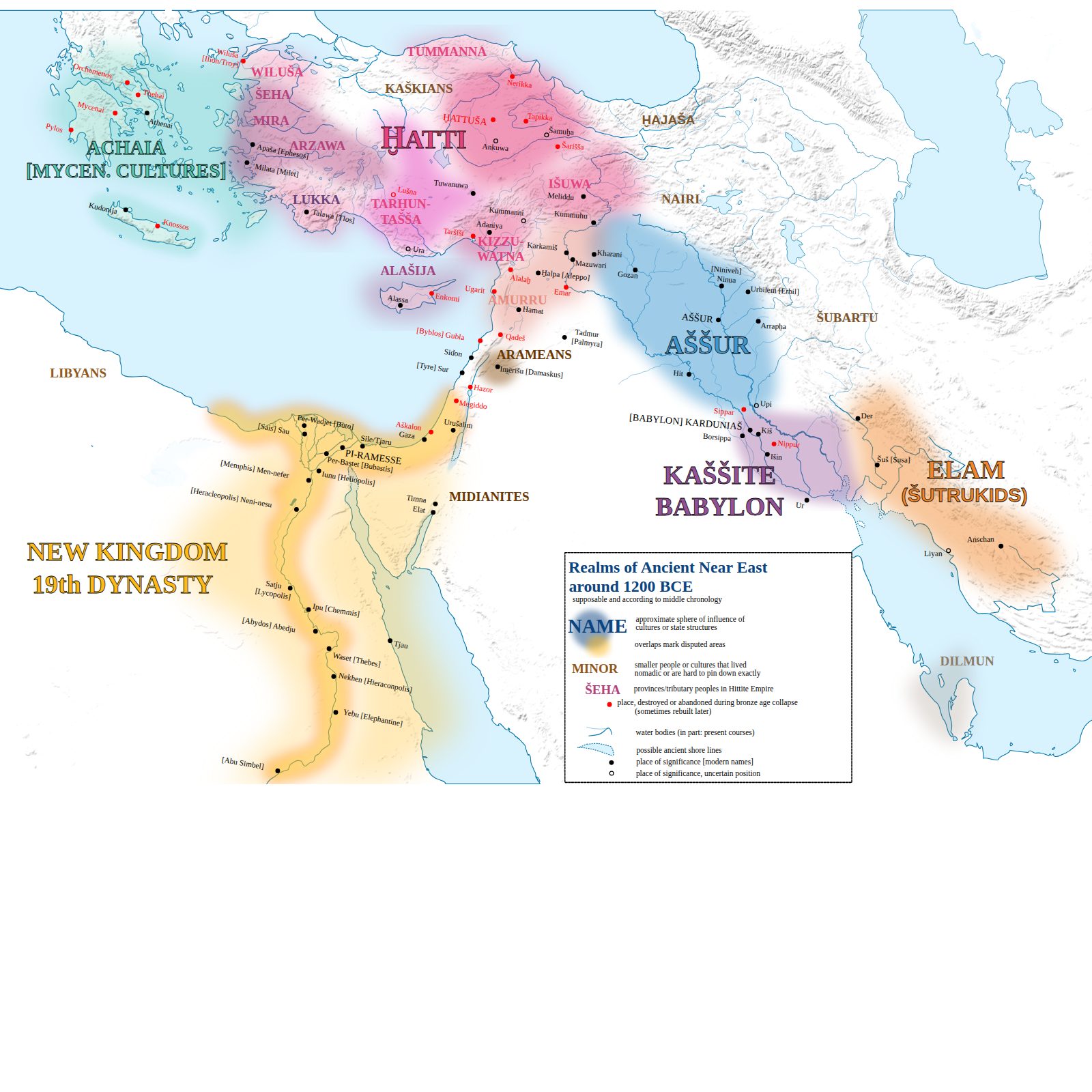
The city fell in 586 BCE. The Babylonians under Nebuchadnezzar broke through the walls of Jerusalem, burned the temple, and carried a large part of the population back to Babylon. The event is called the Babylonian exile, and it is one of the great breaks in the history of the people who had been called Israel. Everything that had been the organising reality of their life — the land, the temple, the monarchy, the sacrificial system — was gone. The people were in a place where those things did not exist, and they had to decide what their identity was when the things that had defined it were destroyed.
This is the moment when the Torah was assembled.
The argument of this chapter is that the final form of the five books of Moses — the Torah, the Pentateuch, the first five books of the Bible — was put together in Babylon, by editors and scribes who were working from sources that had been circulating for centuries, and who were assembling those sources into a single narrative for reasons that had everything to do with the catastrophe that had just happened. The book of Moses, in its final form, is a product of exile. The portrait of Moses, in its final form, is a portrait made by people who had lost the land and were trying to understand who they were without it.
The argument matters because it changes the question the whole book has been asking. If the Torah was assembled in exile, then the story of Moses is not primarily the story of a man who led a people out of Egypt. It is the story of a people who had been brought back to Babylon, looking at a story about a man who led a people out of Egypt, and finding in that story what they needed to survive their own exile. The portrait of Moses is, in this reading, a portable identity — a story a people can carry when they have lost everything else.
The city that was lost
The destruction of Jerusalem was a catastrophe of a kind that the Old Testament memory does not soften. The account in 2 Kings 25 and in Jeremiah and in the prophecies of the exile describes the siege, the famine, the breach of the walls, the flight of the king, the capture and execution of the royal family, the deportation of the skilled and the powerful to Babylon, the burning of the temple, the breaking up of the city walls. The temple — the house of God, the place where the presence of YHWH was supposed to dwell — was destroyed. The Babylonians took the vessels of the temple and carried them to Babylon. The Davidic monarchy, which was supposed to be the permanent dynasty, was ended. The land, which was supposed to be the inheritance, was occupied by foreigners.
The scale of the destruction is not in question. What is in question is the scale of the deportation and the question of who was actually in Babylon. The biblical account gives a large number of deportees — the skilled craftsmen, the warriors, the priests, the people of standing. The archaeological evidence, such as it is, does not contradict the broad picture but does not give a clear census either. The population of Judah before the destruction is estimated at somewhere between eighty and a hundred and twenty thousand. The number deported is unknown, but it was a significant portion of the population, and the elite were almost certainly among them.
The people who were in Babylon were not slaves in the Egyptian sense. They were exiles. They could own property. They could run businesses. They could, in some cases, do quite well. A generation later, one of their number — Daniel — would serve in the court of the Babylonian king. But they were not at home. They worshipped a God whose temple was in Jerusalem. They kept a calendar that assumed the land of Israel. Their identity was tied to a place they could not go. The question that faces them is: what are we, now that we are here?
The sources that were already there
The editors who assembled the Torah in Babylon did not write from scratch. They worked with sources that had already been circulating for a long time. The documentary hypothesis, the subject of chapter 24, identifies four main sources — J, E, D, and P — that were combined to form the Torah. The sources represented different traditions from different times and different groups. J, the Yahwist, wrote in Judah in the south, probably in the tenth or ninth century, and told the story in a vivid, earthy, anthropomorphic style, with God speaking directly and walking in the garden and closing the ark door. E, the Elohist, wrote in the northern kingdom, probably in the ninth century, and told the story in a more abstract style, with God speaking through dreams and angels. D, the Deuteronomist, wrote in the time of Josiah and after, in the late seventh century, and produced the book of Deuteronomy and the historical books that follow it. P, the Priestly source, wrote in a later phase, probably in the exile or after, and was concerned with the law, the calendar, the priesthood, the tabernacle, the order of worship.
By the time the editors were working in Babylon, all of these sources existed. The question was not which one to choose but how to put them together into a single book that would serve the community in exile. The answer was to combine them into a single narrative — the story of creation, the patriarchs, the Exodus, the wilderness, the law, the lands — that would give the community a story that began at the beginning of the world and ended with the people on the edge of the land, with the law in their hands and the promise in their ears, waiting for the moment when they would go in.
Why assemble it now
The reason for assembling the Torah in Babylon is the reason that matters. The community in exile had lost its land, its temple, its monarchy, and its system of worship. The old answers — the temple will be rebuilt, the Davidic king will return, the land will be restored — were not false, but they were not available. The people needed something they could carry. They needed a story that did not depend on the land, a law that did not depend on the temple, an identity that did not depend on the monarchy.
The Torah gave them that. The story of the Exodus was a story of liberation from Egypt, and Babylon was the new Egypt — the power that held them in captivity. The story of the wilderness was a story of a people who had lost the land and were making their way through it, relying on the law and the presence of God. The law — the commandments, the ordinances, the instructions for the camp, the purity laws, the calendar — gave them a structure for life that did not depend on the land or the temple. The tabernacle — the portable sanctuary — gave them a symbol of the presence of God that could be carried. The portrait of Moses — the man who had led them out, who had given them the law, who had died without entering the land — gave them a leader who understood what it meant to be on the edge of the promise and not to enter it.
The whole book was, in this reading, a portable theology. It gave the exiles a story that began at creation and ended on the edge of the land, with the law in their hands and the promise still ahead of them. The ending of the Torah — the death of Moses on Mount Nebo, with the land in sight but not entered — was not a failure of the story. It was the point of the story for the community in Babylon. The man who had led them to the edge and not entered was the man who understood what it was to have the promise and not the land. The portrait of Moses that had been built over centuries was now, in exile, complete.
What the exile did to the text
The exile did several things to the Torah, and the effects are visible in the final text.
The first is the emphasis on law. The Priestly source, which is associated with the later stages of the composition and probably reflects the concerns of the exilic and post-exilic community, is heavily legal. It contains the instructions for the tabernacle, the ordination of the priests, the purity laws, the calendar, the sacrifices. The law is not just a set of rules. It is the structure that makes life possible in a world without the temple and the land. The exiles needed to know how to live as the people of God in Babylon, and the law gave them a framework for that.
The second is the compilation of the sources. The editors who put the Torah together combined the sources in a way that preserved the different voices but made them into a single book. The result is the text we have now — a text that contains the different styles and the different perspectives of the sources, but that reads as a single narrative. The seams are there if you look for them, as chapter 24 explained, but the book is also readable as a single story. The compilers did their work well enough that the seams show only on close inspection.
The third is the shaping of the ending. The Torah ends with the death of Moses on Mount Nebo, with the land in sight but not entered. This ending was there in the sources that preceded it — Deuteronomy already had the death of Moses at the end — but the final assembly of the Torah made it the ending of the whole book, and that choice was significant. The book that begins with creation and ends with the people on the edge of the land, with the law in their hands and the promise ahead of them, is a book that tells the community where they are. They are between the promise and the land. They have the law. They have the story. They have not yet entered. The ending of the Torah is the ending that speaks to the community in exile.
The book that went with the exiles
The Torah that was assembled in Babylon went with the exiles. It was the book they carried. It was the book they read in the synagogues — the gatherings where they met to hear the law read and to pray — and it was the book that became the centre of Jewish life in the absence of the temple. The exile was the beginning of the synagogue, the beginning of the reading of the Torah as the centre of Jewish identity, the beginning of the portable community that would survive the return to the land and the destruction of the second temple and the long Diaspora that followed.
The tradition that grew up around the Torah in exile was the tradition of interpretation — the midrash, the commentary, the study — that would become one of the great achievements of Jewish civilisation. The exiles did not just carry the book. They read it, they studied it, they argued over it, they found in it the answers they needed for the situation they were in. The portrait of Moses that they found in the Torah was the portrait of a man who had led his people out of Egypt and through the wilderness and to the edge of the land, and who had died before he entered. The portrait was the portrait of a leader who understood what it was to be on the way and not at the destination. The exiles saw themselves in that portrait.
The turn in the argument
The argument of this book has been moving toward this chapter. The book has argued that the story of Moses is a story built over centuries, that the portrait of Moses is a portrait made by many hands, that the evidence for the historical Moses is thin and that the story is the thing that matters. The chapter has argued that the story of Moses was assembled into its final form in Babylon, by a community that had lost the land and needed a story that would carry them. The turn is this: the portrait of Moses that we have been following for twenty-five chapters is, in its final form, a portrait made by exiles.
The man who never saw the land is the man who was made by people who had lost the land. The portrait of Moses as the man who led his people to the edge and did not enter is the portrait of a man who understood what it was to be in exile. The story of Moses that the exiles carried with them was the story of a man who had been in exile — in Egypt, in Midian, in the wilderness — and who had led his people through it. The portrait of Moses that the exiles built was the portrait of a leader who could be carried into any land, because the story of his leadership did not depend on the land.
This is the turn that the whole book has been building toward. The portrait of Moses is not a portrait of a historical man. It is a portrait of a man who was made by the needs of a community in exile, and who was then used by that community and by every community that came after to answer the question of what it means to be a people without a land. The portrait is huge, and it is complicated, and it is made of many voices. But at its centre is the man who never saw the land, and the reason he never saw the land is that the people who made him needed a man who could stand at the edge and not enter, so that they could see themselves in him.
The Portrait They Built
This is the chapter that pulls the threads together. The book has spent twenty-six chapters following the story of Moses — the man as Israel told it, the world behind it, the making of it. The portrait that has emerged is not a single face but a composite, built by many hands over many centuries, and the book has been tracing the seams in that composite to see what it is made of. This chapter asks the question that the book has been circling all along: what is the core of the portrait, and what was added later, and how can we tell the difference?
The question is not whether Moses existed. The book argued in chapter three that the evidence for the historical Moses is thin and that the honest position is to hold the uncertainty without letting it dominate. The question is not whether the story is true. The book argued in the same chapter that a story does not have to be a documentary to be true about human beings, and that something happened — a small group of Semitic-speaking people got out of Egypt, or remembered getting out, and around that memory grew a portrait of a man so specific and unflattering that it is hard to believe someone made him up from nothing. The question of this chapter is: what is the portrait, and what can we say about the men and women who built it?
The portrait as it stands
The portrait of Moses that the reader has now met is large. It has the following features, and most of them do not belong to the same hand.
The stammering exile. Moses is the man who says: I am not a man of words. I am slow of speech and tongue. He is the man who argues with God at the bush and loses. He is the man who refuses five times before he accepts the call. He is the man who has a temper and no plan, who kills an overseer and runs to Midian. He is the man who spends forty years with no plan, tending sheep, hiding from the past.
The reluctant leader. Moses is not the man who wants to lead. He is the man who is made to lead. He objects. He argues. He tries to get out of the call. God does not accept his refusals. The story is the story of a man who is pushed into a role he does not want and does not feel he can fill.
The man who speaks for God. Moses is the man who speaks with God face to face, the man who hears the voice and carries the words. He is the man who goes up the mountain and comes down with the tablets. He is the man who intercedes for the people when they sin, who stands between them and God when the people have broken the covenant.
The man who breaks. Moses breaks the tablets when he sees the golden calf. He strikes the rock when the people are thirsty. He loses his temper. He is not the flawless leader. He is the leader who fails, and the tradition records the failure and attaches the punishment to it.
The man who does not enter. Moses climbs Mount Nebo and looks out over the land. He sees it. He does not enter it. He dies on the mountain. The book ends with the tomb that does not exist — nobody knows where he is buried. The founder of the Exodus dies alone, on the mountain, in sight of the land he never enters.
This is the portrait. It is unflattering in the specific ways that the book has been tracing: the stammer, the temper, the refusal, the failure at the rock, the death in sight of the land. It is also magnificent: the voice of God, the argument at the bush, the breaking of the sea, the law, the intercession. The portrait is not a flatterer. It is a portrait that shows the man in full, with the greatness and the flaw together.
The hands that built it
The portrait was built by many hands. The book has traced the sources — J, E, D, P — and the different voices they brought. J is the voice that gives us the vivid, earthy Moses: God walking in the garden, God closing the ark door, God speaking directly and the man hearing the voice. J is the voice that is closest to the human Moses, the man of the argument and the refusal. E is the voice that is more abstract: God speaking through dreams and angels, the man who hears the voice but does not see the face. D is the voice of Deuteronomy: the preacher of the law, the man who speaks from the mountain to a new generation, the voice that sums up the story and urges the people to choose life. P is the voice of the law and the tabernacle: the man who supervises the worship, who carries out the instructions, who keeps the order.
The portrait was built by putting these voices together, and the result is the composite the reader has been following. The different voices do not always agree. J's God is anthropomorphic. P's God is distant and the instruction is precise. D's Moses is the preacher and the lawgiver. The four voices are not the same man. But they have been combined into a single portrait, and the result is the portrait of Moses as the man who was magnificent and flawed, who led his people out of Egypt and through the wilderness and to the edge of the land, and who died before he entered.
What each generation added
The generations that built the portrait added different things, and it is possible to see what they added by looking at the seams.
The oldest layer is probably the Song of the Sea, Exodus 15, which is one of the oldest texts in the Hebrew Bible. The song is a victory song. It is brassy, triumphant, brief. It does not tell the story of Moses in the detail that comes later. It says: Song for the horse and the rider, for Yahweh has triumphed gloriously. It does not dwell on the man. It dwells on the act. This is the oldest layer of the portrait, and it is the layer closest to the memory of the event — whatever the event was.
The next layer is the narrative in Exodus and the rest of the Torah. The story of the basket, the murder, the Midian, the bush, the plagues, the sea, the law, the calf, the wilderness, the rock, the death. This is the story that was built around the oldest song, and it is the story that gives Moses the portrait. The story is the achievement of the generations that followed, and it is the story that turned the event into the man.
The Deuteronomistic layer, D, added the preaching, the law, the emphasis on the covenant and the warning. D made Moses the lawgiver who speaks from the mountain and sums up the story for a new generation. D is the voice of Josiah's reform and the book that was found in the temple, and D put the portrait of Moses to political use for the first time.
The Priestly layer, P, added the law, the tabernacle, the order of worship, the calendar. P made Moses the supervisor of the worship, the man who carries out the instructions precisely. P is the voice of the exile and the portable community, and P gave the community a structure for life without the temple and the land.
The final assembly, in Babylon, put the layers together and made the ending of the Torah — the death of Moses on the mountain, with the land in sight but not entered — the ending of the whole book. The ending was already in the sources, but the final editors made it the ending of the composite, and that choice gave the portrait its final form: the man who led his people to the edge and did not enter.
The core that might be memory
The book has argued that the core of the portrait might be memory. The argument is not that we know who Moses was. The argument is that if there was a Moses — if there was a man who led a small group out of Egypt, or if there was a memory of such a man — then the portrait preserves something of that man in the specific, unflattering details that are hard to invent.
The stammer is hard to invent. A founder of a religion is supposed to be the man who speaks with authority. The tradition keeps the stammer, and it keeps it as a feature of the man that God works with, not around. The refusal is hard to invent. A leader is supposed to step forward. The tradition keeps the refusal, the five objections, the argument at the bush. The temper is hard to invent. A hero is supposed to be in control. The tradition keeps the murder, the breaking of the tablets, the striking of the rock. The failure is hard to invent. A founder is supposed to succeed. The tradition keeps the failure at Meribah, the punishment, the exclusion from the land. The death in sight of the land is hard to invent. A founder is supposed to reach the goal. The tradition keeps the ending — the man who sees the land and dies on the mountain, with nobody knowing where he is buried.
These are the features of the portrait that look like residue. They are the features that do not fit the pattern of a made-up hero, and they are the features that the tradition kept, generation after generation, even when it might have been easier to smooth them over. The portrait of Moses is a portrait with these features in it, and the argument is that the features are there because they are remembered — because something happened, or because a memory of something happened was so specific that the generations that built the portrait could not get rid of it.
The argument is not that the portrait is a photograph of the historical Moses. The argument is that the portrait is a portrait built by many hands, and that the hands did not smooth out the specific, unflattering details. The portrait has the stammer and the refusal and the temper and the failure and the ending. These are the things that look like memory, and they are the things that the book has been tracing through the chapters.
The portrait after the Torah
The portrait of Moses did not stop being built when the Torah was finished. The portrait continued to be built by every generation that read the book and found in it what it needed.
The rabbis added the portrait of the teacher, the man who spoke with God face to face, the man who received the law and transmitted it. The rabbis read the Torah and found the portrait of Moses as the greatest of the prophets, the man who spoke with God, the man who carried the words. The rabbis added the midrash — the interpretation, the elaboration, the story that grew around the text — and they built on the portrait in the Torah with their own hands.
Philo added the portrait of the philosopher. Philo read Moses as the man who ascended to the divine, who understood the logos, who was the philosopher-king of the biblical story. Philo's Moses is the Moses of the Greek intellectual tradition, the man who knew the truth and lived by it.
Jesus read Moses as the lawgiver, the man who received the law and delivered it, and Jesus positioned himself in relation to that portrait — as the man who came not to abolish the law but to fulfil it. The portrait of Moses in the New Testament is the portrait of the lawgiver who stands ahead of Jesus, and Jesus reads the story of Moses in his own terms.
Muhammad read Moses as the prophet, the man who received the word from God and delivered it to the people. The Qur'an mentions Moses more than any other prophet. The portrait of Moses in the Qur'an is the portrait of the prophet who stood against the pharaoh, who received the law, who led his people. Muhammad placed himself in the line of Moses, and the portrait of Moses in the Islamic tradition is the portrait of the prophet who came before.
Freud added the portrait of the Egyptian. Freud's Moses and Monotheism argued that Moses was an Egyptian, that he brought the monotheistic religion of Akhenaten to the people, and that he was killed by the people he led. Freud's portrait is a hypothesis, and it is reception history, not evidence. But it is part of the portrait as it was built by later generations, and it shows what happens when a great mind tries to solve the Moses problem.
Each generation added to the portrait. Each generation found in the story of Moses what it needed, and the portrait grew. The portrait that the reader meets in this book is the portrait as it has been built by all these hands — the hands of the biblical editors, the rabbis, Philo, Jesus, Muhammad, Freud, and the many others who have read the story and found in it what they needed.
The portrait and the question
The portrait of Moses is the answer to the question the book has been asking all along: where does a man like this come from, and why has a story about a stammering exile who died in sight of a land he never entered outlasted every empire that ever tried to bury it?
The answer is that the portrait was built by many hands, over many centuries, and that the hands built a portrait that was too specific to be invented and too useful to be lost. The portrait of Moses is the portrait of a man who understood what it was to be on the edge of the promise and not to enter it, and that portrait was useful to every generation that found itself on the edge of something. The exiles in Babylon found themselves in the man who never saw the land. The rabbis found in the man the teacher who carried the words. The liberation movements found in the man the leader who brought his people out of bondage. The religious readers found in the man the prophet who spoke with God.
The portrait is huge, and it is made of many voices, and it is not a flatterer. It is the portrait of a man who was magnificent and flawed, and the flaw is part of the portrait, and the flaw is the thing that keeps the portrait from being a flatterer. The portrait of Moses is the portrait that can be carried into any land, because the story of the man does not depend on the land. The man never saw the land. That is the point, and it is the point that every generation that read the story has found in it.