Appendices
Timeline
c. 570 CE — Birth of Muhammad ibn Abdullah in Mecca. Traditional birth year is the "Year of the Elephant," associated with the story of Abraha's invasion of the Hejaz. The traditional date is 570.
570–c. 576 — Early childhood. According to tradition, Muhammad is sent as an infant to be nursed by Halima bint Abi Umayya of the Banu Sa'd, a Bedouin tribe, in the desert. He spends his early years with Halima's family.
c. 576 — Return to Mecca. Muhammad is brought back to his mother Amina. The tradition says Amina died when Muhammad was about six years old, on the journey to Medina for her burial.
576–c. 580 — Life with grandfather Abd al-Muttalib. After his mother's death, Muhammad goes to live with his grandfather, the head of the Banu Hashim and the custodian of the Zamzam well.
c. 580 — Death of Abd al-Muttalib. Muhammad's grandfather dies when Muhammad is about eight (the tradition gives the age as eight). Muhammad's uncle Abu Talib becomes his protector.
580–c. 590 — Life in Abu Talib's household. Muhammad grows up in Mecca, traveling with caravans to Syria and Yemen. He earns the reputation for trustworthiness that gives him the nicknames al-Amin ("the trustworthy") and al-Sadiq ("the truthful").
c. 590–595 — Work with Khadija. Muhammad works for Khadija bint Khuwaylid, a wealthy widow of the Quraysh. He leads one of her caravans to Syria.
595 — Marriage to Khadija. Khadija proposes marriage. Muhammad, about 25, marries Khadija, about 40. The marriage lasts 25 years and is monogamous for all but the last few years of Muhammad's life. The couple has children: Qasim and Abdullah (who die in infancy), and Fatima (who survives into the Medinan period).
595–610 — The Meccan period before revelation. Muhammad lives as a merchant and husband in Mecca, known for his trustworthiness. He participates in the reconstruction of the Kaaba and resolves the dispute over the Black Stone by inviting each clan to lift the stone together on a cloak.
610 — The first revelation. Muhammad retreats to the cave of Hira on Mount Nur outside Mecca for meditation, as was his custom during Ramadan. According to tradition, the angel Gabriel appears to him and commands him to "Read" (or "Recite"). Muhammad returns to Khadija in terror, believing he has been possessed. Khadija takes him to her cousin Waraqa ibn Nawfal, a Christian who recognizes the experience as a divine communication. Khadija becomes the first believer.
610–613 — The silence. After the first revelation, there is a gap during which no new revelation comes. The traditions vary on the exact length — months to a year or more — but the effect is consistent: Muhammad waits, uncertain whether the communication will continue. The Qur'an preserves traces of this period in the early Meccan suras, which speak to a man under pressure, called to be steadfast.
613 — The resumption of revelation and public preaching begins. The second revelation comes, traditionally remembered as the command to "arise and warn." Muhammad begins to preach his message publicly: the oneness of God, the rejection of idols, the warning of a coming judgment, the concern for the orphan and the vulnerable, the burial of infant girls condemned.
613–615 — The early opposition. Muhammad's message begins to draw opposition from the Meccan elite. The Quraysh mock him, call him a poet, a magician, a possessed man, a fabricator. The early believers include Khadija, Ali (his cousin), Abu Bakr, Zayd ibn Haritha (a freed slave), and Bilal ibn Rabah (an Abyssinian slave). Bilal is famously tortured on hot ground for refusing to renounce Islam; his only response is to repeat "One God, One God" — Ahad, ahad.
615 — The emigration to Abyssinia. A group of Muslims, including some of the first believers, flee Mecca for Abyssinia (the Christian kingdom of Axum, modern Ethiopia and Eritrea) seeking protection from the persecution. They cross the Red Sea in small boats. The Negus, the Christian ruler of Abyssinia, gives them protection after hearing Ja'far ibn Abi Talib recite from the Qur'an — specifically from Sura Maryam, the chapter about Mary and the birth of Jesus.
615–616 — A second wave of emigration to Abyssinia. A larger group of Muslims follow, including more of the early believers. The Meccan elite send an envoy to demand the Muslims be returned, but the Negus refuses after hearing Ja'far's recitation. The Muslims remain in Abyssinia under the Negus's protection.
616–619 — The boycott. The Meccan elite impose a boycott on the Banu Hashim and the Banu Muttalib (Muhammad's clan and his uncle's clan). The clans are cut off from trade, marriage, and contact. The boycott lasts for three years. The Banu Hashim and the Banu Muttalib live in a sealed area outside Mecca, surviving on what they have and on the help of a few sympathizers who break the boycott at great risk. The hardship is severe; the boycott is remembered as one of the most harrowing periods of Muhammad's early life. The boycott fails to break Muhammad's clan.
619 — The Year of Sorrow. Khadija dies. Abu Talib dies. Muhammad loses his wife and his protector in the same year. The year is called the "Year of Sorrow" in the tradition. Muhammad is left without his wife, his protector, and the practical support of the early community. The Meccan opposition, sensing his vulnerability, prepares to escalate.
619–620 — The period after the Year of Sorrow. Muhammad continues to preach in Mecca, but the opposition intensifies. The Meccan elite, having failed to crush the Muslims by boycott, prepare an assassination plot.
620 — The Night Journey and the Ascension (Isra and Mi'raj). Muhammad is taken by night from Mecca to Jerusalem (the Isra), and then ascends through the heavens (the Mi'raj). In the tradition's memory, he meets the prophets of old in Jerusalem, ascends through the heavens, and is given the commandment of the five daily prayers. The event is remembered as a comfort and confirmation at the lowest point of his life. The Qur'an mentions the night journey in a single verse, but the details come from the later tradition.
621 — The first pledge of Aqaba. A group of men from Yathrib (later Medina) meet Muhammad at the pilgrimage season and pledge to follow him if he comes to their town. This is the beginning of the negotiations that will lead to the hijra.
622 — The second pledge of Aqaba. A larger group from Yathrib pledges to protect Muhammad as they would their own families. The negotiations for the migration are finalized. The Muslims in Mecca begin to leave for Yathrib in small numbers.
622 (September) — The hijra. Muhammad and Abu Bakr flee Mecca by night, pursued by the Quraysh who intend to kill Muhammad. They take refuge in the cave of Thawr outside Mecca for three days. Ali Ibn Abi Talib sleeps in Muhammad's bed as a decoy. Muhammad and Abu Bakr make their way to Medina, arriving in Quba on the outskirts. The migration marks the beginning of the Islamic calendar (year 1 AH).
622 (September–October) — Arrival in Medina. Muhammad enters Medina (then called Yathrib). He is welcomed by the Ansar ("helpers"), the Medinan Arabs who receive the Muslims and support them. The Muhajirun ("emigrants") from Mecca and the Ansar form the early Muslim community in Medina.
622–624 — Establishment of the Muslim community in Medina. Muhammad establishes the Muslim community as a political entity. The Constitution of Medina is established, creating a single political community (the umma) that includes Muslims, the Meccan emigrants, the Medinan helpers, and the Jewish tribes, with Muhammad as the final arbiter. The Muslims begin to organize their lives, establish the prayer times, set up the collection of zakat (alms), and organize the defense of the settlement.
624 (March) — The Battle of Badr. The first major battle of the Muslim community. Muhammad and the Muslims intercept a Meccan caravan returning from Syria, but the caravan escapes. A Meccan force comes to defend the caravan and then confronts the Muslims at Badr, a place between Mecca and Medina. The Muslims are heavily outnumbered (traditionally about 300 Muslims against 1,000 Meccans) but victorious. The victory is the first major military success of the Muslim community and transforms the community's understanding of itself. Several Meccan leaders are killed in the battle, including Abu Jahl.
624–625 — Aftermath of Badr. The Muslims take prisoners and divide the spoils. The treatment of prisoners becomes an episode in the early story — some are released for ransom, some for nothing, some on the condition that they teach Muslims to read and write. The Meccan elite are determined to recover from the defeat.
625 (March) — The Battle of Uhud. The second major battle. The Meccan force under Abu Sufyan attacks the Muslims at Mount Uhud, north of Medina. The Muslims are defeated after some of their fighters disobey Muhammad's orders and leave their position to pursue the Meccan army, exposing the Muslim lines. The Meccans inflict serious losses. Muhammad is wounded. A rumor spreads that he has been killed, and the rumor is disproved when he is found alive afterward. The defeat is serious but not catastrophic. The Qur'an's response to Uhud is one of the most direct pieces of evidence for the way the early community processed a military defeat — somber, instructional, honest.
625–626 — Aftermath of Uhud. The Muslims' morale is shaken but not destroyed. Muhammad continues to lead the community. The Qur'an addresses the defeat as a lesson in discipline and steadfastness. The Muslims remain in Medina.
626–627 — The Battle of the Trench (also called the Battle of the Confederates). A large confederate force of Meccans and their allies assembles against Medina itself. The Muslims, under Muhammad's direction, dig a trench around the exposed side of Medina to defend the town. The confederate army surrounds Medina and the siege lasts for several weeks. The Muslims hold out under severe strain. The confederate force does not remain united; internal tensions, the weather, and the failure of the siege to break lead to the collapse of the confederacy. The siege ends with the confederates withdrawing, and the Muslims' survival is secured. The battle is a test of endurance that the Muslims pass.
627 — Aftermath of the Trench. The immediate consequence of the siege is the judgment on the Banu Qurayza, the third Jewish tribe of Medina. According to the traditional account, the Qurayza had broken their treaty with the Muslims and sided with the confederate army during the siege. After the siege failed, the Muslims besiege the Qurayza, who surrender. An arbitrator, Sa'd ibn Mu'adh (a chief of the Aws, one of the Medinan tribes), is chosen to judge them, and his judgment is that the men of the Qurayza who have reached puberty should be killed, and the women and children taken captive. The traditional account records the execution of the men. The numbers are disputed, but the account states that a significant number of the Qurayza men were killed, and the women and children were taken captive. This is the most serious and the most controversial of the episodes with the Jewish tribes.
627–628 — Expulsion of the Banu Nadir. The second Jewish tribe of Medina, the Banu Nadir, comes into conflict with the Muslims after a dispute. According to the traditional account, a Muslim is killed by members of the Nadir, or the Nadir are involved in a plot against Muhammad. Muhammad summons the Nadir to answer for it, and they refuse to accept the arbitration. The Muslims besiege them, and they surrender on terms that allow them to leave with their possessions except for their weapons and land. The Nadir leave Medina for Khaybar and other places, and their land and property become part of the Muslim community.
628 (March) — The Treaty of Hudaybiyya. Muhammad and a company of Muslims set out from Medina for a minor pilgrimage to Mecca (the umrah). The Meccan elite block the road and prevent the Muslims from entering the town. A standoff ensues at Hudaybiyya, a place on the coast between Medina and Mecca. The Muslims negotiate with the Quraysh, and a treaty is signed. The terms include a ten-year truce, the return of any Muslim who goes from Mecca to Medina without the permission of his guardian, and the withdrawal of the Muslims from Mecca for the year, with the agreement that they will be allowed to perform the pilgrimage the following year. The treaty is deeply unpopular with the Muslims at the time — they think it is a humiliation — but the Qur'an later calls it a clear victory. The treaty is the turning point that makes the conquest of Mecca possible.
628–629 — Aftermath of the treaty. The truce holds. The Muslims use the breathing space to spread their message, make alliances with tribes that had previously been in the Meccan orbit, and build up their strength. The Meccan elite watch the Muslims grow, and the truce ends with the Muslims' return to Mecca in force.
630 — Conquest of Mecca. The Meccan elite break the treaty — a tribe allied to the Quraysh attacks a tribe allied to the Muslims, and the Quraysh's failure to restrain their allies makes the treaty void. Muhammad declares the treaty at an end and marches on Mecca with a large force (traditionally said to be about 10,000). The Muslims enter Mecca without a major fight. The Quraysh's power is broken, the sanctuary is taken, and the idols in the Kaaba are removed. Muhammad declares a general amnesty — the Meccans are forgiven, the town is spared, the Meccans are not massacred. The amnesty is one of the most extraordinary decisions of Muhammad's political life.
630 — Aftermath of the conquest. Muhammad reorganizes the sanctuary, establishes the Muslims' presence in Mecca, and deals with the remaining opposition. The expedition to Hunayn follows, and the siege of Ta'if. The conquest of Mecca is the end of the Meccan opposition.
630 — The expedition to Hunayn. A battle is fought at Hunayn, in which the Muslims defeat a force of the Hawazin and Thaqif tribes. The Muslims take captives and booty. The battle is a victory, but the Muslims face the aftermath of the conquest and the integration of the new territories.
630–631 — The siege of Ta'if. After the conquest of Mecca, Muhammad besieges Ta'if, a town that had rejected him earlier. The siege does not end in a major battle; the town eventually submits.
631 — The delegations from the Arabian tribes. In the last year of Muhammad's life, delegations of Arabs from the peninsula come to Medina to make their peace with Muhammad, to accept Islam, or to agree to treaties. The delegations are the sign that the Muslims' power has spread, and that the Arabian interior is coming into the Muslim orbit. The tribal delegations are the work of the man who has, in twenty-two years, gone from a persecuted preacher in Mecca to the head of a community that is receiving the representatives of the Arabian tribes.
632 (February–March) — The farewell pilgrimage. Muhammad performs the pilgrimage to Mecca in the company of his community. He delivers the farewell sermon at Mount Arafat. The sermon covers several themes: the end of the old tribal feuds, the equality of all Muslims before God, the rights of the orphan, the wife, the slave, and the poor, the sanctity of the Muslim's life, property, and honor, the prohibition of usury, and the responsibility of the believers for one another. The sermon is the crystallization of Muhammad's teaching at the end of his life. The pilgrimage and the sermon are the last time Muhammad performs the pilgrimage in person.
632 (June) — The illness and death of Muhammad. Muhammad becomes ill in the latter part of the year. He grows weaker, continues to lead the prayers as long as he can, and eventually dies in Medina. He dies on a Monday in the month of June 632, in the room of his wife Aisha, the daughter of Abu Bakr. The death comes after the farewell pilgrimage and the tribal delegations and the work of the final phase of his life. He is tired, ill, and weak for days. The tradition remembers the scene of his death — the moments in Aisha's room, the way he leaned on her, the way the community gathered outside and waited, and the way the news came out.
632 (June) — The denial and Abu Bakr's speech. When Muhammad dies, the Muslims outside his house find that the news is not immediately believed. Some of the Muslims think that he is not really dead, or that he will come back, or that the death is a misunderstanding. The denial is not just grief. It is a measure of the place Muhammad had in the life of the community. Abu Bakr, the first caliph, goes to the house, sees Muhammad, confirms the death, and comes out to address the crowd. He quotes the Qur'an: "Muhammad is only a messenger, and messengers have passed before him. If he dies or is killed, will you turn back on your heels?" The speech is the moment when the denial ends and the reality of the death takes hold.
632 (June) — The burial. Muhammad's body is prepared, washed, and shrouded. He is buried in the room of Aisha, in the place where he died. The burial place becomes a site of memory, and later a mosque, and a place of pilgrimage.
632–634 — The caliphate of Abu Bakr. Abu Bakr succeeds Muhammad as the first caliph. He faces the immediate problem of the tribal rebellions — the tribes that had accepted Islam or treaties under Muhammad now rebel, or refuse to pay the zakat, or claim that their loyalty was to Muhammad personally and not to the Muslim community. Abu Bakr suppresses the rebellions, and the Muslim community is held together. The Qur'an is collected in written form under Abu Bakr's caliphate, according to the traditional account.
634 — Death of Abu Bakr. Abu Bakr dies after two years as caliph. He is succeeded by Umar ibn al-Khattab.
634–644 — The caliphate of Umar. Umar expands the Muslim community into the former Byzantine and Sasanian territories. Syria and Palestine fall to the Muslims. Egypt falls. The Sasanian empire is conquered. The Muslim community becomes an imperial power. Umar establishes many of the institutions of the early Islamic state.
644 — Death of Umar. Umar is assassinated. He is succeeded by Uthman ibn Affan.
644–656 — The caliphate of Uthman. Uthman continues the expansion. The Muslim community grows. Uthman organizes the navy, and the Muslim fleet operates in the Mediterranean. The Qur'an is compiled in a standardized form under Uthman's caliphate, according to the traditional account. Uthman is assassinated in 656.
656–661 — The caliphate of Ali. Ali succeeds Uthman as the fourth caliph. His caliphate is marked by the first Islamic civil war (the fitna), between Ali and the forces of Muawiyya, the governor of Syria, and by the conflict with the Kharijites. Ali is assassinated in 661 by a Kharijite.
661–685 — The caliphate of the Umayyads. Muawiyya establishes the Umayyad caliphate, the first hereditary Islamic dynasty. The capital is Damascus. The Umayyad caliphate expands the Muslim empire further.
685–750 — The later Umayyad caliphate. The Umayyad caliphate continues to expand and consolidate. The caliphate reaches its greatest extent under the Umayyads.
750 — The Abbasid revolution. The Abbasids overthrow the Umayyads. The capital is moved to Baghdad. The Abbasid caliphate begins.
This timeline is a guide to the main events in the life of Muhammad and the early Islamic period. It is not a complete chronology, and it does not include all the events and details that are recorded in the sources. It is intended as a reference for the reader who wants to situate the events of the book in time.
Glossary
Arabic and technical terms used in this book, glossed once in plain English.
Glossary (built so far)
Qur'an — The sacred text of Islam, regarded by Muslims as the word of God revealed to Muhammad. It is the earliest and most secure contemporary source for his life — not a biography, but it speaks from inside the events of his lifetime.
Sura — A chapter of the Qur'an. The suras are arranged roughly by length, not chronologically; the earliest Meccan revelations tend to be shorter and clustered at the end of the standard text.
Meccan — Of or relating to the revelations and period before the hijra, when Muhammad and his followers were still in Mecca. Meccan suras are generally shorter, more focused on judgment, the vulnerable, and the afterlife.
Medinan — Of or relating to the period after the hijra, when Muhammad and his followers had moved to Medina. Medinan suras tend to be longer and more concerned with law, community organization, and the conduct of a state.
Sira — A prophetic biography — the life of Muhammad told as a continuous narrative. The earliest surviving sira was written by Ibn Ishaq (d. 767), more than a century after Muhammad's death, and is preserved mainly through Ibn Hisham's later edition.
Hadith — Reports of what Muhammad said or did, transmitted as discrete units with chains of transmission (isnad) tracing them back through narrators. The major collections of Bukhari and Muslim were compiled in the ninth century.
Isnad — The chain of transmission in a hadith report, listing the line of narrators from the present back to someone who may have heard the report from a participant. Scholars used the isnad as a tool for assessing reliability.
Al-Tabari — Muhammad ibn Jarir al-Tabari, early tenth-century historian whose History of the Prophets and Kings preserves substantial material from Ibn Ishaq, including episodes Ibn Hisham omitted.
Ibn Ishaq — Ibn Ishaq (c. 699–767), an eighth-century scholar of Medina and Baghdad who collected oral traditions about Muhammad's life into the earliest surviving sira. His original text does not survive intact.
Ibn Hisham — Ibn Hisham (d. 833), who edited and abridged Ibn Ishaq's sira. His version is the main surviving form, but he omitted material — some of it controversial — and added his own comments.
Bukhari — Muhammad ibn Ismail al-Bukhari (810–870), compiler of one of the six canonical hadith collections, known for applying rigorous critical method to the chains of transmission.
Muslim — Muslim ibn al-Hajjaj (821–875), compiler of the second of the six canonical hadith collections, also known for careful scrutiny of narrators and chains.
Doctrina Iacobi — A Greek Christian text, probably from around 634, that mentions a prophet named Muhammad among the Saracens — one of the earliest non-Muslim references to him.
Thomas the Presbyter — A Syriac document attributed to Thomas the Presbyter, dated to around 640, recording a battle between the Romans and "the Arabs of Muhammad" in Palestine — an early outside witness.
Sebeos — An Armenian chronicler writing in the 660s whose History gives a more detailed account of Muhammad, his followers' emigration, and the military campaigns — the most substantial of the early outside witnesses.
Hagarism — Patricia Crone and Michael Cook, Hagarism: The Making of the Islamic World (1977), a revisionist argument about the earliest evidence for Islam. Mostly not sustained, but the questions they raised must still be engaged.
Meccan Trade — Patricia Crone, Meccan Trade and the Rise of Islam (1987), a revisionist challenge to the traditional picture of Mecca's economy. Mostly not sustained, but still must be engaged.
Muhammad and the Empires of Faith — Sean Anthony, the current state of the art on what the earliest evidence can and cannot support. To be read before writing.
Muhammad at Mecca / Muhammad at Medina — W. Montgomery Watt, still the spine of the Western scholarly account, though dated in places.
Muhammad: His Life Based on the Earliest Sources — Martin Lings, the traditional account, beautifully written, uncritical by design. Read for texture; check facts against Watt or Anthony.
Muhammad and the Believers — Fred Donner, the early community as an ecumenical monotheist movement. Reshapes how Part Five is written.
Seeing Islam as Others Saw It — Robert Hoyland, the outside witnesses, including the Doctrina Iacobi, Thomas the Presbyter, and Sebeos.
Images of Muhammad — Tarif Khalidi, the reception history of Muhammad's image in later tradition.
The Lives of Muhammad — Kecia Ali, what every previous biographer did with the same material and why. Read early.
Muhammad: A Prophet for Our Time — Karen Armstrong, sympathetic and accessible; a model for tone, if not always for rigour.
Hadith — Jonathan A. C. Brown, the best explanation of how the Islamic tradition assessed its own sources.
Muhammad: A Very Short Introduction — Jonathan A. C. Brown, accessible overview from a scholar of hadith.
The Prophet and the Age of the Caliphates — Hugh Kennedy, the wider context of the early Islamic period.
The Venture of Islam, vol. 1 — Marshall Hodgson, depth and context for the wider Islamic story.
The Life of Muhammad (Sirat Rasul Allah) — Ibn Ishaq, trans. A. Guillaume, the earliest sira in English. Read cover to cover.
Part One glossary additions
Kaaba — The cube-shaped stone building at the center of Mecca's sacred precinct, toward which Muslims pray. Before Islam it housed a large number of idols representing the gods of the Meccan and surrounding tribes; it was also a pre-Islamic pilgrimage site and a sacrosanct neutral zone.
Zamzam — The well in Mecca's sacred precinct, traditionally associated with the story of Hagar and Ishmael and revered as a source of water in an otherwise arid valley. Its water was a practical and symbolic resource for pilgrims.
Haram — The sacred precinct around the Kaaba in Mecca, in which violence was traditionally forbidden. The haram made Mecca a place of truce and pilgrimage, and it functioned as one of the main economic reasons the city existed at all.
Quraysh — The dominant tribe of Mecca in the sixth and early seventh centuries, to which Muhammad belonged through his grandfather Abd al-Muttalib. The Quraysh controlled the Kaaba and the pilgrimage trade, and they were the main opponents of Muhammad in the Meccan period.
Bahira — A Christian monk or hermit, according to later tradition, who is said to have recognized a young Muhammad on a Syrian caravan journey as a future prophet. The story is part of the later tradition, not contemporary evidence, and is best treated as a tradition about how the community remembered his early years rather than as a historical fact.
Hanifs — In pre-Islamic Arabian usage, people who sought the original monotheism of Abraham and rejected the polytheism around them. The Qur'an uses the word positively as a description of those who turned away from idol worship. The number of actual hanifs before Muhammad was small, but they are a useful sign that monotheizing ideas were already present in Arabia before Islam.
Uhud — A mountain north of Medina, site of a major battle in 625 in which the Muslims were defeated after some of their fighters disobeyed Muhammad's orders. Uhud was a serious blow but not a catastrophe, and it had lasting consequences for how the early community understood itself.
Jahiliyyah — The Islamic term for the pre-Islamic period, often translated as the "Age of Ignorance." In the traditional Islamic narrative, it described a time of paganism, injustice, and moral disorder, set against the light that came with Islam. Historians today do not use the term as a neutral description of pre-Islamic Arabia, because it is a theological judgment, not a historical category. The habit of treating pre-Islamic Arabia as simply violent and ignorant is one of the things this book tries to avoid.
Part Two glossary additions
Abu Talib — Muhammad's uncle, a son of Abd al-Muttalib, who protected Muhammad after the death of Abd al-Muttalib and throughout the Meccan period, and who died in the Year of Sorrow. He protected Muhammad without, on the best reading of the evidence, becoming a Muslim.
Banu Hashim — The clan of the Quraysh to which Muhammad belonged through his grandfather. The Banu Hashim was a respected but not wealthy clan, and was the clan that protected Muhammad during the Meccan period.
Al-Amin — "The trustworthy," the nickname given to Muhammad in Mecca before his prophethood, reflecting his reputation for honesty and truthfulness. The reputation was a social fact in Mecca, and it is one of the reasons the town trusted him before the revelation and the reason the opposition had to contend with his standing.
Al-Sadiq — "The truthful," the other nickname of Muhammad before his prophethood, reflecting the consistency of his word with his action.
Halima — The wet-nurse of Muhammad in his early childhood, a woman of the Banu Sa'd, under whose care Muhammad spent his early years in the desert. The story of Halima is one of the most memorable early episodes, and it reflects the custom of sending children to the desert to be nursed.
Banu Sa'd — A Bedouin tribe of the Hawazin, among whom Muhammad was nursed in his early childhood. The desert environment of the Banu Sa'd gave Muhammad the early Arabic that would later appear in the Qur'an.
Waraqa ibn Nawfal — A cousin of Khadija, a Christian who knew Hebrew and had some knowledge of the scriptures, who heard Muhammad's account of the first revelation and told him that it was of the same kind as the great divine communications of the prophetic tradition. Waraqa was the first external validation of Muhammad's experience in the tradition's own terms.
Bahira — The Christian monk who, according to tradition, recognized young Muhammad on a Syrian caravan journey. The story is part of the later memory, not contemporary evidence.
Year of the Elephant — The traditional name for the year of Muhammad's birth, derived from the story of Abraha's invasion of the Hejaz and the miraculous repulse by "the birds of Ababil." The year is traditionally given as 570, and the story is a legend around a real event.
Amina — Muhammad's mother, of the Banu Zuhra, a clan of the Quraysh. She died when Muhammad was about six, on the journey to Medina for her burial, and her death was the first of the losses that made Muhammad an orphan.
Qasim and Abdullah — The two sons of Muhammad and Khadija, named in the tradition, who died in infancy. The deaths are remembered as losses, and the names are the elements of the memory that survive.
Fatima — The daughter of Muhammad and Khadija, who survived into the Medinan period and became the ancestor of the line that carried the family forward, and who married Ali, Muhammad's cousin and son-in-law.
Part Three glossary additions
No glossary additions for Part Three.
Part Four glossary additions
Abyssinia — The kingdom of Axum, across the Red Sea from Arabia, a Christian kingdom with a navy and a serious state, to which the first Muslims emigrated in the hijra before the migration to Medina. The Negus of Abyssinia gave the Muslims protection, and the encounter with the Negus is one of the first pieces of evidence for the way the Muslim message was understood from the outside.
Hijra — The migration of the Muslims from Mecca to Medina, which marks the beginning of the Islamic calendar and the beginning of the Muslim community as a political entity in Medina. The hijra is the year zero of the Islamic calendar.
Constitution of Medina — The document, or the arrangement, that is remembered in the tradition as the foundation of the first Muslim community in Medina. It established a single political community, the umma, that included Muslims, Meccan emigrants, Medinan helpers, and Jewish tribes, with Muhammad as the final arbiter.
Umma — The community of the believers, the single political and religious entity that Muhammad established in Medina. The word is used in the Qur'an for the Muslim community, and it is the word that the Constitution of Medina used for the political community that included the various groups of Medina.
Ansar — The "helpers," the Medinan Arabs who received the Muslims and supported them in Medina after the migration.
Musharikun — The "associators," the polytheists of Mecca and the surrounding tribes, the opponents of the Muslims in the Meccan period and the main enemy in the Medinan period.
Ghazu — Raiding, the standard Arabian practice of organized raiding, which ran alongside the caravan trade and which was the normal form of warfare in the Arabian interior before Islam. The raiding was brutal, reciprocal, and normal in the context.
Badr — The first major battle of the Muslim community in Medina, fought in 624 against the Meccan force, and won by the Muslims. The battle was the first military success of the community, and it transformed the community's understanding of itself.
Uhud — The mountain north of Medina, site of the second major battle in 625, in which the Muslims were defeated after some of their fighters disobeyed Muhammad's orders. The defeat was serious, but not a catastrophe, and the Qur'an's response to Uhud is one of the most instructive pieces of the early record.
The Trench — The battle of the trench, fought in 627, in which the Muslims defended Medina against a large confederate force by digging a trench around the exposed side of the town. The siege ended with the withdrawal of the confederates, and the Muslims' survival was secured.
Sa'd ibn Mu'adh — The chief of the Aws, one of the Medinan tribes, who was chosen as the arbitrator in the judgment on the Banu Qurayza, and whose judgment was that the men of the Qurayza should be killed.
Banu Qaynuqa — The first Jewish tribe of Medina to come into conflict with the Muslims, expelled after Badr, and allowed to leave Medina with their families and possessions except for their weapons.
Banu Nadir — The second Jewish tribe of Medina to come into conflict with the Muslims, expelled after a dispute, and allowed to leave Medina with their possessions except for their weapons and land. The Nadir left for Khaybar and other places.
Banu Qurayza — The third Jewish tribe of Medina, which came into conflict with the Muslims during and just after the Trench, and which, according to the traditional account, was besieged, surrendered, and then judged by Sa'd ibn Mu'adh. The men were killed, and the women and children were taken captive. This is the most serious and the most controversial of the episodes with the Jewish tribes.
Khaybar — A Jewish settlement north of Medina, to which the Banu Nadir went after their expulsion from Medina. The Muslims later attacked Khaybar, and the settlement was taken.
Aws and Khazraj — The two main Arab tribes of Medina, the Aws and the Khazraj, who had been fighting each other before Muhammad arrived, and who turned to Muhammad as a mediator. The two tribes became the Ansar, the helpers, and they were the core of the Medinan Muslim community.
Negus — The ruler of Abyssinia, to whom the first Muslims went for protection, and who gave them protection and refused to return them to Mecca. The Negus recognized the truth of the Muslim message in the hearing with Ja'far, and his decision to protect the Muslims was one of the early pieces of evidence for the way the message was understood from outside Arabia.
Ja'far ibn Abi Talib — Muhammad's cousin, who had emigrated to Abyssinia with the Muslims, and who recited from the Qur'an to the Negus in the hearing that led to the Muslims' protection. Ja'far's recitation was from Sura Maryam, and it was the point at which the Negus recognized the Muslim message.
Satanic Verses — A controversial episode, reported by al-Tabari and not by Ibn Hisham, in which Muhammad is said to have temporarily acknowledged the goddesses of the Quraysh in a revelation, and then to have retracted it. The episode is not part of the standard Islamic narrative, and it is rejected by most modern scholars. The honest account does not take a position that cannot be settled, but it notes that the episode exists in the sources and that it is rejected by the later tradition's preferred version.
Part Five glossary additions
Aisha — The daughter of Abu Bakr, who married Muhammad in Medina, who became one of the most important transmitters of hadith, who argued with Muhammad and outlived him by decades, and whose age at the time of her marriage is the subject of the most discussed controversy in the public reception of Muhammad's life. The traditional figure for her age at consummation is nine, but there are other traditions that give her an older age, and the sources do not agree.
Zaynab bint Jahsh — A wife of Muhammad, married after the divorce of his adopted son Zayd ibn Haritha, in a marriage that was a public demonstration that the old custom of adoption did not create a prohibition resembling the prohibition of blood kinship. The marriage was a legal point made public.
Zayd ibn Haritha — A slave or freedman of Muhammad's household, one of the earliest believers, and a man of the household who was treated with a special closeness by Muhammad. Zayd was the adopted son of Muhammad in the old Arabian sense, and the marriage to Zaynab was the public act that broke with the old custom.
Hudaybiyya — The place on the coast between Medina and Mecca where the Treaty of Hudaybiyya was signed in 628, between Muhammad and the Quraysh. The treaty was deeply unpopular with the Muslims at the time, and it was later called a clear victory by the Qur'an. The treaty was the turning point that made the conquest of Mecca possible.
Treaty of Hudaybiyya — The treaty signed at Hudaybiyya in 628, which included the return of Muslim fugitives to Mecca, the withdrawal of the Muslims for the year, and a truce of ten years. The treaty was a humiliation at the moment, and a victory in retrospect.
Conquest of Mecca — The return of the Muslims to Mecca in 630, after the Meccan elite's breaking of the treaty. The conquest was bloodless, the Meccans were given a general amnesty, the idols were removed, and the sanctuary was purified. The amnesty was one of the most extraordinary decisions of Muhammad's political life.
Abu Bakr — Muhammad's close friend, one of the first believers, the man who migrated to Medina with him, the man who was in the cave with him during the migration, and the first caliph after Muhammad's death. Abu Bakr was the one who gave the speech that broke the denial of Muhammad's death.
Farewell Pilgrimage — The pilgrimage to Mecca that Muhammad performed in 10 AH, with his community, and at which he delivered the farewell sermon that became the crystallization of his teaching at the end of his life.
Farewell Sermon — The sermon delivered by Muhammad at the farewell pilgrimage, which declared the end of the tribal feuds, the equality of the Muslims, the rights of the vulnerable, the prohibition of usury, and the sanctity of the Muslim's life, property, and honor. The sermon was the summary of the message at the end of the life.
Part Six glossary additions
Abu Bakr's speech — The speech delivered by Abu Bakr after Muhammad's death, which broke the denial of the Muslims and established the reality of the death, and which quoted the Qur'an's reminder that Muhammad was only a messenger, and that messengers had died before him.
Further Reading
The following is a guide to the books that were most useful in writing this biography, and that the reader may find useful in going further. It is not a comprehensive bibliography. It is a selection, with a note on what each book does.
Primary sources
The Qur'an. The Qur'an is the only source contemporary with Muhammad's lifetime. It is not a biography, and it does not tell his story. But it is the most secure source for what Muhammad was saying, and it is the source that the book relies on most heavily for the interior moments — the verses that console him, rebuke him, answer his enemies, and tell him off for frowning at a blind man. The standard English translations are by M. A. S. Abdel Haleem (Oxford) and by Abdullah Yusuf Ali (many editions). The Abdel Haleem translation is the more readable for a general reader. The Ahmed Ali translation is also worth knowing. For a reader who wants to go to the source, the Abdel Haleem translation is the best place to start.
Ibn Ishaq, The Life of Muhammad (Sirat Rasul Allah), trans. A. Guillaume. Ibn Ishaq (c. 699–767) was the earliest surviving biographer of Muhammad. His original text does not survive intact, but it survives in substantial part through Ibn Hisham's edition and in parts through al-Tabari. Guillaume's translation is the standard English edition. It is the main source for the early biographical narrative — the childhood, the cave, the cave's terror, the boycott, the emigration, the battles, the conquest of Mecca. Read it cover to cover. It is the source behind most of the biographical details in this book. It is also, as a source, late by 130–150 years, and the biographer should know that.
Al-Tabari, The History of al-Tabari (Ta'rikh al-rusul wa'l-muluk), in the English translation published by SUNY Press. Al-Tabari (early tenth century) is the broadest and most ambitious of the early Islamic historians, and his history preserves a great deal of material from Ibn Ishaq that Ibn Hisham omitted — including the controversial episode of the Satanic Verses. The English translation is in many volumes. It is an indispensable source for the later parts of Muhammad's life, and for the episodes that Ibn Hisham omitted. It is also a source that the honest reader should read with the question in mind of how much of it is Ibn Ishaq and how much is al-Tabari.
Ibn Sa'd, The Kitab al-Tabaqat al-Kabir (The Book of the Major Classes), in the English translation by Dashti and Necked. Ibn Sa'd (early ninth century) is the biographical dictionary of the early Islamic community. It is a source for the lives of the companions, the wives, the early believers, and the events of the Medinan period. It is a source that the biographer uses for the texture of the community, the names of the people, the details of their lives.
Al-Waqidi, Kitab al-Maghazi (The Book of Military Expeditions), in the English translation by Watt. Al-Waqidi (d. 823) is the source for the military campaigns of Muhammad. It is a source that the biographer uses for the expeditions, the battles, the negotiations, and the military detail.
The Hadith collections: Sahih al-Bukhari and Sahih Muslim. The hadith are the reports of what Muhammad said and did, transmitted in short, discrete units with chains of transmission. Bukhari and Muslim are the two most authoritative collections, compiled in the ninth century, and their compilers applied real critical judgment to the chains of transmission. They are sources for the small, human moments: how Muhammad ate, how he treated a servant, what he said on particular occasions, the texture of daily life. They are less useful for the broad shape of events. For the hadith, the English translation is by M. M. Khan for Bukhari, and by Abdul Hamid Siddiqui for Muslim.
The Doctrina Iacobi, Thomas the Presbyter, and Sebeos. The earliest non-Muslim references to Muhammad are sparse but real. The Doctrina Iacobi is a Greek Christian text, probably from around 634, that mentions a prophet named Muhammad among the Saracens. Thomas the Presbyter is a Syriac document, dated to around 640, recording a battle between the Romans and the Arabs of Muhammad in Palestine. Sebeos is an Armenian chronicler writing in the 660s whose history gives a more detailed account of Muhammad, his followers' emigration, and the military campaigns. These are the earliest outside witnesses, and they confirm the basic outline of the story from outside. Robert Hoyland, Seeing Islam as Others Saw It, collects these documents with translation and commentary.
Secondary sources — the framework
W. Montgomery Watt, Muhammad at Mecca and Muhammad at Medina. Watt is the spine of the Western scholarly account of Muhammad's life. His two books, one on the Meccan period and one on the Medinan period, are the standard English-language accounts, and they are the baseline against which the other secondary sources are measured. They are dated in places — Watt wrote in the 1950s and 1960s, and the scholarship has moved on — but they are still the most useful single guide to the whole life. They are the books to read first, and the books to keep on the shelf.
Sean Anthony, Muhammad and the Empires of Faith. Anthony represents the current state of the art on what the earliest evidence can and cannot support. He engages the source criticism, the revisionist challenge, and the wider context of the late antique Near East. He is the book to read before writing a word, and the book to read again before writing any chapter that rests on the early evidence.
Fred Donner, Muhammad and the Believers: At the Origins of Islam. Donner reframes the early community as an ecumenical monotheist movement — a movement that initially included Christians and Jews who accepted the authority of the Prophet. The book reshapes how Part Five of this biography is written, and it is the book that changes the question from "How did Islam become a separate religion?" to "How did the early movement develop into the distinct religion that it became?" It is one of the most important books for the Medinan period.
Michael Cook, Muhammad (Very Short Introduction). Cook's short book is the most useful single introduction to the scholarly issues. It is short, sharp, and consistently sceptical in the best sense — sceptical in the way that a historian of late antiquity should be, aware of the limits of the sources and unwilling to pretend that they are more certain than they are. It is the book to read for the questions that the sources cannot answer.
Jonathan A. C. Brown, Muhammad: A Very Short Introduction and Hadith: Muhammad's Legacy in the Medieval and Modern World. Brown is the best guide to how the Islamic tradition assessed its own sources. His Hadith book is the best explanation of the chain-of-transmission system, and of how the scholars of the tradition developed a genuinely sophisticated method for assessing reliability. His Very Short Introduction to Muhammad is the most useful short book on the life, and it is the book to read for the relationship between the tradition's own account and the modern scholarly account.
Martin Lings, Muhammad: His Life Based on the Earliest Sources. Lings's biography is the traditional account, beautifully written, uncritical by design. It is the book to read for the texture of the life, for the human moments, for the sense of Muhammad as a man whom the tradition loved and honored. It is the book to read for the literary quality of the narrative. It is not the book to read for the critical assessment of the sources. Read it for the texture, and check the facts against Watt or Anthony.
Karen Armstrong, Muhammad: A Prophet for Our Time. Armstrong's biography is sympathetic and accessible, and it is the book to read for the tone. It is a model for how to write about Muhammad with respect without being devotional. It is not always as rigorous as it might be, but it is the book to read for the sense of the man as the tradition understood him.
Kecia Ali, The Lives of Muhammad: Islam's Prophet in the Western Imagination. Ali's book is the book to read early. It is the reception history of Muhammad's image in the Western tradition, and it shows what every previous biographer did with the same material and why. It is the book that will show the reader the range of the Western reception, from the hostile to the sympathetic, and it will show the reader the questions that the biographer has to answer before writing a word.
Tarif Khalidi, Images of Muhammad. Khalidi's book is the other end of the reception history, concentrating on the image of Muhammad in the Islamic tradition itself — the way the image developed from the earliest sources to the medieval and modern period. It is the book to read for the legacy of the image, and for the way the image of Muhammad has been one of the central issues in the Islamic tradition.
Hugh Kennedy, The Prophet and the Age of the Caliphates. Kennedy is the best guide to the wider context — the world of the seventh century, the empires, the tribes, the politics, the settlements, the battles, the expansion. It is the book to read for the context of the Medinan period and the early conquests.
Marshall Hodgson, The Venture of Islam, volume 1: The Enterprise of Islam. Hodgson's three-volume history is the most ambitious of the modern accounts of Islamic civilization, and volume 1 is the most useful for the life of Muhammad and the early period. It is the book to read for the depth, the context, the sense of the wider Islamic story.
Patricia Crone and Michael Cook, Hagarism: The Making of the Islamic World. The revisionist challenge. Crone and Cook argued, in 1977, that the earliest evidence for Islam was too late and too unreliable to support the traditional account, and that the early Islamic history had been constructed in the ninth century from a different set of materials. The argument was important, and it raised questions that had to be answered. It is mostly not sustained, and the questions it raised have been answered in various ways, but it is the book to read for the revisionist challenge, and the book to read for the questions that the biographer has to answer.
Patricia Crone, Meccan Trade and the Rise of Islam. Crone's later book challenged the traditional picture of Mecca's economy, and argued that Mecca may not have been the great trading center that the traditional account described. The argument is mostly not sustained, but it is the book to read for the challenge to the traditional picture of Mecca, and for the importance of the debate about the economy of Mecca.
Robert Hoyland, Seeing Islam as Others Saw It: The Origins of Islamic Self-Image in Late Antiquity. Hoyland's book is the best collection of the outside witnesses — the Doctrina Iacobi, Thomas the Presbyter, Sebeos, and the others. It is the book to read for the earliest non-Muslim references to Muhammad, and for the way the Islamic self-image developed in relation to the outside world.
A note on reading
The books listed above are the books that were most useful in writing this biography. They are not the only books that could be read. The reader who wants to go further will find plenty more. The books listed above are the books that the biographer read, and the books that shaped the book. They are the books that the reader should read first, and the books that the reader should read again, and the books that the reader should keep on the shelf.
Maps
The geography below is real: every map and photograph in this appendix is a genuine historical or cartographic source, freely licensed and drawn from Wikimedia Commons, not an illustration generated for this book. In keeping with the production rule stated in the author's note, no image anywhere in this text depicts Muhammad as a human figure; the images here are confined to maps, a battlefield diagram, and a photograph of an early Qur'anic manuscript page.
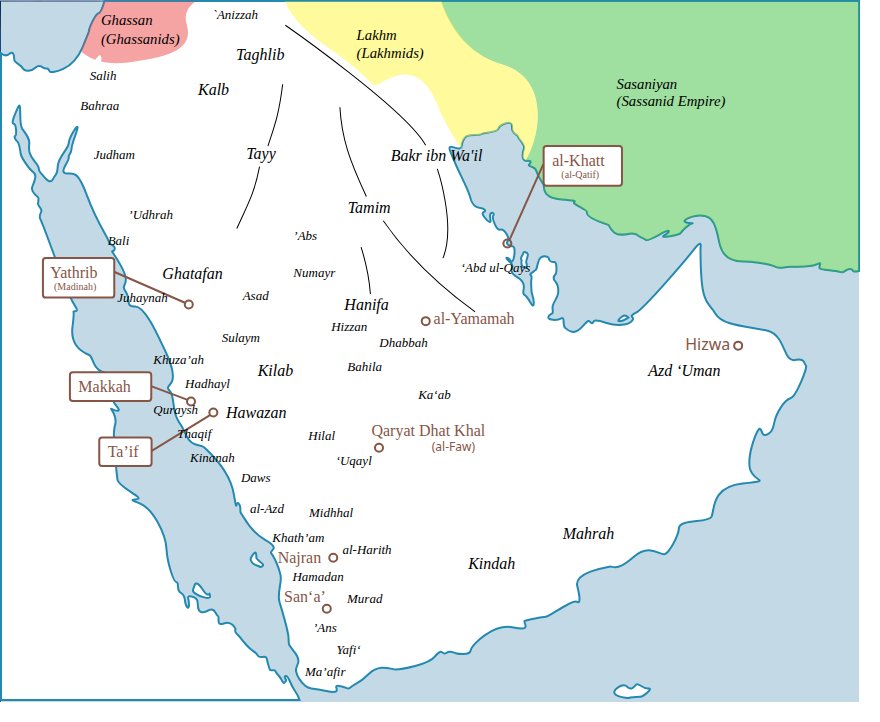
Figure 1: Arabia around 600 CE. The map shows the major tribal confederations of the peninsula and the two client kingdoms — Ghassanid in the northwest, allied to Byzantium, and Lakhmid in the north, allied to the Sasanian empire — that mediated between the desert tribes and the two great powers described in Chapter 4. Mecca, Yathrib (Medina), and Ta'if are marked along the Hejaz, the western mountain corridor where the book's events take place. Adapted by Murraytheb from an earlier tribal map; released to the public domain. (Image: Murraytheb, public domain, via Wikimedia Commons.)
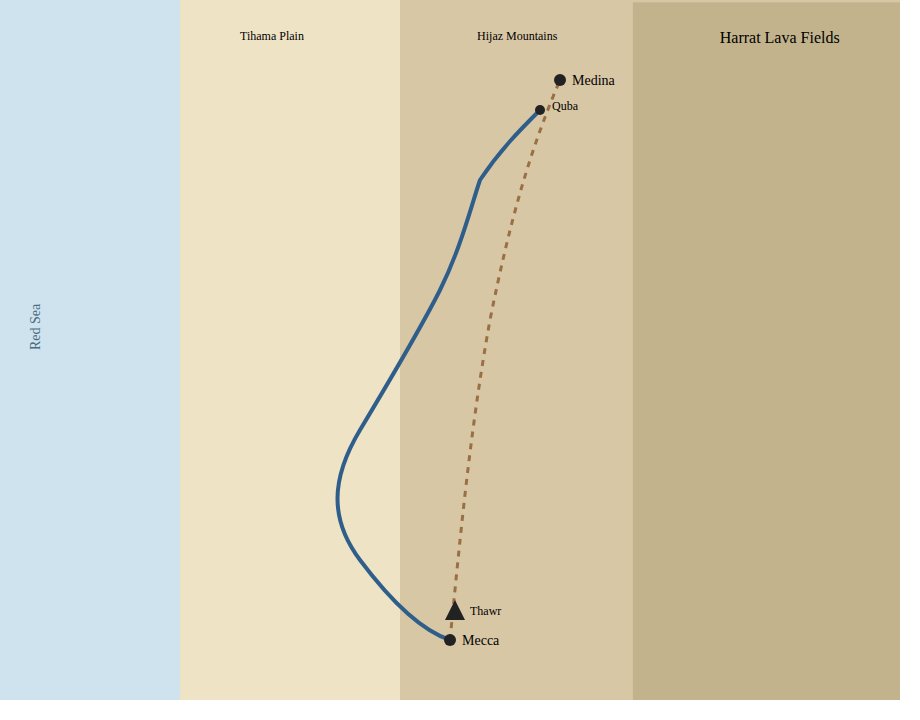
Figure 2: The hijra route. The map traces the traditional path of Muhammad's and Abu Bakr's migration in 622: south from Mecca to the cave of Thawr, where the tradition remembers them hiding for three days while the Quraysh searched for them, then north along the coastal side of the Hijaz mountains, avoiding the main caravan road, to Quba and Medina. The route shown is approximate — no single road is attested — but it reflects the geography the sources describe. (Image: SPQR10, CC0 1.0, via Wikimedia Commons.)
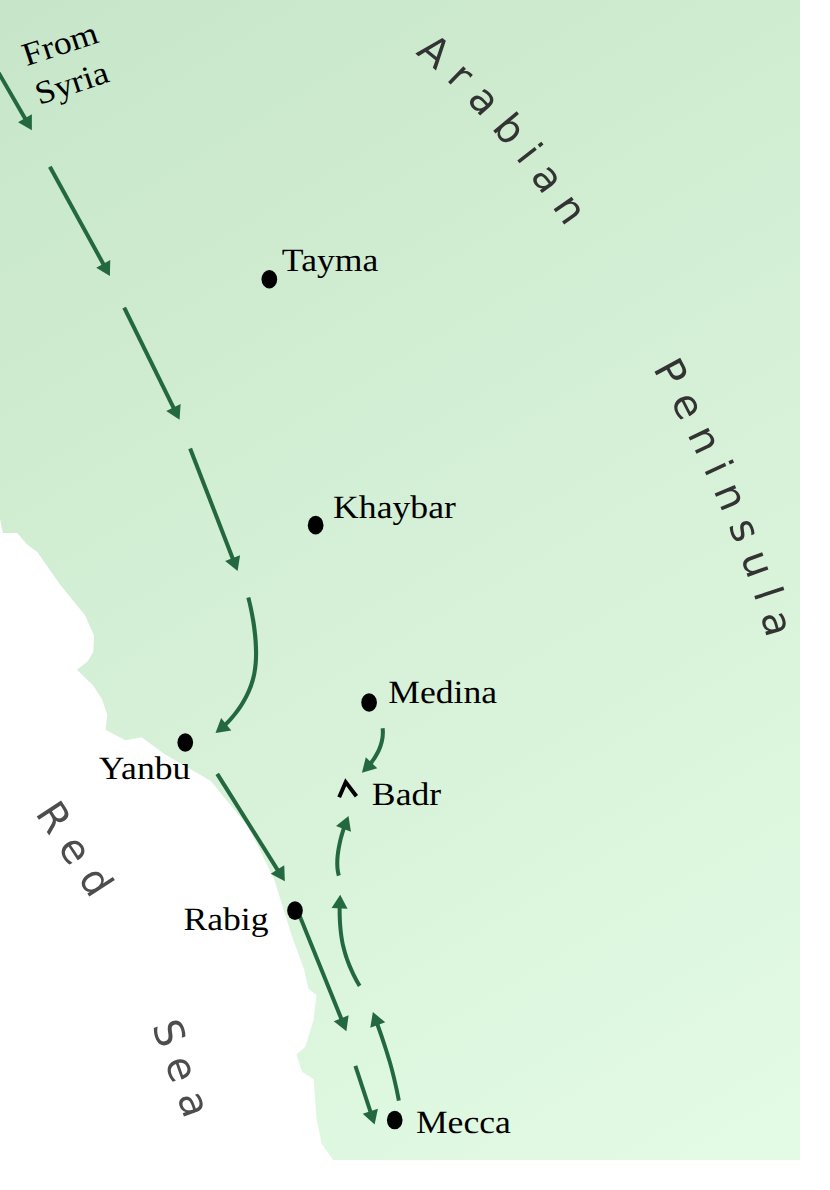
Figure 3: The Badr campaign of 624. The diagram shows the three forces converging on the wells at Badr, between Mecca and Medina: the Meccan trade caravan under Abu Sufyan approaching from the northwest along the coast road, the Muslim army moving out from Medina to intercept it, and the Meccan army sent from Mecca to protect the caravan arriving from the southeast after the caravan itself had already slipped past. The three-way convergence is what turned an attempted raid into the first pitched battle of the Muslim community. Base geography from islamonline.net. (Image: Tom66, CC BY-SA 3.0, via Wikimedia Commons.)
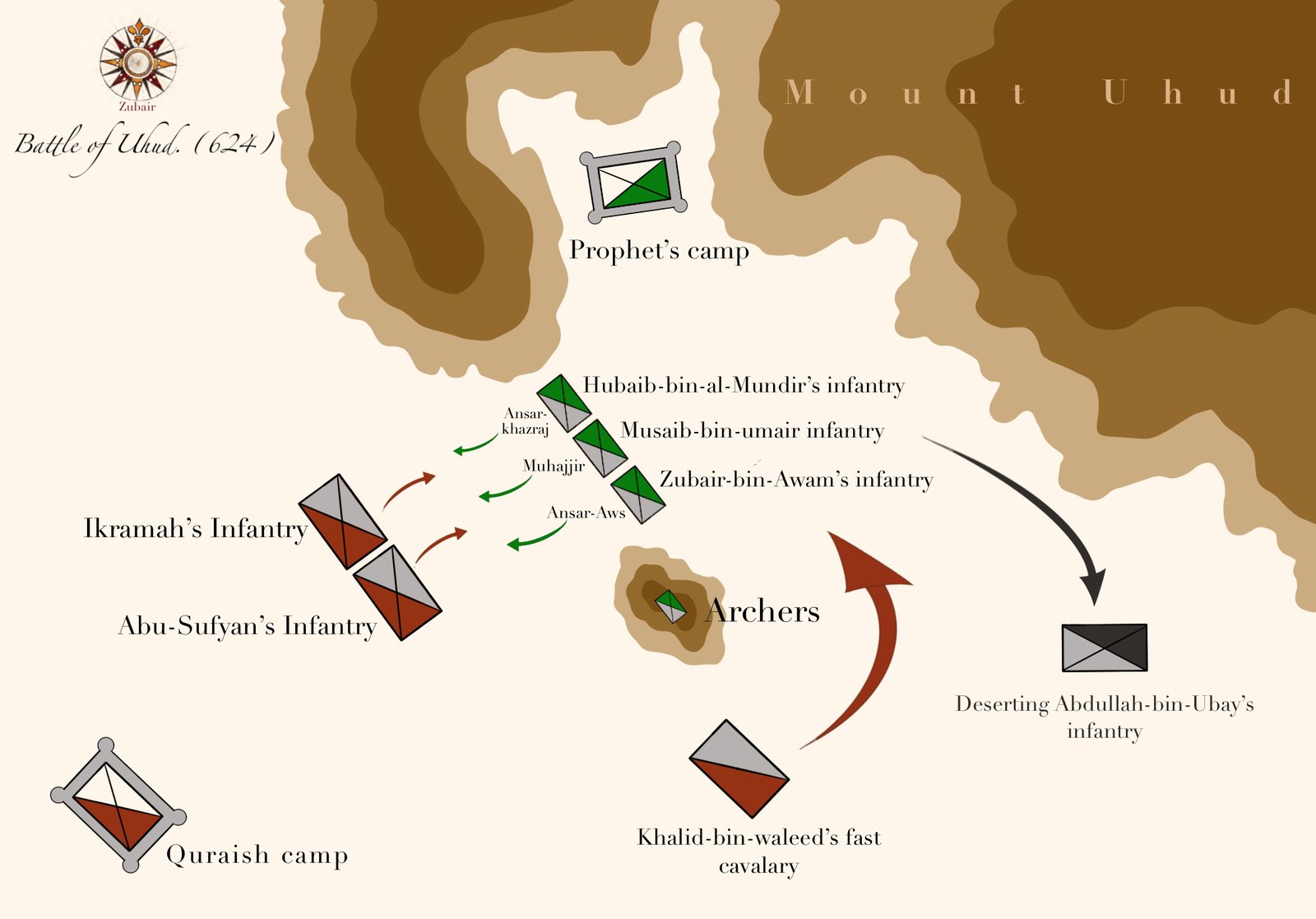
Figure 4: The Battle of Uhud, 625. The diagram shows the Muslim line drawn up with Mount Uhud at its back, the detachment of archers posted on the rise to guard the flank, and the Meccan cavalry under Khalid ibn al-Walid swinging around once the archers left their position to join the pursuit of a retreating Meccan line. The maneuver that decided the battle is visible in the arrow sweeping from the cavalry position around the exposed Muslim flank. (Image: DrZubairRashid, CC BY-SA 4.0, via Wikimedia Commons.)
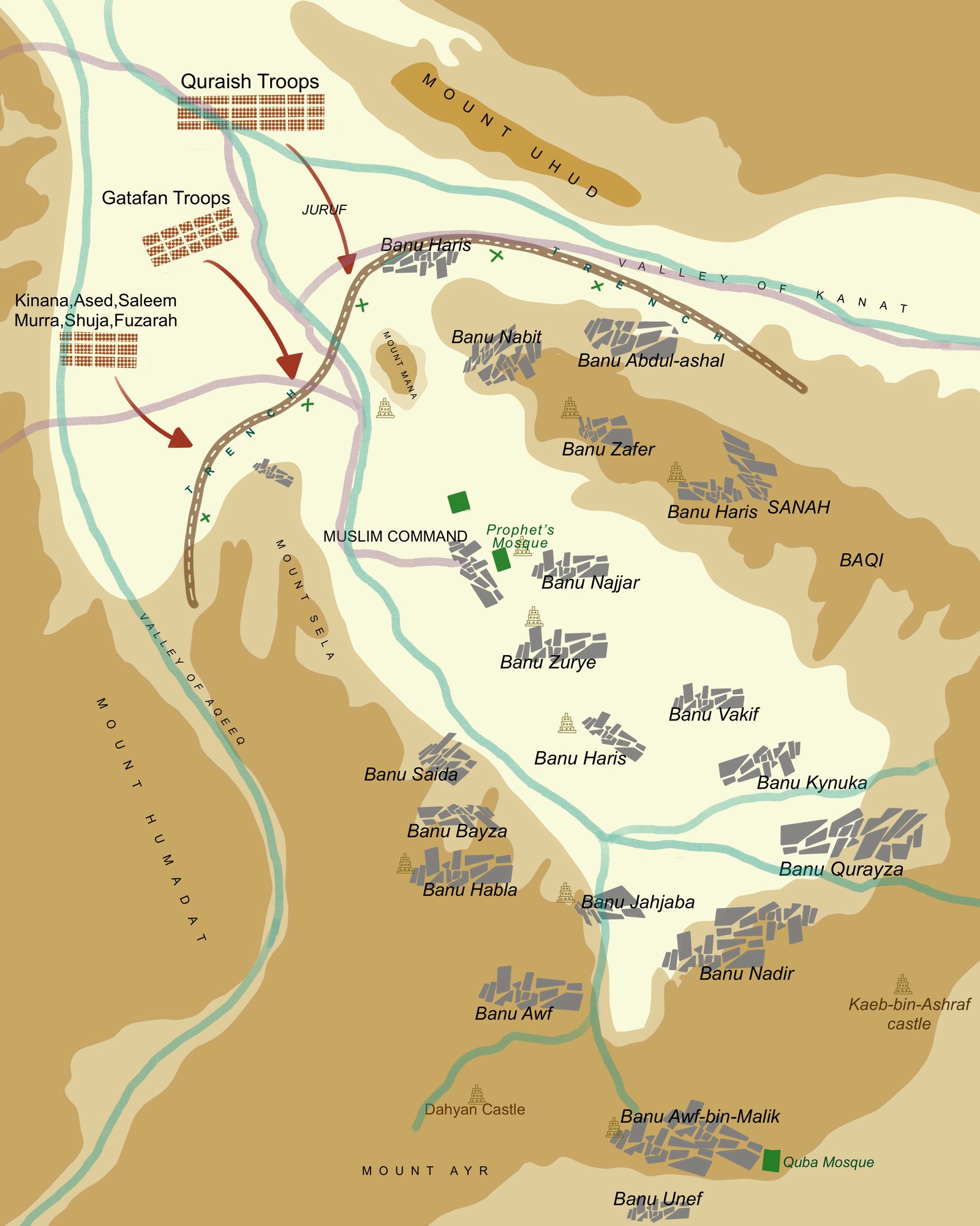
Figure 5: Medina and the Battle of the Trench, 627. Unlike Mecca, Medina was never a single-tribe town: this map shows the oasis settlement's separate quarters, each associated with a different clan — the Ansar clans of the Aws and Khazraj, and the Jewish tribes, including the Banu Qurayza and Banu Nadir discussed in Chapter 25 — spread across the cultivated land between the lava fields. The trench itself, dug along the one side of the settlement left open to attack, runs across the top of the map, with the confederate forces of Quraysh and their allies shown converging from the northwest. (Image: DrZubairRashid, CC BY-SA 4.0, via Wikimedia Commons.)
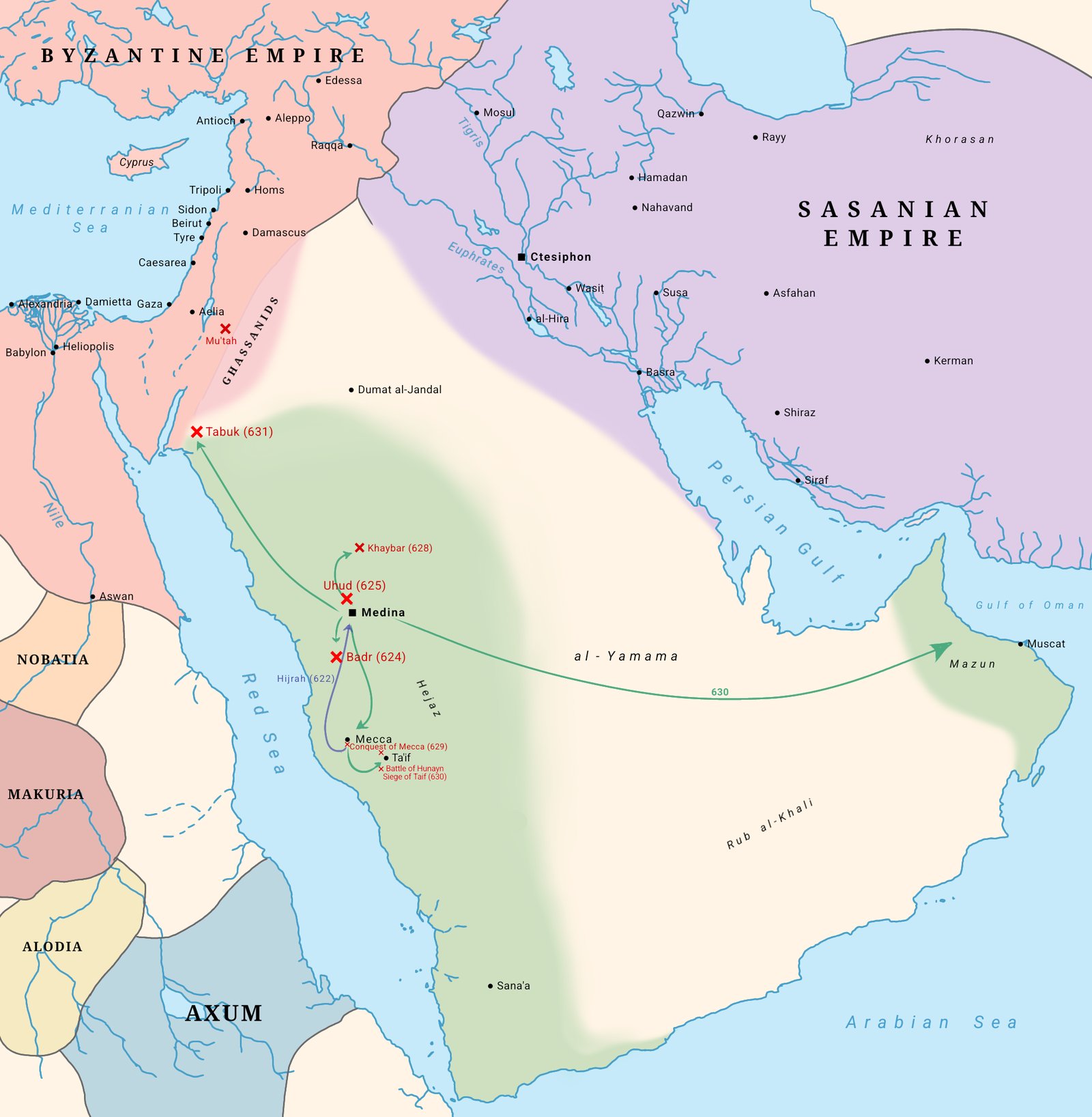
Figure 6: Arabia at Muhammad's death, 632. The shaded area shows the approximate extent of the community's political reach at the end of his life — built up through the campaigns and treaties marked on the map, from the hijra in 622 through Badr, Uhud, Khaybar, the conquest of Mecca, Hunayn, Ta'if, and the expedition to Tabuk in the last years — set against the much larger Byzantine and Sasanian empires to the north. Individual campaign dates on the source map are approximate and, in a few cases, differ by a year from the dates used in this book's own chronology; the shape and scale of the expansion are what the map is included to show. Based on the historical atlas tradition associated with Malise Ruthven's Historical Atlas of Islam. (Image: Fazoffic, CC0 1.0, via Wikimedia Commons.)
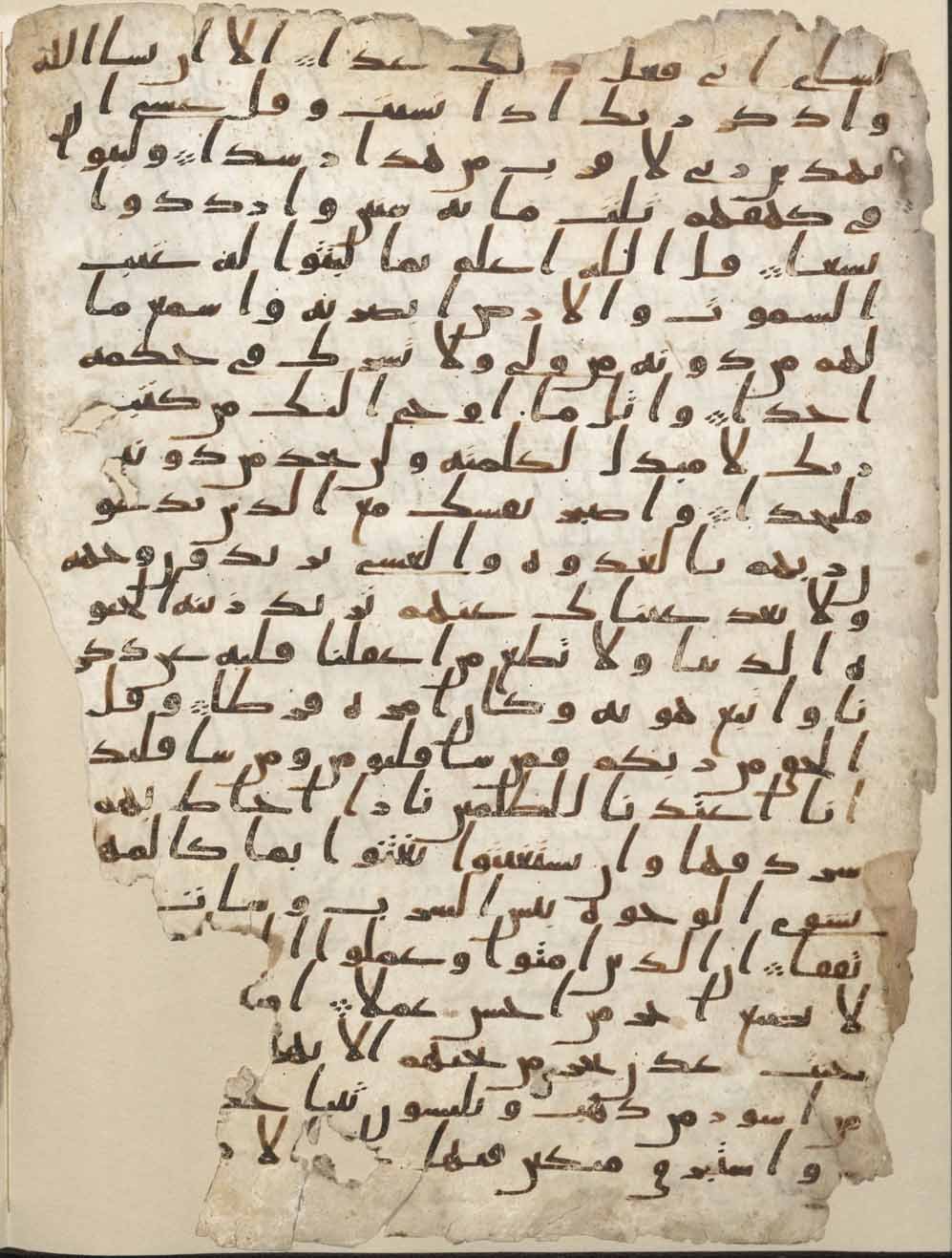
Figure 7: A folio from the Birmingham Qur'an manuscript (University of Birmingham, Mingana Collection). Written in the early angular Hijazi script on parchment, the leaf was radiocarbon-dated in 2015 to between 568 and 645 CE, placing it within a generation of Muhammad's lifetime — among the earliest surviving physical fragments of the Qur'anic text anywhere. The manuscript is discussed as an artifact, not reproduced as a devotional object; it contains no image of any person. (Image: public domain, via Wikimedia Commons.)