Part Six: Return and Farewell
The Treaty That Looked Like a Defeat
In the spring of 628, Muhammad and a company of Muslims set out from Medina with a purpose so modest that no one at the time could have called it the turning point of a religious movement. They wanted to perform a minor pilgrimage to Mecca — the umrah — to circle the Kaaba, to do what pilgrims did. They did not come with an army. They came in the clothing of pilgrims, with sacrificial animals walking beside them, with the plain intention of worship. The Meccan elite blocked the road. What followed — the standoff at Hudaybiyya, the negotiation, the treaty that the Muslims' own followers found intolerable, and the ten-year truce that made the conquest of Mecca possible — was the hinge on which the entire Meccan period turned.
The treaty has a reputation for paradox. It looked like a defeat when it was signed. It was understood by the Qur'an as a clear victory. Both things can be true at once. The first is about the feelings of the men standing in the dust at Hudaybiyya, furious at what they had been forced to accept. The second is about the strategic reality that only became visible in retrospect, once the truce had given the Muslims the breathing space they needed and the Meccan elite had watched their own alliances evaporate. The biographer's job is to hold both truths without letting either cancel the other.
The journey to Hudaybiyya
The Muslims left Medina in the month of Dhu al-Qa'da in the sixth year after the hijra. The number of those who came with Muhammad is traditionally given as fourteen hundred, though the sources vary and the exact figure is not something a historian can settle. The point is that it was a substantial body — large enough to be seen as a real force, small enough to be denied the pilgrimage by a blockade.
They traveled with sacrificial animals, seventy camels for slaughter, carrying the plain intention that they had come to perform the rites of the minor pilgrimage and then to go home. They did not expect resistance. The Meccan elite, however, had been watching. When news reached Quraysh that Muhammad had set out for the pilgrimage, they dispatched a force to intercept. The two sides met at Hudaybiyya, a place on the coast between Medina and Mecca, where a well supplied water. The Meccan force arrived first and blocked the Muslims from entering the town. A standoff ensued. The Muslims made camp. The Meccans prevented access. The pilgrimage that had brought them all this way was now impossible by the simple fact of being blocked.
The standoff could have become a battle. Muhammad had men with him. The Quraysh had men with them. Neither side wanted war at that moment, and the standoff was managed through negotiation rather than force. What is striking about the episode is how much of the early Muslim movement now ran on Muhammad's capacity to control his own followers in moments of acute frustration. The Muslims had every reason to be angry. They had traveled with sacrificial animals, with the intention of worship, and they had been stopped by a blockade. The natural response would have been to fight through the blockade, to force the pilgrimage by violence. Muhammad chose negotiation instead, and the choice was controversial within his own camp.
There are also the negotiations with the Meccan representatives, including the moment when Muhammad sent Uthman ibn Affan, his own cousin by marriage and a man of standing, to speak with the Quraysh. Uthman was detained by the Meccans, and the story developed that he had been killed — a report that nearly provoked Muhammad to fight before the truth emerged. Uthman was in fact alive. The episode shows how close the standoff came to breaking, and how much depended on the discipline of the Muslim camp.
The Meccan side, meanwhile, was not a single mind. The Quraysh had sent the champion wrestler Khalid ibn al-Walid — not yet a Muslim, still one of their military leaders — along with others, including Ikrima ibn Abi Jahl and others from the leading clans. Even among the Quraysh, there were men who saw that a settlement might serve their interests, and men who wanted to fight. The negotiation that followed was shaped by this internal division.
The negotiation
The negotiations took place over the weeks of the standoff. They were not simple. They moved through several stages, and the tradition records a sequence of offers and counteroffers that ended in what became known as the Treaty of Hudaybiyya.
The first Muslim position was straightforward: let us come to Mecca and perform our pilgrimage, and we will go home. The Quraysh refused. They did not want Muhammad and his followers entering the town, even for a short pilgrimage. The sanctuary city was the center of their religious and economic life, and the idea of the Muslims entering for the rites — even without fighting — was unacceptable. The Quraysh offered instead that the Muslims should go back this year and try again the following year, and that if any Meccan wished to join the Muslims and go with them to Medina, he would be allowed to do so without interference, but that if any Muslim wished to return to Mecca, he would be sent back.
This was the Quraysh's opening position, and it was not what the Muslims wanted. Muhammad proposed modifications. The negotiation went back and forth. The tradition remembers the moment when Muhammad sat with his companions in the shade of a tree — or in the place where he made the agreement — and told them to write down the terms. He called for Ali ibn Abi Talib, his cousin and the young man who had grown up in his household, to serve as his scribe. Ali wrote the terms, and Mohammad recited them aloud, and the Muslims witnessed the agreement.
The terms of the treaty, as they appear in the tradition, are specific and revealing:
The Muslims and the Quraysh would observe a truce for ten years. Any tribe that wished to be allied with the Quraysh could do so, and any tribe that wished to be allied with Muhammad and the Muslims could do so — the field was left open, and tribes could choose their side without the agreement being violated. If a Meccan person went over to Muhammad without permission from his guardian, the Muslims would return him to the Quraysh. If a Muslim person went over to the Quraysh without permission, they would not be returned. The Muslims would withdraw from Mecca this year and would be free to return the following year for three days to perform their pilgrimage.
The terms that caused the most anger among the Muslims were the return clause — the one that said any Muslim who left Muhammad for Mecca would be sent back, but any Meccan who left Mecca for Muhammad would not. This meant that if a Meccan slave or freedman converted to Islam and fled to Medina, he would have to be sent back to his Meccan master. The Muslims found this intolerable. It was one thing to negotiate a truce between two political forces. It was another thing entirely to agree to return a person who had found faith to the people who had persecuted him.
The other difficult clause was the asymmetry of the pilgrimage — the Muslims had to go home and wait a full year. They had come for the pilgrimage, and they were being sent away without having entered the town.
Muhammad accepted the terms. He did not consult his companions before accepting. He simply told them to write. When they heard the terms, many of them objected. The most famous reaction was that of Abu Bakr, who said to Muhammad, "Are you the Messenger of God and you accept these terms?" — a question that in its bluntness captures the disbelief of the moment. Another companion, Abu Hurayra, is remembered as saying that when the terms were read, he was so angry that he could not think clearly. The Muslims were not being asked to surrender militarily. They were being asked to accept a political settlement that recognized the Quraysh as a party of equal standing and that imposed on them a humiliating return clause. They did not like it.
Muhammad's response to their anger was to tell them to write and to accept. He did not explain at the moment why he had accepted. He simply said that he was the Messenger of God and that God would not let the truth be defeated. The tradition remembers that the Muslims were furious, and then that Muhammad's word carried them. This is one of the moments in the early story where leadership is most visible: a man who could not have imposed the treaty by force chose to impose it by the authority of his own conviction, and his companions — furious, disappointed, disbelieving — accepted it because of who he was.
The terms in detail
The asymmetry of the return clause deserves closer attention, because it is the term that looks worst on the face of the agreement and that therefore demands the most honest explanation.
The clause said that anyone from Quraysh who went to Muhammad without his guardian's permission would be returned, but that anyone from Muhammad's side who went to Quraysh without permission would not be returned. The apparent effect was that a Meccan who converted and fled to Medina would be sent back to his old life, while a Muslim who defected back to Mecca would be allowed to stay. The asymmetry looks like a reward for defection and a punishment for conversion.
The explanation that the tradition and the historians give is that the clause was about political allegiance, not about faith. The treaty was between two political entities — the Muslims and the Quraysh — and the clause was about the movement of people subject to the political authority of each side. Mecca was the Quraysh's city. A Meccan was a subject of the Quraysh. If he left and went to Medina without permission, the treaty required his return on the grounds that he had left his tribe's political orbit without authorization. The Muslims were not being asked to return a person on the grounds of his faith. They were being asked to observe an agreement about political desertion.
This is not a fully satisfying explanation, and the honest account should not pretend that it is. For the Muslims who heard the terms at Hudaybiyya, the practical effect was clear: a slave who had found faith could be sent back to his master. The moral force of that reality was not erased by the political language of the treaty. The honest account holds both things — the political logic of the clause, and the human cost it implied — without letting either cancel the other.
The other clause that caused anger was the pilgrimage delay. The Muslims had come to perform the rites. They were being sent home and told to try again the following year. The following year, they would be allowed to enter Mecca for three days and perform the pilgrimage, and then they would leave. This was a real deprivation. They had traveled for the pilgrimage and had not been allowed to perform it.
The truce clause itself — ten years of peace between the Muslims and the Quraysh — was, in itself, a positive thing. The Quraysh had never agreed to a sustained truce with Muhammad before. The boycotts, the pressure, the assassination attempts, the battles — all of it had been continuous. A ten-year truce was an extraordinary concession from a political opponent. It meant, in practice, that the Muslims could operate in Medina and beyond without the constant threat of Meccan military action. But the truce was wrapped in terms that made it look like a Quraysh victory, and the combination produced the anger.
Why the Quraysh agreed
The Quraysh's motivation for signing the treaty is worth understanding, because the agreement makes more sense when you see what the Quraysh believed they were gaining.
At the moment of the standoff, the Quraysh were not in a strong position. They had blocked the Muslims from the pilgrimage, but they had not forced them to surrender or leave. The situation was a stalemate. The Muslims were camped with their sacrificial animals, with a substantial force, and with the moral energy of people who believed they were serving God. The Quraysh were outside, blocking the road. Neither side wanted to fight, but neither side had a clear way to win without concessions.
From the Quraysh's point of view, the treaty offered several things. It stopped the Muslims from entering Mecca this year, which was the primary objective. It established that the Muslims would have to come back next year and perform their rites in a controlled, limited way. It recognized the Quraysh as a party of equal standing in the agreement — not as a defeated enemy, not as an outlaw force, but as a power with which Muhammad was willing to make a formal settlement. The asymmetry of the return clause gave the Quraysh a tool for retaining control over their own people. And the ten-year truce, while appearing generous, gave the Quraysh a period in which they believed they could wait out the Muslims and let the movement weaken.
The Quraysh did not understand what they were signing. They believed they had secured a temporary advantage. They did not see that the truce would, over the following two years, allow the Muslims to make alliances with tribes all across the Arabian peninsula, to spread their message in a way that was impossible while the war with Mecca was active, and to build a network of relationships that would collapse the Meccan position when the truce finally ended.
The Quraysh's mistake was not in signing the treaty. It was in believing that the treaty was a victory for them. It was a defeat they did not recognize as a defeat until two years later, when the Muslims returned to Mecca without resistance.
The reaction of the Muslims
The anger at Hudaybiyya is one of the most human moments in the early story. The Muslims had followed Muhammad through persecution, boycott, exile, war. They had lost their homes in Mecca. They had lost their wealth. They had fought at Badr and Uhud and the Trench. They had believed that God was with them. And now, at the moment when they believed they had reached the city of their sanctuary, they were being sent home with terms that looked like a surrender.
The tradition records several specific reactions. Abu Bakr, as noted, questioned Muhammad directly. Umar ibn al-Khattab was reportedly so angry that he went to Muhammad and complained, and Muhammad told him to be patient. Other companions are remembered as being silent, or as accepting with difficulty, or as expressing their frustration in private. The overall picture is of a group of men and women who were emotionally honest about their disappointment and who found it difficult to believe that the terms were the right ones.
This is an important moment for the honest method. The tradition does not hide the anger. It preserves it. The honest account does the same. This was not a moment when everyone calmly agreed that the treaty was wise. It was a moment of genuine frustration, and the frustration matters because it refutes any reading that treats the early Muslims as a monolithic group of uncritical followers. They were human. They reacted like human beings to a settlement that they did not understand and did not like.
The one person whose reaction was different was Muhammad himself. He received the terms with the calm of a man who believed that the outcome was in God's hands and that the settlement, however it looked, would prove to be what God had intended. The tradition's account of his reaction is not detailed — the sources are more interested in the companions' anger than in Muhammad's interior state — but the difference between his calm and their fury is itself part of the story. He had seen something they had not yet seen.
The Qur'anic response
The Qur'an's response to the treaty came later, in the form of the sura known as al-Fath, the "Victory." The sura was revealed after the Muslims had returned from Hudaybiyya and after the terms had begun to take effect. It is one of the clearest examples in the Qur'an of a passage that looks back on an event and reframes it.
The sura declares, in its opening verses, that God has granted a clear victory. It speaks of the pledge of allegiance that the Muslims gave under the tree at Hudaybiyya — the bay'at al-ridwan, the pledge under the tree — and treats it as a sign of God's approval. It promises that the Muslims will enter the sacred mosque in Mecca in safety, if God wills, and that He will know what they know. It announces that God will punish those who opposed the Muslims and that the believers will be favored.
The framing is unmistakable: the treaty is called a victory. The apparent humiliation of the terms is reinterpreted as a strategic triumph. The Qur'an's language is not diplomatic. It is the language of victory, of divine assistance, of a turning point that the believers may not yet fully see but that God has already decreed.
For the biographer, the Qur'anic response is important for two reasons. First, it shows that the Muslim community itself struggled to understand the treaty in the immediate aftermath, and that the reframing came as a revelation that helped them accept what had happened. The anger at Hudaybiyya was real, and the Qur'an's response was the community's way of processing that anger into understanding. Second, it shows the way the Qur'an functioned in the early community: not as a detached record of events, but as a voice that spoke into the community's experience, reframing setbacks as victories and disappointments as signs of God's plan.
The Qur'an's language of victory is not propaganda. It is the Islamic community's own understanding of what happened, preserved in the form of revelation. The biographer who treats the Qur'an as the earliest source for what Muhammad was saying should read al-Fath as part of that record — a piece of the community's self-understanding at a moment when the settlement had just been made and the future was still uncertain.
The consequences
The treaty's immediate consequence was the breathing space it created. For the next two years, the Muslims were not at war with the Quraysh. The truce held. During those two years, the Muslims were able to expand their reach in ways that had been impossible before.
The most significant development was the spread of Islam into new tribes and regions. Before the treaty, the Muslims' energy had been concentrated on survival and defense. The Meccan threat had absorbed almost all of their political and military attention. With the truce in place, Muhammad and the Muslims could turn outward. Delegations came from tribes across the peninsula. Letters were sent to rulers and leaders. The message spread into the Hijaz and beyond. The treaty did not cause the spread — the message itself did that — but it removed the barrier that had been preventing the spread from happening at full speed.
The treaty also shifted the balance of alliances. The clause that allowed tribes to ally with either side became a real political opportunity. Various tribes chose to side with the Muslims, recognizing that the Muslim community was growing and that neutrality was no longer the safest position. The Meccan elite watched these defections with increasing alarm, but the treaty prevented them from acting. They had agreed to a truce, and the truce held.
By the time the truce broke — when a tribe allied to the Quraysh violated the agreement by attacking a tribe allied to the Muslims, and the Quraysh's protection of that violation made the treaty void — the Muslims had changed in ways that the Quraysh had not anticipated. Their numbers had grown. Their alliances had expanded. Their position had strengthened. The return to Mecca that followed was not the return of a persecuted minority. It was the return of a force that the Quraysh could no longer resist.
The treaty, then, was the hinge. Without it, the Muslims would have remained locked in a struggle for survival against the Meccan elite. With it, they had the space to grow into a power. The conquest of Mecca two years later was made possible by the treaty. The amnesty that followed the conquest was made meaningful by the discipline the Muslims had shown at Hudaybiyya. The entire final phase of the Meccan period — the return, the purification of the sanctuary, the general amnesty — rests on the foundation laid at Hudaybiyya.
The tree and the pledge
One of the most enduring images of the treaty is the pledge of allegiance given under a tree at Hudaybiyya. The tradition records that the Muslims gave Muhammad their pledge of loyalty at a tree near where they had made camp. The pledge was a statement of commitment — that they would obey Muhammad, that they would stand with him, that they would not abandon him. The Qur'an refers to this pledge in al-Fath, and the image of the pledge under the tree became, in later Islamic memory, one of the emblematic moments of the early community.
The pledge matters because it captures the moment of commitment right before the truce. The Muslims were about to accept terms that looked like a defeat. They were about to go home without having performed the pilgrimage. They were about to watch the Quraysh retain control of Mecca for another year. And at that moment, they gave their pledge — not just to Muhammad as a political leader, but as a community affirming its bond to him and to the message. The pledge under the tree is the emotional counterpoint to the legal terms of the treaty. The treaty was the political settlement. The pledge was the human commitment that made the settlement possible.
The difficulty of reading the treaty honestly
The treaty of Hudaybiyya is one of the episodes that tests the biographer's commitment to honesty. It is tempting to explain it away — to say that the terms were not really as bad as they looked, that the return clause was only about political allegiance, that the Muslims were foolish to be angry, that the Qur'an's framing shows the truth. Each of these explanations contains a piece of truth, and each is incomplete.
The honest account says this: the terms were, by the standards of the Muslims at the moment, humiliating. They were angry. The anger was justified by the terms as they understood them. The return clause did have the practical effect of sending some converts back to their Meccan masters. The Qur'an's later reframing does not erase the anger; it addresses it. The treaty was a political settlement that looked like a defeat to the men who signed it and a victory to the community that inherited it. Both readings are part of the story. The honest account presents both without forcing the reader to choose between them.
The treaty also matters for the larger argument of the book. It is a counterexample to the idea that Muhammad's career was one of continuous and uncomplicated triumph. It was not. It was a career of setbacks that were reframed as victories, of moments that looked like the end and turned out to be the turning point. The boycott failed to break the Muslims. The assassination plot failed. The stoning at Ta'if was the lowest point of Muhammad's life. And the treaty at Hudaybiyya was the moment when the Muslims' own followers thought he had made a mistake, and were wrong. The pattern is consistent: the movement faced threats that appeared decisive, and survived them in ways that only became clear in retrospect.
Mecca
The return to Mecca in 630 was, by the standards of Arabian conquest, remarkable. The Muslims entered the town with a force large enough to overwhelm any resistance, and the resistance collapsed before they arrived. The town that had boycotted Muhammad for three years, that had tried to kill him, that had driven him into exile, surrendered without a siege, without a massacre, without the blood that the story might so easily have contained. The conquest was bloodless, and the amnesty that followed it was, in the judgment of the tradition, one of the most extraordinary decisions of Muhammad's political life.
The chapter that follows is about the return to Mecca and the decision that made that return more than a military success. The amnesty is the center of the story. Everything else — the violation of the treaty, the march north, the entry, the removal of the idols, the submission of the Meccan elite — is context for the decision that Muhammad made when he stood in the town that had been his enemy and declared that his enemy was now free.
The breaking of the treaty
The Treaty of Hudaybiyya, signed two years earlier, had held. For most of that time, the truce had worked as intended: the Muslims had used the breathing space to grow, to make alliances, to spread their message across the Arabian peninsula. The Meccan elite had watched this happen and had been unable to act, because the treaty bound them. Then, in the eighth year after the hijra, the treaty broke.
The traditional account names the incident that ended the truce. A tribe allied to the Quraysh — the Banu Bakr — attacked a tribe allied to the Muslims — the Banu Khuza'a — at night, in a raid that fell within the terms of the treaty's protection. The Khuza'a had been allies of Muhammad, and the attack on them was a violation of the agreement by the Quraysh's side. Muhammad, when the news reached him, considered the treaty void. The Meccan elite had failed to restrain their allies, and their failure meant the truce was over.
The sequence is worth tracing carefully, because it shows the Meccan elite's position unraveling in a way they had not anticipated. The treaty had not only prevented the Muslims from attacking Mecca. It had also prevented the Meccan elite from acting against the Muslims' allies without the whole agreement collapsing. When the Banu Bakr attacked the Khuza'a, they had done so under the assumption that the truce would protect them. Instead, the truce became the mechanism by which their action was judged unlawful. The Quraysh had violated their own agreement, and the violation gave Muhammad the legal and moral basis to act.
The Meccan elite realized, at this point, that they had lost control of the situation. Their tribe's allies had attacked Muhammad's allies. The treaty had been broken by their side. And the man with whom they had made the truce now had the grounds to march on Mecca. They sent an envoy to Muhammad to try to negotiate a settlement, to offer reparations, to explain that the violation had not been authorized by the Quraysh's leaders. Muhammad's response, according to the tradition, was to set conditions that were so stiff that the Meccan envoy returned and told his masters that no settlement was possible on those terms. The door to negotiation had closed.
The march north
Muhammad began to assemble the force for the march on Mecca. The traditional number given for the Muslims who accompanied him is ten thousand, though the sources vary and the exact figure is not something a historian can settle. The point is that it was a force large enough to overwhelm any resistance the Quraysh could have offered. It included the Meccan emigrants who had left their homes, the Medinan helpers, the men who had fought at Badr and Uhud and the Trench, and the men who had grown in number during the years of the truce.
The march was not secret. It was known. Muhammad sent ahead men to instruct the Muslim camps along the way to move quietly, to avoid alerting the Meccan scouts. The force moved through the night where it could. They camped at stages on the road. The secrecy was not concealment — the Meccans ultimately knew what was coming — but it was a precaution against a surprise resistance that might have changed the outcome. By the time the Muslims arrived at Mecca, the Meccan elite had had time to understand what was coming and had had time to decide that resistance was futile.
The approach to Mecca was the moment when the whole shape of the Meccan period became visible in a single movement. Muhammad was coming back to the town that had rejected him, not as the man who had fled in secrecy and danger, but as the head of a community that had outgrown the town's capacity to resist. The force that came to Mecca was the embodiment of everything that had happened in the twenty years since Muhammad had left the cave of Hira and the town had first heard his message.
The entry
The entry into Mecca is remembered with the detail that the tradition gives to the most significant moments of Muhammad's life. The Muslims entered the town in the morning. Muhammad had instructed his commanders that no one was to be fought except those who actively resisted. He had given strict orders that the conquest was to be conducted without slaughter, without revenge, without the kind of violence that a conquest of this kind might have produced.
The Meccan elite had gathered at the Kaaba, or in the streets, or in the positions they thought might allow them to resist. When the Muslims arrived in force, the Meccans saw that resistance was impossible. The leadership of the Quraysh had already decided. The town was not going to fight. Some of the Meccan leaders submitted immediately. Others held out briefly and then submitted. The surrender was rapid, and the Muslims' entry was bloodless by the standard of what a city captured by force usually produced.
One of the most vivid moments in the tradition is the entry into the sanctuary itself. The Kaaba was filled with idols — the statues of the Meccan gods, the images of the gods of the surrounding tribes, the collection that had been the center of the town's religious and economic life for generations. Muhammad stood at the Kaaba and ordered the idols to be removed. The tradition gives the image of the idols being taken down, one by one, and destroyed. The sanctuary was purified. The house that had been the center of the polytheist worship of Mecca was now, in the Muslim understanding, the house of God alone, the one God who had sent Muhammad.
The removal of the idols is one of the symbolic moments of the whole story. It is also the moment when the Meccan elite's world — the sanctuary, the pilgrimage, the trade, the prestige that had all been built around the Kaaba and its idols — was visibly undone. The idols were the material expression of the Meccan elite's claim to authority. Their removal was the visible sign that that authority was over.
Muhammad is remembered as declaring, as he stood in the Kaaba, that God had fulfilled His promise and given the Muslims victory. He said that every Meccan who did not fight the Muslims, who did not oppose them, would be forgiven and would be free. The declaration of amnesty was made in the sanctuary, in the most public possible place, and it covered the town.
The amnesty
The amnesty is the extraordinary decision at the center of the chapter, and it deserves the fullest weight the biographer can give it.
The Meccans had been Muhammad's enemy for years. They had boycotted his clan. They had pressured his followers. They had tried to kill him. They had stoned him at Ta'if. They had fought him at Badr and Uhud. The battles had killed Muslims. The boycott had brought hunger. The persecution had cost lives. The Meccan elite had done all of this. And now Muhammad stood in their city, having defeated them by force, and he declared that they were free.
The amnesty was not forced on Muhammad by circumstance. It was a choice he made. He had the men, the force, the anger of his followers. He had the right, under the laws of war, to take revenge. He did not. He declared the Meccans free, and he ordered that no one was to be harmed except those who had actively fought against the Muslims and refused to submit.
The decision is extraordinary for several reasons. First, it was the decision of a man who had every reason to take revenge. The Meccans had not simply opposed Muhammad politically. They had persecuted him personally, his family, his followers. They had destroyed his standing in his own town. They had driven him into exile. A less disciplined leader, or a movement less committed to restraint, could easily have turned the conquest into a massacre. The amnesty was the overcoming of that temptation.
Second, the amnesty was broad. Nearly the entire population of Mecca was included. The exception was a small number of individuals — the men who had been most directly responsible for killing Muslims, or who had committed specific crimes against the Muslims, or who had been leaders of the opposition in a way that made their continuing presence a threat. The tradition names some of those who were excluded — the men who had led the persecution, the men who had been most responsible for the violence against the Muslims. But the number of those excluded was small, and the number of those forgiven was large.
Third, the amnesty changed the meaning of the conquest. A military conquest of a hostile town usually ends in the punishment of the conquered. The amnesty turned the conquest into something different — not just a military success, but a moral one. The Meccans were not massacred. They were not enslaved. They were not stripped of their property by general confiscation. They were forgiven. The town was spared. The decision made the conquest a moment of mercy as much as victory.
The general amnesty was one of the most extraordinary decisions of Muhammad's political life. The decision deserved to be given its full weight. It is not enough to mention the amnesty in passing. It must be presented as the decision that made the conquest more than a military event, the decision that transformed the return to Mecca from the end of an enemy into the beginning of a new relationship between the Muslims and the town they had conquered.
The amnesty also matters because of what it did to the Meccan elite. The leaders who had opposed Muhammad for years were not killed. They were not imprisoned. They were given a place in the new order. Many of them submitted and became Muslims. Others remained non-Muslims but accepted the political reality. The amnesty allowed the Meccan elite to be absorbed rather than destroyed. This was a political act as much as a moral one: the decision to forgive the enemy rather than destroy it was also the decision to build the future rather than settle the past.
The men who were excluded
A careful account does not pretend that the amnesty was total. The tradition records that a small number of individuals were excluded from the general pardon, and the account is clear about who they were and why.
The most commonly named among those excluded are the men who had been directly responsible for killing Muslims. The tradition names Ikrama ibn Abi Jahl — the son of the man who had been one of the most relentless opponents of Muhammad in the Meccan period — as among those who were initially excluded, though he later submitted and was forgiven. The tradition also names others who had led the persecution, and the general principle is that those who had committed acts of direct violence against the Muslims and had not submitted before the entry were at risk of being excluded.
The exclusion of individuals is not a contradiction of the amnesty. It is the limit of the amnesty. The general pardon covered the town. It did not cover those who had committed specific crimes against the Muslims and who had not submitted. The distinction is important: the amnesty was broad and it was real, and it did not cancel the principle that those who had killed Muslims might answer for it. The honest account does not flatten the distinction into "everyone was forgiven" or into "some were punished, so the amnesty was not real." The amnesty was real and partial. That is the honest description.
The biographies of those who were excluded and then forgiven are also part of the story. Ikrima, for example, fled to Abyssinia at first, fearing the consequences of the amnesty, and then returned and was forgiven by Muhammad. The detail is remembered because it shows that the amnesty was not just a legal formula. It was a real decision that was applied in specific cases, and that the application of it was itself a kind of mercy.
The reaction of the Meccans
The Meccans' reaction to the entry is remembered with some complexity. Some submitted immediately. Some had believed that the Muslims would massacre them and had prepared for that. When they learned that the amnesty had been declared, they were relieved, and some of them were astonished. Muhammad's words as he entered Mecca — that God had given them victory and that the Meccans were free — were heard by the town, and the town had to come to terms with what they had heard.
The honest account does not read the Meccans' reaction as simple gratitude. They had been defeated. Their town had been taken. Their sanctuary had been purified. Their idols had been removed. Their authority had been ended. The amnesty did not erase the fact of defeat. But the amnesty did give them something they had not expected: a place in the future rather than punishment for the past. The Meccans who submitted accepted that Muhammad was now the ruler of their town, and that the sanctuary was now the sanctuary of his community. For many of them, this was a change they could accept. For some, it was a change they could not accept, and they left Mecca rather than submit.
The most important single reaction is the reaction of the Quraysh's leaders. The men who had opposed Muhammad for years, who had boycotted him, who had tried to kill him, now had to decide what to do. Some of them submitted and became Muslims. Abu Sufyan, a leader of the Banu Umayya and the man who had led the Meccan caravan that the Muslims set out to intercept at Badr, is remembered as having been one of the last to submit, and as having asked Muhammad for protection when he finally came to submit. Muhammad gave him protection. Abu Sufyan became a Muslim, and his conversion — the conversion of one of the most obstinate opponents of the early period — was a sign of the completeness of the conquest.
The conversion of Abu Sufyan is a good example of the way the amnesty worked in practice. He had been among the leaders of the opposition. He had led the Meccan forces against the Muslims at Uhud and the Trench. He could have been excluded from the amnesty. Instead, he submitted, and Muhammad forgave him. The decision was not automatic. It required Muhammad to make the choice. The choice was the amnesty.
The removal of the idols and the reorganization of the sanctuary
The removal of the idols is the most visible act of the conquest. The Kaaba had been filled with statues — the gods of the Meccan tribes and of the surrounding groups, each with its shrine and its following, all gathered in the sanctuary that was the center of Mecca's religious and economic life. Muhammad ordered the idols to be taken down and destroyed. The tradition gives the image of this happening, and the image is one of the most powerful moments in the early story.
The removal of the idols was not just a symbolic act. It was the practical undoing of the Meccan elite's religious authority. The sanctuary had been the center of the polytheist worship of Mecca. Its purification — the removal of the idols, the declaration that it was now a house for God alone — was the sign that the Meccan elite's world had been fundamentally changed. The pilgrimage would continue, but it would be a Muslim pilgrimage, and the Kaaba would be a Muslim sanctuary.
The reorganization of the sanctuary also included the destruction of the idols around the Kaaba, and the cleansing of the sanctuary of the symbols of the old worship. The tradition records that the walls of the Kaaba were washed, and that the symbols of the old worship were removed. The sanctuary was made into what the Muslims understood it to be: the house of God, the qibla, the direction of prayer, the most sacred place in the Muslim world.
This was a transformation of the town's central institution. The Meccan elite had built their wealth and prestige on the sanctuary and the pilgrimage. The purification of the sanctuary changed the meaning of both. The pilgrimage continued, but it was now a Muslim pilgrimage, and the Meccan elite's role in it was now as Muslims, or as subjects of the Muslim community, rather than as guardians of the polytheist shrine.
The aftermath of the conquest
After the entry and the amnesty and the removal of the idols, the Muslims established their presence in Mecca. The town was not destroyed. It was taken over and reorganized. The Meccan elite were not massacred. They were given a place in the new order. The sanctuary was purified. The idols were gone. The town that had been Muhammad's first adversary was now his town, and the sanctuary that had been the center of his opposition was now the sanctuary of his community.
The conquest of Mecca changed the balance of power in the Arabian peninsula. The Quraysh, the dominant tribe of Mecca, had been the main opponent of Muhammad in the Meccan period. Their power had been based on the sanctuary, the pilgrimage, and the trade. The conquest removed those foundations and replaced them with the Muslim community's control of the sanctuary and the pilgrimage. The Quraysh's power as a polytheist elite was over. The Quraysh as individuals — or many of them — became Muslims and became part of the Muslim community.
The conquest also changed the position of the surrounding tribes. Many of the tribes that had been watching the struggle between Mecca and Medina now saw that Mecca had fallen and that the Muslims had won. The conquest accelerated the spread of Islam into the peninsula, because the defeat of the Quraysh demonstrated that the Muslim community was now the dominant force in the region. Tribes that had been neutral or hostile now had reason to submit.
The conquest was not the end of the struggle — there were still tribes that resisted, and there were still campaigns to be fought, including the expedition to Hunayn and the siege of Ta'if that followed the conquest of Mecca. But the conquest of Mecca was the turning point after which the Muslim community's dominance of the peninsula became the clear direction of events. The town that had persecuted Muhammad for years was now his town, and the sanctuary that had been the center of his opposition was now the sanctuary of his community.
The meaning of the conquest
The conquest of Mecca is the moment in the story when the movement that had begun in a cave outside the town returned to take that town. The return was bloodless. The amnesty was declared. The idols were removed. The sanctuary was purified. The Meccan elite submitted, and the town that had been Muhammad's first adversary became his town.
The honest account does not let the amnesia of the later tradition flatten the conquest into a simple victory. It was a victory, and it was a bloodless one, and the amnesty was extraordinary. But the conquest also had a cost, and the cost should not be erased by the amnesty. The Meccans had lost their town, their sanctuary, their idols, their authority. The amnesty spared their lives, but it did not spare them from defeat. The honest account holds both things — the mercy of the amnesty and the reality of the defeat — without letting either cancel the other.
The conquest also matters for the argument of the book. It is the moment when the movement that had been persecuted in Mecca returned as the power that had outgrown the persecution. The amnesty is the decision that made the return more than a military conquest. It was the decision that turned the conquest into a moral event, the decision that showed what kind of leader Muhammad was at the moment when he had the most reason to take revenge and the least reason to show mercy. The amnesty is the most extraordinary decision of his political life, and it is the decision that should be given its full weight.
The Last Year
In the tenth year after the hijra, Muhammad performed what is remembered as the farewell pilgrimage — the last time he would go to Mecca, the last time he would preach to the Muslims gathered at Arafat, the last time he would speak to the community he had built as a whole. The pilgrimage and the sermon that accompanied it became, in the Islamic tradition, the crystallization of the message at the end of his life. For the biographer, the farewell pilgrimage is the moment when the man who had been an orphan from a middling clan in a desert town stood at the summit of what he had achieved and turned to the things that mattered most — the equality of the believers, the rights of the vulnerable, the sanctity of the Muslim's life and honor, and the warning that came at the end of a life: remember this, and do not forget.
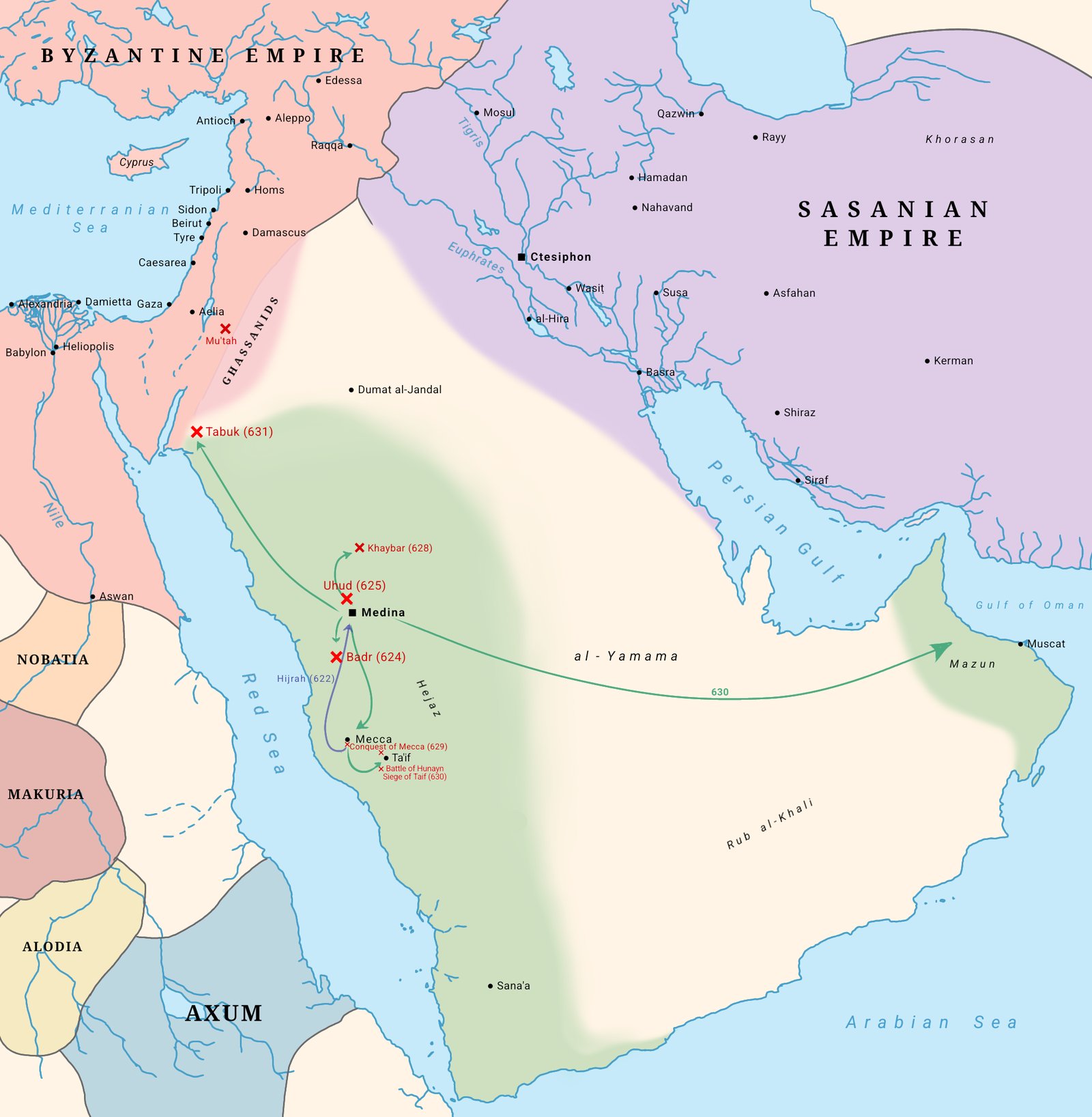
The year was also the year of the tribal delegations — the moment when the Arabs of the peninsula, the tribes that had not yet submitted to Islam, came to Medina to make their peace, to accept Islam, or to agree to terms. The delegations were the sign that the peninsular revolution had become a fact, that the Muslim community had become the power that the Arabian interior had to reckon with, and that the man who had begun as a preacher in Mecca had become the leader of a peninsula.
And the year was the year of the illness. The tradition records that Muhammad grew sick in the latter part of the year, that his illness was not dramatic but persistent, that he tried to continue his duties as long as he could, and that he died in Medina in the room of his wife Aisha, in the presence of those who loved him, at the end of a life that had changed the world.
The pilgrimage to Mecca
The farewell pilgrimage took place in the month of Dhu al-Hijja in the tenth year after the hijra. Muhammad and his followers — the tradition gives the number as over a hundred thousand, though the precise figure is not something a historian can settle — traveled from Medina to Mecca for the rites of the pilgrimage. It was the first and last time Muhammad performed the pilgrimage in person, and it was the last pilgrimage he presided over as the living head of the community.
The pilgrimage itself was the ritual that had been the center of Mecca's religious and economic life before Islam — the circumambulation of the Kaaba, the standing at Arafat, the running between Safa and Marwa, the sacrifice. The Muslims performed the rites in the way that Muhammad had taught them, with the sanctuary now purified, the idols gone, the direction of prayer now toward Mecca rather than Jerusalem. The pilgrimage that had once been the center of the polytheist worship of Mecca had become the central ritual of the Muslim community, and Muhammad stood at its center as the living leader of that community.
The detail that matters for the biographer is not the number of the pilgrims. It is the fact that Muhammad was there, in Mecca, leading the community he had built in the most sacred place of the Arabian peninsula, after the conquest that had made it possible. The man who had been boycotted in this town, who had fled it in danger, who had been exiled from it, had returned to perform the pilgrimage at the head of a community that had outgrown the town's capacity to resist. The farewell pilgrimage was, in that sense, the full circle of the Meccan story — the return of the man who had been rejected, at the moment when the rejection was history and the acceptance was present.
The sermon at Arafat
The sermon is the most famous of Muhammad's speeches, and it is the speech that carries his teaching forward into the Islamic tradition in a concentrated form. The tradition records the sermon as delivered at Mount Arafat, the place where the pilgrims stand on the day of the pilgrimage, and it records the substance of what Muhammad said.
The sermon, as it is remembered, covered several themes, and each of them was a message that Muhammad had spent his life developing.
First, the sermon declared the end of the old tribal feuds. Muhammad told the Muslims that the blood vengeance of the pre-Islamic period was over, that the tribal wars that had characterized Arabian life before Islam were ended, and that the believers were now one community. The reference was specific — the old tribal disputes that had defined the Arabian interior, the blood feuds that had been the law, the revenge cycles that had produced violence for generations — and the declaration was that Islam had ended that cycle. The sermon was, in this respect, a statement about the new order replacing the old.
Second, the sermon declared the equality of all Muslims before God. Muhammad told the pilgrims that the Arab had no superiority over the non-Arab, that the white man had no superiority over the black man, except in piety and good deeds. The statement was, in its context, a radical declaration. It said that the tribal and racial hierarchies that had defined the Arabian world before Islam were no longer operative within the Muslim community. The only distinction that remained was piety.
The declaration of equality was not an abstract proclamation. It was addressed to a crowd that included Arabs and non-Arabs, free men and slaves, men of the peninsula and men from beyond it. It was a statement about the community they had become. The sermon declared that the old markers of status — clan, tribe, skin color — were no longer the measure of a person within the Muslim community. The measure was piety.
Third, the sermon declared the rights of the vulnerable. Muhammad spoke about the orphan, the wife, the slave, the poor. He declared that the orphan's rights were to be honored, that the wife's rights were to be respected, that the slave's rights were to be protected, that the poor were to be cared for. The sermon was, in this respect, a summary of the moral and legal teaching of Islam regarding the vulnerable — the concern with the orphan that had run through the Qur'an from the beginning, the concern with the wife that reflected the marital and inheritance reforms that Muhammad had instituted, the concern with the slave that reflected the manumission ethic that was part of the Islamic tradition.
Fourth, the sermon declared the sanctity of the Muslim's life, property, and honor. Muhammad told the pilgrims that the life, property, and honor of every Muslim were sacred to every other Muslim, and that no one was to violate them. The declaration was a statement about the internal order of the Muslim community — that the believers were now bound to each other in a way that made violence against one another forbidden. The sermon was, in this respect, the ending of the internal raiding and feuding that had characterized the pre-Islamic period, and the establishment of a community in which the believer's life was protected by the community itself.
Fifth, the sermon declared the prohibition of usury. Muhammad told the pilgrims that usury was abolished, and that the old debts that had been contracted on the basis of usury were forgiven. The reference was to the financial practices of the pre-Islamic period — the interest-based lending that had been part of the commercial life of Arabia — and the declaration was that such practices were no longer permitted within the Muslim community. The sermon was, in this respect, a statement about the economic reform that Islam had instituted.
Sixth, the sermon declared the responsibility of the believers for one another. Muhammad told the pilgrims that they were all responsible for each other, that the community was bound together by mutual obligation, and that no one was to be left unprotected. The sermon was, in this respect, a statement about the mutual responsibility that the Muslim community had established — the principle that the believers were responsible for each other's welfare, and that the community as a whole had an obligation to its members.
The sermon ended with Muhammad telling the pilgrims that he was leaving them with two things — the Book of God and his own example — and that if they held to these, they would not go astray. The reference to the Book of God was the Qur'an. The reference to his example was the sunna, the way of Muhammad. The two things together were the inheritance that the community would carry forward after his death.
The sermon's authority and the sermon's limits
The tradition records the sermon as a single speech, delivered at Arafat, and transmitted in a form that has been preserved in the Islamic sources. The honest account does not pretend that the sermon is a verbatim transcript of what Muhammad said on that day. The sermon is remembered in the tradition, and the tradition shaped it. The sermon as it survives is a memory of what Muhammad said, shaped by the later tradition's need to preserve the substance of the teaching in a form that could be transmitted and used.
At the same time, the honest account does not pretend that the sermon has no authority as a historical record. The sermon is one of the most firmly established pieces of the early Islamic memory. The substance of the sermon — the declarations of equality, the rights of the vulnerable, the sanctity of the Muslim's life, the prohibition of usury, the responsibility of the believers — is consistent with what the Qur'an says and what the early community understood Muhammad to have taught. The sermon is not an invention. It is the crystallization of a teaching that Muhammad had been developing for twenty-two years, and that he delivered at the end of his life to the community he had built.
The honest account treats the sermon as a real speech, remembered in a form that the tradition preserved, and carrying the substance of what Muhammad taught at the end of his life. The biographer does not pretend that every word is certain. The biographer does not pretend that the substance is uncertain.
The tribal delegations
After the farewell pilgrimage, and in the same year, the Arabs of the peninsula came to Medina in delegations. The tradition records that the tribal delegations arrived throughout the last year of Muhammad's life, and that they came from all parts of the peninsula — from the Hijaz, from the Najd, from the Yemen, from the tribes that had not yet submitted to Islam, from the tribes that had been watching the Muslim community's growth and had now decided to join it.
The delegations were the sign that the peninsular revolution had become a fact. The tribes were coming to Medina to make their peace with Muhammad, to accept Islam, or to agree to treaties. The number of the delegations was large, and the number of the tribes they represented was large, and the fact of the delegations was the fact that the Muslim community had become the power that the Arabian interior had to reckon with.
The delegations are important for the biographer because they show the scope of what Muhammad had achieved. At the beginning of his career, he had been a preacher in Mecca, rejected by his own town, persecuted by his own tribe. At the end of his career, he was receiving delegations from the tribes of the entire peninsula, and the tribes were coming to him to accept his authority, to join his community, to make their peace. The change from the beginning to the end was total, and the delegations were the visible sign of that change.
The delegations also show the character of the community Muhammad had built. The Muslims had not conquered the whole peninsula by force. They had grown by persuasion, by alliance, by the attraction of the message and the power of the community. The delegations were the result of that growth. They were the tribes coming to join, not being forced to join. The fact of the delegations was the fact that the Muslim community had become a movement that the tribes of the peninsula wanted to be part of.
The delegations were not only a political event. They were also a social and religious event. The tribes that came to Medina brought their own practices, their own customs, their own understandings of religion. Muhammad received them, taught them, and arranged the treaties or conversions that brought them into the Muslim community. The delegations were the moment when the Muslim community became the center of the Arabian peninsula's religious and political life, and when Muhammad became the leader not just of the Medinan community but of the peninsula as a whole.
The delegations must be made visible as a sign of the scope of what Muhammad had achieved. They should not become a footnote. They are part of the story of the last year, and they are part of the story of the man who had gone from a persecuted preacher in Mecca to the head of a community that was receiving the representatives of the Arabian tribes.
The illness
The illness that took Muhammad began in the latter part of the tenth year. The tradition records that he became sick, that he grew weaker, that he continued to lead the prayers as long as he could, and that he eventually died in Medina. The illness was not dramatic in the way the earlier episodes of his life were dramatic. It was a quiet illness, a decline, a death that came in the room of Aisha, his wife, and in the presence of those who loved him.
The tradition remembers several details of the illness. Muhammad received thesacrifice of the pilgrimage, and then he grew sick. He led the prayers as long as he could, and then he could no longer lead them. He asked for instructions about the prayers, and he told the community to pray at the times of the prayers. He grew weaker, and he died in the room of Aisha.
The illness is remembered as a fever. The tradition gives the name of the illness as a fever, and it records that he was treated with remedies that were typical for the time — cooling applications, care, attention. The illness was not a sudden catastrophe. It was a decline that came over him gradually, and that he met with the same patience that he had met the other events of his life.
The detail that matters is the human fact of the illness. Muhammad had been through the revelations, the persecution, the migration, the battles, the constitution, the conquest. He had done the work of a lifetime, and he was now at the end of it, tired, ill, and preparing for the end. The illness was not a dramatic end to a dramatic life. It was a quiet end to a life that had been full. The dramatic events of the earlier parts of the story should not make the illness seem less significant. The illness is the end of the life, and the end of the life is the end of the story.
The death came in the room of Aisha. The tradition records the scene — Muhammad in Aisha's room, surrounded by those who loved him, growing weaker, and then dying. The room was the place where he had spent his last days, and where he died. The detail is human. It is the detail of a man dying in the company of his wife, in the room that had been his, with the people who had been closest to him. The death should not become an abstract fact. It was a human death, in a human room, with human beings around him.
The character of the last year
The last year of Muhammad's life was the year of the farewell pilgrimage, the sermon, the delegations, and the illness. It was the year in which he stood at the summit of what he had achieved, and the year in which he began to approach the end.
The character of the year was the character of a man who had done the work of a lifetime and who was now turning to the things that mattered most. The preaching, the migration, the battles, the constitution, the conquest — all of that had been done. The last year was the year of consolidation, of farewell, of the slow approach of death. It was not a period of new revelation in the sense of a new phase of the message. It was the period of the message's crystallization, of the sermon that summarized it, of the delegations that showed what it had become, of the illness that brought it to an end.
The atmosphere of the last year should be clear. Muhammad was tired. He was ill. He had done the work of a lifetime — the preaching, the migration, the battles, the constitution, the conquest — and he was now at the end of it, turning to the things that mattered most, receiving the delegations, and preparing for the end. The last year was not a period of new revelation in the sense of a new phase of the message. It was a period of consolidation, of farewell, of the slow approach of death.
The last year was also the year in which Muhammad's teaching reached its most concentrated form. The sermon at Arafat was the moment when he spoke to the community he had built and declared the things that mattered most — the equality of the believers, the rights of the vulnerable, the sanctity of the Muslim's life and honor, the prohibition of usury, the responsibility of the believers for one another. The sermon was the crystallization of the message, and it was the message that the community would carry forward after his death.
The last year was the end of the life of Muhammad, and the end was approaching, and the death would come in the room of Aisha, and the death would be reported to the community in a way that would test their faith — the announcement that the Prophet was dead, and the crowd that refused to believe it, and the speech of Abu Bakr that broke through the denial and reminded the Muslims that Muhammad was mortal.
The next and last chapter will look at the death, in Aisha's room, the failure of the community to believe it at first, and Abu Bakr's speech to the crowd, and the closing on the man rather than on the empire.
He Died in Her Room
The illness that had been building through the last year of Muhammad's life now closed in on him. He had been weak for days. He had been tired in a way that sleep did not fix, and ill in a way that the remedies of the time could not reverse. The fever had come and stayed. He was in the room of his wife Aisha in Medina, and the people outside that room — his wives, his companions, the members of his household — were waiting, and the community of Medina was unaware, and the Arabian peninsula was moving toward a new shape that no one yet understood would begin the moment this man stopped breathing.
Muhammad died on a Monday in the month of June in the year 632, by the reckoning of the West, in the eleventh year after the hijra, in the room of Aisha. The tradition records the scene in some detail, and the detail matters because it is the last moment in which the sources give us access to the interior of Muhammad's life — the last time, after the death, that the story becomes something other than what the man himself experienced.
The tradition remembers that Muhammad asked for something to be brought to him — a vessel of water, the small practical things that a dying man asks for — and that he performed the ritual ablutions, and that he wrapped himself in his cloak, and that he lay down, and that his breathing changed, and that he died. He was, at the end, in the room of Aisha, his wife, the daughter of Abu Bakr, the woman who had been among the youngest of his wives and who had been with him in the last years of his life, the woman whose chamber became the place where the story ended.
The scene in the room is one of the few moments in the whole biography where the sources allow us to be present at the end of a life that is not a legend and not a sermon and not a battle. It is a room. A man is dying in it. His wife is with him. His companions are waiting outside. The death is not dramatic in the way the earlier episodes of his life were dramatic — the cave, the boycott, the stoning at Ta'if, the battles, the treaty that looked like a defeat. It is quiet. It is a man closing his eyes. The quietness should not be mistaken for insignificance. The quietness is the point. The most extraordinary life in the book ends the way most lives end — in a room, with a body that fails, with a breath that stops, with people who are close to the man grieving what they have lost.
The death is the moment at which the story of the man ends and the story of the empire begins. This is not a distinction the book invents. It is a distinction the tradition itself knew. The community that had built itself around Muhammad had to learn, in the hours after his death, how to continue without him. The empire that Muhammad had left — the Muslim community, the conquest of Mecca, the submission of the tribes, the constitution, the laws, the sanctuary — was real. It would grow in the years after his death, under Abu Bakr and then Umar and the Rashidun, and then under the Umayyads and the Abbasids, and then across the world. But the book has not been the story of that empire. It has been the story of the man who built it. The death is where the book ends, and it is where the book should end — on the man, in the room, with the death.
The scene in the room
The tradition gives the death scene with a kind of careful attention that distinguishes it from the legendary elaboration that surrounds other moments of Muhammad's life. The companions who were present in the house reported what they saw. Aisha, who was there, reported what she saw. The account that survives is the account that these people gave, and it is one of the more solid pieces of the early memory.
Muhammad asked for something to drink, or for water to be brought. He had been feverish. He had been weak. His body was failing in the way that an elderly body fails, and the fever had added to the failure. He was not in pain in any sharp sense; he was tired and ill and coming to the end of his strength. He asked Aisha, who was with him, to do what needed to be done, and she prepared the small acts of care that a wife performs for a dying husband — the water, the cloths, the presence.
Then he made the ablutions, or asked for them to be made for him — the ritual washing that a Muslim performs before prayer, the small ceremony that marked the end of his life as a Muslim and the beginning of his life as a dead man. He wrapped himself in his cloak. He lay down. His breathing changed. He died.
The companions who were outside, or who came in as the death approached, saw what was happening. They were not a large crowd. They were the people of his household, the people who had been closest to him, the people who had been waiting for this moment without quite believing that it would come. When it came, they were, in the way of people who have lost someone central to their life, suddenly bereft in a way that the certainty of the death did not prepare them for.
Aisha's account of the death is the most detailed of the early memories. She remembered the time of day, the season, the physical details of the room. She remembered Muhammad's last words, if he had spoken them — the tradition records his last words as being of a kind that spoke of the care of the believers, of the reminder that what he had taught them was true, of the concern for the community he was leaving. She remembered the manner of his death — the way he lay, the way he breathed, the way the body changed when life left it.
The death scene is one of the most intimate moments in the early Islamic memory, and it is one of the moments that should not be overwritten. The tradition has given us a death scene that is modest and specific and human. That should be respected. The scene is not a spectacle. It is a death. A man dies in a room. His wife is with him. That is enough.
The denial
When Muhammad died, the news had to go out. The community outside the house had to know. Those who knew first — the companions in the house, Aisha, the men who had been with Muhammad in his final days — understood that the death was real. But the community at large did not.
The tradition records that when the news was announced, there was denial. Some of the Muslims, hearing that Muhammad was dead, refused to believe it. They thought that he was not really dead, or that he would come back, or that there had been a mistake. The denial was not a small thing. It was, in the memory of the tradition, a significant reaction — the community so used to Muhammad's presence, so used to the idea that he was the Prophet and would not die, that the announcement of his death met with a refusal to accept it.
The denial is one of the most human things in the memory of the death, and it is one of the things that should not be skipped. The story of the death is not just the fact of death. It is the fact of death plus the reaction to it, and the reaction is as important as the death. The Muslims, who had built their whole life around Muhammad, found it hard to accept that he was gone. The denial was the shape of their grief, and it was the shape of their inability to imagine the community without him.
The denial was not disbelief in the religious sense. It was not that the Muslims did not believe that Muhammad was a prophet, or that they did not believe that he had been sent by God. It was that the death of a man who had been the center of their life for twenty-two years — who had been their guide, their leader, their judge, their head of state — was a fact that the mind resisted. The community had become so organized around Muhammad's presence that the removal of that presence left a gap that the mind could not immediately fill.
The tradition remembers that some of the Muslims were so overcome that they did not know what to do. They stood in the lanes of Medina, or in the mosque, or at the door of the house, waiting for the news to become real. The death was true. The denial was human. Both should be presented without letting the denial become a charge against the community or a virtue of the community — it was simply what grief does. It refuses, for a time, to accept what has happened.
Abu Bakr's speech
The speech that broke the denial came from Abu Bakr. Abu Bakr had been the closest friend of Muhammad in the earliest days, the man who had believed in him when he came down from the cave shaking and convinced he was mad. He had been the man who had migrated to Medina with Muhammad, who had been with him in the cave of Thawr during the escape from Mecca, who had been chosen by the community to succeed him as the first caliph. He was now the man who had to take the news of the death to the community that refused to believe it.
Abu Bakr came to the house, and he saw Muhammad, and he confirmed the death. He came out and addressed the crowd that had gathered. The words he said are remembered as the speech that established the reality of the death, and the words are among the most important in the early Islamic memory.
The words were not Abu Bakr's own. They were a quotation from the Qur'an — a verse that the community knew, a verse that had been revealed in a different context but that now, in this moment, had the force of a reminder that Muhammad was mortal. The verse was this: "Muhammad is only a messenger, and messengers have passed before him. If he dies or is killed, will you turn back on your heels?"
The speech was short. It was a single verse. Abu Bakr came out to the crowd that was in denial, and he said the words, and he said them in a way that made them land. The denial ended. The crowd understood that Muhammad was dead. The community, which had built its whole life around Muhammad's presence, had to face the fact that he was gone.
The speech is one of the most powerful moments in the early Islamic memory, because it is the moment at which the community learned, in the most direct possible way, that Muhammad was human. The Qur'an had said all along that Muhammad was only a messenger, that messengers had died before him, that the faith did not depend on the physical presence of any one man. But the community had not fully internalized that until the moment when Abu Bakr said it to them after the death. The speech was the reminder that the community had needed, and that it had not known it needed until the death came.
Abu Bakr's speech also established the continuity of the community. By quoting the Qur'an, by reminding the Muslims that messengers had died before Muhammad and that the faith would continue, Abu Bakr showed that the community could survive the death of its leader. The denial broke, the reality took hold, and the community began the work of continuing without Muhammad. The speech was the moment at which the community turned from grief into continuation.
The preparation of the body
After the death, the body of Muhammad had to be prepared. The tradition records the small acts that followed — the washing of the body, the shrouding, the placing of the body in the room where he had died. The body was not moved far. It remained in Aisha's room, in the place where he had died, and it was there that the community came to pay its respects, and it was there that the memory of his last days was preserved.
The preparation of the body is one of the moments in the early memory that should be treated with care. The tradition records the acts of washing and shrouding with the modesty that distinguishes the early Islamic account from the legendary elaboration that surrounds some other moments. The body was washed by the men who were closest to Muhammad — by Ali and by others of the household — and it was shrouded in the simple garments that a Muslim is shrouded in at death. The preparation was not elaborate. It was the preparation of a man who had died in Medina, in the room of his wife, with the community outside grieving and waiting and then beginning to accept the death.
The body remained in Aisha's room. This is one of the facts that the tradition preserves with some care, and it is a fact that matters for the biography because it keeps the death connected to the room and to Aisha and to the human setting of the last years. Muhammad died in Aisha's room, and his body remained there. The room became the place where the memory of his death was kept, and where the community came to remember him, and where the brief, powerful moments of his final illness and death were preserved.
The room itself is part of the story. It was Aisha's room. Aisha had been one of the youngest of Muhammad's wives, the daughter of Abu Bakr, the woman who had been with him in the years after Khadija's death, the woman who would outlive him by decades and become one of the most important transmitters of the tradition about his life. The room was hers, and it was the place where Muhammad died, and it was the place where the body was kept. The connection between the death and the room and the woman who had been Muhammad's wife is one of the human details that the tradition has preserved, and that should not be lost.
The funeral
The funeral of Muhammad was not a large spectacle. The tradition records that the Muslims gathered in Medina, that they prayed for him, that they buried him in the room where he had died, in the chamber that became the site of the mosque that would later be built around it. The burial was simple. The body was placed in the grave that was prepared in the room, and the community paid its respects, and the memory of the death was sealed in the place where it had happened.
The funeral is one of the moments that the tradition treats with the modesty that is its most valuable characteristic. There is no elaborate description of the funeral procession. There is no story of the crowd weeping in a way that would be legendary. There is the fact of the gathering, the fact of the prayer, the fact of the burial, and the fact that the body was laid to rest in the room of Aisha, in Medina, where it remains in Islamic memory to this day.
The burial place is itself part of the story. The room of Aisha became the site of a mosque, and the mosque became a place of pilgrimage, and the place where Muhammad died became a place that Muslims would visit for centuries. The fact that the room became a mosque is a historical fact, and it should be recorded without making it the center of the chapter. The center of the chapter is the death, not the building that later grew around it. The death happened in the room. The mosque came later. The sequence should be kept clear.
The funeral is also the moment at which the community began to organize itself around the absence of Muhammad. The gathering in Medina was not just grief. It was the beginning of the work of continuing without him. The community had to bury its leader. It had to begin the work of succession. It had to begin the work of carrying forward the message that Muhammad had brought. The funeral was the moment at which the death became a community event, and the community began the work of living with the death.
What Muhammad left behind
Muhammad left behind a community that had been built over twenty-two years, from the cave of Hira to the room of Aisha. The community had its constitution — the document that had bound Muslims, pagans, and Jewish tribes into a single political community in Medina. It had its laws — the inheritance rules, the marriage rules, the rules of war and peace, the rules of the market and the weights and measures, the rules of the orphan and the debtor and the captive. It had its army — the men who had fought at Badr and Uhud and the Trench, the men who had learned to fight and to win and to lose and to survive. It had its sanctuary — the Kaaba in Mecca, purified of idols, facing the qibla, the direction of prayer, the most sacred place in the Muslim world. It had its revelation — the Qur'an, the word of God in the Islamic understanding, the record of a man's experience in the historical reading, both things true at once. And it had its message — the message of one God, of the equality of the believers, of the rights of the vulnerable, of the sanctity of the Muslim's life and honor, the message that had been delivered at the farewell pilgrimage and that would be carried forward after his death.
Muhammad left behind a community that was already a power in the Arabian peninsula. The tribes had submitted. The delegations had come. The conquest of Mecca had made the sanctuary Muslim. The amnesty had shown what kind of leader Muhammad was at the moment when he had the most reason to take revenge and the least reason to show mercy. The community had its constitution and its laws and its army and its sanctuary and its revelation. The empire was real. It would grow. But the book has not been the story of the empire. It has been the story of the man.
The man at the end
Muhammad at the end was the man who had been an orphan. He was the boy whose father had died before he was born and whose mother had died when he was six, and whose grandfather had died when he was eight, and whose uncle Abu Talib had protected him without, on the best reading of the evidence, becoming a Muslim. He was the boy who had been sent to the desert to be nursed by Halima among the Banu Sa'd, who had grown up with the desert Arabic that would later appear in the Qur'an, who had returned to Mecca and entered the caravan trade.
He was the man who had married Khadija, the wealthy widow who had proposed to him, who had been the first believer, who had stood by him when he came down from the cave thinking he was mad, who had died in the Year of Sorrow, leaving him without his wife and without his protector in the same year. He was the man who had been known in Mecca as al-Amin, the trustworthy, and al-Sadiq, the truthful, who had solved the dispute over the Black Stone by spreading his cloak on the ground and inviting each clan to lift it together.
He was the man who had come down from the cave of Hira convinced he had lost his mind, who had been told by Khadija and by Waraqa that he had not, who had waited through the silence, who had begun to preach, who had been mocked and boycotted and threatened. He was the man who had sent the first Muslims to Abyssinia, who had lost his wife and his protector in the Year of Sorrow, who had gone to Ta'if and been stoned and driven out, who had received the night journey and the ascension.
He was the man who had migrated to Medina, who had established the Constitution of Medina, who had become a statesman, a judge, a tax collector, a legislator, a general, a head of state. He was the man who had fought Badr and won, who had fought Uhud and lost, who had fought the Trench and survived. He was the man who had dealt with the Jewish tribes — the Qaynuqa expelled, the Nadir expelled, the Qurayza judged. He was the man who had taken several wives after Khadija's death, who had married Aisha, who had married Zaynab bint Jahsh, who had married the widows of fallen Muslims and the women of political alliances.
He was the man who had made the Treaty of Hudaybiyya, the treaty his followers had found intolerable and that had turned out to be the turning point. He had conquered Mecca with an amnesty, with the general forgiveness of the enemy that had persecuted him for years. He had performed the farewell pilgrimage, had delivered the sermon at Arafat, had declared the equality of the believers and the rights of the vulnerable and the sanctity of the Muslim's life and honor. He had received the tribal delegations in the last year, and the tribes had come to Medina to make their peace, to accept Islam, to agree to treaties.
And he was the man who had died in the room of Aisha, tired and ill, in the presence of the woman who had been his companion in the last years, in the presence of the community that had built itself around him and that now had to learn to live without him.
The close
The death closes the book on the man, not on the empire. The empire that Muhammad had built, or that the community had built under his leadership, was already there. It would grow in the years after his death. The story of that growth is not the story this book has been telling. This book has told the story of a man — an orphan, a husband, a trader, a preacher, a persecuted leader, a migrant, a statesman, a judge, a general, a head of state, a man who had received revelations he believed were from God, and who had to live out those revelations in the practical life of a real community, and who had done all of it, and who had died.
The reader who has followed the story from the cave of Hira to the room of Aisha should now have a sense of a life. Not a saintly life. Not a sinful life. Not a life smoothed of its edges. Not a life treated as a prosecution brief or a defense brief. A life. The life of a man who believed, with his own initial terror, that God was speaking to him, and who then had to be a husband, a general, a judge, and a head of state while it kept happening, and who did all of it, and who died.
The death is the moment at which the story of the man ends. The story of what happened after the death — the caliphate of Abu Bakr, the suppression of the tribal rebellions, the conquests of the Syrian and Egyptian and Persian lands, the empire that grew across the world — is a different story, a story that is part of the Islamic tradition but that is not the story of Muhammad's life. This book has told the story of Muhammad's life. It ends with the death.
The death is a human death. It happens in a room. A man dies. His wife is with him. His companions are outside. The community grieves. The denial breaks. Abu Bakr speaks. The body is prepared. The funeral is held. The body is laid to rest in the room where he died, and the room becomes a mosque, and the place where he died becomes a place of memory for centuries. But the death itself is a man closing his eyes, in a room, in Medina, in the eleventh year after the hijra, in the month of June in the year 632 by the reckoning of the West.
The man is dead. The empire is left. The book ends.