Part Four: Persecution and Exile
The Boycott
The opposition in Mecca had begun with mockery and argument. The Quraysh had heard Muhammad say that the gods of the Kaaba were false, that God was one, that the sanctuary had been corrupted, and that the Meccans were in danger of a coming judgment. At first, they had responded with the language of ridicule — calling him a poet, a magician, a possessed man, a fabricator. They had tried to dismiss the message with words. The words did not work. The small community that had gathered around Muhammad held firm. A few more people had believed. The Meccan elite had watched their own position begin to erode in a way that argument could not stop.
So they stopped arguing and started organizing. The boycott was the result.
It is worth pausing on the fact that a boycott was the first serious escalation. Not an assassination attempt, not a military attack, not a legal prosecution — an embargo. The Meccan elite decided to use the clan system against Muhammad's own clan, to impose starvation and social isolation on the Banu Hashim until they surrendered their protégé. The boycott was not dramatic in the way a battle would be dramatic. But it was, for the men and women and children who lived through it, a slow, grinding, three-year assault on everything they needed to survive. And it tells us something essential about the Meccan elite's understanding of their own society: they knew that the clan was the weapon, that starvation was the method, and that the only way to break Muhammad was to make the people around him unable to bear his protection.
The document
The mechanics of the boycott are preserved in the tradition, mainly in Ibn Ishaq and Ibn Hisham, and they are worth knowing because they are specific. The clans of the Quraysh drew up a document. They bound themselves, by a formal agreement, to cut off the Banu Hashim and the Banu Muttalib — Muhammad's clan and his uncle Abu Talib's clan, which were closely related and often treated as a single unit in Meccan political life — from trade, from marriage, and from all contact.
The terms were comprehensive. No one was to buy from them. No one was to sell to them. No one was to marry into them. No one was to help them. The agreement was to seal the pact against them until they surrendered Muhammad to the Quraysh, or until they called him off. The document was hung in the Kaaba, in the sanctuary that was supposed to be a protected zone, and it stood there as the formal declaration of the embargo against Muhammad's own family.
The detail of the document matters because it shows how deliberate the boycott was. This was not a spontaneous reaction to an insult. It was a written, sealed, public agreement, hung in the sanctuary itself, binding the leading clans of Mecca to an act of collective punishment. The sanctuary, which was supposed to be a place where violence was forbidden, became the place where the document was displayed — a bitter irony, and an indication of how far the Meccan elite's sense of Mecca's own rules had eroded in the pursuit of Muhammad.
The boycott was directed at a specific group: the Banu Hashim and the Banu Muttalib. The agreement did not apply to all of the Quraysh. It applied to Muhammad's clan, and to the clan that shared his protection. The logic was clear. The Quraysh knew that Abu Talib would not abandon Muhammad. They knew that Muhammad's own clan would not abandon him. So they tried to make the clan's protection too expensive to maintain. If the Banu Hashim could be made to suffer enough, they would either abandon Muhammad or be destroyed.
The place of exile
The boycott lasted, according to the tradition, for three years. During that time, the Banu Hashim and the Banu Muttalib were imprisoned in a part of the Meccan valley separate from the town — a valley, or a ravine, or a region of the outskirts where they were isolated from the rest of the Meccan community. The exact location is not something the historian can settle with confidence, but the effect is clear: they were cut off from the town, from the market, from the wells, from the trade, from the marriage connections, from the ordinary life of Mecca.
They lived on what they had brought with them. They lived on what they could obtain by stealth. They lived on the few sympathizers who would break the boycott, at great personal risk, and bring them food. They lived on the meager supplies that kept them from outright starvation. The hardship was real. Muhammad was in the midst of it. Khadija was in it. The children of the household were in it. The elderly, the sick, the weak, were in it.
The boycott was not a military siege in the sense of an army surrounding a city with weapons. It was a social and economic siege — a cut-off from the resources of the town, a separation from the network of relationships that normally sustained a clan in Mecca. But the effect was the same as a siege in one important respect: it reduced the people inside to a condition of hunger and dependence on the narrowest possible resources.
The tradition remembers the hunger. It remembers the suffering of the children. It remembers the way the people in the ravine had to eat leaves, or scraps, or whatever they could find. The memory is shaped by the later Islamic desire to emphasize the martyrdom of the early community, but the basic fact — that the boycott produced real hunger over a period of years — is not in serious doubt.
What the boycott was meant to do
The boycott was not simply a punishment of Muhammad. It was a punishment of his clan, and it was intended to bring the clan to heel by making the cost of protecting him unbearable. The Meccan elite knew that they could not simply kill Muhammad — his clan was too strong, his reputation as al-Amin was too solid, and the sanctuary too public a place to kill a man without causing a wider conflict. So they tried to make the clan give him up by making the clan's loyalty too expensive.
This was a sophisticated understanding of the Meccan political system. The clan was the unit of protection and the unit of social power. A man without a clan could not survive in Mecca. A clan that could not feed itself could not protect its members. The boycott targeted the clan's ability to function, and it targeted it at the root: food, trade, marriage, contact.
The Meccan elite also understood that the Banu Hashim were not wealthy. They had lost ground economically by Muhammad's time. Their protection of Muhammad was real, but it was not backed by the financial resources of the leading Makhzum or Umayya clans. The boycott was designed to exploit that vulnerability — to make the Banu Hashim's protection of Muhammad a burden they could not sustain.
The strategy required patience. The boycott was not expected to work in a few weeks. It was expected to work over months, over years, as the suffering grew and the clan's ability to protect Muhammad eroded. The three-year duration of the boycott tells us that the Meccan elite were serious about their strategy and were willing to sustain it for a long time.
The people in the boycott
The people inside the boycott were a cross-section of the Banu Hashim and Banu Muttalib. They included Muhammad himself, his wife Khadija, his uncle Abu Talib, his children, his cousins, his relatives, and the servants and clients who belonged to the clan. They included people of different ages and conditions: the young, the old, the sick, the children who had no voice in the political decision but who bore the consequences of it.
The hardship was not evenly distributed. The old and the sick suffered most. The children suffered in ways that adults could sometimes survive but that children could not. Khadija, who had been the source of the community's wealth, now found herself without the resources to feed her household. Muhammad, who had been a man of the caravan trade, found himself cut off from the trade that had been his livelihood.
The boycott was, in this sense, a class event as much as a political one. The Meccan elite used the economic vulnerability of the Banu Hashim against them. They knew the clan's resources were limited, and they pressed those limits until they found what they could break.
The acts of defiance
The three years of the boycott are remembered for the suffering they caused, but they are also remembered for the acts of defiance that the suffering produced. The tradition preserves some of these, and they are worth recording because they show that the boycott did not simply break people into submission. It produced resistance, and the resistance was of a kind that the Meccan elite had not expected.
One of the most famous of these acts was the defiance of Hakim ibn Hizam, who secretly brought food to the Banu Hashim at great risk to himself. Hakim was not a Muslim — he was a man of the Makhzum, the clan of Abu Jahl, one of the leading opponents of Muhammad. But he was a kinsman of the Banu Hashim through his mother, and he defied the boycott by bringing them food. The story, as it is told, is that he came by night, or by stealth, with donkeys loaded with food, and that he was one of the few who broke the embargo.
Another act of defiance was that of a woman — unnamed in some versions, named in others — who also brought food to the Banu Hashim. The fact that the tradition remembers these acts at all is itself a sign that they mattered. They were not the main story of the boycott — the main story was the suffering. But they were the counter-story, the story of people who refused to let the embargo work unopposed.
The defiance matters for the biographer because it shows that the boycott did not achieve the silence it was intended to produce. It produced stories. It produced memories. It produced acts of people who, even while they were not Muslims, refused to let the clan of Muhammad be destroyed. The boycott was meant to isolate the Banu Hashim. In part it succeeded. In part it failed, because some of the Meccans themselves would not let isolation be total.
The psychology of the boycott
The boycott was not only a physical hardship. It was a psychological one. The Banu Hashim were cut off from the town, from the market, from the ordinary social life of Mecca. They were separated from the network of relationships that normally sustained a clan. They were placed in a position of visible suffering that every other Meccan could see, and that reinforced the Meccan elite's message: this is what happens when you protect a man the town has decided against.
The psychological pressure was part of the strategy. The Meccan elite wanted not only to starve the Banu Hashim but to humiliate them, to make them an object lesson, to show the rest of Mecca that protection of Muhammad was not a viable position. The boycott made the Banu Hashim visibly, publicly, the object of a collective punishment that everyone in Mecca could witness.
This was, in one sense, a mistake by the Meccan elite. The boycott made Muhammad and his clan more sympathetic, not less. It showed that the Meccan elite were willing to use the full force of their clan system against a man who had never used force against them. The boycott hardened the resolve of the Muslims rather than breaking it, because it demonstrated to them that the Meccan elite were serious, and that there was no middle ground. The boycott was the moment when the Meccan elite stopped pretending that the conflict was a matter of argument and began treating it as a matter of survival on both sides.
Why the boycott did not work
The boycott failed in its purpose. Muhammad did not recant. His clan did not abandon him. After three years, the Banu Hashim had suffered, but they had not surrendered. The Meccan elite had discovered, in the course of the boycott, that the old tribal loyalty was stronger than their pressure.
This failure is important for the biography because it marks the point at which the Meccan elite understood that the boycott was not going to work. The next escalation was the attempt to kill Muhammad outright. The boycott had failed, and the failure made the Meccan elite willing to consider more extreme measures. The assassination plot that followed — the plan to send a young man from each of the leading clans to strike Muhammad down at once, so that his blood would be on all of them and his clan could not revenge a single killer — was the product of the realization that the boycott had failed.
The boycott also failed in another sense. It did not break the small Muslim community. The Muslims who were not of the Banu Hashim — those who had no clan protection in Mecca — were more vulnerable, and the boycott intensified their vulnerability, but the community held together. The small group of believers continued to believe. The boycott had been intended to crush the movement by crushing its leader's clan. It had not done that.
The end of the boycott
The boycott ended, according to the tradition, when some of the Quraysh began to defect from the agreement. The tradition names a few men who are said to have broken the pact — men who were beginning to feel the pressure of their own conscience, or who were persuaded by the pleas of sympathizers, or who were sufficiently moved by the suffering to withdraw from the agreement. The boycott was lifted. The Banu Hashim and the Banu Muttalib were able to return to the town.
The return was not a return to normal life. Muhammad had been through three years of hardship. His wife had been through it. His uncle had been through it. His children had been through it. The town was still hostile. The opposition had not ended. It had only changed form.
The end of the boycott is one of the moments in the early story that should not be rushed past. The three years of boycott were over, but the damage had been done. The moral and psychological pressure of the boycott had been real. The suffering had been real. The failure of the boycott to break the Muslims had been real, but the failure had not produced reconciliation. It had produced the realization on the Meccan elite's side that a different kind of action was needed.
What the boycott tells us
The boycott tells us several things about the Meccan period that the biographer needs to understand.
First, it tells us that the Meccan elite were not simply mocking Muhammad and dismissing his message. They were willing to organize, to write formal agreements, to impose sustained suffering on a clan of their own tribe, to use the full weight of the Meccan system against a man they had once respected. The boycott was a sign of how serious the opposition had become.
Second, it tells us that the Meccan elite understood their own society well enough to use its mechanisms against Muhammad. The clan system was the load-bearing wall of Meccan life, and the boycott used that wall as a weapon. The Meccan elite knew how to apply pressure through the clan, and they chose the form of pressure that they believed would be most effective.
Third, it tells us that the Meccan elite were not omnipotent. They could impose the boycott, but they could not force the Banu Hashim to surrender. The clan's loyalty to Muhammad was stronger than the Meccan elite's pressure. The boycott failed, and the failure was a strategic failure for the Meccan elite, because it led them to the more extreme measure of the assassination plot.
Fourth, it tells us that the suffering of the early Muslim community was real and sustained and was not limited to the dramatic moments of persecution. The boycott was a three-year siege of a clan, and it produced hunger, isolation, and psychological pressure that were as serious as any of the more famous episodes. The boycott should not be skipped in favor of the dramatic moments that came after it. The boycott was part of the story of what the early community endured.
The bridge to the next phase
The boycott was the bridge between the early years of preaching and the later years of crisis. It was the moment when the Meccan elite moved from argument and mockery to organized, sustained pressure. It was the moment when the Muslims understood that the Meccan elite were serious and that the conflict would not be resolved by argument. And it was the moment when the Meccan elite discovered that their first serious escalation had not worked, and that they would have to escalate again.
The next escalation was the attempt to kill Muhammad. The assassination plot took shape after the boycott failed. Muhammad lost his protector and his wife in the same year — the Year of Sorrow. The opposition moved from the boycott to the attempt at assassination, from pressure to the threat of murder.
The three years of the boycott were the bridge between the early years of preaching and the later years of crisis, and they showed that the Meccan opposition was a real, organized, sustained effort to crush a movement that, at this point, was still small enough to be nearly crushed. The boycott failed. But it had not been a small thing. It had been a three-year siege of a clan, and it had almost worked. The next chapter — Chapter 16 — will look at the emigration to Abyssinia, the first attempt by the Muslims to escape the pressure of Mecca by crossing the sea.
Across the Sea
The boycott had failed. The Meccan elite had not broken Muhammad's clan, and they had not broken the small Muslim community. But the pressure had not gone away. It had concentrated. The boycott had shown the Meccan elite that economic and social pressure alone would not produce the result they wanted, and the increase in their own determination meant that a different kind of action was coming. The assassination plot was being formed. Muhammad was being marked for death by a coalition of the leading clans. And a group of the Muslims — men and women, young and old, some with protection and some without — decided that the only way to survive was to leave.
They left for Abyssinia.
The emigration to Abyssinia is the first organized migration of Muslims from Mecca, and it is the first time in the story that the Muslims are forced to leave their home because the home has become too hostile to bear. It is the first hijra in the sense of a migration for the sake of faith, before the great hijra to Medina that would come later. And it is the episode that introduces the first non-Arab, non-Meccan ruler to the story — the Negus, the Christian king of Axum, who would have to decide what to do with the people who had come to him asking for protection.
The chapter that follows is about the emigration across the Red Sea, about the negotiation with the Meccan elite who followed the Muslims, about the hearing before the Negus, about the recitation from the Qur'an that won the Negus's protection, and about the way this first exile established something important about the Muslim community's relationship to the wider world.
The decision to leave
The date of the emigration is not perfectly certain, but the tradition places it during the boycott or shortly after, when the persecution had become severe enough that some of the Muslims could no longer stay in Mecca. The exact sequence of events is not well recorded, but the general picture is clear: a group of Muslims, seeking safety, decided to emigrate across the Red Sea to the Christian kingdom of Abyssinia.
The reason for choosing Abyssinia is significant. Abyssinia — the kingdom of Axum, in what is now Ethiopia and Eritrea — was a serious state, a Christian kingdom with a navy, with a ruler who was known to be just, with a history of contact with Arabia across the Red Sea. The Muslims knew that the Negus of Abyssinia was a Christian and that Christians were not pagans. They knew that the sanctuaries of Christianity might be more hospitable than the sanctuary of Mecca, which had become the instrument of their persecution. And they knew that the Red Sea was not an absolute barrier — that crossing it was possible, and that Abyssinia was a place where they could hope for protection.
The emigration was not a flight of the cowardly. It was a decision to abandon the only home most of them had ever known. It was a decision to leave behind the clan, the town, the marketplace, the sacred precinct of the Kaaba, the ancestors, the identity, the life. The men and women who went were not the most powerful of the Muslims. Many of them were the most vulnerable — slaves, freedmen, those without strong clan protection, those who were being persecuted in ways that made staying impossible.
Muhammad himself did not go. He remained in Mecca. He was still protected by his clan and by his own reputation. He was still al-Amin, still known, still a man of standing. The Muslims who went were the ones who could not stay. The emigration was a partial exodus — some of the community leaving while the rest remained — and it was the first sign of the disintegration of the Muslim community's presence in Mecca.
The first wave
The migration happened in two waves, according to the tradition. The first wave was smaller. It consisted of a group of Muslims — men and women — who left Mecca and crossed the Red Sea in small boats, arriving in Abyssinia and seeking protection from the Negus.
The first wave was not a large group. The tradition does not give a consistent number, but the point is that it was substantial enough to be noticed by the Meccan elite, and substantial enough to prompt the Meccan elite to decide that the emigration had to be stopped. The Muslims had not just left; they had left with their faith, and they had left for a place where they could practice it without persecution. The Meccan elite understood, at this point, that the emigration was a threat to their authority over the Muslims — if the Muslims could leave and be safe, then the Meccan elite's power over them was limited.
The first wave established the presence of the Muslims in Abyssinia. They settled there, they practiced their faith, they found a measure of safety. The Negus gave them protection, or was understood to have given them protection, and they were able to live as Muslims without the persecution they had fled.
The first wave was also the first time that the social composition of the Muslim community became visible to an outside ruler. The Muslims who came to Abyssinia were not a uniform group. They were men and women. They were free and slave. They were young and old. They were some of the first believers — the ones who had believed early, who had left Mecca because the pressure had become too much, who had come to Abyssinia with the hope that they could live as Muslims in peace. The Negus saw, in the first wave, the shape of the Muslim community — not a political force yet, but a group of people who had a faith that they were willing to leave their homes for.
The Meccan pursuit
The Meccan elite did not accept the emigration. They sent an envoy to Abyssinia to demand the return of the Muslims. The tradition records that the Meccan envoy came to the Negus, and argued that the Muslims were not a religion but a new and dangerous sect, that they had abandoned the religion of their ancestors, that they had broken clan ties, that they were a threat to the Meccan social order, and that they should be returned to Mecca to be punished.
The Negus's response to the Meccan envoy is one of the first pieces of evidence in the early story for the way the Muslim message was understood from outside Arabia. The Negus did not simply order the Muslims to be returned. He asked to hear them. He wanted to understand what the Muslims believed before he decided what to do with them. The Meccan envoy's argument was that these people had abandoned their religion and were not worth protecting. The Negus's response was that he would hear them, and that then he would decide.
This was a significant moment. The Negus was a Christian ruler, and the Meccans were pagans. The Meccan envoy was asking a Christian ruler to help pagans suppress a monotheistic sect. The Negus was not committed to the Meccan elite's version of the story. The hearing that followed was the moment when the Muslims had their first real exchange with a non-Arab, non-Meccan ruler, and when that ruler had to decide whether the Muslims were people to be protected or people to be returned.
The second wave and Ja'far
The second wave of emigration was larger, and it included some of the most prominent of the early Muslims. The tradition records that the second wave included men and women who had decided to leave Mecca after the first wave, and that the second wave was deliberate — the Muslims had learned from the first wave that Abyssinia was a place of safety, and they had come in larger numbers.
Among the second wave was Ja'far ibn Abi Talib, Muhammad's cousin. Ja'far was a man of the Banu Hashim, the nephew of Muhammad, the brother of Ali. He had been one of the early Muslims, and he had left Mecca with the second wave and had become the leader of the Muslim community in Abyssinia. It was Ja'far who would speak for the Muslims at the hearing before the Negus.
The hearing before the Negus is the most famous episode of the emigration, and it is remembered with the detail that the tradition gives to the most significant moments of the early Muslim experience. The Meccan envoy had come to the Negus and demanded the return of the Muslims. The Negus had refused to return them without a hearing. He had summoned the Muslims to come before him and explain what they believed.
Ja'far ibn Abi Talib was chosen to speak. He stood before the Negus and gave what the tradition remembers as a speech about the Muslim faith — a speech that described the condition of the Muslims before Islam, the revelation that had come to Muhammad, the message of monotheism and justice and the rights of the vulnerable, and the persecution that had driven them from Mecca. Ja'far's speech was the first sustained account of Islam delivered to a non-Muslim ruler, and it is one of the founding documents of the Muslim understanding of how the faith should be explained to those outside it.
The tradition records that Ja'far recited from the Qur'an during the hearing. The passage he recited was from Sura Maryam, the chapter of the Qur'an that tells the story of Mary and the birth of Jesus. The choice of Sura Maryam was not an accident. The Negus was a Christian, and the Muslims were speaking to him in a language he would understand — the story of Mary and the birth of Jesus was a story that the Negus, as a Christian, knew. The recitation of Sura Maryam was the Muslims' way of saying to the Negus that their faith was not a foreign cult but a faith that had points of continuity with the Christian tradition, that recognized Jesus as a prophet, that honored Mary, that worshiped the same God that the Christians worshiped.
The Negus's reaction to the recitation is remembered as a striking moment. The Negus wept at what he heard. He recognized, in the recitation, something that was consistent with his own faith. He said that the Muslims and the Christians were close in their understanding of God, and that he would not return the Muslims to the Meccan elite. He gave the Muslims his protection, and the Meccan envoy went home empty-handed.
The Negus's decision
The Negus's decision is one of the most important early encounters in the story, because it is the first time that a non-Arab, non-Meccan ruler had to decide what to do with the Muslims, and because his decision was to protect them.
The Negus's reasoning was twofold. First, he recognized that the Muslims were not simply a mutinous sect or a rebellious group but a community with a faith that was connected to the broader Abrahamic tradition. The recitation from Sura Maryam demonstrated that the Muslims worshiped a God who was recognizably the God of the Christians, and that they honored Jesus as a prophet. The Negus, as a Christian, could see that the Muslims were not attacking Christianity but were, in some important respect, in continuity with it.
Second, the Negus saw that the Muslims had been persecuted in Mecca, and that they had fled to Abyssinia to escape persecution. The Meccan envoy's demand for their return was a demand that the Negus help the Meccan elite persecute the Muslims. The Negus declined. He gave the Muslims protection.
The Negus's protection was not a conversion to Islam. He remained Christian. He did not accept Muhammad as a prophet. But he accepted that the Muslims had a right to practice their faith in Abyssinia without persecution, and that the Meccan elite had no right to demand their return. The protection was political, not religious. It was the act of a ruler who had listened to a group of refugees and had decided to protect them.
The significance of the emigration
The emigration to Abyssinia is significant for several reasons, and each of them matters for the biography.
First, it established that the Muslims could find protection outside Arabia. The Meccan elite had assumed that they could control the Muslims by controlling Mecca — by the boycott, by the social pressure, by the threat of assassination. The emigration to Abyssinia showed that the Muslims could escape, and that the Meccan elite's power was limited by geography. The Muslims could leave. They could find a place where they could live as Muslims without the Meccan elite's persecution. This was a lesson that the Meccan elite did not want to learn, and it was a lesson that the Muslims would teach them again later, when the hijra to Medina made the community impossible to contain.
Second, the emigration established contact with the wider world in a concrete and dramatic way. The Muslims came face to face with a Christian ruler. They explained their faith to him. They won his protection. The encounter with the Negus is one of the early pieces of evidence for the way the Muslim message was understood from the outside — not as a foreign cult but as a form of monotheism that had points of continuity with the Christian tradition, and that could be recognized, fairly, by a Christian ruler. The Negus's protection was the first sign that the Muslim message might find a sympathetic hearing in the Christian world.
Third, the emigration established that some of the Muslims were willing to leave their home, their clan, and their life in Mecca for the sake of their faith. The emigration was not a flight of the cowardly. It was a decision to abandon the only home most of them had ever known. The ones who went were not all the Muslims — Muhammad remained in Mecca, and those who stayed remained under the pressure of the Meccan opposition — but those who went were the ones who could not stay. The emigration was the first sign that the Muslim community was willing to pay a high price for its faith, and that the price of leaving was one that some of them were prepared to pay.
Fourth, the emigration created a community of Muslim exiles outside Arabia. The Muslims who went to Abyssinia did not just disappear. They formed a community. They practiced their faith. They lived as Muslims. Some of them stayed in Abyssinia for years. Some of them would later return to Medina after the hijra. The emigration created a Diaspora of Muslims that extended beyond Arabia, and that diaspora was one of the first signs that Islam was not going to be confined to the Arabian peninsula.
The Meccan reaction
The Meccan elite's reaction to the emigration was anger. They had not wanted the Muslims to leave. They had not wanted the Muslims to be safe. They had wanted to crush the movement in Mecca, and the emigration had shown that they could not. The Meccan envoy had gone to Abyssinia and come back without the Muslims. The Negus had protected them. The Meccan elite's authority over the Muslims had been not only defied but publicly humiliated.
The Meccan elite's humiliation is significant because it shows the limits of their power. They could impose a boycott. They could pressure individuals. They could try to assassinate Muhammad. But they could not control the movement of the Muslims across the Red Sea. They could not force a Christian ruler to return the Muslims. They could not prevent the Muslims from establishing a safe community outside Mecca. The emigration was the first sign that the Meccan elite's power was not absolute, and that the Muslim community was beginning to outgrow the Meccan elite's ability to suppress it.
The Meccan elite's reaction also set the stage for the escalation that followed. The failure of the boycott and the failure of the attempt to stop the emigration meant that the Meccan elite's next move would have to be more drastic. The assassination plot was being formed. The Meccan elite were preparing to kill Muhammad. And the emigration to Abyssinia was the sign that, if Muhammad did not leave or die, the Muslims would keep leaving.
The Muslim community in Abyssinia
The Muslim community in Abyssinia was not a temporary refuge. It was a community that lasted for years. The Muslims who went to Abyssinia settled there, practiced their faith, raised their children, and lived as Muslims under the protection of the Negus. Some of them stayed until after the hijra to Medina, and some of them returned to Medina when the community was established there. Others stayed longer.
The community in Abyssinia is important for the biographer because it is the first Muslim community outside Arabia, and because it established a pattern that would be repeated in later centuries — the Muslim community living under the protection of a non-Muslim ruler, practicing its faith in peace, and maintaining its identity in a context that was not its own. The Abyssinian community was the first example of this, and it is the first sign that Islam could survive outside Arabia, and that the Muslim community could function under non-Muslim rule.
The community in Abyssinia also preserved a memory of the early Muslim experience that was different from the Meccan memory. The Muslims in Abyssinia had left Mecca because of persecution. They had found protection in a Christian kingdom. They had heard the recitation of Sura Maryam in the hearing before the Negus. Their experience was the experience of exiles, of refugees, of people who had been forced to leave and who had found safety. This was a different side of the early Muslim story than the side that was being lived in Mecca, where the pressure was still building and where the assassination plot was being formed.
The return from Abyssinia
The Muslims who had gone to Abyssinia returned to Medina after the hijra. When Muhammad had established the community in Medina, and when the Meccan elite had failed to kill him, some of the Muslims who had stayed in Abyssinia came back to Medina. The return was a reunion — the Muslims who had fled to Abyssinia coming back to the community that had been established in Medina, and finding that the community had grown and had become a state.
The return is not the most dramatic moment of the story, but it is a significant one. It shows that the emigration to Abyssinia was not a permanent exile but a temporary refuge, and that the Muslims who had fled had been able to return when the community was safe. It shows that the Negus's protection had been real, and that the Muslims had been able to survive in Abyssinia until they could return.
The return also shows that the Muslim community had become a place that the exiles could return to. The community in Medina was not the community that had been persecuted in Mecca. It was a different community — a political entity, a state, a movement that had survived the persecution and had become something larger. The Muslims who returned from Abyssinia found that the community had changed, and that they had changed, and that the story had moved on.
The chapter in the larger story
The emigration to Abyssinia is a chapter in the larger story of the Muslim community's growth. It is the first chapter of the exile, and the first chapter of the expansion beyond Arabia. It is the chapter that shows that the Muslim community was willing to leave its home for its faith, and that the Meccan elite's power was not absolute.
The emigration is also the chapter that introduces the first non-Arab ruler into the story — the Negus of Abyssinia — and that shows that the Muslim message could find a sympathetic hearing outside Arabia. The Negus's protection was the first sign that the Muslim community was not going to be confined to the Arabian peninsula, and that the message might find a place in the wider world.
The emigration is the bridge between the Meccan period and the Medinan period. It is the chapter that shows that the Meccan elite's pressure had failed, and that the Muslims were beginning to leave. The hijra to Medina would be the larger version of the same story — the Muslims leaving Mecca for a place where they could be safe — and the emigration to Abyssinia was the first, smaller version, the first sign of what was to come.
The chapter ends here, with the Muslims in Abyssinia under the protection of the Negus, with the Meccan elite having failed to stop the emigration, and with the reader understanding that the Muslim community had now established itself outside Arabia, and that the story was moving toward the hijra to Medina — the great migration that would be the year zero of the Islamic calendar. The next chapter — Chapter 17 — will look at the year of sorrow, the deaths of Khadija and Abu Talib, and the loss of the two relationships that had sustained Muhammad in Mecca.
The Year of Sorrow
The Year of Sorrow is the year in which Muhammad lost the two relationships that had held his life together in Mecca. It is the year that the tradition names with a grief that is not editorial language but the language of the old sources themselves — the year of sorrow. Not a year of a single sorrow, but a year in which two sorrows arrived together, and in which the shape of Muhammad's life in Mecca came to an end.
The two deaths that gave the year its name were the death of Khadija and the death of Abu Talib. Khadija had been his wife, his first believer, the woman whose wealth had sustained the early community, the woman who had stood by him when he came down from the cave thinking he was mad. Abu Talib had been his uncle, his protector, the man who had kept him in the clan, who had stood by him through the boycott and the opposition and the years of pressure, who had not joined his movement but had protected him as an uncle protects a nephew.
The two losses together left Muhammad, in the Meccan world, without the two main pillars of his life: the woman who was his wife and his first believer, and the man who was his uncle and his clan's protection. He was now, in the terms that mattered in Mecca, a man without a wife of his own and without the protection of a powerful clan member. The Year of Sorrow was not just a year of sadness. It was a year of strategic transformation. The Meccan opposition, sensing that Muhammad was now without the protection of Abu Talib and the support of Khadija, moved to end him.
The deaths
The tradition puts both deaths in the same year, the year before the hijra to Medina. The exact order is not perfectly clear. Some versions say Abu Talib died first. Some say Khadija died first. The important thing is that both died in the same year, and that the year was a year of concentrated loss. With Abu Talib's death, Muhammad lost the man who had been his protector for decades. With Khadija's death, Muhammad lost the woman who had been his wife, his first believer, and the practical support of the early community.
Khadija's death is remembered as a profound personal loss. She had been the first believer, the first support, the woman whose wealth sustained the early community. She had been his wife of twenty-five years, the woman who had proposed to him, the woman who had stood by him through the first revelation and the first opposition and the boycott. Her death was the end of the first layer of his prophetic life. The tradition remembers that Muhammad spoke of her with affection after her death, that his later wives knew she had been the first and the best beloved, that he never forgot her. The memory of Khadija is part of the record of the man he was — the man who had been capable of a deep, sustained, monogamous attachment, and who carried that attachment into the rest of his life in a way that the later marriage structure complicated but did not replace.
Abu Talib's death is more complicated, because the tradition and the later sectarian memory have complicated it. Abu Talib had protected Muhammad and died as a non-Muslim, according to the strongest reading of the evidence. He had been a man of the Quraysh who had stood by his nephew without becoming part of his movement. The Shia tradition, later, wanted him to be a Muslim or a secret Muslim. The Sunni tradition, later, wanted him to die in the state he was in. The early sources do not agree, and the honest account does not settle what cannot be settled. What can be said is that his protection of Muhammad was real, and that its loss was real, and that Muhammad felt the loss in a way that the story remembers as a major event.
The two deaths together are the reason the year is called the Year of Sorrow. It is not a name the biographer gives. It is a name the tradition gives, and it is a name that captures the concentration of the loss. Muhammad had lost his wife and his protector in the same year. He had lost the two relationships that had made Mecca bearable. He had lost the woman who believed in him and the man who protected him. The Year of Sorrow was the end of the Meccan period as he had known it.
The significance of Khadija's death
Khadija's death matters for the biography for several reasons, and each of them is worth tracking.
First, she was the first believer. When Muhammad came down from the cave of Hira after the first revelation, shaking and convinced he had lost his mind, Khadija's response was the first act of belief. She did not panic in the way he told her he feared he had. She took him to her cousin Waraqa ibn Nawfal, who recognized his experience as belonging to the prophetic tradition. Her belief was the first belief, and it was the foundation of everything that followed. Without Khadija's belief, the story of the early community might have gone differently — or might not have gone at all.
Second, she was the practical support of the early community. Her wealth sustained the Muslims in the years before the migration, when the Muslims were being persecuted, when the boycott was in place, when the economy of the Muslim households was under pressure. Her wealth mattered. She was not simply the wife of the Prophet. She was a businesswoman of the Meccan world, a woman whose wealth and independence made her able to support the movement in practical ways at the moment when it was most vulnerable. Her death removed that support.
Third, she was the embodiment of the monogamous attachment that defined Muhammad's earlier life. For twenty-five years, Muhammad was married to one woman alone. The traditions preserve, in spite of their tendency to idealize, the sense of a relationship that was mutual in ways that early Islamic biography sometimes records and sometimes suppresses. Khadija is remembered as the first believer, the first to accept Muhammad's message, the first to stand by him when he doubted himself, and the woman whose wealth made the early community's survival possible. Her death was the end of that chapter. When Muhammad afterward married multiple women — widows of fallen Muslims, political alliances, women he married for practical reasons in the Medinan period — the change was real, and it did not erase Khadija's place.
Fourth, her death was a strategic loss for the early community. The small Muslim community in Mecca had depended on Khadija's wealth and Muhammad's protection. With both gone — Khadija dead, Abu Talib dead — the community was exposed in a new way. The Meccan elite could sense that Muhammad was now more vulnerable, and they moved to exploit that vulnerability.
The significance of Abu Talib's death
Abu Talib's death is equally significant, and it is equally complicated.
Abu Talib was the son of Abd al-Muttalib, the brother of Muhammad's father Abd Allah. He was a member of the Banu Hashim, the clan of the Quraysh to which Muhammad belonged. He was a merchant who took part in the caravan trade. He was not wealthy, but he was respected. He took Muhammad into his household when Abd al-Muttalib died, and he cared for him through the years when a boy became a young man. He protected Muhammad throughout the Meccan period, even when the opposition to Muhammad became severe. He remained Muhammad's uncle and protector until his death in the Year of Sorrow.
The tradition is clear that Abu Talib protected Muhammad. It is also clear, on the strongest reading of the evidence, that Abu Talib did not become a Muslim. He protected Muhammad as an uncle protects a nephew. He did not join his movement. The later tradition, especially in some strands of Shia and Sufi memory, has wanted him to be a secret or a hesitant believer. Other traditions say he died in the old religion. The honest account does not settle what cannot be settled — the tradition is not unanimous and the earliest sources do not agree — but it does register that his protection of Muhammad was real, and that its limits were real too: he stood by his nephew, but he did not join his movement.
The significance of Abu Talib's death is that it removed the clan protection that had kept Muhammad alive in Mecca. Without Abu Talib, Muhammad was a man without a protector in the clan. He was still al-Amin, still known, still a man of some standing, but he was no longer protected by the powerful figure of his uncle. The Meccan elite could sense that Muhammad was now more vulnerable, and they moved to exploit that vulnerability.
The loss of Abu Talib was also a personal loss. Muhammad had lived with him for decades. He had been his uncle, his guardian, his protector. The tradition remembers the bond between them, and the loss of that bond was a major event in Muhammad's life. Abu Talib's death was not just the removal of political protection. It was the loss of a relationship that had sustained Muhammad for decades.
The change in Muhammad's position
The two deaths together changed Muhammad's position in Mecca fundamentally. He was now, in the Meccan world, a man without wife and without protector. He had been a man with Khadija's wealth and Abu Talib's clan protection. He was now a man without either. The Meccan elite could sense the change, and they moved to exploit it.
The pressure on Muhammad intensified after the Year of Sorrow. The assassination plot took shape. The Quraysh decided to kill Muhammad. The plot led to the hijra to Medina. But before the plot and the hijra, there was the immediate aftermath of the two deaths — the period in which Muhammad was physically present in Mecca but strategically exposed in a new way.
The Meccan elite had failed to crush the Muslims by boycott. They had failed to break them by pressure. After the death of Abu Talib, they had lost the man who had shielded Muhammad from the clan's pressure. After the death of Khadija, they had lost the woman who had given the movement its first and most important support. Muhammad was now, in the Meccan world, exposed in a new way. And the Meccan elite moved to exploit that exposure.
The assassination plot
The assassination plot is remembered as the immediate consequence of the Year of Sorrow. The Quraysh decided that Muhammad had to be killed. The problem they faced was that Muhammad was protected by the Banu Hashim, and that killing him would bring the vengeance of the Banu Hashim on the killer's clan. The solution they devised was to have a young man from each of the leading clans strike Muhammad down at once, so that his blood would be on all of them and his clan could not revenge a single killer.
The plot was a calculated attempt to solve the problem of clan vengeance. If one man killed Muhammad, the Banu Hashim would revenge him. If many men from many clans killed him together, no single clan could be identified as the killer, and the Banu Hashim could not revenge the death without attacking all the leading clans of the Quraysh at once. The plot was clever in its own terms. It was designed to make the assassination politically safe for the killers.
The plot failed, because Muhammad and Abu Bakr escaped from Mecca before it could be carried out. Muhammad learned of the plot, and he and Abu Bakr fled to the cave of Thawr, and then to Medina. The assassination plot was the immediate context of the hijra. It was the reason Muhammad had to leave Mecca in secrecy and at night. It was the reason Abu Bakr accompanied him. It was the reason Ali slept in Muhammad's bed as a decoy. The plot was the immediate pressure that drove the hijra.
The plot is important for the biography because it shows the Meccan elite's escalation. The boycott had failed. The emigration to Abyssinia had not stopped the Muslims. The assassination plot was the next step — the decision that Muhammad had to be killed, and that the killing had to be done in a way that would be politically safe for the killers. The plot was the product of the Year of Sorrow: the realization that Muhammad, without Khadija and Abu Talib, could be killed without the same immediate consequences.
The emotional texture
The Year of Sorrow is a year that the tradition remembers with a profound emotional weight. The tradition does not simply record the deaths. It records the loss as a major event in Muhammad's life. The grief is part of the story. The sorrow is part of the story. The name "Year of Sorrow" is not a later invention. It is the name the tradition gives to the year, and it is a name that captures the concentration of the loss.
The emotional texture of the year matters because it humanizes Muhammad in a way that the later triumphal story sometimes does not. The triumphal story moves from the first revelation to the hijra to the battles to the conquest to the death, skipping the years of pressure in between. But those years were the years in which Muhammad lost the two most important people in his life. The sorrow is part of the story. The grief should not be skipped. The Year of Sorrow should not be skipped.
The grief also matters because it makes the later decisions more intelligible. The decision to emigrate to Medina was not just a strategic decision. It was a decision made by a man who had just lost his wife and his protector, who had just been through the most concentrated period of loss in his life, and who was now exposed in a new way. The hijra was driven by the loss of the two relationships that had sustained Muhammad in Mecca. The Year of Sorrow was the end of the Meccan period as Muhammad had known it.
The year in the larger story
The Year of Sorrow is the pivot of the Meccan period. It is the moment when the Meccan period that Muhammad had known came to an end. The boycotted, the persecuted, the pressured, the slowly growing Muslim community — all of that was still there. But the two relationships that had held Muhammad's life together in Mecca were gone. The woman who had believed in him was dead. The man who had protected him was dead. Muhammad was now exposed in a new way.
The Year of Sorrow is also the moment when the Meccan elite moved from pressure to the threat of murder. The boycott had failed. The emigration to Abyssinia had failed to stop the Muslims. The assassination plot was the next step. The Year of Sorrow was the context of the plot. It was the moment when the Meccan elite understood that Muhammad was vulnerable, and that the time to act had come.
The Year of Sorrow is the bridge between the Meccan period and the Medinan period. The deaths of Khadija and Abu Talib ended the Meccan period as Muhammad had known it. The assassination plot led to the hijra. The hijra led to Medina. The Year of Sorrow was the end of the Meccan period and the beginning of the Medinan period.
The chapter ends here, with the two deaths, the change in Muhammad's position, the assassination plot, and the reader understanding that the Year of Sorrow was the year in which Muhammad lost the two relationships that had held his life together in Mecca, and that the loss of those two relationships led to the hijra to Medina. The next chapter — Chapter 18 — will look at the stoning at Ta'if, the lowest point of Muhammad's life, and the return from Ta'if that made the hijra possible.
Stoned at Ta'if
After the deaths of Khadija and Abu Talib, after the Year of Sorrow, after the Meccan elite had decided to kill him, Muhammad went to Ta'if.
Ta'if was a town in the mountains of the Hijaz, a place of vineyards and a cooler climate, a place that had its own sanctuary and its own tribal life, a place that was not part of Mecca and not under the Meccan elite's direct control. The reason Muhammad went there, according to the tradition, was desperation. He had lost Khadija. He had lost Abu Talib. The Quraysh were now openly trying to kill him. He had no protector left in Mecca. He went to Ta'if hoping that the people there would listen to his message, would accept it, and would give him protection. He went hoping for shelter.
He did not get it.
He went to the leaders of Ta'if, and he asked them to accept his message, and they refused. They not only refused. They drove him out. They set the town's children and the lower people against him, and they stoned him, and they drove him from the town, and he was wounded, and he fled, and he went back toward Mecca in a state of physical and emotional devastation.
The story of Ta'if is one of the most powerful episodes in the early biography, and it is one of the most human. The man who had received the revelations, who had been through the cave and the silence and the first public preaching and the boycott and the Year of Sorrow, had now reached the point at which he went to another town hoping for shelter and was driven out and stoned. The tradition remembers the stoning as a physical wound, and it remembers the emotional wound, and it remembers the way Muhammad prayed afterward — the prayer that is remembered as his supplication to God after the rejection at Ta'if, in which he expressed his distress and his sense of being abandoned, and in which he asked God to help him or to take him in His care.
The journey to Ta'if
The journey to Ta'if was a journey of the last resort. Muhammad had no place else to go. Mecca was hostile. The assassination plot was being formed. His wife was dead. His protector was dead. He had to go somewhere, and Ta'if was the place he chose.
Ta'if was not Mecca. It was a town of the Banu Thaqif, a tribe of the Hijaz, with its own sanctuary — the idol of al-Lat, one of the three goddesses who had been venerated at the Kaaba in Mecca, was particularly associated with Ta'if. The town was known for its agriculture, its vineyards, its cooler climate. It was a place that might have offered shelter, if the people there had been willing to give it.
Muhammad's reasoning, as the tradition reconstructs it, was that Ta'if might be more receptive than Mecca. The Meccan elite had rejected him. The town had boycotted him. The assassination plot was being formed. Ta'if was a different place, with different people, with its own tribal politics, with its own sanctuary. Perhaps the people of Ta'if would listen to his message. Perhaps they would accept him. Perhaps they would give him protection.
The hope was not unreasonable. Ta'if was a place that might have given shelter to a man who had no place else to go. But the hope was not realistic in the way that Muhammad needed it to be. The people of Ta'if refused him.
The rejection
Muhammad went to the leaders of Ta'if. He told them his message. He told them about the one God, about the idols, about the judgment, about the message that had come to him. He asked them to accept his message, and to give him protection.
The leaders of Ta'if refused. They not only refused. They drove him out. They set the town's children and the lower people against him. They told him that he was not welcome. They told the people to stone him, to drive him away, to keep him out of the town.
The children threw stones. The lower people threw stones. Muhammad was wounded. He was bleeding. He was exhausted. He fled from the town, and he went back toward Mecca in a state of physical and emotional devastation. The physical wounds were real. The emotional wounds were real. The rejection was total.
The story of the stoning is one of the most powerful episodes in the early biography, and it is one of the most human. The man who had received the revelations, who had been through the cave and the silence and the first public preaching and the boycott and the Year of Sorrow, had now reached the point at which he went to another town hoping for shelter and was driven out and stoned.
The tradition remembers the stoning as a physical wound, and it remembers the emotional wound, and it remembers the way Muhammad walked back toward Mecca, wounded and unable to walk easily, and the way he prayed afterward — the prayer that is remembered as his supplication to God after the rejection at Ta'if, in which he expressed his distress and his sense of being abandoned, and in which he asked God to help him or to take him in His care.
The prayer after Ta'if
The prayer that Muhammad is remembered as having made after Ta'if is one of the most powerful moments of the early biography. The tradition records that Muhammad, wounded and bleeding and exhausted, prayed to God, and that his prayer was a prayer of distress and of hope — a prayer in which he expressed his sense of being abandoned, and his sense of being alone, and his hope that God would help him.
The prayer is remembered as a prayer of real distress. Muhammad had just been stoned. He had just been driven out of Ta'if. He had just been rejected by the leaders of the town. He had just been wounded. He had just been at the lowest point of his life. And he prayed — not a prayer of triumph, not a prayer of certainty, but a prayer of distress, of hope, of the sense of being abandoned, of the hope that God would help.
The prayer is one of the moments in the early biography that should not be skipped. The triumphal story skips the Ta'if episode, or treats it as a brief setback on the way to the hijra. But the Ta'if episode is one of the most human moments of the early life, and the prayer is one of the most human prayers. The prayer should not be skipped. The prayer is the moment when Muhammad expressed his distress, and his hope, and his sense of being abandoned, and his hope that God would help him. The prayer is the moment when the interiority of the early life comes through most clearly.
The angel and the mercy
One of the traditions about Ta'if is that an angel came to Muhammad after the stoning, and offered to crush the town of Ta'if between two mountains, and that Muhammad refused, and that the refusal was a sign of his mercy and his restraint. The tradition is not unanimous on the detail, and it should not be treated as certain. But the tradition records the offer, the refusal, and the mercy. The story, even if it is shaped by later memory, captures something essential about Muhammad — the refusal of revenge, the refusal of the temptation to crush the people who had rejected him, the mercy that was part of the character of the man.
The refusal of the angel's offer is one of the moments in the early biography that should be treated with care. The tradition records the offer, the refusal, and the mercy. The detail should not be invented, but it should not be dismissed either. The refusal is part of the story that the tradition tells, and it is a story that captures something essential about Muhammad — the refusal of revenge, the refusal of the temptation to crush the people who had rejected him, the mercy that was part of the character of the man.
The return to Mecca
Muhammad returned to Mecca after Ta'if. He came back to the town that had persecuted him, to the town that had boycotted him, to the town that had tried to kill him. He came back wounded in body and in spirit, and he came back to the Meccan elite who had succeeded in making his position impossible in Ta'if, but who had not succeeded in killing him in Mecca.
The return is important because it shows that Muhammad survived the lowest point. The lowest point was Ta'if. The stoning was the lowest point. The rejection was the lowest point. And Muhammad survived it. He came back to Mecca. He kept going. He did not give up. The return is the moment when the story shows that the man who had been stoned at Ta'if was the man who would later go to Medina and succeed. The return is the moment when the story shows that the man who had been at the lowest point was the man who would rise again.
The Meccan elite had succeeded in making his position impossible in Ta'if. But they had not succeeded in killing him in Mecca. He was still alive, still receiving revelations, still under the pressure of the threat. The return is the moment when the story shows that the man who had been at the lowest point was still alive, still receiving revelations, still under the pressure of the threat, and still going forward.
The negotiations with Yathrib
The return to Mecca after Ta'if was followed by the negotiations with Yathrib — the town that would become Medina. The negotiations were the next stage of the story. They were the negotiations that led to the hijra — the migration of Muhammad and the Muslims from Mecca to Medina — and the hijra is the year zero of the Islamic calendar.
The negotiations with Yathrib were the work of the Muslims who had contacts with Yathrib, and of the people of Yathrib who had been impressed by Muhammad's message and had wanted to invite him to their town. The tradition records that the people of Yathrib had met Muhammad at the pilgrimage season or at the market, and that they had asked him to come to their town, and that Muhammad had agreed, and that the Muslims of Mecca began to migrate to Yathrib in small numbers before the final emigration.
The negotiations were the work of the Muslims who had been in Mecca, and of the people of Yathrib who had been impressed by Muhammad's message. The negotiations were the work of the Muslims who had been in the boycott, and in the Year of Sorrow, and in the stoning at Ta'if. The negotiations were the work of the Muslims who had survived the lowest point, and who had come back to Mecca, and who had then gone to Yathrib.
The chapter ends here, with the return to Mecca, the stoning at Ta'if, the prayer, the angel, the mercy, and the reader understanding that the Ta'if episode was the lowest point of Muhammad's life, and that the life that followed was made possible by the fact that he survived the lowest point and did not give up. The next chapter — Chapter 19 — will look at the night journey, the ascension, the negotiation with Yathrib, and the hijra — the year zero.
The Night Journey and the Road Out
In the year before the hijra, in the period after the deaths of Khadija and Abu Talib, after the rejection at Ta'if, and in the midst of the Meccan elite's preparation to kill him, Muhammad received what the tradition has remembered as the Isra and the Mi'raj — the Night Journey and the Ascension. It is one of the most famous episodes of Muhammad's life, and one of the hardest for a biographer to handle, because the sources are late, because they disagree on the details, because the event is, in the tradition's own terms, extraordinary, and because the honest account has to hold together two things at once: the event as the tradition remembers it, and the event as a modern reader can critically assess it.
The chapter that follows maps the event carefully — the two parts of the Isra and the Mi'raj, the layers of the sources, the reason the event matters for the biography, and the road out of Mecca that followed, the negotiations with Yathrib, the hijra itself, and the cave of Thawr. The road out is the bridge between the Meccan period and the Medinan period, and it is the bridge the biographer has to cross carefully, because it is the moment when the story changes from a man under pressure in his own town to the head of a community in a new place.
The Isra — the night journey to Jerusalem
TheIsra is the journey from Mecca to Jerusalem in a single night. The tradition says that Muhammad was taken by night from the sacred mosque in Mecca — the Masjid al-Haram, the sanctuary that housed the Kaaba — to the distant mosque in Jerusalem, the al-Masjid al-Aqsa, the Farthest Mosque, the site that the tradition identifies with the Temple mount, the place where the prophets of old had lived and prayed.
The journey, as the tradition remembers it, was a journey of the body — Muhammad's body was taken from Mecca to Jerusalem in a single night. Some versions say he was taken on a creature called the Buraq, a creature that was described in the tradition as something like a mule with wings, or a creature smaller than a mule and larger than a donkey, or a creature that was white and that carried him at great speed. The story of the Buraq belongs to the later tradition, and it should not be treated as certain. But the basic claim — that Muhammad was taken from Mecca to Jerusalem in a single night — is the Isra, and it is the first part of the remembered event.
At Jerusalem, the tradition says, Muhammad was met by the prophets of old. He was led in prayer with them — the Muslim tradition holds that Muhammad led the other prophets in prayer at Jerusalem, and that this was a sign of his place in the succession of the prophets. The tradition says that he was met by Moses, and by Abraham, and by Jesus, and by the other prophets, and that he stood with them in prayer.
The detail of the prayer is important. The tradition holds that Muhammad led the prophets in prayer, and that this placed him in a position of leadership over the previous prophets — a claim that would later be understood as a claim to supersession, and that was originally, in the tradition's own memory, a claim to continuity: Muhammad was the last of the prophets, and he was led by the previous prophets in prayer, and he was given the prayer that would be the central practice of his community. The Jerusalem connection is also the origin of the Muslim claim to Jerusalem as a holy place, and it is the origin of the connection between Islam and the Jerusalem of the prophets.
The Mi'raj — the ascension through the heavens
The Mi'raj is the ascension from Jerusalem through the heavens. The tradition says that Muhammad ascended from Jerusalem through the seven heavens, meeting the angels and the prophets at the various stages, and that he arrived at the point where he spoke with God — the point, in the tradition's memory, of the direct divine communication that gave him the commandment of the five daily prayers.
The tradition describes the heavens as stages, each one associated with a prophet or a sign. At each stage, Muhammad meets a prophet — at one stage Adam, at another John the Baptist and Jesus, at another Joseph, at another Idris, at another Aaron, at another Moses, at another Abraham. At the highest stage, Muhammad speaks with God. The tradition says that God gave Muhammad the commandment of the five daily prayers — the fifty prayers that were first commanded, then reduced to twenty-five, then to ten, then to five, in the conversation between Muhammad and Moses at the various stages.
The story of the reduction of the prayers is one of the most famous details of the Mi'raj. Moses, according to the tradition, advised Muhammad to ask God to reduce the number of prayers, because he knew from his own experience that the people would not be able to bear fifty prayers a day. Muhammad asked, and the number was reduced. Moses advised again. The number was reduced again. The process continued until the number was five. Moses advised one more time, but Muhammad said that he was ashamed to ask again, and that the five prayers were the final commandment. The five daily prayers are one of the central practices of Islam, and the tradition holds that they were given in the Mi'raj.
The layers of the sources
The night journey is a difficult source to handle, because the sources are not unified on the details, and because the event is, in the tradition's own terms, an extraordinary one. Some traditions treat the Isra as a physical journey — Muhammad's body was transported from Mecca to Jerusalem in a single night. Other traditions treat it as a spiritual journey — the body remained in Mecca and the soul or the vision traveled.
The honest account does not settle what cannot be settled. The event is remembered across the Islamic tradition as a real event, and the disagreement about whether it was physical or spiritual is a disagreement within the tradition about the nature of the event, not a disagreement about whether the tradition remembers it as happening. The honest account does not pretend that the disagreement can be resolved. It registers it, and then moves on to what the event meant for the man who experienced it.
The sources here require care, because the sources must be treated with their lateness in view. The Isra and Mi'raj are remembered in the hadith and the sira, and they are remembered in a form that developed over time. The Qur'an itself mentions the night journey in a single verse — "Glory to the One who took His servant by night from the sacred mosque to the distant mosque" — but the Qur'an does not narrate the ascension or the meeting with the prophets or the command of the five prayers. Those details come from the later tradition.
The Qur'anic verse is the only contemporary layer of the event. The rest is the later tradition's memory of the event. The honest account reads the verse as the contemporary layer, and the hadith and sira as the later tradition's memory of the event, and does not conflate the two. The verse says that God took His servant by night from the sacred mosque to the distant mosque. The rest is the tradition's memory of what the journey was, what the ascension was, what the meeting with God was, what the command of the prayers was.
The reader should understand that the event is remembered in a form that the tradition shaped, and that the Qur'anic verse is the only contemporary layer of the event. The honest account does not hide the lateness of the sources. It registers the layers, and then asks what the event meant for the man who experienced it.
What the event meant
The night journey, as remembered, has several important consequences, and they are worth tracking.
First, it gave Muhammad, in his own understanding, a direct experience of the divine presence and a confirmation of his prophethood that was, in his experience, unmistakable. The meeting with God — in the tradition's memory, the point of the Mi'raj — was the moment in which the prayers were commanded, and the five daily prayers are one of the central practices of Islam in their origin. The event, in this sense, is the origin of the prayer regimen, and it is the origin of the claim that Muhammad was taken into the divine presence and given the instruction that would structure the daily life of the Muslim community.
For Muhammad, the event was the most direct encounter with God that the tradition remembers. The first revelation in the cave had been an encounter with the angel. The events that followed had been revelations, words spoken to him over time. The Mi'raj was the encounter with God himself — the point at which Muhammad, in the tradition's memory, spoke with God, and was given the command that would structure the daily life of the Muslim community. The event was the confirmation of the prophethood that the first revelation had begun, and the confirmation of the message that the years of preaching had developed.
Second, the journey to Jerusalem and the meeting with the prophets of old is a claim about Muhammad's place in the Abrahamic succession. The tradition remembers that he led the prophets in prayer in Jerusalem, and that this placed him in a position of leadership over the previous prophets. The claim was originally one of continuity — Muhammad was the last of the prophets, and he was led by the previous prophets in prayer, and he was given the prayer that would be the central practice of his community. The later understanding of the event was one of supersession — the claim that Muhammad was the final prophet, and that the previous prophets had been messengers in anticipation of him.
The Jerusalem connection is also the origin of the Muslim claim to Jerusalem as a holy place. The tradition remembers that Muhammad was taken to Jerusalem in the night journey, and that he led the prophets in prayer there. The site became, in the Muslim understanding, the third holiest place in Islam, after Mecca and Medina. The night journey is the origin of that claim, and it is the origin of the connection between Islam and the Jerusalem of the prophets.
Third, the event, in the chronology of Muhammad's life, comes at a moment of extreme pressure. The Year of Sorrow had ended with the deaths of Khadija and Abu Talib. Ta'if had ended with the stoning and the rejection. The assassination plot was being organized. Muhammad was at the lowest point of his life in Mecca — or close to it — and the night journey came in this context, as a confirmation and a comfort. The tradition remembers that the event was a comfort to Muhammad, and that it strengthened him for the trials that were to come.
The chronology matters for the biographer because it places the event at the moment when Muhammad was most in need of it. The deaths of Khadija and Abu Talib had left him exposed. The stoning at Ta'if had left him wounded. The assassination plot had left him in danger. And the night journey came at this moment, as a confirmation and a comfort. The event was the response of the divine to the pressure of the human, and the tradition remembers it as such.
The road out — the negotiations with Yathrib
The road out is the next part of the story, and it is the story of the negotiations with Yathrib — the town that would become Medina — and the emigration that followed.
The negotiations were carried out by the people of Yathrib, who had been impressed by Muhammad's message and wanted to invite him to their town, and by the Muslims of Mecca, who had contacts with Yathrib and who had been looking for a place to go. The tradition records that the people of Yathrib had met Muhammad at the pilgrimage season or at the market, and that they had asked him to come to their town, and that Muhammad had agreed, and that the Muslims of Mecca began to migrate to Yathrib in small numbers before the final emigration.
The first Muslims to go to Yathrib were the ones who had the contacts there, the ones who had been impressed by the message, the ones who had wanted to leave Mecca because of the pressure. The migration happened in small numbers at first, as the Muslims went to Yathrib one by one or in small groups, and as the people of Yathrib received them and gave them protection. The migration was not a single event. It was a process that happened over a period of time, and Muhammad's own migration came last, after the assassination plot had been set, and after the Quraysh had decided to kill him, and after he had learned that the plot was in motion and had to leave immediately.
The negotiations with Yathrib were the work of the Muslims who had been in Mecca, and of the people of Yathrib who had been impressed by Muhammad's message. The negotiations were the work of the Muslims who had been in the boycott, and in the Year of Sorrow, and in the stoning at Ta'if. The negotiations were the work of the Muslims who had survived the lowest point, and who had come back to Mecca, and who had then gone to Yathrib.
The hijra — the migration
The hijra is the most important single event in the early Islamic story, because it is the moment at which the Muslims left Mecca and went to a town that would accept them, and at which the Islamic community began to exist as a political and social entity. The migration was not just a move. It was the founding of a new center. It was the beginning of the Islamic state. It was the beginning of the Islamic calendar. It was the beginning of the period in which Muhammad was not just a preacher in Mecca but the head of a community.
The tradition records that Muhammad left Mecca in the night, with Abu Bakr, and that the assassins were waiting for him at his house, and that he escaped by having Ali sleep in his bed in his place, and that he and Abu Bakr went to the cave in Thawr, and that they stayed there for a few days, and that they then traveled to Medina.
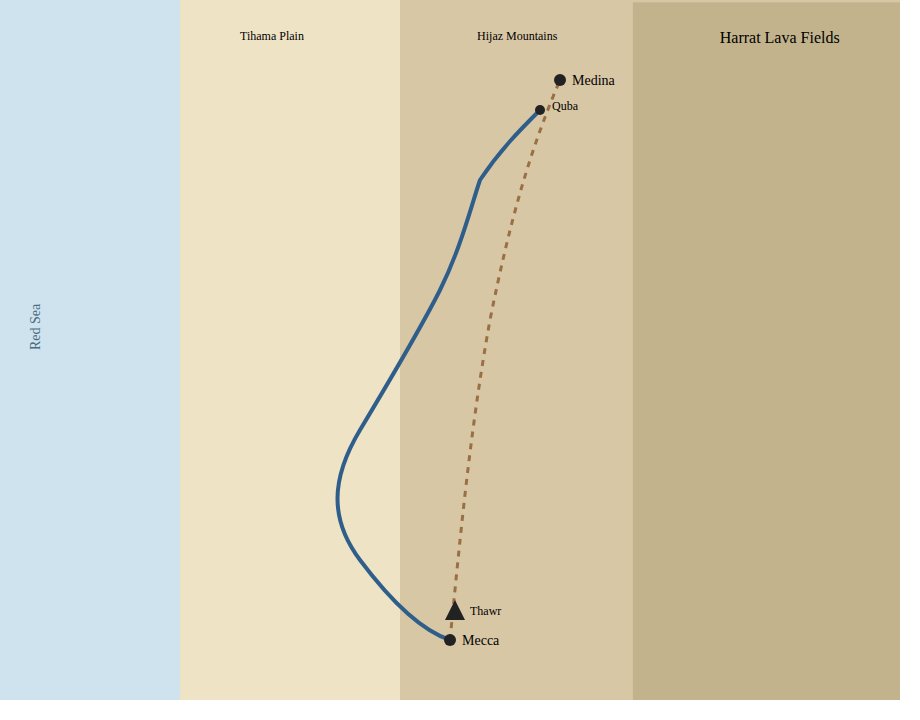
The detail of the cave is one of the most famous moments of the hijra. Muhammad and Abu Bakr went to the cave of Thawr, a cave in the mountain outside Mecca, and they stayed there for three days. The assassins were watching the house, waiting for Muhammad to come out. They did not know that he had escaped. They found Ali in the bed, and they believed that Muhammad was in the bed. They did not find Muhammad. Muhammad and Abu Bakr stayed in the cave, and the tradition remembers that Abu Bakr was afraid, and that Muhammad comforted him, and that God sent spiders to weave webs at the entrance of the cave, and that pigeons laid eggs there, and that the web and the eggs deceived the pursuers into thinking that no one had entered the cave recently. The story of the cave is one of the most famous moments of the early Islamic memory, and it is one of the moments that the tradition remembers with the detail that distinguishes it from the legendary elaboration that surrounds some other moments.
The journey to Medina took about a week. The tradition records that Muhammad and Abu Bakr traveled overland, following the coast road to avoid the main caravan tracks and the pursuit of the Quraysh, and that they arrived in Quba, on the outskirts of Medina, and that Muhammad stayed in Quba for a few days, and that he then went to Medina. The tradition records that the Muslims of Medina came out to meet him, and that the women of Medina sang, and that the children welcomed him. The arrival in Medina was the beginning of the Medinan period, and the beginning of the Islamic state.
The significance of the hijra
The hijra is the most important single event in the early Islamic story, because it is the moment at which the Muslims left Mecca and went to a town that would accept them, and at which the Islamic community began to exist as a political and social entity. The migration was not just a move. It was the founding of a new center. It was the beginning of the Islamic state. It was the beginning of the Islamic calendar. It was the beginning of the period in which Muhammad was not just a preacher in Mecca but the head of a community.
The Muslims left Mecca for Medina. The migration was the result of everything that had come before — the message, the opposition, the boycott, the Year of Sorrow, Ta'if, the night journey, and the assassination plot. It was the beginning of a new phase of the story, the phase in which Muhammad would become the statesman, the judge, the general, and the head of the community.
The hijra is the year zero of the Islamic calendar. The years are counted from the hijra, not from the birth of Muhammad, not from the first revelation, but from the migration to Medina. The calendar is the sign that the migration was the founding moment of the Islamic community, the moment at which the community began to exist as a political and social entity. The years before the hijra are the years of the Meccan period. The years after the hijra are the years of the Medinan period. The calendar is the sign that the migration was the turning point.
The road out from Mecca is the bridge to that phase. The chapter ends here, with the hijra, the arrival in Medina, and the reader understanding that the road out is the bridge between the Meccan period and the Medinan period, and that the Medinan period is the period in which Muhammad would become the statesman, the judge, the general, and the head of the community. Part Five takes up the Medinan period in full: the Constitution of Medina, the battles, the Jewish tribes, and the household. The road out from Mecca is the bridge to that phase.