Part Five: Medina
A New Kind of Community
Muhammad arrived in Medina with the Muslims who had followed him from Mecca, and with a message that had already cost him his wife, his protector, his standing in Mecca, and his physical safety. He arrived in a town that had invited him, a town whose people had offered him protection and had offered the Muslims refuge, and a town whose tribal life was organized in a way that was different from Mecca's — less dominated by a single sanctuary and a single dominant tribe, more a collection of the Medinan Arab tribes, the Aws and the Khazraj, and the Jewish tribes that lived there, and the others who had a place in the town.
The first thing Muhammad had to do in Medina was to establish the community on a new footing. In Mecca, the Muslims had been a persecuted minority in a hostile town. In Medina, they were a substantial body that had its own base, its own people, its own land, and its own future. But Medina was not simply a Muslim town. It was a town of Arab tribes and Jewish tribes, of relationships and rivalries, of a settlement that had its own internal politics and its own conflicts. The Aws and the Khazraj, the two main Arab tribes of Medina, had been fighting each other for years before Muhammad arrived, and their conflict was part of the reason they had looked for a mediator and had turned to Muhammad. Muhammad's arrival, in this sense, was not only a religious event. It was an event in Medinan politics.
The Constitution of Medina — the document, or the arrangement, that is remembered in the tradition as the foundation of the first Muslim community in Medina — is the key to the transformation. It is a document that is known from the tradition, mainly from Ibn Ishaq and Ibn Hisham and the later historians, and it is one of the most remarkable pieces of early Islamic history. It is a document that binds Muslims, pagans, and Jewish tribes into a single community — the umma — with Muhammad as its leader, and with a set of rules for how the groups would live together, how disputes would be settled, how war and peace would be managed, and how each group's religious identity would be respected.
The Constitution of Medina is not, in its survival, a perfect document. It comes down to us in the traditional sources in a form that may have been shaped in transmission, and it is not a modern constitution in the sense of a single legal instrument. The document's exact date, its unity as a single text, and the precise terms of some of its clauses are all matters of scholarly debate, and the honest account does not pretend that these questions are settled. But the substance of it is clear enough: it established the Muslims of Medina — the Meccan emigrants and the Medinan helpers, the ansar — as one community, it recognized the Jewish tribes as parties to the agreement, it established the principle that the believers and the Jews were one community in the political sense while remaining distinct in the religious sense, it set rules for mutual defense, for the payment of blood money, for the conduct of war, for the resolution of disputes, and for the role of Muhammad as the final arbiter.
The document is astonishing in one respect above all: it made the Muslim community a political entity that included non-Muslims as parties to a single agreement. The Jewish tribes of Medina — the Banu Qaynuqa, the Banu Nadir, the Banu Qurayza, and others — were not forced to convert. They were not required to give up their religious identity. They were bound, in the political arrangement, to the Muslims as allies and as parties to the same community, and they were given rights and Obligations under the same framework. The constitutional idea — that a religiously diverse population could be organized into a single political community under a single leadership — was not a common idea in the seventh century. The Constitution of Medina is, in this sense, one of the most original political documents of the early period.
For the biographer, the Constitution of Medina is one of the most important pieces of the story, because it shows Muhammad making the transition from a man who had been a preacher and a persecuted leader to a man who was now the leader of a real political community. The community that had followed him from Mecca was not just a religious group. It was now, in Medina, a polity. The Constitution was the framework in which that polity was built, and it was the framework in which the Muslims and the Jewish tribes and the others lived together for the years that followed, before the conflicts with the Jewish tribes that will be the subject of Chapter 25.
The Constitution matters for what it reveals about the man who made it. Muhammad had arrived in Medina as a refugee with a following. He could have set himself up as the leader of the Muslims only, excluding the other groups of the town. He did not. He made a compact that included the Jews, that recognized their distinct religious identity, that gave them rights and obligations within the same political framework as the Muslims. This was not a universal declaration of religious freedom — the document was a political arrangement made in a specific situation, and it was shaped by the needs of that situation — but it was, in its context, an unusual act of political inclusion. It set a precedent for the kind of polity Muhammad would try to build: a community that was, in the religious sense, Muslim, but that in the political sense could include others.
The Constitution also established the principle of the qibla — the direction of prayer — at this stage. The Muslims at first prayed facing Jerusalem, in a gesture of connection with the Jewish and Christian tradition and with the site of the night journey. The qibla would later be changed to Mecca, and the change would be one of the markers of the community's independence, but at the beginning the Jerusalem orientation was part of the Abrahamic framework in which the community was formed.
The difference between the physical arrival and the political act was the difference between the refugee and the founder. Muhammad's arrival in Medina was the physical event. The Constitution was the political event. The two together transformed Muhammad from a refugee with followers into the head of a community. The story from this point is the story of that community in action — the legal and administrative work of the statesman, the battles that followed, the political and religious crisis with the Jewish tribes, and the way the community developed into the shape that would carry Islam into the rest of Arabia.
The Constitution also made provision for the clan-based structure of Medinan society. The document did not erase the tribal affiliations that had shaped the lives of the people of Medina. It acknowledged them. It bound the various tribes to each other through the new political community while leaving their internal structures intact. This was a pragmatic arrangement. The tribes were realities. The new community had to work with them, not pretend they did not exist. The result was a polity that was layered: the political community of the umma on top, the tribal affiliations underneath, and the religious community of Muslims within and across both. This layered structure would prove unstable over time — the conflicts with the Jewish tribes, the growing distinction between Muslims and non-Muslims, the eventual breakdown of the arrangement — but at the moment of its creation it was a genuine attempt to build a political home for groups that had not previously lived together under a single authority.
With the Constitution in place and the community established, Muhammad was now the leader of Medina as well as the leader of the Meccan emigrants. The next chapter looks at what it meant for Muhammad to become a statesman, a judge, a tax collector, a legislator, and a man who had to receive revelations that were, from this point, longer, more legal, and more concerned with the conduct of a state.
The Prophet Becomes a Statesman
Muhammad's life did not end with the migration to Medina. It changed shape. In Mecca, he had been a preacher, a persecuted leader, a man who had received revelations and had been subjected to the pressure of a hostile town. In Medina, he became, over time, a statesman.
The change is not a change of vocation. The revelations continued, and Muhammad was still the man who received them, who believed they came from God, and who transmitted them to his community. But the character of the revelations changed, and the character of Muhammad's work changed with them. The Meccan revelations had been short and intense, focused on judgment, the vulnerable, the one God, and the warning to the Quraysh. The Medinan revelations, from the time after the migration onward, were longer, more detailed, and more concerned with law,with community organization, with the rules of inheritance and marriage and divorce, with the rules of war and peace, with the treatment of the poor and the orphan and the debtor, with the structure of the community and the relationships between the Muslims and the other groups in Medina.
The change in the revelations reflects the change in Muhammad's circumstances. In Medina, Muhammad was not just the man who warned a hostile town. He was the man who had to govern a community, resolve disputes, collect taxes, organize the defense of the settlement, negotiate treaties, and make decisions that affected the lives of a population that included Muslims, Jews, and the other inhabitants of the town. The revelations that came in Medina were the revelations of a man who was doing those things, and they were the revelations of a man who was receiving from God the guidance that would shape the community's legal and moral life.
The boredom that the biographer has to guard against here is the sense that the Medinan period is a catalogue of rules and campaigns, the sense that the statesman's work is less interesting than the preacher's. This is a mistake. The Medinan material is where the biography's most distinctive insight sits — the insight that the revelations change character with the job, and that the change tells us something about the man who received them. Muhammad was not the same man after the migration that he had been before. He was the same man, but he had a different job, and the revelations that came to him while he was doing that job were different in kind. The sequence of the revelations — short and intense, judgment and warning in Mecca; long and legal, detail and regulation in Medina — is not an accident. It is the record of a life in which the message grew with the responsibilities.
The statesman's work included the administration of the community. Muhammad set up the systems by which the Muslim community in Medina would live: the collection of the zakat, the alms tax, the poor tax, the systematic giving of a portion of wealth to the support of the poor and the community; the organization of the distribution of spoils and the rules for the division of wealth that came into the community from war and from other sources; the regulation of marriage, divorce, and inheritance; the establishment of the prayer times and the communal prayer; the regulation of the market and the weights and measures; the rules for the treatment of the orphan, the debtor, the traveler, the captive, the slave, and the freedman.
The statesman's work also included the judiciary. Muhammad decided disputes between members of the community, between Muslims and the other inhabitants of Medina, and between the tribes. The tradition records that he was the final arbiter in Medina, and that disputes were brought to him, and that he decided them according to the revelations that had come and according to the principles that the community was building. The judicial role shows Muhammad in a new register — not just the preacher or the warner, but the man who had to apply the message to the concrete problems of a real society.
The tradition preserves a number of cases that give a sense of how this worked in practice. There are reports of disputes over inheritance, over the boundaries of property, over the treatment of debtors, over the responsibilities of one tribe to another when a killing had occurred. The details of these cases are not always consistent across the sources, and some belong to the later tradition's effort to illustrate Muhammad's wisdom. But the general picture is clear enough: Muhammad was the point at which the community's legal and moral questions came to rest. He was not, in the Medinan period, a king in the sense of a ruler who imposed his will by force on a subject population. He was, rather, a leader whose authority rested on a combination of religious standing, personal reputation, and the consent of the groups who had agreed to be part of the community he led. That authority was real, but it had to be exercised in a context where the Medinan tribes retained their own loyalty and their own grievances.
The statesman's work also included the military and the diplomatic.
The statesman's work also included the military and the diplomatic. The battles that would follow — Badr, Uhud, the Trench, and the later campaigns — were not the subject of a standing army in the modern sense. They were the actions of a community that had to defend itself, to organize raid and counter-raid, to negotiate with the surrounding tribes, and to deal with the Meccan elite's determination to destroy the Muslim community. Muhammad was the head of the community in these matters, and the decisions he made — when to fight, when to wait, when to negotiate, when to forgive — were the decisions of a man who was both a religious leader and a political leader, and who had to make the two roles work together.
The point of the chapter is not to list these functions. It is to show that the period in Medina was the period in which Muhammad became a statesman, and to argue that this matters for the biography because it shows the life of a man who was given a message and then had to live out that message in the practical life of a real community. The Medinan period is not the anticlimax of the Meccan period. It is the period in which the message, which had been a warning to Mecca, became a social and legal and political reality in Medina, and in which the man who brought the message had to live with the consequences of that reality.
The chapter ends here, with Muhammad established in Medina as the head of a community that was both religious and political, and with the reader understanding that the Medinan revelations and the Medinan work were the record of a life in which the message became a state. The next chapter — Chapter 22 — will look at the first battle, Badr, the raid that became a battle, and the way the outnumbered Muslims won and were transformed.
Badr
The first battle of the Muslim community in Medina came out of the normal Arabian practice of raiding, and it turned into something that changed the movement's sense of itself forever.
The background is the rivalry between Mecca and Medina, the persistence of the Meccan elite's determination to destroy the Muslim community, and the economic and political logic of Arabian warfare. The Muslims in Medina were not simply a religious community. They were a political and military entity, and they had to secure their own food, their own wealth, their own safety, and their own position. The Meccan elite, for their part, had not abandoned the idea of destroying Muhammad and his followers. The boycott had failed. The emigration to Abyssinia had not eliminated the Muslims. The assassination plot had failed. The Muslims had escaped to Medina. The Meccan elite now faced a community that was established outside Mecca, that was building its own power, and that was, from the Meccan point of view, a threat to the town's prestige and its economic position.
The raid that became the Battle of Badr began as a Meccan caravan. The tradition records that a caravan of the Quraysh, returning from Syria under the leadership of Abu Sufyan, was making its way back to Mecca, and that Muhammad and the Muslims set out to intercept it. The caravan was a rich target. It was carrying goods that had been acquired in Syria, and the Muslims hoped to capture it. The Meccan elite, hearing that the Muslims were coming, sent a force from Mecca to protect the caravan — a force that was intended to defend the goods and to teach the Muslims a lesson. The caravan itself, under Abu Sufyan, heard that the Muslims were coming and took a different route, escaping the interception. But the Meccan force, now without the caravan to defend, was still in the area, and the Muslims, having learned that the caravan had escaped, decided to face the Meccan force instead.
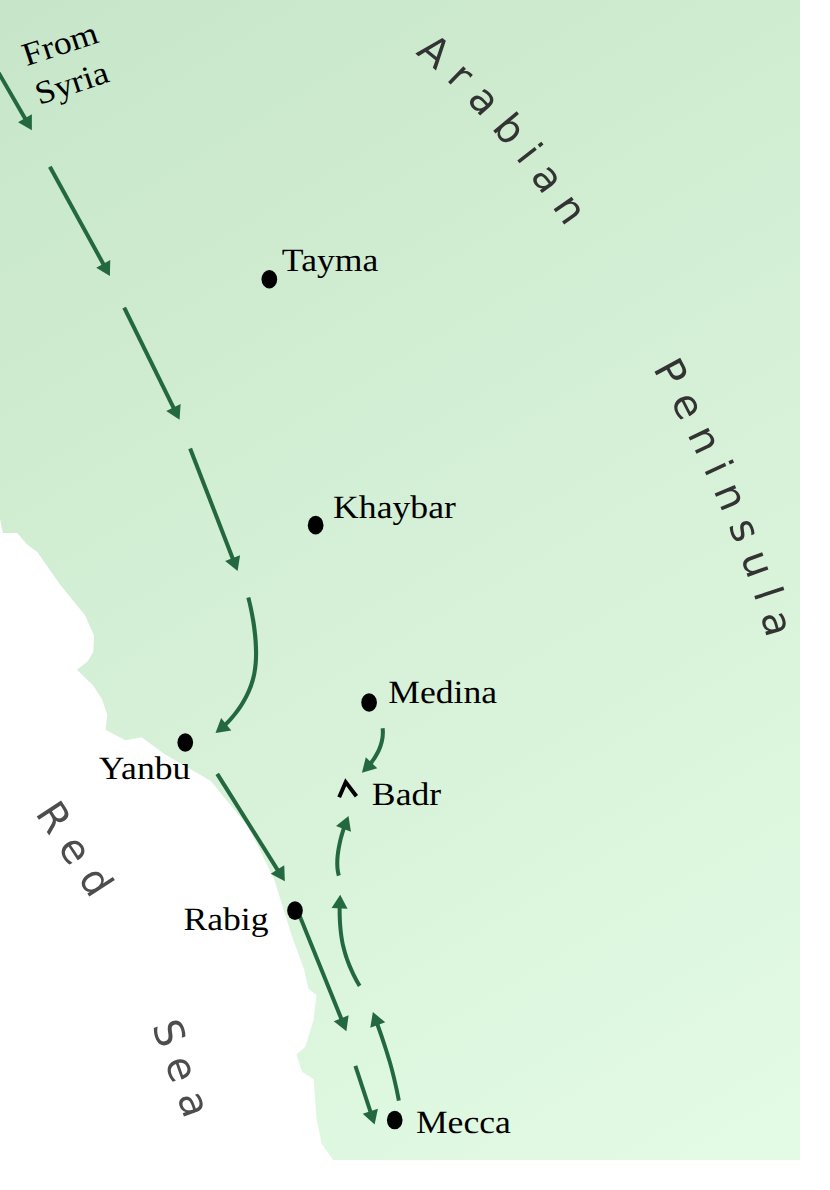
The battle took place at Badr, a place between Mecca and Medina, in the year 2 AH (624 CE). The Muslims were heavily outnumbered. The Meccan force is traditionally given as around a thousand men, the Muslim force as around three hundred. The Muslims had the advantage of morale, of the belief that God was with them, and of the leadership of Muhammad. The Meccans had the advantage of numbers and of equipment and of the confidence of the proud Quraysh.
The battle was fought, and the Muslims won. The tradition records the course of the battle, the deaths of the Meccan leaders — among them Abu Jahl, the most determined of the early opponents — the capture of the Meccan prisoners, the division of the spoils, and the way the victory transformed the Muslim community's understanding of itself. The victory at Badr was the first major military success of the Muslim community, and it was a success that came against a force that was stronger in numbers and that had all the local advantages. The Muslims believed, and the Qur'an later reflected, that the victory was a sign of God's help, and that it confirmed the truth of the message.
The battle was not, however, simply a triumph. The Muslims had made choices that brought them to this point — the choice to intercept the caravan, the choice to fight rather than withdraw when the caravan escaped. These were choices made under pressure, in a moment when the community's survival was still uncertain. The victory validated those choices, but it did not erase the risks they had involved. The community that won at Badr was not yet a secure power. It was a small group that had just astonished itself by defeating a much larger force, and the exhilaration of the victory sat alongside the knowledge that the Meccan elite had not been destroyed and would not stop.
The prisoners taken at Badr were treated according to the rules that Muhammad set.
The battle was not a simple thing. The Muslims had planned to intercept the caravan and had ended up fighting the Meccan force instead. The battle was the result of choices made in a specific context, and it was the result of the Arabian practice of raiding and the Meccan determination to destroy the Muslim community. The Muslims were not a nation-state. They were a community that had to fight to survive, and Badr was the fight in which they first proved that they could survive against the Meccan elite's military power.
The prisoners taken at Badr were treated according to the rules that Muhammad set, and the treatment of the prisoners is one of the episodes in the early story that the tradition records in detail and that the modern reader should read with care. The Muslims took prisoners, and they treated them in ways that were, in the context of Arabian warfare, relatively humane — some prisoners were released in exchange for ransom, some were released for nothing, some were set free on the condition that they teach the Muslims to read and write. The kindness that the tradition records in the treatment of some prisoners is the kind of detail that the later tradition preserved because it wanted to show that the Muslims were better than their enemies, and that Muhammad's community had standards. The honest biographer does not flatly dismiss the tradition's record of humane treatment, but he also does not pretend that the battle was a modern operation, or that the treatment of prisoners was free from the roughness of the period.
The victory at Badr changed the balance of power in Arabia. It showed the Quraysh that the Muslims could not simply be crushed by force. It showed the Muslims that they could fight and win. It strengthened the morale of the Muslim community. It made Muhammad's leadership more secure. It gave the community wealth from the spoils. It made the Meccan elite realize, with alarm, that the Muslims were a serious force.
For Muhammad, the victory had a personal dimension as well. He had been the one who made the decision to intercept the caravan. He had been the one who led the community into the battle. The victory confirmed his leadership in a way that nothing before had done — not the respect of the Meccans in the years before his prophethood, not the fact that he was known as al-Amin, not the support of Khadija and Abu Talib. Badr was a public test, and he had passed it. The man who had once come down from the cave thinking he was mad had now led a community to victory against a force that outnumbered it. The contrast between those two moments — the cave and Badr — is one of the measure of the change that the first fourteen years had produced.
The chapter from this point turns to the way the Meccan elite recovered and planned revenge, and the way the next battle, Uhud, would come in 625 and would end in a Muslim defeat and a serious loss. But Badr is the first battle, and it is the battle that established the Muslim community as a military force. The victory at Badr was not the end of the story. It was the beginning of a phase of warfare that would continue for years, and that would test the community in ways that Badr did not.
The chapter ends here, with the Muslims victorious at Badr, the spirits of the community high, and the Meccans determined to recover. The next chapter — Chapter 23 — will look at Uhud, the defeat, and the way losing changed the movement.
Uhud
The second major battle of the Muslim community in Medina ended in defeat, and the defeat mattered.
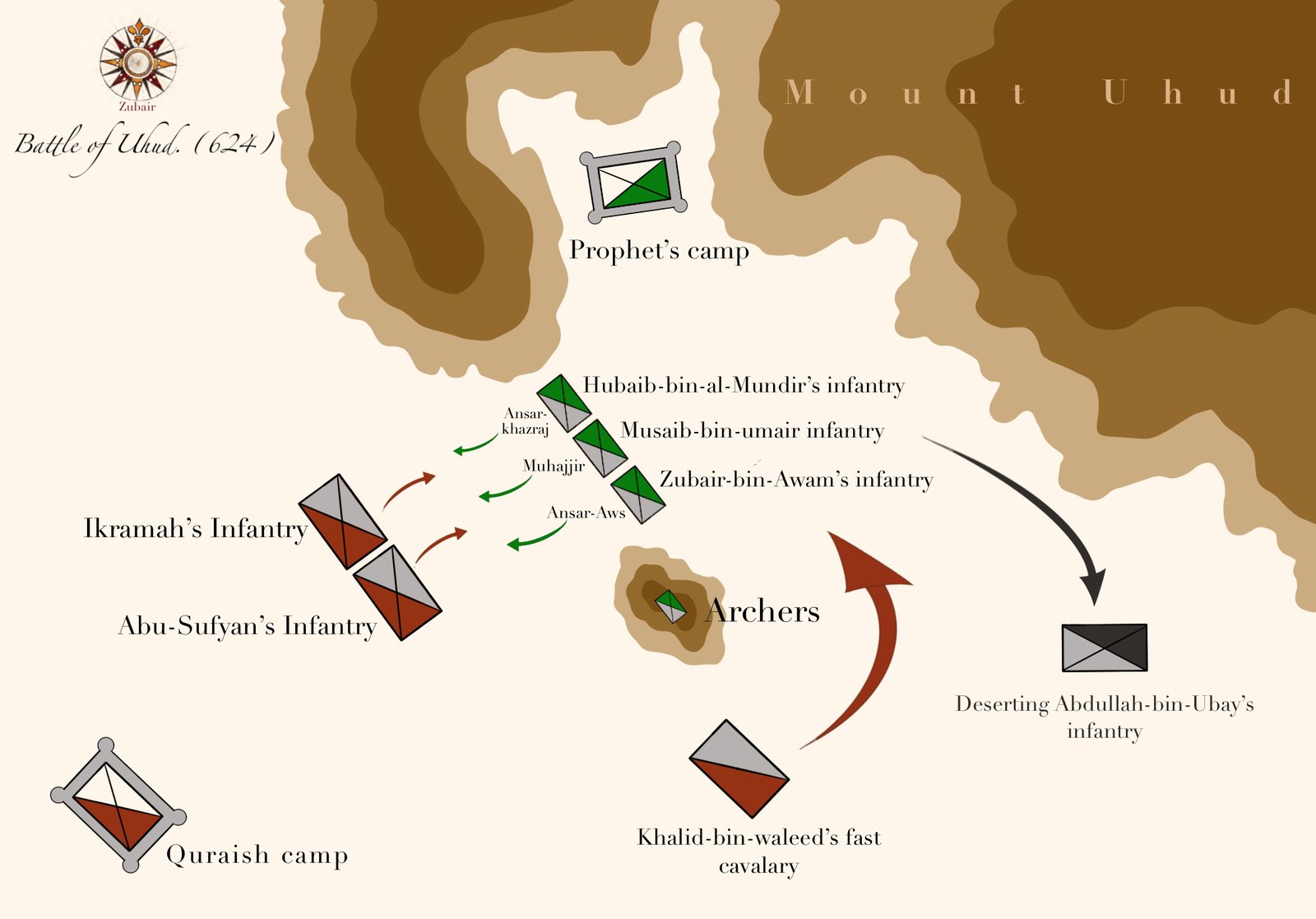
Uhud took place in 625, a year after Badr, and it is remembered as the battle in which the Muslims were beaten back, in which the Meccan force under Abu Sufyan managed to inflict serious losses, and in which the Muslims' own disobedience contributed to the outcome. The battle was fought on the slopes of Mount Uhud, north of Medina, and the terrain played a role in the fighting. The Muslims had taken a position on the mountain, with a small detachment left to guard the rear against a Meccan flanking movement. The Meccans attacked, the Muslims fought, and at a critical moment some of the Muslim fighters — young men, tempted by the hope of capturing the Meccan war booty — left their position against orders and went down from the mountain to pursue the Meccan army. The move left the Muslim lines exposed, and the Meccans turned and counterattacked, and the battle turned into a reversal.
The defeat was serious. Some of the Muslims were killed — seventy men, by the traditional count — including a number of the leading men of Medina and the Meccan emigrants. Among the dead were the uncle of Muhammad, Hamza, who had been one of the first to take up the sword in defense of the Muslims and who had become a symbol of the community's martial spirit. The loss of Hamza was a personal blow to Muhammad and a symbolic wound to the community, because he had been a figure of such visible courage. Muhammad himself was wounded — the tradition remembers the wound, the rumor that he had been killed, and the way the rumor spread, and the way he was found alive afterward and confirmed that he was alive. The loss of life was not trivial. It was a setback, and it was an emotional shock, and it was a test of the community's confidence in the way that Badr had not been a test.
The question of Hamza's death is one of the moments in the battle that the tradition remembers with particular sharpness. He was killed by a slave of the Meccan force, in an exchange that the sources describe in some detail. The killing was not, in the tradition's account, a noble duel between warriors but a sudden act in the confusion of the battle — which is, in its own way, a more honest kind of detail than a more heroic version might have been. The death of such a prominent figure in such a manner is the kind of thing that the later tradition preserves because it was felt to matter, and it matters because it shows that the battle was not a clean encounter but a violent event in which the outcome was determined by many small acts, some of them ugly.
The Qur'an's response to Uhud is one of the most direct pieces of evidence for the way the early community processed a military defeat. The suras that came after Uhud contain passages that are, in tone, very different from the triumphant passages after Badr. They speak of the wound that was inflicted on the Muslims, of the distress of the battle, of the Muslims' guilt for disobeying Muhammad's orders, and of the need for steadfastness and repentance. The tone is not triumphal. It is somber, instructional, and honest. The Qur'an does not hide the defeat. It takes it seriously, and it uses it to teach the lessons that the defeat made visible.
The Muslims' disobedience at Uhud is an important detail. The young men who left their position against orders were tempted by the promise of war booty, and their action exposed the lines and contributed to the defeat. The tradition records the sequence clearly, and it records the lesson that the community had to learn — that success in battle depended not only on fighting but on obedience to the strategy, and that the pursuit of booty could have consequences that outweighed the immediate gain.
The Meccan side of the battle is also worth tracking. The Meccans under Abu Sufyan had not abandoned their determination to crush the Muslims. Badr had been a defeat for them, and Uhud was, in part, the chance to recover. The Meccan force came to Uhud with the memory of Badr in mind, and the battle was, in their terms, a reversal of the earlier result. But the reversal was not complete — the Meccans did not follow up to take Medina, and the Muslims remained in the town, and the battle ended without the Muslims being destroyed.
The chapter from this point turns to the way the defeat affected the Muslim community, the way the morale was restored, and the way the community continued to develop despite the loss. Uhud was a serious setback, but it was not a catastrophe. The Muslims remained in Medina. Their leadership was intact. Their faith, though shaken, was not destroyed. The defeat was a test, and the test was the subject of the Qur'anic response, which used the defeat as a lesson in discipline, obedience, and steadfastness.
The chapter ends here, with the Muslims having suffered a defeat they did not want, and with the reader understanding that Uhud was a serious loss, but that the community survived it, and that the next phase — the Battle of the Trench — would test them in a different way, and would require them to defend Medina itself rather than to meet the Meccans in the open field.
The Trench
The third major military crisis of the Muslim community in Medina came in 627, when a large confederate force assembled against Medina itself, and the Muslims had to defend the town rather than meet the enemy in the open.
The background is the accumulation of the Meccan elite's hostility, the continuing rivalry, and the alliances that brought together the Meccans and their allies in a force large enough to threaten the Muslims' survival. The tradition records that the Meccans, after Badr and Uhud, were still determined to destroy the Muslim community, and that they gathered a confederate force from Mecca and from the surrounding tribes — a force that was intended to attack Medina directly. The confederate army is traditionally given as a large force, and the Muslims, who were outnumbered, had to find a way to defend the town.
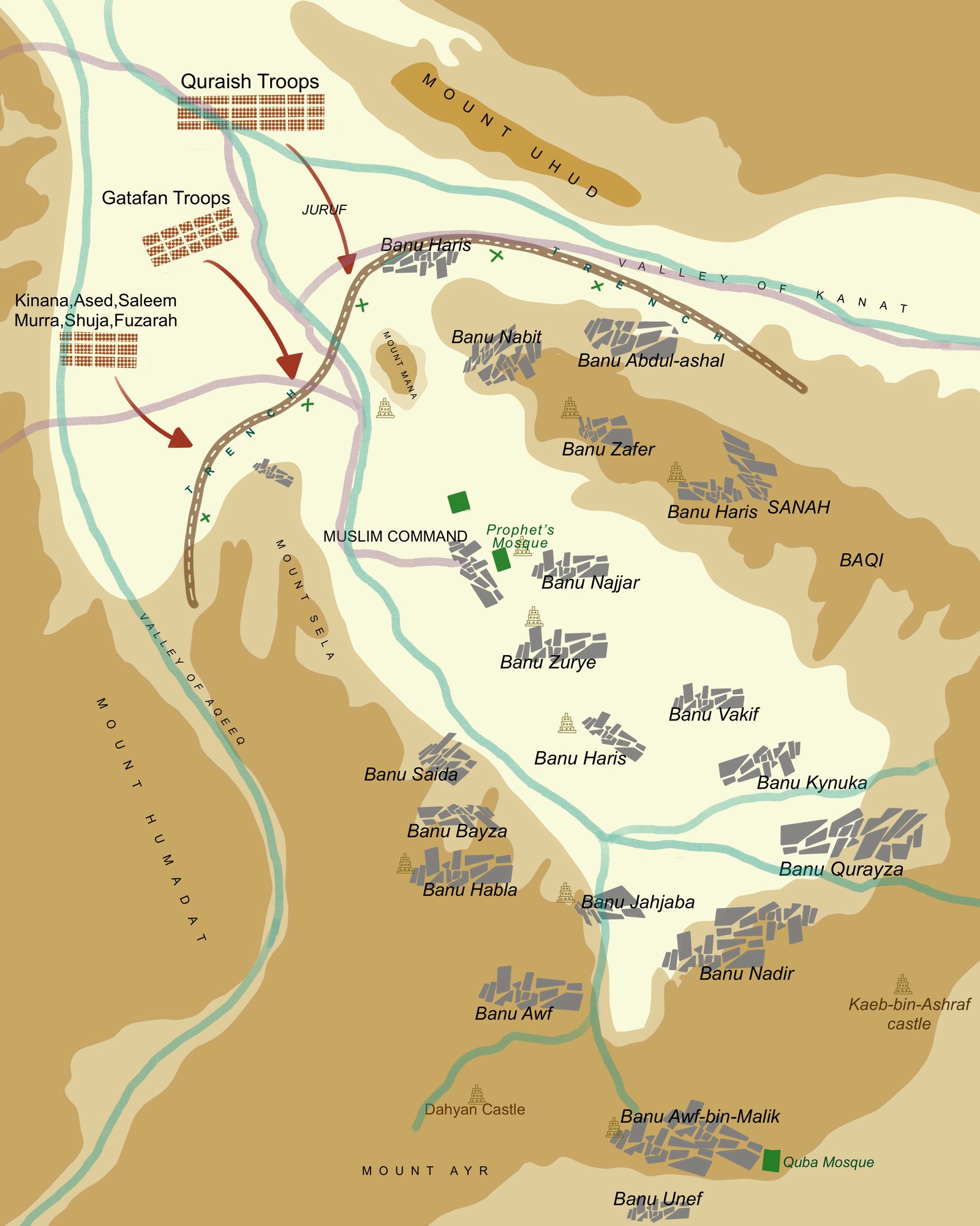
The defense centered on a trench dug around the exposed side of Medina. The idea was to create a barrier that the confederate cavalry could not easily cross, and to force the enemy into a siege rather than a pitched battle on terms favorable to them. The trench is one of the most distinctive elements in the early Islamic military story, and it is one of the clearest examples of Muhammad's strategic thinking in Medina. The trench turned the battle into a siege, and the siege turned on the endurance of the Muslims, the weather, the mutual antagonisms within the confederate force, and the negotiations that eventually broke the siege.
The siege lasted for some weeks, according to the tradition, and the Muslims were under severe strain. The confederate army surrounded Medina, and the Muslims in the trench faced the enemy across the barrier, and the situation was tense, and the outcome was not assured. The pressure of the siege, the way it worked, and the way the Muslims held out are worth tracking carefully. The trench itself was an innovation — digging a ditch around the exposed side of Medina was not a standard Arabian tactic, and it reflected Muhammad's willingness to adapt the methods of warfare to the specific circumstances of this siege. The confederates expected to fight a pitched battle or to storm the town; they did not expect a defensive ditch that neutralized their cavalry. The surprise was mutual: the Muslims surprised the confederates by the existence of the trench, and the confederates surprised the Muslims by the stubbornness of their siege.
The confederate force did not remain united throughout the siege. The tradition records that the Meccans and their allies had their own internal tensions, and that the weather, and the failure of the siege to break, and the negotiations, led to a collapse of the confederacy. The siege ended with the confederates withdrawing, and the Muslims' survival was secured. The Battle of the Trench was not a victory in the sense of a field battle in which the Muslims defeated the enemy in open combat. It was a victory in the sense that the Muslims survived a siege that was intended to destroy them, and that the confederate force failed to take Medina.
For Muhammad, the siege was a test of a different kind from Badr or Uhud. In both of those battles, the Muslims had chosen to meet the enemy in the open — at Badr by intercepting a caravan and ending up fighting the Meccan force, at Uhud by taking the field north of Medina. At the Trench, the choice was defensive: to stay inside Medina, to dig the ditch, to wait. This was a decision about how to fight, and it reflected the changed circumstances of the community. By 627, the Muslims had been fighting for three years. They had won at Badr and lost at Uhud. They had a growing population in Medina and a network of alliances. The Meccan elite had not given up, but they had not succeeded in destroying the community either. The Trench was the moment when the community's survival was tested at its most serious, and when the defensive strategy — the trench, the refusal to come out and fight on the Meccans' terms — proved to be the right one. The decision to dig the trench rather than meet the confederates in the open was, in its way, as significant as the decision to fight at Badr.
The chapter from this point turns to the aftermath of the siege, the way the Muslim community had been tested severely, and the way the victory, such as it was, had consequences for the position of the community in Medina. The Battle of the Trench was a test of endurance, and it was a test that the Muslims passed. The siege had been one of the most serious threats the community had faced, and the survival of Medina was a real achievement.
The chapter ends here, with the Muslims having survived the siege, and with the reader understanding that the Battle of the Trench was a different kind of victory from Badr, and that the community had been tested in a way that Badr and Uhud had not tested it, and that the survival of Medina was the foundation for the next phase of the story. The next chapter — Chapter 25 — will look at the Jewish tribes of Medina, the conflicts that followed, and the way the conflicts resolved.
The Jewish Tribes
By the time Muhammad had established the Muslim community in Medina and led it through Badr, Uhud, and the Trench, the relationship between the Muslims and the Jewish tribes of Medina had become one of the most difficult and consequential relationships in the early Islamic story.
The constitutional arrangement of Chapter 20 had brought Muslims, Meccan emigrants, Medinan helpers, and Jewish tribes into a single political community, the umma, with Muhammad as the final arbiter. The Jewish tribes — the Banu Qaynuqa, the Banu Nadir, the Banu Qurayza, among others — were parties to this arrangement, with their own religious identity intact, their own laws, their own synagogues, and their own position in Medina. The Constitution had recognized that the Muslims and the Jews were one community in the political sense while remaining distinct in the religious sense. That was the arrangement, and for a period it held.
The breakdown of the relationship did not happen all at once, and it did not happen for a single reason. It happened over the course of the Medinan period, in a series of episodes involving different tribes, in a context of war, treaty, and suspicion, and in a way that the sources — late, partisan in their survival, and shaped by the later tradition's need to explain what had happened — do not fully clarify.
The sources that tell us about the Jewish tribes are the same sources we have been using throughout: Ibn Ishaq and Ibn Hisham's sira, al-Tabari's history, the hadith, and the Qur'an. They are all Islamic sources, all written decades and in some cases centuries after the events, and all shaped by the need to present the story in a form that made theological and political sense to the community that transmitted them. To read them honestly is to read them with the question in mind: what did the tradition want to say about the Jewish tribes, and what can we be sure actually happened?
The traditional account gives a sequence of three major episodes: the Banu Qaynuqa, the Banu Nadir, and the Banu Qurayza.
The Banu Qaynuqa, a Jewish tribe in Medina, came into conflict with the Muslims after the Battle of Badr. The tradition records that a dispute broke out between a Muslim and a member of the Qaynuqa, that tensions escalated, and that the Muslims besieged the Qaynuqa in their fortress. The Qaynuqa surrendered, and the Muslims expelled them from Medina, allowing them to leave with their families and their possessions, with the exception of their weapons, which were taken. The expulsion of the Qaynuqa was the first removal of a Jewish tribe from Medina, and it set a precedent for what would follow.
The Banu Qaynuqa were, like the other Jewish tribes of Medina, a community of merchants — their strength lay in trade, in their position in the market, in their skills with metalwork. The conflict with them came at a moment when the Muslims had just won at Badr and had gained confidence and momentum. The Qaynuqa's fort was in the southern part of Medina. The siege lasted for fifteen days, according to the traditional account, after which the Qaynuqa surrendered. Their expulsion was not, in the tradition, a massacre — they were allowed to leave — but it was a serious event, the first time a Jewish tribe had been removed from Medina, and it marked the beginning of the breakdown of the constitutional arrangement.
The Banu Nadir came next. The tradition gives a different reason for the conflict. It says that a Muslim was killed by members of the Nadir — or that the Nadir were involved in a plot against Muhammad — and that Muhammad summoned the Nadir to answer for it, and that they refused to accept the arbitration, and that the Muslims besieged them, and that they surrendered on terms that allowed them to leave with their possessions except for their weapons and land. The Nadir left Medina and went to Khaybar and other places, and their land and property became part of the Muslim community.
The Banu Nadir were different from the Qaynuqa in important respects. They were a wealthier tribe, with more land and more property, and their removal therefore had a larger material consequence for the Muslim community. Their land — the cultivated fields and the date palms — was distributed among the Muslims, and the wealth that came from it helped to support the community. The Nadir also had connections with the Meccan elite, and the tradition records that they sent messengers to Mecca to encourage the Quraysh to continue the fight against the Muslims. Whether that was a cause of their expulsion or a consequence of it is one of the questions the sources do not settle clearly. The Nadir left Medina in 625, after the battle of Uhud, and their departure marked a second step in the breakdown of the arrangement with the Jewish tribes.
The Banu Qurayza were the last and the most serious. The episode came during or just after the Battle of the Trench, in 627. The traditional account says that the Qurayza had broken their treaty with the Muslims and had sided with the confederate army that was besieging Medina, and that after the siege failed, the Muslims turned on the Qurayza, besieged them in their fortress, and after a siege of their own, the Qurayza surrendered. The judgment on the Qurayza, according to the tradition, was made by an arbitrator — Sa'd ibn Mu'adh, a chief of the Aws, one of the Medinan tribes — and the judgment was that the men of the Qurayza who had reached puberty should be killed, and that the women and children should be taken captive. The tradition records the execution of the men.
This is the account that the sources preserve, and it is the account that has generated the most controversy, the most debate, and the most damage to the reputation of Islam in the minds of hostile readers, and the most pain to the minds of believing readers.
A careful reader of history has to read this account with several things in mind.
First, the sources are late. The story of the Jewish tribes is told by the Islamic tradition, and the tradition's account was shaped by the need to justify what had happened. We cannot be sure that every detail is accurate, or that the reasons given for the conflicts are the real reasons. The tradition gives reasons for the conflict with each tribe — the Qaynuqa for a personal dispute and general hostility, the Nadir for a murder or a plot, the Qurayza for treachery during the siege. These reasons may be true, or they may be the tradition's way of explaining events that had more complex causes. The honest account does not pretend that the reasons are settled beyond dispute.
Second, the numbers are disputed. The tradition gives specific numbers for the deaths of the Qurayza — the most famous figure is 600 or 700 men, but there are other figures, and the sources do not agree. The scale of the killing is a matter of historical debate, and the honest account does not present any single number as certain. What can be said is that a significant number of the Qurayza men were killed, and that the women and children were taken captive, and that this was a serious event by any standard.
Third, the context matters. The conflict with the Jewish tribes took place in a Medina that was at war, in a community that was under pressure, and in a situation in which the treaty relationships, the suspicions, the political alignments, and the military realities had all broken down. The expulsion of the Qaynuqa and the Nadir, and the killing of the Qurayza men, were the result of a political and military situation, not a theological or racial program. The Muslims did not set out to kill all the Jews of Medina. The conflicts with each tribe were specific, and they happened in the context of the Medinan war and the breakdown of the treaty arrangements.
Fourth, the killing of the Qurayza men happened. This is the fact that the honest biographer must not evade. Whatever the nuances, whatever the uncertainties about the numbers, whatever the arguments about the reasons, the traditional account is that the men of the Qurayza were executed after the siege. The killing was not a light matter. It was a serious violation, by modern standards, of the norms that we would apply to a civilian population. The honest account does not excuse it. The honest account does not pretend that the tradition's account is obviously wrong. The honest account sets out the fact, with the context, and lets the reader sit with it.
Fifth, the scholarly debate about the events is real, and it should be acknowledged. Some scholars — particularly those working from the later Western orientalists' tradition — have argued that the traditional account is exaggerated, that the numbers are inflated, that the reasons given for the conflict are insufficient, that the judgment was not as it is remembered, or that the event should be understood in a different way. The most prominent version of this argument is that the number of Qurayza killed — 600 or 700 men — is too high, and that the real number was much smaller, or that the killing was not the indiscriminate execution of all the men but a more limited punishment of the leaders and those directly involved in the breach of treaty. Other scholars — working both within and outside the Islamic tradition — have defended the broad shape of the traditional account, arguing that the Muhammad of Medina was a political leader operating in a context of total war, that the laws of war in that context did not distinguish between combatants and non-combatants in the way that modern international law does, and that the judgment of Sa'd ibn Mu'adh, however severe by modern standards, was the judgment of a recognized arbitrator within the terms of the Medinan constitution and Arabian custom.
The honest account does not take a side in this debate that cannot be settled. It presents the traditional account, it acknowledges the debate, and it acknowledges the uncertainties. It is worth noting, however, that the scholarly debate has itself been shaped by the passions the episode arouses. The readers who most want to reduce the numbers are often those who want to minimize the moral problem; the readers who most want to hold to the traditional numbers are often those who want to hold Muhammad to the full severity of the act. The honest reader should be aware of this dynamic and should not let it decide the question for them.
The other side of the chapter is the relationship between the Muslims and the Jews before the breakdown.
This chapter is the chapter most likely to be quoted against the book. It should be written for a reader who is a devout Muslim and for a reader who is a hostile critic, and it should leave both feeling that they were dealt with honestly. The goal is not to minimize the killing, or to deny it, or to excuse it, or to make it the centerpiece of the whole story. The goal is to tell the truth about what happened, with the context that makes it intelligible, without flinching and without sensationalizing.
The other side of the chapter is the relationship between the Muslims and the Jews before the breakdown. The Constitution of Medina had brought them together. The Jewish tribes had been parties to the agreement. There had been periods of cooperation, of trade, of mediation, of coexistence. The breakdown was not the whole of the relationship. The relationship had a history, and the history matters for the biography because it shows that the Muslims and the Jews of Medina did not begin in a state of permanent war. They began in a political arrangement, and the arrangement broke down.
The Jewish tribes of Medina were not a monolith. The three tribes were different from one another in their politics, their alliances, their traditions, and their relationship to the Muslims. The Qaynuqa, the Nadir, and the Qurayza did not all act the same way, and they did not all face the same outcome. The honest account keeps them separate, and it does not treat them as a single entity.
The chapter ends here, with the traditional account of the three episodes, with the uncertainties and the debates acknowledged, with the killing of the Qurayza men stated plainly, and with the reader left to decide what to make of it. The next chapter — Chapter 26 — will look at Muhammad's household, the later marriages, the age question surrounding Aisha, and the way the Prophet's private life became, in the later tradition and in the later polemics, one of the most contested areas of his story.
His Household
Muhammad's household in Medina was not a single thing, and it is one of the most contested areas of his life — in the Islamic tradition, in the modern historical scholarship, and in the public reception of his story.
After the death of Khadija in the Year of Sorrow, Muhammad married again, and over the years of the Medinan period he took several wives. The wives were not all of one kind. Some of them were widows of Muslims who had died in the battles or in the early years of the community, and their marriages to Muhammad were in part a protection and an honor for the families of the fallen. Some were political alliances, marriages that connected Muhammad to other tribes and to the leaders of the surrounding Arab groups, and that were a way of building relationships and securing alliances. Some were marriages that took place for other reasons, including the marriage to Zaynab bint Jahsh, which was, according to the tradition, a public demonstration that a man could marry the woman his adopted son had divorced, and that the old Arab custom of adoption did not create a prohibition resembling the prohibition of blood kinship. The tradition records the marriages as they happened, and it records the reasons, and it records the fact that the Prophet's household was not a uniform institution.
The number of the wives and the timing of their marriages have been the subject of endless attention in the Islamic tradition and in the polemics of opponents. The Islamic tradition remembers that Muhammad's wives were "mothers of the believers," that they were women of standing, that they were to be treated with respect, and that the Prophet's household was held to a high standard. The polemics of opponents have focused on the number of the wives, on the ages of some of them, and on the marriage to Aisha in particular, in ways that have shaped the public understanding of Muhammad out of all proportion to what the sources actually say.
The marriage to Aisha bint Abi Bakr is the most discussed of all, and it deserves a careful, plain treatment.
The traditions in the Islamic sources — mainly the hadith collections of Bukhari and Muslim and the later biographical tradition — give Aisha's age at the time of the marriage. Two main figures appear: that she was married at the age of six or seven, and that the marriage was consummated when she was nine. These figures come primarily from the hadith collections of Bukhari and Muslim, and specifically from the reports transmitted through the chain that goes back to Aisha herself, in which she is reported as saying that she was seven or nine when the consummation took place. The most commonly cited report is the one in which Aisha states that the Prophet married her when she was six and consummated the marriage when she was nine. The other traditions in the same collections suggest a different chronology, and that she was older — that she was a young woman of marriageable age in the Arabian context at the time, perhaps in her mid-teens. The difference between the two traditions is not a small one, and it has been the subject of debate among Muslim scholars and Western historians for a long time.
The hadith that gives the nine-year figure is narrated by Aisha herself in Bukhari, and it is one of the most frequently cited pieces of evidence in the debate. The chain of transmission goes back to Aisha, and the report is therefore, in the terms of hadith scholarship, a direct narration from the wife herself — which is, in the context of hadith study, as close to a first-person account as the tradition provides. The counter-tradition, which gives an older age, is less prominent in the canonical collections but is found in other sources and has been argued by scholars who question whether the nine-year report should be taken at face value. The existence of the counter-tradition is not in doubt; what is in doubt is its weight relative to the nine-year report.
The honest account of this issue needs to register several things.
First, the traditions are not unanimous, and the earliest sources do not agree on the age. The figure of nine for the consummation is a well-known and well-attested tradition, but it is not the only tradition, and it is not the only figure. Some scholars — among them the conservative scholars of the Islamic tradition who hold to the reliability of the hadith collections — have argued that the traditional figure is the more reliable, and that Aisha was in fact young at the time of the marriage. They point to the direct narration from Aisha herself in Bukhari, to the consistency of the report across the collections, and to the fact that the nine-year figure has been the dominant understanding in the Islamic tradition for centuries. Other scholars — among them some Western historians and some Muslim scholars who have revisited the question — have argued that the alternative tradition, the one that gives her an older age, is also valid, and that the marriage took place when she was a young woman in the terms of seventh-century Arabia. These scholars point to the inconsistencies in the chronological reports, to the possibility that Aisha's own narration in Bukhari may have been shaped by the norms of the later tradition, and to the argument that the age of Aisha's sister Asma — who is reported to have been fifty at the time of the conquest of Mecca in 630, which would make her born around 580, and therefore older than Aisha by a significant margin — supports an older age for Aisha than the nine-year figure.
The debate between these two positions is not a small or marginal one. It goes to the heart of how the sources are to be read. The conservative position holds that the hadith collections are reliable enough to settle the question, and that the nine-year figure should be accepted. The revisionist position holds that the hadith collections, for all their careful preservation, were shaped by the concerns of the later tradition, and that the age question cannot be settled by the hadith alone. The honest account does not settle the question definitively, because the sources do not settle it definitively.
Second, the context of seventh-century Arabia matters. The age of marriage in the Arabian peninsula in the seventh century was not the same as the age of marriage in the twenty-first century, and the norms of the time and place were different. The tradition that Aisha was young at the time of the marriage needs to be read in the context of an Arabian society in which the age of marriage could be younger than it would be understood today, and in which a marriage of this kind would not have been regarded as anomalous. The honest account does not pretend that the facts, whatever they are, can be understood apart from the world in which they happened, and it does not pretend that the modern reader's instinctive response to the age question is the only legitimate one. At the same time, the honest account does not pretend that the modern instinctive response is illegitimate. A reader today, reading about a marriage to a girl of nine, will have a reaction, and that reaction is not a sign of bad faith. The honest account allows the reader to have the reaction without insisting that the reaction settles the historical question.
Third, the purpose of the marriage in the tradition was not simply a personal arrangement. Aisha was the daughter of Abu Bakr, who was one of the first believers and who would become the first caliph. The marriage was, in part, a bond of alliance between Muhammad and the most important of the first believers, and it was a marriage that connected the Prophet to the man who would succeed him in the political leadership of the community. The political dimension of the marriage is not a secret in the tradition. It is part of the record, and it matters for understanding why the marriage took place and why it was important.
Fourth, the treatment of Aisha in the later tradition has its own history. Aisha was not simply the child bride of the Prophet. She was a woman who grew up in the household of the Prophet, who became one of the most important transmitters of hadith, who argued with Muhammad and outlived him by decades, and who was a central figure in the early Islamic political and intellectual life. The tradition remembers her as a woman of learning, of strong opinion, and of importance. The account of her marriage in the later tradition does not erase this, and the honest account does not erase it either.
Aisha's role as a transmitter of hadith is one of the most significant facts about her. She is reported to have narrated more than two thousand hadith, and she was one of the principal sources for the early biographical and legal tradition. Scholars of the Islamic tradition — men and women — studied with her, and her reports are found in all the major hadith collections. She was not a marginal figure in the early community. She was a central one, and her centrality is one of the things that the later polemics about her age tend to obscure. The honest account of Aisha should include the fact that she was a major intellectual figure in the early Islamic community, that she was a source of law and tradition, and that her later life was one of the most consequential in the early Islamic period.
Aisha's political role after Muhammad's death is also part of the story. She was involved in the conflict between Ali and those who demanded that the assassins of Uthman be punished, a conflict that led to the battle of the camel, in which Aisha led a faction against Ali. The battle was a defeat for her, and she was removed to Medina after it, where she spent the rest of her life as a scholar and transmitter of the tradition. The fact that she led a faction in a civil war is one of the things that the later tradition records with some ambivalence — she is remembered as a woman of strong opinion and as a figure who took a political side, and the later Sunni tradition in particular has not always known what to do with that fact. The honest account does not erase the political dimension of Aisha's life, and it does not reduce her to the age question alone. She was a woman of many dimensions, and the biography should reflect that.
The topic is handled without apologia and without anachronistic prosecution. The traditional reports are given. The scholarly arguments about their reliability are given. The different marital norms of seventh-century Arabia and of Mediterranean antiquity are set out. The reader is left to judge for himself, with the facts and the context in view.
Zaynab bint Jahsh is a different case, and it is worth a separate note. The marriage to Zaynab was, according to the tradition, a public demonstration that the old Arabian custom of adoption — the practice of making a son of a man's slave or of a close relative into a full son — did not mean that the adopted son's former wife was forbidden to the man in the way that a blood daughter-in-law was forbidden. The marriage was arranged to make this point, and it was a demonstration of the new Islamic law's break with the old custom. The tradition records the episode as a deliberate move by Muhammad to show that the new law was in effect, and it records the way the community responded. The point of the chapter is to include this in the record of the household, as one of the marriages that was not only a personal arrangement but also a public act with a legal meaning.
The other wives, in the main, were women of different kinds — widows of fallen Muslims, women of political families, women who came into the household for reasons the tradition records. The list is not a list of equals in the sense of a moral or biographical taxonomy. It is a list of women who were in the household of the Prophet at different times, for different reasons, and whose lives in that household became part of the record.
Muhammad's private life, in Medina, was not a separate world from his public life. It was entangled with it — his wives were political alliances, his wives were mothers of the believers, his wives were transmitters of the hadith, his wives were the women who carried the memory of his life into the next generation. The household was not a retreat from the public story. It was part of it, and the way the household is remembered is part of the reason the public story of Muhammad has taken the shape it has.
The chapter ends here, with the household described in the terms that the sources allow, with the Aisha question treated plainly, and with the reader left to make up his own mind about the age question, as the honest historian must leave it. The next chapter — Chapter 27 — will look at the Treaty of Hudaybiyya, the treaty that looked like a defeat and was the making of the movement.