Part Six: The End
Going Anyway
The warning came from the prophet Agabus, and it came in the courtyard of the house in Caesarea, and it came after Paul had already made up his mind.
That is the order, and the order matters. The reader should not get the impression that Paul met a warning, sat down, and weighed his options. He had been warned by people much nearer to him than a prophet from Jerusalem who had travelled down to Caesarea for the purpose of saying what he had to say. The friends who loved him had been begging him not to go for months. The money had to be delivered, and it had to be delivered in person, and that was the whole argument, and Paul had already answered it to his own satisfaction and to the satisfaction of the people who were going with him.
What Agabus added was not a reason. It was a picture. He took Paul's belt, the leather belt Paul wore around his robes, and he tied his own hands and feet with it, and he said the Holy Spirit spoke through him and that the Jews in Jerusalem would bind the man who wore the belt in the same way and deliver him into the hands of the Gentiles. It was a dramatic performance, and it was the sort of thing that the church had learned to respect, and it was the sort of thing that could have stayed Paul's hand if Paul had been the sort of man who was persuaded by dramatic performances.
He was not.
Luke tells the story in Acts 21, and Luke tells it carefully. Luke tells us that the prophet's warning was received not with disbelief but with grief. The people with Paul wept. They begged him. They said, in effect, do not go. They said it in the name of the friends and the companions who had come down from the churches with the money, and they said it in the name of Paul's own safety, and they said it in the name of the obvious fact that Caesarea was a Roman port and Jerusalem was a city on a short fuse and the trip between them was the short stretch between a man in his right mind and a man handed over to the authorities.
Paul's answer was characteristically direct and characteristically unbothered by the emotional force of the moment. He said that the man should not be weeping, because he was ready not only to be bound but to die in Jerusalem for the name of the Lord Jesus. He said it in a way that sounds, to the modern reader, almost reckless. The reader should slow down here and not let the recklessness swallow the sense.
The collection had been in the making for years. The money had been raised from the Gentile churches, churches in Galatia and Macedonia and Achaia, churches that Paul had founded and that were poor and that had given generously anyway. The collection was Paul's longest project apart from the mission itself. It ran through the letters, through the repeated mentions, through the sending of representatives, through the careful effort to make sure the gift arrived in a form that would not offend the people it was meant to relieve. It was a practical thing and a theological thing at the same time. It was meant to be proof that the Gentile churches were not a separate thing but part of the same family as the mother church in Jerusalem, proof that the covenant promise had reached the ends of the earth and come back to its source.
The argument of the collection, the theological argument, was that the Gentiles were debtors to the Jews, not in the sense of a debt of guilt but in the sense of a debt of gratitude and relationship, and that the settling of the debt was itself a witness. Paul says in Romans that the non-Jews should come and pray with the Jews and that the non-Jews should share in the spiritual blessings, and the collection is the material form of that argument. It is the hard, visible thing that stands for the invisible claim that the family is one.
That was also the argument that made the collection dangerous. The Jerusalem leadership did not entirely trust the Gentile mission. The rivals did not trust it. The collection threatened nobody and everybody at once. It was a gift, and gifts are disarming, and yet it was a gift that said the giver had been right about the thing the recipients were uncertain about. It was a reconciliation gesture that almost guaranteed that somebody would feel that it had been administered badly or that the wrong terms had been set. The collection had killed the project before it was ever delivered. The question was whether it would kill the man who carried it.
Paul knew this. He knew it better than the prophet in Caesarea, and he knew it better than the friends who were weeping in the courtyard, and he knew it better than Luke would know it when Luke wrote the account years later and tried to make the whole thing look like a divine drama that Paul had stepped into without quite understanding.
Paul knew it because he had spent the months before the journey working to make sure the delivery was as clean as it could be. He had sent Trophimus ahead, and Trophimus had not been the problem. Trophimus was a Gentile, and the temple had zones, and Gentiles were not meant to go where only Jews could go, and the accusation in Jerusalem would be false and still it would have a shape. Paul had made sure the men who accompanied the money were purified at the temple, done the ritual washing, paid the cost, made the gesture that said the delivery would be ritually correct even if the opposition would not accept it as correct. He had done everything he could do to minimise the offence of the delivery.
He could not minimise the opposition.
The opposition was already there. The rivals had been watching the collection from a distance, and the Jerusalem leadership was nervous, and the city was tense, and the long-simmering question of the Gentiles and the law and the table and the boundary had not been settled in Jerusalem even if it had been settled in principle at the earlier meeting. Paul was arriving with money from the churches that had refused circumcision, money from the churches where James's own emissaries had caused trouble, money from the churches whose very existence was the argument Paul had won and lost and won again across a decade. The money itself was a provocation disguised as a gift.
Paul had seen enough of the world to know that provocations disguised as gifts were the ones that people remembered.
The friends who begged him not to go were right. The reader should not let Paul's resolution cancel their accuracy. They were not weeping because they did not understand the theology of the covenants or the place of the collection in the argument of the letter to the Romans. They were weeping because they knew the man, and they knew the city, and they knew that a man like Paul, arriving in a city like Jerusalem with a purpose like this, was walking toward something that had his name on it.
They were right that the thing was dangerous. They were right that the prophet's dramatic performance was probably not just a performance but a genuine sense of what was coming. They were right that the temple was a trap if Paul was going to be anywhere near it in the hours when the accusation could be made. They were right that the Roman authorities, if they got involved, would not care about the theology and would care a great deal about the riot.
They were right, and Paul went anyway.
The going anyway is the subject of this chapter, and it is not the same thing as stubbornness. It is not the same thing as a hero's refusal to turn aside. It is the settled conviction of a man who has been told by God to go to Jerusalem even if it means chains and sufferings and who has understood, for years, that the thing he was called to do was not the comfortable thing and not the thing that made sense to the people who loved him. Paul does not present himself in the letters as a man who had a monopoly on courage. He presents himself as a man who had a task and a conviction that the task had to be done and that the cost was part of the cost of the task.
The task was the delivery of the collection. The conviction was that the collection mattered, and that the delivery mattered, and that the man who had raised it and escorted it was the man who had to bring it in. Paul had spent years telling the Gentile churches that their gift was not a sentimental gesture but a binding act of fellowship. To leave the gift in Caesarea or in Troas or to send it by courier and not in person would have been to say that the fellowship was real only up to the point where it became unsafe. Paul did not believe that. He believed that the thing he was doing had to be done in person and at the cost it cost.
The death he faced was, in his own understanding, not an accident and not a failure but part of the story he was in. The letters do not say that Paul expected to be executed. They do not say that he expected to die in Jerusalem. But they say, in several places, that his life was not his own and that he was being poured out and that he was being led in chains and that the thing he feared was not death but being unfaithful. The death he was walking toward was, in this sense, already part of the thing God was doing with him, and to turn back at Jerusalem would have been to say that the story had reached a place where the man who had been following it had the right to decide the terms.
He did not believe that, either.
The reader who knows the story already will know what happened in Jerusalem. The reader who does not know it should be warned that the next chapter is the chapter of the arrest and the riot and the years in custody and the appeal to Caesar and the slow, strange, professional custody that Rome gave a man it did not quite know what to do with. The arrest came from the temple, and it came from the accusation that Paul had brought Gentiles into the temple, and it came from the violence of the crowd and the failure of the Roman tribune to understand what was happening until it was too late. None of that should be invented by the reader in advance. But it is worth knowing that the warning was not wrong.
The warning at Caesarea was not wrong. The friends were not wrong. The prophet's drama was not wrong. The thing that Paul did, going anyway, was not done because the warnings were false or because the danger was imaginary. It was done in full knowledge of the danger, and in full knowledge that the knowledge would not help, and in full knowledge that the thing had to be done anyway.
That is the shape of the chapter and the shape of the man at this point in the story. He was not ignorant. He was not mistaken about the world. He was not a man who had not listened. He was a man who had listened, and who had heard what was coming, and who had resolved to go because he believed he had to.
There is a temptation, in writing about this moment, to make Paul into a prophet of his own fate, a man who saw death in Jerusalem and accepted it as his martyrdom. That is not what the letters suggest. The letters suggest a man who knew that risk was part of his life and that he had already paid so much of it that one more payment was not the thing that frightened him. The letters suggest a man who was more concerned with the integrity of the thing he was carrying than with the survival of the man carrying it. The letters suggest a man who had, by this point, reached the point where the question was not whether he would be safe but whether he would be faithful to the thing that had been given him to do.
The collection had to be delivered. The church in Jerusalem had to be met, even if it was met under accusation. The Gentile churches had to be represented in person, because representation in person was the point. Paul had argued, in Romans and in the other letters, that the covenant was one and that the family was one and that the non-Jews were not a separate branch but members of the same body. The delivery of the collection was the most concrete expression of that argument available to him. He could not delegate it. He could not send it by messenger and have it count for the same thing. He had to go.
He went.
He went from Caesarea. He went up to Jerusalem. He did not go in disguise and he did not go quietly and he did not go expecting to be welcomed, though he went hoping to be received. The hope was not naive. It was the same hope that ran through the letter to the Romans and the same hope that ran through the collection and the same hope that had kept the churches contributing for years. He hoped the thing he believed was true about the family would be enough to receive him.
He hoped it and he went.
Some readers will want to read this chapter as a story about martyrdom and some will want to read it as a story about stubbornness and some will want to read it as a story about the cost of principle. All three readings contain something true. None of them contains everything. The honest reading is the one that keeps them apart and holds them together at the same time. Paul was not courting death, and Paul was not being stubborn, and Paul was not selling a principle to people who did not care about it. Paul was carrying a gift that had taken years to assemble, into a city that was dangerous for him, in full knowledge of the danger, because he believed the gift had to be delivered and the thing behind the gift had to be made real and the man who had spent his life arguing for it had to be the man who brought it in.
The death he faced was part of the story. He did not say that. Luke says a version of it in Acts, and Luke puts the speech in Paul's mouth a little later in the chapter, when Paul tells the tribune and then the crowd that he had been bound in a chain in Jerusalem and that he had been rescued by the Romans and that he had stood before Felix and Festus and that he had appealed to Caesar because there was no evidence against him and that he had to go to Caesar. Luke also has Paul say, to the people in Jerusalem, that he had received a call to be sent to the Gentiles, and that the things he was doing were known to God, and that he was standing trial for the hope of the promise made to the fathers.
The letters are quieter about the death. The letters say that Paul had been in danger many times and that he had been rescued and that the danger had not stopped him. The letters say that Paul had been prepared to die in Jerusalem and that he was ready to be bound and that he was ready to die for the name of the Lord. The letters say, most powerfully in 2 Corinthians 1:8-10, that Paul had been given over to death and had been delivered and that the delivery had only made him rely on God more. The letters do not present death as the goal. They present the work as the goal and the survival as the gift and the death as the thing that had already been visited on Paul more than once and could be visited again.
That was enough.
The reader who comes to this chapter wanting a hero will find a man who walked into Jerusalem knowing what was coming and knowing he could not stop it and knowing that the thing he believed about the family had to be made real at the cost of his own safety. The reader who comes to this chapter wanting a fool will find a man who knew the risks and took them anyway. The reader who comes to this chapter wanting a theologian will find a man who had spent his life arguing that the non-Jews belonged in the covenant and that the covenant was not over and that the collection was the proof of the thing he had been saying for years.
All three are present. None is the whole man.
The whole man at this point in the book is the man who had spent thirty years in motion and was now, at the end of the motion, carrying the thing that mattered most into the place where it was most dangerous. The man who had written Romans, the longest argument he had ever made, and who had argued in it that the story of Israel was not over and that the non-Jews were grafted in and that the gifts and calling were irrevocable. The man who had learned, by the end of his life, that the thing he had been given to do was not the comfortable thing and that the thing he had been given to do had to be done by him and in person and at the cost it cost.
He went anyway.
He went up the road from Caesarea to Jerusalem in the season when the city was swelling with pilgrims and the temple was full and the accusations were ready and the man with the money in his bags was aware, as he had been aware for months, that the thing he was carrying was the last great project of his life and that the cost of delivering it would be what it cost.
The next chapter is the chapter of the arrest and the riot and the years in custody at Caesarea and the slow, strange, professional Roman custody that followed, and of the decision to appeal to Caesar, and of the voyage that began and the shipwreck that ended it and the house arrest in Rome that began the last part of the story that Acts tells and that Acts alone tells and that the letters do not tell and that the reader has to be careful with.
The man who went anyway arrived in Jerusalem. He went into the temple to complete the purification. He was accused. The crowd turned. The tribune arrested him. The years in custody began. The collection was delivered, but not in the form he had hoped for and not without the cost he had been willing to pay.
The chapter that follows is the chapter of what happened when the man who was ready to die for the name of the Lord walked into the city where that death had been coming for him for a long time.
Arrest
The arrest happened in the temple, and it happened in the hours when the temple was most crowded and most volatile, and it happened because the accusation was made in the right place at the right time and by the right people.
That last phrase — "the right people" — is doing a lot of work. The accusation was not made by people who were enemies of Paul in the abstract. It was made by people who had been watching the collection for months, people who had watched Paul bring Gentiles into the fellowship and who had watched the Jerusalem leadership try and fail to control what came of it, people who understood, better than Paul understood, that the arrival of a man carrying money from the Gentile churches was not an arrival that could be received without a fight. The accusation was not an afterthought. It was prepared. It was waiting.
Luke tells the story in Acts 21, and Luke tells it with the care of a man who knows he is writing the thing that will be remembered. Luke gives us the accusation in detail: that Paul had brought Greeks into the temple and had defiled it. Luke gives us the crowd turning: the Jews from Asia who had seen Paul in the city and recognised Trophimus the Ephesian in the city with him and assumed the worst. Luke gives us the tribune's intervention: the Roman officer who had been told that the whole city was in an uproar and who knew, from long experience, that the way to handle a riot in Jerusalem was to arrest the man at the centre of it and ask questions later.
None of that should be invented by the reader in the sense of imagining details that the sources do not give. But it should be understood that the sources themselves — especially the letters — give us a man who had been arrested before and who had been rescued by the Romans before and who had been told, in the letters, that he would be handed over to the Gentiles again. The warning at Caesarea, the belt tied around the hands, the picture of the binding: all of that was not a guess. It was a forecast.
The riot in the temple was the sort of riot that Jerusalem produced regularly and the sort that the Roman authorities handled regularly, and it was the sort that Paul had seen in other forms and in other cities. It was not, in its origin, a theological riot. It was the riot of a crowd that had been told, by people it trusted, that a man had done something outrageous, and that had been given a moment of outrage to work on, and that had worked on it until the temple guards and the Roman tribune and the centurions were all involved and the man at the centre of it had been dragged out and the gates shut and the crowd left pounding on the doors and the man inside being protected by the soldiers he had been trying to reach.
The accusation was false. Trophimus had not been brought into the temple. Gentiles were not allowed into the inner courts, and the accusation depended on the fact that the crowd would not check and would not distinguish between a Gentile being in the city and a Gentile being in the temple. The accusation was the sort of lie that works because it is the sort of thing that might have happened, and that works because the city was already tense and because the rival teachers had already been talking and because a man with a Gentile name in the city was a thing the crowd could feel angry about without having to think.
The crowd turned, and the tribune turned, and Paul turned, and the direction of the turning was toward the barracks and then toward the years of custody.
What the letters tell us about this moment is less than what Luke tells us. The letters do not describe the temple riot. They do not describe the tribune's intervention. They do not describe the years of custody at Caesarea in anything like the detail that Acts gives. But the letters tell us, in several places, that Paul had been in custody before and that the custody had been rescued and that the rescue had been the work of God and that the experience had made Paul rely on God more and that the experience had not stopped the work.
The letters tell us, most powerfully in 2 Corinthians, that Paul had been given over to death and had been delivered and that the delivery had only made him rely on God more. The letters tell us that Paul had been in danger many times and that he had been rescued and that the danger had not stopped him. The letters tell us that Paul had been in prison and had been released and had gone on writing and going and sending. The letters do not present the arrest in Jerusalem as a surprise. They present it as one more delivery of the thing Paul had been told he would face.
The reader who wants to know what Paul thought in the hours after the arrest will not find that in the letters in the form of a narrative. The reader will find, instead, that the letters are full of the conviction that the arrest was not the end of the work and that the work had to continue and that the man who had been arrested was still the man who had the things to say and the churches to encourage and the collection to deliver — even if the delivery would now be delivered by a letter or by a word passed through a visitor or by a visit that happened under guard.
The years in custody at Caesarea are described by Luke in Acts 21–25, and described with the care of a man who had either been there or had been close to someone who had been there. The description gives us the Roman governors: Felix, who was corrupt and kept Paul in custody for two years because he hoped for a bribe, and Festus, who was more or less honest and did not know what to do with a man who had appealed to Caesar and who was therefore out of his hands. The description gives us the Jewish leadership, who came down from Jerusalem to argue the case and who were, as always, divided among themselves and unable to present a case that held together. The description gives us the hearings: the hearing before the tribune, the hearing before Felix, the hearing before Festus, the hearing before Agrippa, and the decision, at the end, that Paul had done nothing that deserved death and that he had done nothing that deserved imprisonment — and that he had appealed to Caesar and therefore had to go to Caesar.
The description is careful, and the care matters. Luke does not invent the hearings. Luke does not invent the governor's hesitation. Luke does not invent the fact that the Jews could not agree on what the charge should be. Luke gives us a man who was being held without being tried, held by one governor who wanted money and held by another governor who wanted to be fair and could not find a charge that would hold, and who was therefore, in a strange way, being protected by the fact that nobody could agree on what he had done wrong.
That is part of the shape of the custody. Paul was not in custody because he had been convicted. He was in custody because he had been arrested in a riot and because the Roman authorities did not know how to handle a man who was at once dangerous to the peace and not clearly guilty of anything that Roman law cared about. The custody was the sort of custody that Rome gave to people it did not quite know what to do with — long, slow, professional, and shaped by the fact that the man in custody was, from the Roman point of view, a nuisance rather than a criminal.
The reader should understand that the custody was real. The reader should understand that the custody was not a divine drama in which Paul was being whisked around for the purpose of preaching to governors. Paul was in custody. He was in custody for years. He had lost the freedom he had been moving in for thirty years. He had lost the ability to go where he wanted to go and to see the churches he wanted to see and to deliver the collection in the form he had hoped for. The custody was a real cost. It was also, in the strange arithmetic of Paul's life, the thing that delivered him to Rome and therefore to the hearing that Acts spends so much time on and that, in Luke's telling, is the thing that completes the journey to the capital.
The appeal to Caesar is the decision that moves Paul from the custody in Caesarea to the voyage to Rome, and the decision is interesting because it is both strategic and costly and because it is both the thing Paul chose and the thing that, in the Roman legal system, was simply available to him as a Roman citizen. Paul says in Acts that he appealed to Caesar because there was no evidence against him and because he was being handed over to the Jews and because he had to go to Caesar. Paul says, in the letters, that he had appealed to Caesar and that the appeal had meant that he would go to Rome and that he had hoped, through the journey and the imprisonment, to be useful to the church in Rome and to the churches that would hear of his situation.
The appeal was, in one sense, the only thing left to do. The governor had no charge that held. The Jews had brought no charge that held. The man had been in custody for two years without being tried. The only remaining legal move, for a Roman citizen, was to appeal to Caesar, and the appeal meant that the case would be heard in Rome and that Paul would go to Rome in custody. Paul chose it, and the choice cost him the rest of his freedom for a long time, and the choice delivered him to the place where Acts ends its account and where the letters do not follow and where the reader has to stop inventing and start reading what is there.
The reader should note, at this point, that the appeal to Caesar is one of the things in Paul's story that the letters and Acts do not overlap in detail. The letters do not describe the appeal. The letters do not describe the voyage. The letters do not describe the house arrest in Rome. The letters say, in the letter to the Philippians, that Paul was in prison and that he was writing from prison and that the imprisonment had given him new opportunities to preach and that the churches should not be discouraged by it. The letters say, in the letter to Philemon, that Paul was writing from chains and that Onesimus had become useful to him in the chains. The letters do not say where the prison was, and they do not say how long the imprisonment would last, and they do not say what the outcome would be.
The reader who comes to this chapter wanting to know the full story of the arrest and the custody and the voyage will have to put together what Acts says and what the letters say and note the places where they do not agree and the places where one is silent and the other is not. The honest reading is the one that holds the two together and does not pretend that they are the same account told in the same way.
The arrest in Jerusalem was the end of the journey Paul had been on for years. The collection had been delivered, but not in the way he had hoped. The Gentile churches had not been represented in Jerusalem in the way he had hoped. The man who had spent his life arguing that the family was one had arrived in the city where the family was most divided and had been arrested before he could speak. The years in custody at Caesarea had begun, and the appeal to Caesar had been made, and the voyage to Rome was the next thing, and the reader knows what comes next because the reader knows the story already.
The man who had gone anyway had arrived, and the arrival had cost him the freedom he had been moving in for thirty years, and the cost was the cost of the things he had been told he would face. The warning had not been wrong. The friends had not been wrong. The prophet's drama had not been wrong. The thing Paul did, going anyway, was not done because he did not know what was coming. It was done because he knew what was coming and because the thing he was carrying had to be delivered and the man carrying it had to be the man who had carried it all the way.
The chapter that follows is the chapter of the voyage and the shipwreck and the house arrest in Rome, and of the end of the account that Luke gives, and of the refusal to invent what the sources do not give about the death that came after.
The arrest had happened. The years in custody had begun. The collection had been delivered in the wrong form and at the wrong cost and to the wrong reception, and the man who had carried it was now in custody in Caesarea and then on the way to Rome and then in Rome, and the story that began in Tarsus was now being written in the custody of Rome.
Rome
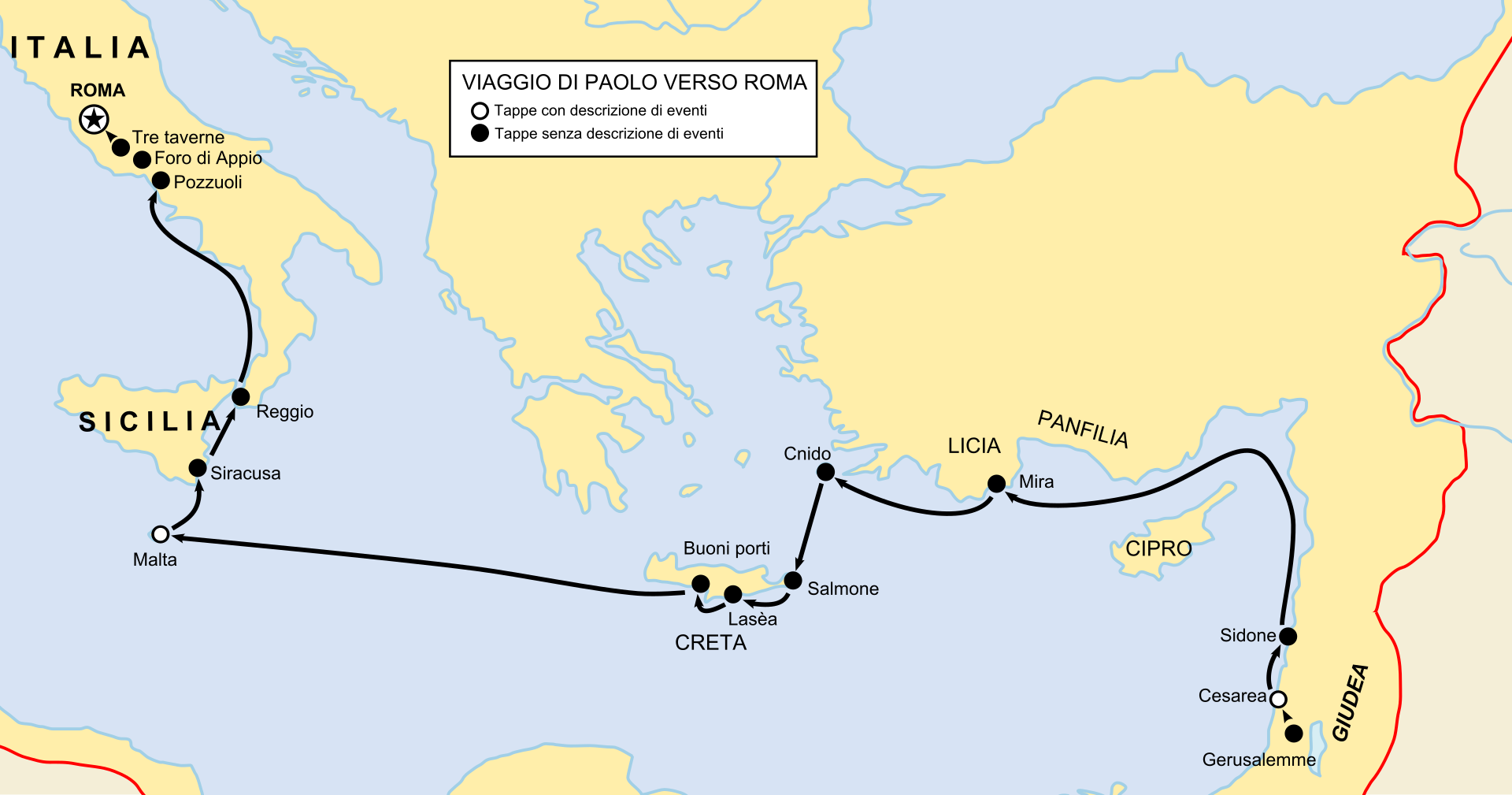
The voyage to Rome is the story that Acts tells in the longest single episode in the book, and the story is told with the kind of detail that makes it clear that the writer either was there or had been told by someone who was. The voyage does not begin in the way a modern reader might expect a voyage to begin. It begins in the decision of the centurion Julius, who had been assigned to guard Paul, to treat him with a degree of kindness, and then in the decision to leave Caesarea with the other prisoners and the soldiers and the ships, and then in the stop at Sidon and the stop at Myra and the slow, miserable slowness of a ship trying to make its way west against the wind.
The reader should not let the kindness of the centurion be the only thing that registers. The centurion was not being kind to Paul. He was being professional and, in the Roman way, humane. He allowed Paul to visit friends in Sidon. He allowed Paul to be taken on board the ship from Adramyttium. He allowed Paul to be treated as something more than a prisoner when the ship was in port. That is not the same thing as believing Paul was innocent or that the case was unjust. It is the same thing as the kind of humanity that a Roman soldier could show to a prisoner he did not want to make more difficult than he had to.
The voyage was, from the Roman point of view, a thing that had to be done and a thing that had best be done before the weather turned. The reader who knows the story already will know that the weather did turn. The reader who does not know it should be warned that the next part of the story is the part of the storm and the part of the shipwreck and the part of the island and the part of the winter that followed and the part of the one-year stay in Malta and the part of the slow, strange, professional Roman custody that continued all the same.
The storm is described with the precision of a man who knew what it felt like to be in a ship being driven by the wind and unable to steer. Luke gives us the wind: the Euroclydon, the wind that came from the northeast and drove the ship southwest and kept the ship from being able to face the wind and forced the crew to let the ship go and to be driven. Luke gives us the despair of the sailors: the lowering of the cargo, the lowering of the tackle, the despair of the passengers, the despondency of the ship, the loss of hope that the ship would be saved. Luke gives us the figure of Paul, who had been told by an angel that he would stand before Caesar and that God had given the lives of all who were sailing with him, and who therefore stood among the sailors and told them not to be afraid and told them that the ship would be lost but that the lives would be saved.
The reader should notice, at this point, that Paul's role in the storm is not the role of a man who is in control. Paul is a prisoner. Paul is a man who was told, in the letters, that he had been given over to death and had been delivered and that the delivery had made him rely on God more. Paul is a man who had been told, in Acts, that he would stand before Caesar and that God had given the lives of all on the ship. Paul is not the captain of the ship. Paul is not the man who could steer the ship out of the storm. Paul is the man who, in the middle of the storm, said that the storm would end and that the ship would be lost and that the lives would be saved, and who, in saying it, gave the sailors something they could hold on to.
The storm is not made better by being read as a divine drama. The storm is a storm. The ship is lost. The lives are saved. The reader who comes to this chapter wanting the storm to be a sign that Paul was being protected in the sense of the story being about his safety will miss the point that the storm was a storm and that Paul was in it and that he said what he said and that the ship went down and that the men swam and climbed and made it to land and that the winter followed and the custody continued.
The island is Malta, and the stay on Malta is described with the kind of attention that makes the story come alive: the fire on the beach, the snake that bit Paul and did not kill him, the strange combination of fear and curiosity that the islanders showed, the hospitality that followed, the healing of the father of the chief official of the island, the hospitality that continued, the stay that lasted through the winter, the ship that was found in the spring and the voyage that continued.
The island episode is the sort of episode that Acts is good at: the kind of story where the writer gives us the human detail and the human reaction and the strange mix of faith and curiosity that accompanies Paul's presence in a place where he is at once a prisoner and a figure of interest. The reader should not let the episode be reduced to a miracle story. The reader should let the episode be what it is: a story of a man who had been shipwrecked and was being cared for by people who had reason to be afraid of him and who became, in the course of the winter, people who were glad he was there. The reader should note that the snake story is the kind of story that the later tradition picked up and ran with, and that the later tradition ran with it in ways that made Paul into a kind of magician of the sea and that made the miracle into the point instead of the miracle being the thing that marked him as someone the islanders wanted to know more about.
The reader should note, too, that the island episode is the kind of episode that the letters do not follow. The letters do not mention Malta. The letters do not mention the stay in Malta. The letters do not mention the voyage as a voyage. The letters say, in the letter to the Philippians, that Paul was writing from prison, and they say, in the letter to Philemon, that Paul was writing from chains, and they do not say where the prison was or how long it would last or what the voyage had been. The reader who wants to know the full story has to put together the account in Acts with the silence in the letters and notice, again, that the silence is not an absence of information but an absence — the letters do not tell this part of the story, and the reader should not pretend they do.
The arrival in Rome is the arrival that Acts gives some space to, and the space matters because it tells us something about the way the story ends in the book that tells the story. Luke gives us the centurion's report to the tribune: that the prisoners were brought to Rome and that Paul was allowed to stay by himself with the soldier who guarded him, and that Paul was allowed to receive the visitors who came to him, and that Paul was allowed to preach for two years in the house where he was staying, and that Paul welcomed all who came to him and preached the kingdom of God and taught the things concerning the Lord Jesus Christ with all boldness and without hindrance.
The arrival is not the triumphant entry that a modern reader might want. The arrival is the arrival of a prisoner who is allowed, by the Roman authorities, to stay in a house under guard and to receive visitors and to preach to them. The arrival is the arrival of a man who had been told, in Acts, that he would stand before Caesar and that he would have his case heard, and who had now arrived in Rome and who had now been told, in effect, that the case had been heard and that he was not guilty and that he was to be left alone with his visitors and his preaching and his two years.
The arrival is the arrival of a man who had spent thirty years in motion and who was now, in the capital, in a house under guard and preaching to the people who came to him. The arrival is the arrival of a man who had argued, in Romans, that the story of Israel was not over and that the non-Jews were grafted in and that the gifts and the calling were irrevocable, and who was now in Rome and was now preaching to the church that had been gathered in Rome before he arrived and that he had written to in the letter to the Romans and that he had hoped to visit and that he was now visiting in custody.
The reader should note, at this point, that the two years of preaching in Rome are the last thing that Acts says about Paul. The book ends with Paul in Rome, in custody, preaching without hindrance. The book does not tell us what happened after the two years. The book does not tell us whether Paul was released or whether he was executed or whether he left Rome or whether he stayed. The book tells us that Paul was in Rome, in custody, preaching, and that the preaching continued for two years, and that the book ended there.
That is the refusal that the book makes. The book does not invent the death. The book does not invent the trial that ended in execution or the release that ended in a later journey or the letter that ended in a death outside the story that Acts tells. The book ends with the man in Rome, in custody, preaching. The reader should not add to that ending. The reader should let the ending be what it is.
The reader who wants to know what Paul wrote from Rome will find the prison letters, and the prison letters are the letters that the tradition has attached to this period — Ephesians, Philippians, Philemon, and sometimes Colossians and sometimes others, and the attachment is the sort of attachment that the tradition makes and that the reader should test rather than accept. The letters say, in the letter to the Philippians, that Paul was writing from prison and that the imprisonment had given him new opportunities to preach and that the churches should not be discouraged by it. The letters say, in the letter to Philemon, that Paul was writing from chains and that Onesimus had become useful to him in the chains. The letters say, in the letter to the Ephesians, that Paul was a prisoner in Christ, and that the imprisonment was part of the mystery that Paul had been given to make known.
The letters do not say where the prison was. The letters do not say how long the imprisonment would last. The letters do not say what the outcome would be. The letters say, in the way that the letters say things, that Paul was in prison and that the prison was part of the work he was doing and that the work was continuing and that the churches should know this and should not be discouraged by it.
The reader should note, at this point, that the prison letters are among the most carefully studied letters in the Pauline corpus and that the question of where they were written and when they were written and whether they were written in Rome or in Ephesus or in Caesarea is a question that the scholars have studied and that the scholars have not settled. The reader does not need to settle the question in order to read the letters. The reader needs to read the letters and to notice that they are letters written from a prison, and that the prison is part of the story, and that the prison is not the end of the story but the thing that the story moves through.
The refusal to invent the death is the refusal that the book has been making all along and that the book makes again at the end. The book does not tell us that Paul was beheaded in Rome. The book does not tell us that Paul was released and went on to the pastoral letters and the household codes and the silencing of women and the Paul of Augustine and Luther. The book does not tell us that Paul died in Rome or that he died anywhere else. The book tells us that Paul was in Rome, in custody, preaching for two years, and that the book ended there.
That refusal is not a refusal because the writer did not know what happened. That refusal is a refusal because the writer knew that the story he was telling was the story that Acts tells, and that the story Acts tells ends in Rome with the man in custody and the preaching continuing and the book ending. That refusal is the refusal that the reader should honour: the reader should not invent what the sources do not give, and the reader should not pretend that the sources give what they do not give, and the reader should not say that Paul was beheaded in Rome when the sources do not say that, and the reader should not say that Paul was released and wrote the pastoral letters when the sources do not say that.
The reader should say what the sources say. The reader should say that Paul was in Rome, in custody, preaching. The reader should say that the book ends there. The reader should say that the rest of the story is the story that is told by the tradition and that the tradition is not the same thing as the story Acts tells and that the reader should not confuse the two.
The reader should also note, at this point, that the refusal to invent the death is not the same thing as the refusal to think about the death. The reader can think about the death. The reader can read the tradition that says Paul was beheaded in Rome and think about whether that tradition is reliable and what it means and what it says about the way the story was remembered. The reader can read the tradition that says Paul was released and wrote the pastoral letters and think about whether that tradition is reliable and what it means and what it says about the way the story was remembered. The reader can read the tradition and think about it and not confuse it with the story Acts tells.
The book that this chapter is part of is not the book that ends with the death. The book is the book that ends with the man in Rome, in custody, preaching, and with the refusal to invent what comes after. The death is the death that comes after, and the death is the death that the tradition tells, and the death is not the death that Acts tells. The reader should let the distinction stand.
The Rome that Paul arrived in was the Rome that he had written to and the Rome that he had hoped to visit and the Rome that he had prayed about. The Rome that Paul arrived in was the Rome that had a church before he arrived, a church that had been gathered by the spreading of the word and the coming of visitors and the work of people whose names the sources do not always give. The Rome that Paul arrived in was the Rome where he would stay in a house under guard and preach to the people who came to him and teach them about the kingdom of God and the Lord Jesus Christ.
The reader should notice, at this point, that the arrival in Rome is the arrival that completes the journey that began in Tarsus and that went through Jerusalem and Damascus and Arabia and the missions and the churches and the letters and the collection and the warning and the arrest and the custody and the voyage and the shipwreck and the island and the winter and the sea and the land and the capital. The arrival in Rome is the arrival that completes the journey that the letters had been pointing toward and that the collection had been pointing toward and that the warning had been pointing toward.
The arrival is the arrival of a man who had gone anyway. The arrival is the arrival of a man who had carried the collection and the warning and the letters and the churches and the work and the cost and the risk and the thirty years of motion. The arrival is the arrival of a man who had gone anyway and had arrived in Rome and was now in custody and preaching and that the book ended there.
The chapter that follows is the chapter of the Paul who was not Paul, the chapter of the pastoral letters and the household codes and the silencing of women and the Paul of Augustine and Luther, and the chapter of the separation of the man from the monument and the end of the book.
The Paul Who Wasn't Paul
The man who wrote the letters and the man who was remembered are not the same man. The difference between them is not a small difference. It is the difference between a man who wrote arguments and a man who became a symbol, and the symbol does not contain the man and the reader who wants the man has to look past the symbol and the reader who wants the symbol has to look past the man.
This is the chapter of the separation. It is the chapter of the things that were built on top of the man after he was gone, and of the ways in which the things that were built on top of him changed what people thought he had said, and the chapter that ends the book.
The first thing the tradition built on Paul was the idea that he had converted from Judaism to Christianity, that the conversion was the event that made him the man he became, and that the man before the conversion was a Jew who had failed and the man after the conversion was a Christian who had succeeded.
This is the Lutheran construction, and it is not in the letters. The letters say that Paul was called by God's grace, that the call came to him through a revelation of Jesus Christ, that he did not consult with any human being about it, that the gospel he preached was not a gospel of human origin, that he received it from God. The letters never say that Paul left Judaism. The letters never say that Christianity existed as a separate religion that Paul could leave. The letters say that Paul remained a Jew who believed that the God of Israel had acted in the history of Israel and that what had happened in Jesus was the fulfilment of that history, not its replacement.
The tradition built the conversion story because the conversion story is the story that makes Paul a founder of a new religion. Without the conversion, Paul is a Jew who believed something new about the God of Israel. With the conversion, Paul is the man who left one religion and founded another. The latter story is the story that Augustine told, the story that Luther told, the story that the tradition told for fifteen hundred years. It is the story that made Paul into the theologian of the break between Judaism and Christianity, the story that made Paul into the man who hated the law and the man who rejected the covenant and the man who replaced Israel with the church.
None of that is in the letters. Paul says he did not consult with any human being. Paul says his gospel came from a revelation. Paul says the covenant with Abraham was not annulled by the law. Paul says the story of Israel is not over. The man who wrote those sentences did not believe he had left Judaism. The tradition that built the conversion story built it on top of a man who had not left Judaism, and the reader who wants the man has to look past the story to see him.
The second thing the tradition built on Paul was the idea that he had argued against the law, that the law had failed, that the law had been replaced by the gospel, and that Paul was the man who had made the law unnecessary and had replaced it with faith.
This is the Lutheran construction again, and it is not in the letters either. Paul says that the law is holy, and the commandment is holy, and the law is just, and good. Paul says that the law was given through angels. Paul says that the law was added because of transgressions until the seed came to whom the promise had been made. Paul says that the law was a guardian, a paidagogos, a servant appointed to bring the children to maturity. Paul says that the inheritance depends on the promise, not on the law, because the law came four hundred and thirty years after the promise and cannot annul what came before it.
Paul does not say that the law failed. Paul does not say that the law was replaced by the gospel. Paul does not say that the covenant was revoked. Paul says that the Gentiles do not have to keep the law, and that the Gentiles are justified by faith, and that the covenant with Abraham is the foundation, and that the law was the temporary measure that pointed toward the promise. The law had a function. The function was not to save. The function was to reveal transgression, to show that the inheritance could not be won by keeping rules, to prepare the way for the promise to be received by faith.
The tradition built the rejection-of-the-law story because the rejection-of-the-law story is the story that makes Paul the theologian of grace and the enemy of the law. It is the story that made Paul into the man who said that the law was bad and that the gospel was good and that the two were opposed. It is the story that the Reformers used when they argued against the Roman Catholic Church and the works-righteousness they thought they saw in it. It is the story that made Paul into the man who replaced Israel with the church.
The man who wrote the letters did not argue against the law. He argued that the Gentiles did not have to keep it. He argued that the covenant was not revoked. He argued that the story of Israel was not over. The tradition built the wrong argument on top of the man, and the reader who wants the man has to look past the argument to see him.
The third thing the tradition built on Paul was the idea that he had silenced women in the churches, that the silencing of women was the teaching of Paul, and that the silencing of women was the thing that the churches should do.
The tradition built this from the pastoral letters — 1 Timothy, 2 Timothy, Titus — and from the household codes in those letters, and from the later tradition that read the pastoral letters as Paul's own words and built the teaching of the church on top of them. The pastoral letters contain instructions about women that are not in Paul's authentic letters — the instructions about silence, about submission, about not teaching, about being saved through childbirth. The household codes set out the hierarchy of husband over wife, father over children, master over slave, and the tradition read these as the teaching of Paul.
The tradition was wrong about the authorship, and the scholars have been clear about it for a long time. The pastoral letters are from a later period. They are from a time when the church had become more institutional, when the question of authority had become more pressing, when the conflict between the Gentile mission and the Jerusalem side had been settled by the victory of the Gentile side and the imposition of order. The pastoral letters are the letters that the tradition attached to Paul in order to give his authority to the institution that had grown up in his name.
The tradition was also wrong about what Paul himself said about women. Paul named women in his letters — Junia outstanding among the apostles, Phoebe the deacon and patron, Prisca the colleague who taught Apollos, Lydia the patron who opened her house, the women who prophesied in Corinth, the women who co-worked with him in the gospel. Paul did not silence women. Paul worked with them. Paul trusted them with money and letters and the organization of the churches. Paul's letters do not contain the instructions about silence that the pastoral letters contain.
The tradition built the silencing story on top of a man who had women as co-workers and patrons and apostles and leaders, and the tradition built it in order to give its own hierarchy the authority of Paul's name. The reader who wants the man has to look past the silencing story to see the women Paul named and trusted and worked with, and to see that the silencing was the tradition's and not the man's.
The fourth thing the tradition built on Paul was the idea that he was the author of the pastoral letters, and that the pastoral letters were the letters that the church should use and teach from and build its teaching on.
The pastoral letters are the letters that the tradition has attached to Paul. The tradition has attached them to him in ways that the scholars have studied and that the scholars have not fully settled — the question of authorship is debated, and the debate matters because the letters are different from Paul's letters in their vocabulary and their theology and their situation, and the reader should test the attachment rather than accept it.
The pastoral letters are the letters that the tradition built on top of Paul in order to give its teaching about the church and about office and about order and about the way the church should be run and about the way the church should be taught and about the way the church should be led the authority of Paul's name. The pastoral letters are the letters that contain the household codes and the instructions about women and the instructions about the qualifications of the bishop and the deacon and the older women and the younger women and the slaves and the masters. The pastoral letters are the letters that the tradition read as Paul's own, and that the tradition used to build the institutional church and the hierarchy and the silencing of women and the ordering of the household and the teaching of the church.
The reader who wants to know what Paul wrote has to look at the letters that the scholars judge to be Paul's and the letters that the scholars judge not to be Paul's and the letters that the scholars judge to be disputed, and has to look at the judgment of the scholars and the letters themselves and see what they say about the church and about office and about order and about the way the church should be run, and see whether the letters fit the man who wrote the other letters and see whether the letters are the letters of the man or the letters of the monument.
The separation of the man from the monument in this area is the separation of the letters that Paul wrote from the letters that were written in his name, and the separation of the teaching that Paul gave from the teaching that was built on top of him, and the separation of the Paul of the letters from the Paul of the tradition, and the reader should look at the letters and see what they are and see who wrote them and see what they say.
The fifth thing the tradition built on Paul was the Paul of Augustine and Luther, the Paul who was the theologian of grace and justification and the rejection of the law and the break between Judaism and Christianity and the silencing of women and the householder and the church and the Pauline epistles and the pastoral letters and the household codes and the Pauline tradition and the Pauline monument.
The Paul of Augustine and Luther is the Paul that the tradition built from the letters and the pastoral letters and the household codes and the history of the church and the theological controversies of the church and the needs of the church and the arguments of the church against itself and the arguments of the church against the world. The Paul of Augustine and Luther is the Paul that the tradition built in order to answer the questions that the tradition had, not the questions that Paul had, and the reader should read it as the Paul that the tradition built and should separate it from the man.
Augustine read Paul as the theologian of grace and the enemy of the Pelagians, the man who taught that human beings were condemned by the law and saved by grace, the man who taught that the will was bound and that the grace of God was the only way to salvation. Luther read Paul as the theologian of justification by faith alone, the man who taught that human beings were justified by faith and not by works, the man who taught that the law condemned and the gospel saved, the man who was his ally in the argument against the Roman Catholic Church.
Neither Augustine nor Luther read Paul as the man who wrote the letters. Neither read Paul as the Jew who remained a Jew and whose crisis was not guilt and whose women were structural and whose law argument was about the Gentiles and not about the rejection of the Torah. They read Paul as the answer to their own questions, and they built the theologian on top of the man, and the theologian was the monument and the man was the man and the reader who wants the man has to look past the theologian to see him.
The reader should understand, at the end, that this chapter is not a chapter of hatred. It is not a chapter of the rejection of Paul. It is the chapter of the careful reading of Paul, and the careful reading of Paul requires the separation of the man from the monument and the reader to know the difference between what the man said and what was said about him and what was built on top of him.
The man is the man who wrote the letters. The man is the man who founded the churches. The man is the man who travelled and argued and suffered and was arrested and was in custody and went to Rome and preached in Rome and wrote the letters and is the Paul of the letters and the Paul of this book.
The monument is the monument that was built on top of the man. The monument is the conversion story and the rejection-of-the-law story and the silencing-of-the-women story and the pastoral-letters story and the Paul of Augustine and Luther. The monument is the thing the tradition built and the thing the reader should look past in order to see the man and see the monument and see the difference between them.
The book that this chapter ends is the book that began with a short man with bandy legs and a man who persecuted the church and a man who saw a light and heard a voice and was blinded and was healed and was baptised and was sent and went and went and went and argued and wrote and founded and suffered and was arrested and was in custody and went to Rome and preached in Rome and wrote the letters and is the man who is the Paul of the letters and the Paul of this book.
The book ends with the man and not the monument and the book ends with the man and not the tradition and the book ends with the man and not the Pauline epistles and the book ends with the man and not the pastoral letters and the book ends with the man and not the household codes and the book ends with the man and not the Paul of Augustine and Luther and the book ends with the man and not the Paul of the tradition and the book ends with the man and not the Paul of the monument and the book ends with the man and not the Paul of the thing that was built on top of him.
The man is not the monument, and the monument is not the man, and the reader who wants the man has to look past the monument, and the reader who wants the monument has to look past the man, and the reader who wants both will find both, and the reader who wants the difference between them will find the difference between them.