Christianity / The Carpenter's Son
Part Three: The Movement
Capernaum
Jesus left Nazareth and did not go back. That is the first thing this chapter has to say, and it is a bigger thing than it sounds. The village of four hundred, the village on a ridge north of the lake, the village where he grew up in a tektōn household on wages and margin — he left it and the story of his public work does not return to it in the way the earlier life did. The Gospels do not have him going home to Nazareth to set up the ministry. He goes to Capernaum instead, on the shore of the lake, and Capernaum becomes the base from which the rest of the public work moves.
The break with Nazareth matters because it is the break with the village the reader has spent two chapters inside. Chapter 5 gave the reader the household on wages, the body of a builder, the walk to Sepphoris, the family large enough to matter, the village four miles from a city being built. Chapter 6 gave the reader the thirty years of silence that end when the adult Jesus appears at the Jordan. Chapter 7 gave the reader John the Baptist, the wild man at the river, the best-attested figure in the region at this moment. Chapter 8 gave the reader the baptism — the most secure event in the Gospels, the entry into the public story. And then, after the baptism and the testing in the wilderness, Jesus leaves Nazareth and makes a new base on the lake. The village of his upbringing is not the village of his ministry.
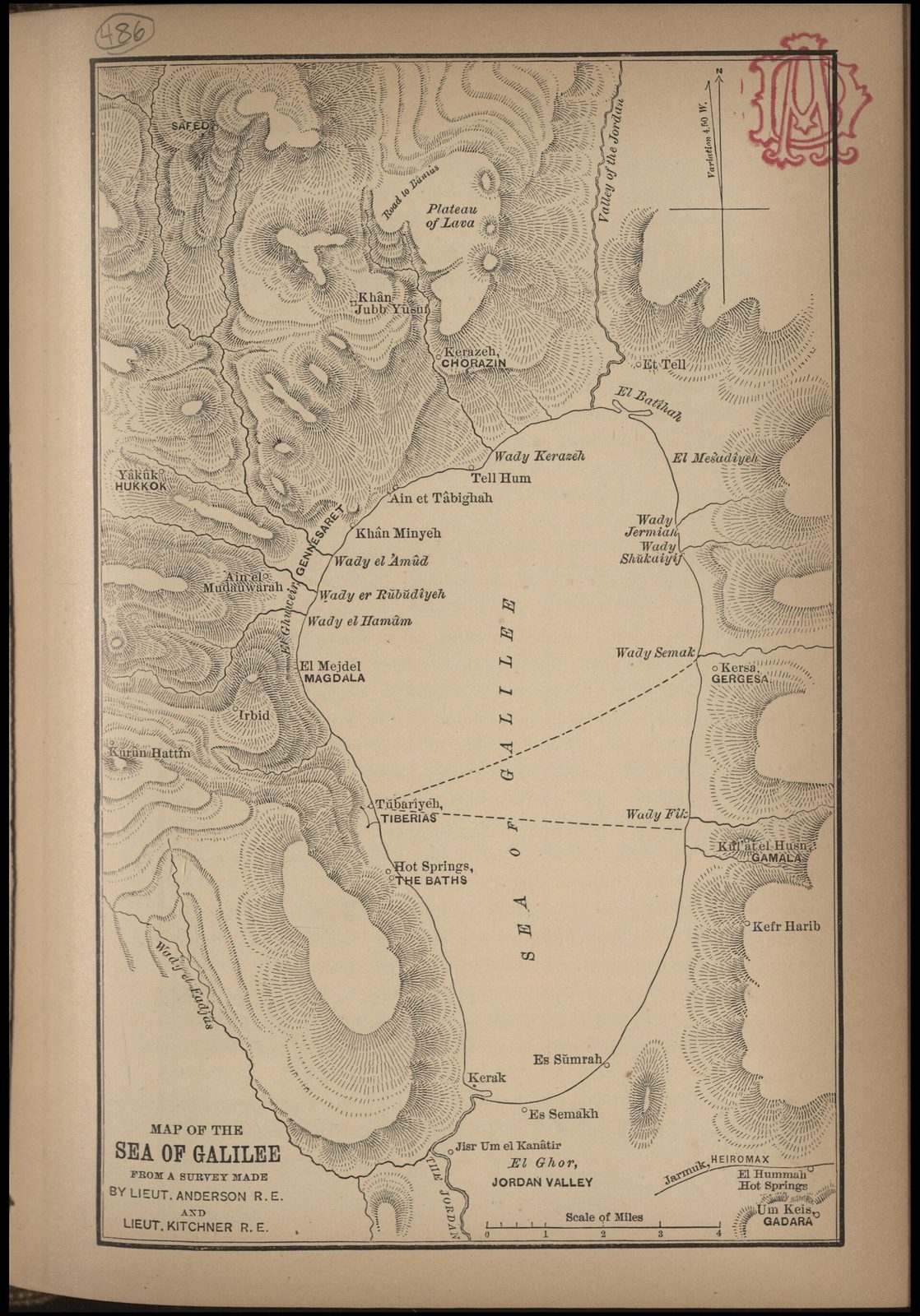
The village of his ministry is Capernaum, on the northwest shore of the Sea of Galilee. It is a fishing village, not a city, not a regional capital, not a place that would have mattered to anyone without the story attached to it. It matters to the story because it sits at a node on the lake that lets a peripatetic teacher move in every direction. The lake is the highway; the villages around it are the destinations; Capernaum is the place from which the movement radiates. The reader should understand the lake not as a scenic feature but as a road — the road by which people and news and fish and trade moved in the region, and the road by which Jesus moved from village to village in the course of his public work.
Matthew says Jesus "left Nazareth and made his home in Capernaum" (Matthew 4:13), and Matthew uses the move to make a theological point, quoting Isaiah about the land of Zebulun and Naphtali and the people who sat in darkness seeing a great light. Matthew is doing the work of connecting the move to the Old Testament expectation of light coming to the northern territory. The reader should understand that Matthew is making a claim about the move — this is where the light comes on — but the historian can say the move itself is the thing the sources agree on, and Matthew's Isaiah claim is Matthew's framing, not a historical datum we can verify independently. The fact of the move to Capernaum is the agreement; the Isaiah framing is Matthew's.
Mark does not describe the move to Capernaum as a separate narrated event the way Matthew does. Mark says that after John's arrest, Jesus began his ministry in Galilee, proclaiming that the kingdom of God had come near, and then, passing along the Sea of Galilee, he saw Simon and Andrew and called them. Later, Mark says, "they went to Capernaum," and the Capernaum activity begins — teaching in the synagogue on the Sabbath, the exorcism in the synagogue, the healing of Peter's mother-in-law at Peter's house, the crowds that gather at the door at evening. Mark establishes Capernaum as the base not by describing the move to it but by showing the activity concentrated there. The reader understands the base from the concentration of the action, not from a narrated relocation.
Luke is less explicit about Capernaum as the base. Luke has Jesus teaching in the Capernaum synagogue (the exorcism there, in Luke 4) and has Jesus leaving and going on to other places, but Luke does not name Capernaum as the residence in the same way Matthew does. The Capernaum activity is present in Luke, but the base is less sharply defined. The historian can say the Capernaum base is clear in Mark and Matthew and consistent with Luke, even if Luke does not name it in the same way. The reader does not need the sharpest possible agreement to understand that Capernaum is the centre of the public work in the Synoptic tradition.
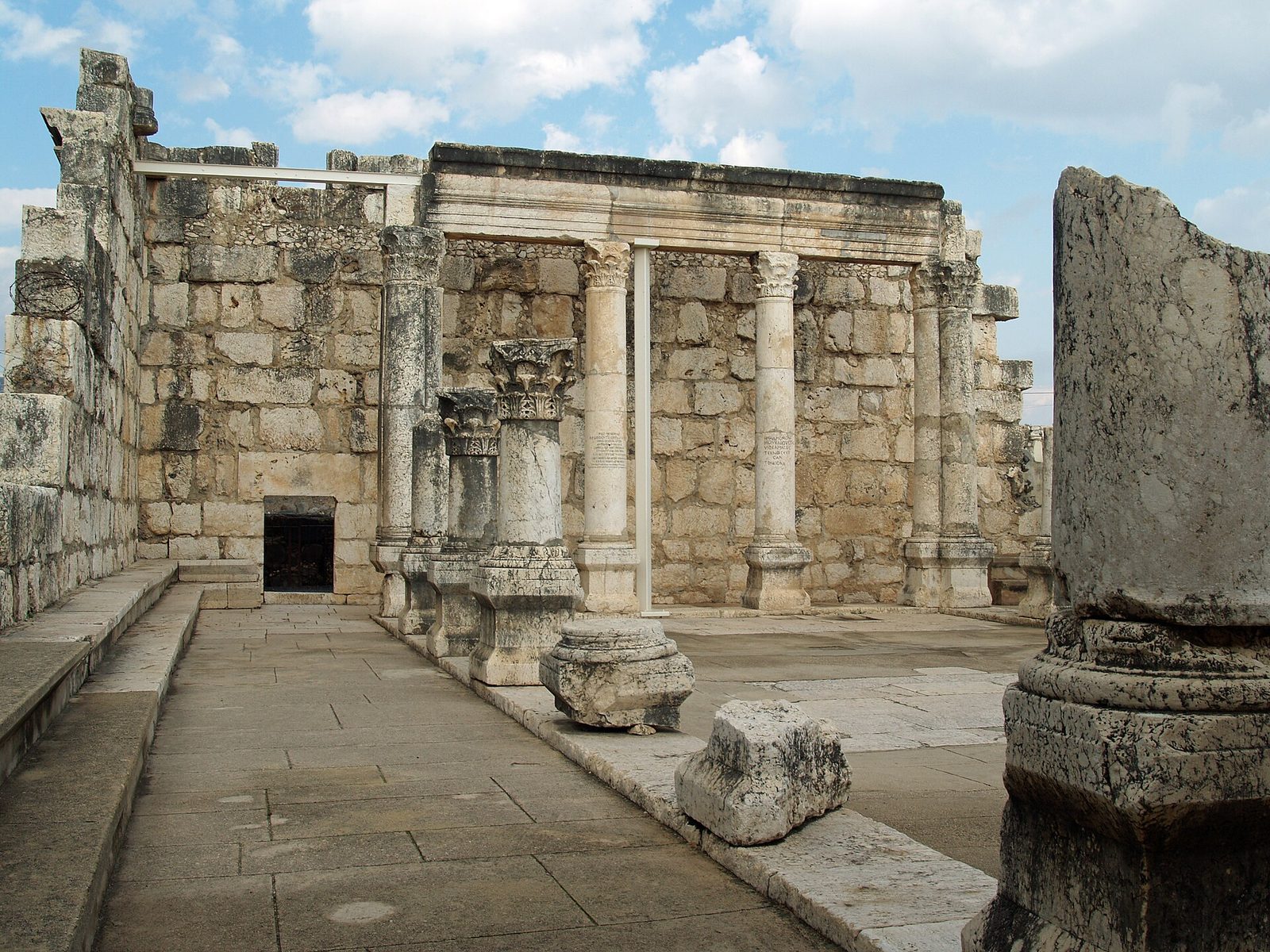
The archaeology of Capernaum supports the picture of a fishing village on the lake, though it does not prove everything the Gospels imply. The site is the place tradition calls Kefar Nahum, and the title is preserved in the Arabic Tell Hum. Excavations show a first-century fishing village with a synagogue — the white limestone synagogue that visitors see is later than the first century, built in the Byzantine period; beneath it is a basalt synagogue of the right period, the kind of synagogue a fishing village would have had. The village is the right kind of place for the story: a village on the lake with a synagogue, a place where a teacher could teach and a crowd could gather and the sick could be brought.
The house that tradition identifies as the house of Peter — the "house of Peter" — is a structure beneath a later Byzantine church built over it. The earliest phase of that house dates to the first century, and the tradition that it was Peter's house is the tradition the reader has inherited. Archaeology is consistent with the tradition — the right period, the right location, the right kind of structure — but it cannot prove that the house was Peter's. The chapter should not assert the identification as fact. The reader should understand that the tradition says the house of Peter was in Capernaum and that the site is consistent with that tradition, and that the identification is a matter of tradition, not archaeological proof.
The house of Peter matters to the story because it is where things happened. In Mark, it is the house where the crowd gathers when Jesus returns to Capernaum — so crowded that there is no room, not even in front of the door, and the paralytic is lowered through the roof. It is the house where the sick are brought at evening, when the whole city gathers at the door. It is the house where Jesus heals Peter's mother-in-law. The house of Peter is the centre of the Capernaum activity in the Synoptic tradition, the place from which the healing and the teaching and the gathering radiate. The reader should understand that the base of the movement in Capernaum was a house, not a synagogue or a hall or a public place. A house is the centre.
The household at the centre of the movement is itself worth noticing. Peter's mother-in-law is healed at the house — which means Peter is married, a fact the Gospels assume without comment and that the later tradition has had various things to say about. The reader should not be surprised by it; the Gospels present married men in the ministry as a matter of fact. The household of Peter is the first household of the movement, and the reader should feel that: the movement begins in a house, with a family, with a mother-in-law healed and the crowd gathering at the door. This is not the movement the reader might have imagined from the sermon-on-the-mount pictures; it is a movement that began in a fishing village house with nets and boats and a mother-in-law.
The first disciples are called beside the lake, in the work world of the fishermen. Mark's account is the earliest and the simplest: Jesus passes along the Sea of Galilee and sees Simon and Andrew, the brothers, casting a net into the sea — they are fishermen — and he says to them, "Follow me and I will make you fish for people." And they leave the nets and follow him, immediately. James and John, the sons of Zebedee, are called in the same scene, in their boat with their father Zebedee, mending the nets. They leave the father and the boat and follow.
The reader should understand the call as it happens — beside the lake, in the work, to men who are working. The metaphor "fish for people" is drawn from the fishing trade the reader has just seen in the village. The reader should not hear it as an abstract religious phrase but as a metaphor pulled from the work the men were doing the day they were called. To fish for people is to do for people what the fishermen had been doing for fish — to gather them, to bring them in, to work the net. The metaphor is from the Capernaum world, and the reader should understand it that way.
The immediate response — they leave the nets and follow immediately — is the shape of the call in Mark. The reader should understand that the call is not a long negotiation. It is a word spoken beside the lake, answered by the leaving of the work and the walking after the one who spoke. The reader should also understand that the call is not a free choice in the modern sense of the word; it is a response to a Jewish teacher in a Jewish world, and the response is the kind of response the tradition records. The immediacy is part of the story, but the historian should not press the immediacy into a romantic abandonment of family and livelihood. The father is left with the boat; that is a real thing; the brothers leave the nets; that is a real thing; the reader should feel the cost in the detail of the nets and the boat and the father without turning it into a sermon about sacrifice.
The reader should also understand that the calling of the first disciples is not the beginning of the public work — the ministry in Galilee has already begun by the time Mark calls the first disciples. The public work begins with the proclamation of the kingdom in Galilee after John's arrest. The calling of the first disciples is the formation of the inner circle that will travel with Jesus and, after his death, carry the movement on. The reader should understand the sequence correctly: the ministry begins, the proclamation is made, the first disciples are called, the base at Capernaum is established as the centre of the activity. The chapter's order is not a chronology of the first days; it is a geography of the base.
Capernaum is not grand, and the chapter should not make it grand. It is a fishing village. The reader should feel the village: the boats, the nets, the fish, the houses, the synagogue, the lake as the road, the households that fish and the households that eat fish and the households that smoke and salt and carry the fish to market. The village is subject to the same Herodian economy and Roman arrangement the reader has encountered before — the same building boom, the same tax, the same margin between work and crisis. Capernaum is not a liberation from that world; it is a place inside it. The reader should understand that the base of the movement is inside the Herodian and Roman world, not outside it. The kingdom of God is going to break into that world from within.
The chapter that follows will turn to the message Jesus proclaimed when he came to Galilee — the kingdom of God in plain English, the pivotal chapter of Part Three. The reader has the base now, and the first followers, and the fishing village on the lake. What comes next is the message itself, stripped of the twenty centuries of meaning that have accumulated around it. The kingdom of God is not a place you go when you die; it is God's rule breaking into the present, and the invitation is to live inside that now. The chapter that follows will say that, plainly, and the reader will see what the kingdom meant to a man who had left the village of his upbringing and made a new base on the lake, among fishermen and the sick and the crowds that gathered at the door.
The Kingdom, in Plain English
The reader has the base now, and the first followers, and the fishing village on the lake where Jesus made his home after leaving Nazareth. What comes next is the message itself — the thing Jesus proclaimed as he walked through the villages of Galilee, the thing that summoned the fishermen from their nets and that would, in time, draw thousands of people and reorganise their lives around him. The message is the kingdom of God. This is the pivotal chapter of Part Three, and it is the chapter that every other chapter in this part flows from. If the reader misunderstands the kingdom here, the healings, the table, the disputes, the family problem, the road to Jerusalem, all of it will be misread. The chapter has to get the kingdom right — or rather, has to get it plainly, stripped of the two thousand years of accumulated meaning that the reader will bring to it.
The reader's default understanding of the kingdom of God is probably something like this: the kingdom is heaven, the place you go when you die if you have believed the right things. Or the kingdom is a spiritual state, the inner reign of God in the heart of the believer. Or the kingdom is the church, the community of the saved, and the kingdom is coming in the future when Jesus returns. All of these are later meanings, and all of them are real meanings in the tradition that grew up around Jesus. But they are not the meaning the reader will find in the Gospels if they read them as the sources present them. The kingdom of God in the mouth of Jesus is the rule of God breaking into the present — the reign of God arriving in the world now, in the ministry of Jesus, and the invitation to live inside that reign now. The kingdom is not a place you go when you die. It is a reality breaking into the world now, with a future culmination still to come.
The simplest version of the proclamation comes from Mark, the earliest Gospel, right at the beginning of Jesus' public work. Jesus comes to Galilee after John's arrest, proclaiming the good news of God: "The time is fulfilled, and the kingdom of God has come near; repent, and believe in the good news." That is it. The time is fulfilled — the moment has arrived. The kingdom has come near — not fully here, not distant, but near. Repent and believe — turn and trust. This is the core of the message, and it is spare, and the spare-ness is itself a point. The reader should not look for a long theological exposition in the proclamation; the proclamation is a declaration and a summons, and the declaration is that the rule of God is arriving now, and the summons is to turn and enter it.
The word "kingdom" translates a Greek word — basileia — that means rule, reign, the domain of a king. The kingdom of God is the rule of God, the reign of God, the domain where God's will is done. When Jesus says the kingdom of God has come near, he is saying that God's rule is breaking into the present, that the world is not as it should be and God is acting to make it otherwise, and that the act is happening now, in Jesus' ministry, in the healings and the exorcisms and the table and the proclamation itself. The reader should hear "kingdom" as "rule" — not a territory on a map, not a destination after death, but the reign of God arriving in the world.
Matthew uses a different word — "kingdom of heaven" — instead of "kingdom of God," and the reader should understand that this is the same kingdom under a different name. Matthew's habit of saying "heaven" instead of "God" is a Jewish reverential practice, not a different theology. The kingdom of heaven in Matthew is the kingdom of God in Mark; the reader should not mistake the name difference for a theological difference. The kingdom is the rule of God, in both Gospels, breaking into the present.
The reader should also understand that the kingdom is not only future. The proclamation says the kingdom has come near, and the miracles and healings and exorcisms in the Gospels are presented as signs that the kingdom is breaking in now — the blind see, the lame walk, the lepers are cleansed, the deaf hear, the dead are raised, the poor have good news brought to them, as the Gospel of Matthew puts it in a quotation that crystallises the point. The kingdom is present in the sense that the rule of God is arriving now, in Jesus' ministry, and the reader should not lose that present-breaking-in strand. At the same time, the kingdom is also future, and the parables of the end — the weeds, the net, the wedding feast — are part of the kingdom teaching, pointing to a final consummation when the rule of God will be complete. The reader should hold both strands: the kingdom is breaking in now, and it is not yet complete; it is near, and it is coming.
This is the tension the reader should understand and not try to resolve. The sources contain both strands — the present-breaking-in and the future-consummation — and the historian cannot say with certainty how much of each was in Jesus' own mind. The reader should not expect the chapter to tell them whether Jesus was an apocalyptic prophet expecting the end of the world in the near future, or a preacher of a present breakthrough, or some combination of the two. The chapter can say that both strands are in the sources, and that the historian's job is to report both without resolving the tension that the sources themselves contain. The chapter that follows this one in the book's sequence — chapter 19 — will take up the apocalyptic question directly and will be the place where the most uncomfortable finding of modern scholarship is stated plainly. This chapter is not that chapter. This chapter is the plain statement of the message, and the plain statement is: the kingdom of God is the rule of God breaking into the present, now, with a future hope attached.
The message is taught in parables, and the parables are worth understanding, because they tell the reader something about the kingdom that a plain doctrinal statement would not. The parables are not lessons with clean morals; they are stories that refuse to hand the reader a tidy answer. The reader who expects the parables to teach neat principles will be disappointed; the parables are unsettling on purpose. The chapter should say this, and should then give the reader a few of the parables in their plain sense, so that the reader can hear the kingdom as Jesus taught it.
The parable of the sower is the most famous, and it is the one where Mark himself has to add an interpreter later, which is itself a point worth noticing — the parable does not explain itself in the text, and the explanation is added. The seed is the word, the sower sows the word, and the different soils are the different responses the word meets. The kingdom goes out into the world and lands in different ground; some of it is taken away, some of it grows and is choked, some of it bears fruit. The parable is not about sowing method; it is about reception. The kingdom is a word that goes out and encounters different reception in the world, and the reader should understand the kingdom as something that is spoken and heard and either received or rejected, not as a doctrine that is merely taught.
The parable of the mustard seed is the parable of growth. The kingdom is like a mustard seed, the smallest of seeds, that grows into a tree large enough for the birds to nest in. The point is that the kingdom starts small — a village on the lake, a fisherman, a tax collector, a handful of followers — and grows. The birds nesting in the branches is the shelter the kingdom provides, the place where the marginal find a home. The reader should hear the parable as a parable of growth and shelter, not as a parable of size. The kingdom is not impressive to start with; it grows.
The parable of the yeast is the parable of the kingdom working from within, invisibly, until the whole is transformed. The kingdom is like yeast that a woman mixes into the dough until the whole batch is leavened. The kingdom is not a visible spectacle; it is a transforming presence that works from within. The reader should hear the parable as a parable of quiet transformation, not of dramatic arrival.
The parable of the weeds is the parable of the mixed present. A man sows good seed in his field, and an enemy sows weeds among the wheat, and the householder says to let both grow together until the harvest, when the reapers will gather the weeds and burn them and the wheat will be gathered into the barn. The kingdom now contains both the good and the bad; the separation comes at the end. This is the parable that Matthew interprets, and the interpretation is the kingdom at the end, with the harvest and the fire. The reader should hear the parable as a parable of the coexistence of good and evil in the kingdom until the end, and of the future sorting.
The parable of the treasure in the field and the parable of the pearl are the parables of value. The kingdom is like treasure hidden in a field, and like a pearl of great value. The man who finds the treasure sells all he has to buy the field; the merchant who finds the pearl sells all he has to buy it. The kingdom is of such value that it reorganises a life. The reader should hear the parables as parables of total commitment to the kingdom, not as parables of how to get into it. The kingdom is worth everything.
The parable of the net is the same pattern as the weeds: the kingdom is like a net that gathers fish of every kind, and at the end the good are kept and the bad are thrown away. The mixed present, the future sorting. The reader should hear the parable as a parable of the end, when the kingdom is complete and the sorting happens.
The parable of the wedding feast is the parable of the invitation and the refusal. A king prepares a wedding feast for his son, and the invited guests refuse to come, and the king sends his servants to bring in whoever they find, and the feast goes on. The kingdom is the reign of God that receives the invited and the not-invited, and the refusal of the invited is the refusal that the kingdom addresses. The reader should hear the parable as a parable of the inclusion of the marginal and the refusal of the important.
These parables together give the reader the kingdom as Jesus taught it: the word going out and being received or rejected; the growth from small to large; the quiet transformation from within; the mixed present and the end; the total value; the invitation and the refusal. The reader should not hear the parables as a list of lessons but as a way of teaching the kingdom that resists neat summary. The kingdom is taught in stories that unsettle, and the reader should expect that.
The kingdom is also announced in the Beatitudes, and the Beatitudes are the kingdom as reversal. Blessed are the poor, the hungry, the weeping — the kingdom belongs to them. Luke's version is the starkest: "Blessed are you who are poor, for yours is the kingdom of God." The kingdom is for the poor, the hungry, the weeping — the marginal, the ones the world has left out. The reversal is social: the kingdom is the rule of God that includes the marginal now, and the marginal are the ones to whom the kingdom is announced. The rich are warned — the rich fool who stores up wealth and is called a fool because his life is required that night, the warning that the kingdom is not a reward for wealth. The great banquet — the invited refuse, and the poor and crippled and blind are brought in. The kingdom is the rule of God that reverses the current order, and the reader should understand the reversal as a social reality, not as a spiritual metaphor.
The reversal is not only about the poor; it is about the whole order. The kingdom is the rule of God in which the last are first and the first are last, in which the meek inherit the earth, in which the merciful receive mercy, in which the pure in heart see God. The reader should understand the Beatitudes as the kingdom stated in terms of the reversal — the kingdom is the rule of God that overturns the current hierarchy and includes the marginal. The reader should not hear the Beatitudes as a list of nice sentiments but as a social claim about the direction of the kingdom.
The Lord's Prayer is the kingdom in a sentence. "Your kingdom come. Your will be done, on earth as it is in heaven." The prayer is the distillation of the kingdom for the daily use of the followers. The kingdom is the rule of God coming, and the will of God being done on earth. The reader should hear the prayer as the kingdom compressed into a petition — the rule of God arriving, the will of God being done here, in the world. The prayer is not a wish for the future; it is a petition for the present, and the petition is that the rule of God break into the world now.
The kingdom is announced in the proclamation, taught in the parables, announced in the Beatitudes, distilled in the Lord's Prayer, enacted in the healings and the exorcisms, signalled in the table with the marginal. The reader should understand the kingdom as the rule of God breaking into the present, with a future culmination, and with the social reversal that includes the marginal. The kingdom is the central message of Jesus, and every other chapter in Part Three flows from it. The healings are signs of the kingdom breaking in; the table is the sign of the kingdom including the marginal; the disputes with the Pharisees are disputes over the right keeping of Torah inside the kingdom; the family problem is the cost of the kingdom in the life of the man who proclaimed it.
The reader should also understand what the kingdom is not, because the accumulated meaning the reader brings to the chapter is heavy and the chapter has to clear it away. The kingdom is not heaven as a destination after death. The kingdom is not the church as an institution. The kingdom is not a political program in the modern sense — it is the rule of God, and that is a different kind of thing from a political platform, though it has political implications. The kingdom is not an internal state only — it is a public reality, a reign, a rule, a new order. The kingdom is not only future — it is breaking in now, in the ministry of Jesus. The kingdom is not only present — the future consummation is part of it.
The reader should leave this chapter with the kingdom stated plainly: the rule of God breaking into the present, now, in the ministry of Jesus, with a future hope attached, and with the social reversal that includes the marginal. The kingdom is the message Jesus proclaimed, and the message summoned people. The chapter that follows will introduce the people who answered the summons — the twelve men and the women who funded the ministry — and the reader will see what the kingdom looked like in the shape of a following.
The chapter that follows will turn to the people who followed Jesus — the twelve and the women, and the women especially, who are in the earliest sources at the funding of the ministry and at the cross and at the tomb, and who have been treated as a footnote in too many accounts of the movement. The kingdom summons people, and the people who answer are the ones who follow, and the following includes the women. The chapter that follows is the one that should put the women where they belong — at the centre of the funding, not at the edges.
The People Who Followed
The kingdom summons people, and the people who answer are the ones who follow. This chapter introduces the following that formed around Jesus as his public work moved through the villages of Galilee — the twelve men who made up the inner circle, and the women who funded the ministry and who were in the movement from the beginning, at the funding, at the cross, and at the tomb. The reader has seen the kingdom proclaimed in the previous chapter; this chapter shows the kingdom answering itself in the shape of a following, and the following includes the women, who have been treated as a footnote in too many accounts of the movement and who belong here, at the centre, as a matter of course.
The twelve are the inner circle. Mark gives the list — Simon, whom he named Peter; James and John, the sons of Zebedee, whom he named Sons of Thunder; Andrew; Philip; Bartholomew; Matthew; Thomas; James son of Alphaeus; Thaddaeus; Simon the Cananaean; and Judas Iscariot, who betrayed him. The list is a Synoptic tradition — Mark gives it, Matthew gives it close to Mark's version, Luke gives it close to Mark's version — and John does not give a list at all. The historian should not press the list into biographical detail the sources do not provide. The reader should understand the twelve as the nucleus of the movement, the ones called to be with Jesus and to be sent out, given authority to cast out unclean spirits and to preach. The dual purpose — presence and mission — is explicit in Mark. They are with him, and they are sent out. That is the shape of the inner circle.
The reader should also understand that the list includes the betrayer. Judas Iscariot is in the twelve. The tradition names him, and the tradition does not hide him. The reader should not expect the chapter to paper over that, but the chapter should also not make the betrayer the focus. The following is the subject of this chapter; the betrayal comes later. The betrayer in the list is a fact the reader should carry: the inner circle of the movement included the man who would hand Jesus over, and the movement did not know at the time which of its own would do it. The reader should feel the weight of that — the intimacy of the circle, and the fact that the person who turned is one of its own.
The twelve are not the whole following. The reader should understand the following as a spectrum. The twelve are the inner circle. Beyond them is the larger group of disciples — the people who followed Jesus in the villages, who heard him teach, who were healed by him, who were part of the movement in a wider sense. And beyond them are the crowds — the people who came to the houses and the synagogues and the lakeshore to hear him and to be healed. The reader has seen the crowds at Capernaum, the whole city gathering at the door at evening. The crowds are part of the following, but they are not the twelve. The reader should understand the movement as a structure with layers: the twelve, the larger disciple group, the crowds.
The chapter that turns to the women is the chapter that should put them where they belong — not at the edges of the story but at the centre, as a matter of course. Luke 8 is the chapter in the Gospels that names the women who followed Jesus, and the reader should treat it as the bombshell the brief says it is. Luke writes that Jesus went through the cities and villages proclaiming the kingdom, and that the twelve were with him, and also some women — Mary, who was called Magdalene, from whom seven demons had gone out; and Joanna, the wife of Chuza, Herod's steward; and Susanna; and many others, who provided for them out of their means. The women provided for Jesus and the twelve from their own resources. The reader should hear that sentence and understand what it means: the movement was funded by women, and the women who funded it were named by Luke, and there were many others besides the three named.
The readers should not come to this chapter with the familiar picture of Mary of Magdala as a repentant prostitute rescued from a life of sin. That picture is a later tradition — from the sixth century, when Pope Gregory I conflated Mary of Magdala with the unnamed sinful woman in Luke 7 and with Mary of Bethany. The Gospels do not do that. The Gospels identify Mary of Magdala as a woman from Magdala, a town on the western shore of the Sea of Galilee, from whom seven demons had gone out. The seven demons are a description of a healing, not of sexual sin. The reader should understand Mary of Magdala as a follower of Jesus, a witness at the cross, a witness at the tomb, and the recipient of a resurrection appearance in John — the first person to whom the risen Jesus appears, in John's Gospel. The reader should not carry the prostitute myth into this chapter.
Joanna is the wife of Chuza, Herod's steward. A steward is a manager of a household or an estate. Chuza manages Herod's affairs, which means Joanna is connected to the court of Herod — the same Herod Antipas whose building boom the reader encountered in chapter 5 and whose capital at Sepphoris is four miles from Nazareth. Joanna is not a marginal person; she is connected to the ruling household of the region, and she has means, and she uses those means to fund the ministry of Jesus. The reader should understand the irony of this — the wife of the steward of Herod, the tetrarch who killed John the Baptist and who will later be the one who hands Jesus over to Pilate's province, is one of the women funding the movement that Herod's household would eventually suppress. The reader should not overstate the irony; it is an irony the reader can notice, and the chapter should let the reader notice it without turning it into a sermon.
Susanna is named. Nothing else is said about her. The reader should not try to fill in what Luke does not say. Susanna is one of the women who followed, one of the women who provided for the ministry, and that is what the source gives. The reader should not invent a story for Susanna. The chapter should let her stand as named, and as one of many.
The "many others" matters. Luke names three women and says there are many others. The reader should understand the list as not exhaustive. The women who followed Jesus were not just these three; they were many, and the tradition names only three. The reader should not assume that the three named are the only women in the movement, or that the women's role is limited to the three named. The chapter should make clear that the funding of the movement came from a group of women, and that Luke names three and says there are many others.
The reader should also understand that the women are not a marginal addition to the movement. They are part of it from the beginning, and they are in the earliest sources at the funding. Luke 8 is a Gospel, not a late addition, and the women are there from the start of the Galilean ministry in Luke's account. The reader should understand that the funding of the ministry by women is not a late or marginal fact; it is a fact about the shape of the movement, and the chapter should treat it as such.
The women are also present at the cross. Mark 15 names the women who were looking on from a distance when Jesus died: Mary of Magdala, Mary the mother of James the younger and of Joses, and Salome. They had followed him and ministered to him when he was in Galilee — the same women, or overlapping with the same women, who provided for the ministry in Luke 8. The reader should understand the continuity: the women who funded the ministry in Galilee are the women who are at the cross when Jesus dies. The women are in the movement at the funding and at the death, and the chapter should make that continuity clear. The reader should understand that the women who gave their means to support Jesus in Galilee were there, at a distance, when he died, and that they did not abandon the movement when it became dangerous.
The women are also present at the tomb. Mark 16 — the original ending of Mark — has the women going to the tomb early on the first day of the week, bringing spices to anoint the body. Mary of Magdala, Mary the mother of James, and Salome. They are the ones who go to the tomb, and they are the first witnesses of the empty tomb in Mark. The reader should understand that the women who funded the ministry and were at the cross are also the women who go to the tomb. The continuity runs through the funding, the cross, and the tomb. The reader should understand that the women are witnesses of the full arc of the movement — the funding, the death, and the resurrection tradition.
The readers should understand that the women's presence at the tomb makes them the first witnesses of the resurrection if the empty tomb tradition is taken as historical. Mark's Gospel, the earliest, has the women at the tomb and the young man in white telling them that Jesus has been raised. The women are the first to know. The reader should understand that the resurrection tradition begins with the women, and that the women are the first witnesses of the empty tomb. The chapter that follows this one in the book's sequence is not the resurrection chapter — that comes much later, in Part Five and Part Six. But the reader should carry forward from this chapter the fact that the women are at the tomb, and that the resurrection tradition, however the reader understands it, begins with the women.
The chapter that follows will be chapter 13, on the stories that don't resolve — the parables. The reader should understand the following as the shape of the kingdom in action: the twelve, the larger disciple group, the crowds, and the women who fund it all. The parables in chapter 13 will be told to this following, and the reader should understand that the stories that don't resolve are told to people who have already answered the summons. The kingdom has summoned them, and the stories are what the kingdom says to the people who have come.
The reader should leave this chapter with three things. First, the twelve are the inner circle, and the list includes the betrayer. Second, the following is not just the twelve; it includes the larger disciple group and the crowds. Third, the women are part of the movement from the beginning, and they fund it, and they are at the cross, and they are at the tomb, and they are in all three places in the Gospels. The women are not a footnote. They are in the earliest sources at the funding, at the cross, and at the tomb, and the chapter should write them in as a matter of course.
The chapter should also leave the reader with the understanding that the following is the shape of the kingdom in action — the kingdom has summoned people, and the people who answer form a movement around Jesus, and the movement includes the twelve and the women and the crowds. The kingdom is not an idea; it is a following. The chapter that follows will show the kingdom teaching itself to this following in the form of stories that don't resolve, and the reader should understand the parables as addressed to the people who have already answered the summons.
Stories That Don't Resolve
The kingdom was not taught as a set of propositions, as a creed to be recited or a code of rules to be followed. Jesus taught the kingdom in stories — parables — and the parables are the form of the teaching that the reader most likely knows in their Christianised versions. The reader who comes to this chapter with a memory of church Sunday-school lessons about the parables — the sower is about hearing the word, the mustard seed is about small beginnings, the lost son is about repentance and forgiveness — should not leave with those versions intact. The chapter's job is to give the reader the parables as they are in the Gospels, as stories that unsettle and refuse to resolve, and to let the reader hear what Jesus was doing when he told them.
The parables are public and the explanation is private, and this is one of the most important things about them. Mark writes that Jesus told the crowds in parables, and that when he was alone with the disciples he explained everything. The parables are given to the public in their public form; the deeper meaning is given to the inner circle in private. The reader should understand that the parables are not coded messages to be cracked by the clever; they are stories told to the crowds, and the ones who are inside the movement get the explanation, while the ones who are outside hear the story and either understand it or do not. The parables are a way of teaching the kingdom that keeps the secret from those who are outside and opens it to those who are inside. The reader should hear this and understand that the parables are not simply beautiful stories; they are stories that divide the listener, and the division is part of the point.
Mark 4 is the earliest cluster of parables in the Gospels, and it gives the reader the shape of the teaching. The sower goes out to sow, and the seed falls on the path and is eaten by birds, on the rocky ground and springs up and withers, on the thorny ground and is choked, and on the good ground and bears fruit — thirtyfold, sixtyfold, a hundredfold. The parable is not about sowing method, and the reader should not hear it as a lesson about how to sow better. The parable is about the word of the kingdom going out into the world and landing in different ground. The word fails on the path, where it is taken away; it springs up and withers on the rocky ground, where the listener has no endurance; it is choked on the thorny ground, where the cares of the world choke it; and it bears fruit on the good ground. The parable unsettles because it acknowledges that the word of the kingdom does not succeed everywhere — that there is ground where it fails, and that the failure is part of the story. The reader who hears the parable is asked to decide what ground they are, and that decision is the point.
Matthew gives the parable in the fuller form, and adds the explanation in private — the sower is the one who sows the word, the path is the one who hears and the evil one takes it away, the rocky ground is the one who hears and receives with joy but has no root and falls away, the thorny ground is the one who hears and the cares of the world and the deceitfulness of riches choke it, and the good ground is the one who hears and understands and bears fruit. The reader should understand that Matthew's explanation is the private interpretation — the parable told to the crowds, the explanation given to the disciples. The reader should hear the parable and the explanation as two layers, and should not reduce the parable to the explanation. The parable is the story; the explanation is the private meaning. The reader should hear both and decide.
The parable of the weeds is the parable that teaches the mixed present and the future sorting. A man sows good seed in his field, and an enemy sows weeds among the wheat, and the householder says to let both grow together until the harvest, when the reapers will gather the weeds and burn them and the wheat will be gathered into the barn. The parable unsettles because the enemy is in the field and the householder does not pull the weeds out now — he waits until the harvest. The kingdom now contains both the good and the bad, and the separation comes at the end. The reader should hear the parable and understand that the kingdom is not a pure present kingdom of only the good; it is a mixed present in which good and bad grow together, and the judgment comes at the end. Matthew explains the parable privately — the field is the world, the good seed are the sons of the kingdom, the weeds are the sons of the evil one, the enemy is the devil, the harvest is the end of the age, the reapers are the angels. The reader should hear the explanation and the parable and understand the teaching: the kingdom is mixed now, and the end will sort it.
The parable of the yeast is the parable that teaches the kingdom's quiet working. The kingdom is like yeast that a woman mixes into the dough until the whole batch is leavened. The parable unsettles because the kingdom is not a dramatic arrival; it is a quiet transformation from within, invisible at first, until the whole is changed. The reader who expects the kingdom to be a spectacle is unsettled by the yeast. The reader should hear the parable and understand the kingdom as a quiet, hidden power that works from within and transforms the whole. The parable refuses to make the kingdom dramatic, and the reader should understand that the kingdom's power is in its quiet working, not in its visible display.
The parable of the mustard seed is the parable that teaches growth. The kingdom is like a mustard seed, the smallest of seeds, that grows into a tree large enough for the birds to nest in. The parable unsettles because the kingdom starts small and grows large, and the birds nesting in the branches are a detail that is ambiguous. Some interpreters hear the birds as a positive image — the shelter the kingdom provides, the place where the marginal find a home. Other interpreters hear the birds as a negative image — in Ezekiel 31 and Daniel 4, the great tree and the birds in its branches are images of empire and the nations nesting in it, and the birds are a sign of the tree's pride. The reader should hear the parable and not impose one interpretation. The parable is a story about growth, and the birds are part of the story, and the reader should hear the ambiguity. The kingdom starts small and grows large, and the reader should hear the parable as a story about growth without deciding whether the birds are a comfort or a warning.
The parable of the treasure in the field and the parable of the pearl are parables that teach the cost of the kingdom. The kingdom is like treasure hidden in a field, and like a pearl of great value. The man who finds the treasure sells all he has to buy the field. The merchant who finds the pearl sells all he has to buy it. The parables unsettle because the kingdom requires everything — total commitment. The reader should hear the parables not as lessons about how to get the kingdom but as stories about the kind of commitment the kingdom demands. The kingdom is worth everything, and the cost is everything. The reader should hear the parables and understand that the kingdom is not a bargain; it is a total reorganisation of a life.
The parable of the net is the parable that repeats the mixed-present, future-sorting pattern of the weeds. The kingdom is like a net that gathers fish of every kind, and at the end the good are kept and the bad are thrown away. The reader should hear the parable and understand that the kingdom is mixed now and sorted at the end. The net gathers all kinds, and the end sorts them. The reader should hear the parable and understand the teaching without needing to reduce it to one image.
The parable of the wedding feast is the parable that teaches the invitation, the refusal, and the judgment. A king prepares a wedding feast for his son. The invited guests refuse to come — one goes to his farm, another to his business, and the rest seize and kill the servants. The king sends his troops to destroy the murderers and burn their city, and then sends the servants to bring in whoever they find — the poor, the crippled, the blind — and the feast goes on. The reader should hear the parable and understand the shape: the invited refuse, the marginal are brought in, and the feast is not a pure gathering — it includes the improperly dressed. One guest is thrown out for not wearing a wedding robe. The reader should hear the parable and understand the complexity: the kingdom includes the marginal, but it is not unconditioned; the kingdom is inclusive, but it requires the wedding robe. The reader who hears the parable is asked to decide whether they are the invited who refuse or the ones brought in from the roads, and whether they are wearing the wedding robe.
Luke's parables of the lost are the parables that teach the joy of recovery, and the elder brother in the prodigal son parable is the figure the reader should hear most carefully. Luke gives the parable of the lost sheep — the shepherd leaves the ninety-nine to find the one — and the parable of the lost coin — the woman searches the house for the lost coin and rejoices when she finds it — and the parable of the prodigal son — the father runs to meet the returning son and throws a feast, and the elder brother refuses to go in. The parables unsettle because they present the recovery of the lost as a joyful event, and the elder brother is the one who refuses the joy. The reader who identifies with the elder brother — the one who has stayed, who has done the right thing, who resents the celebration of the one who wasted everything — is the reader the parable is aimed at. The reader should hear the parable and understand that the kingdom's joy is in the recovery of the lost, and that the one who refuses the joy is the one who thinks the kingdom is about their own obedience rather than about the recovery of the lost. The reader should hear the parable and decide whether they are the elder brother or the one who rejoices.
The reader should also understand that the parables are not moral lessons in the modern sense. The reader who comes to the parables expecting a clean moral lesson will be disappointed, because the parables refuse to hand the reader a tidy answer. The sower does not explain what the reader should do; the reader must decide what ground they are. The weeds does not explain what the reader should do; the reader must decide what to do with the mixed present. The mustard seed does not explain what the reader should do; the reader must decide what to make of the birds. The wedding feast does not explain what the reader should do; the reader must decide whether they are the invited who refuse or the ones brought in. The prodigal son does not explain what the reader should do; the reader must decide whether they are the elder brother or the father. The parables are tools of decision, and the reader should understand them as such. The kingdom is not a lesson; it is a decision.
The reader should also understand that the parables are not an esoteric code to be cracked. The parables are stories told to the crowds; the explanation is given to the disciples in private. The reader should not treat the parables as puzzles with a single hidden answer. The parables are stories that unsettle the listener into decision. The reader who hears the sower and decides they are the good ground is hearing the parable correctly, but the parable does not stop there — the parable is also a story about the word failing on the path and the rocky ground and the thorny ground, and the reader is asked to hear that failure as part of the story. The reader should hear the parable in its full form and not reduce it to one point.
The parables are the kingdom taught in a form that unsettles. The reader should leave this chapter with the understanding that the parables are not Christian lessons with clean morals; they are stories that refuse to resolve, and the refusal is the point. The kingdom is taught in stories that ask the reader to decide, and the reader who decides is the one who has answered the summons. The chapter that follows will turn to the kingdom acting in the world of the healings and the exorcisms — the kingdom not only taught in stories, but enacted in the world of illness and social death.
The reader should understand the healings and exorcisms in this next chapter as the kingdom acting in the world, and should understand the act of healing as the kingdom breaking in. The chapter that follows is the chapter that should show the reader what the kingdom looks like when it moves into the world of the sick and the possessed and the outcast, and the reader should understand the touch of Jesus as the kingdom touching the untouchable.
Touching the Untouchable
The kingdom was not only proclaimed and taught; it was enacted. The reader has seen the kingdom announced in the proclamation of chapter 11, the following that answered the summons in chapter 12, and the parables that taught the kingdom in stories that don't resolve in chapter 13. This chapter turns to the kingdom acting in the world — in the healings and the exorcisms. The reader should understand these not as magic tricks or as proofs of divinity, but as the kingdom breaking into the world of the sick and the possessed and the outcast, and restoring the people whom the world had removed from the community.
The world of Jesus was a world in which illness removed a person from the community. A leper was unclean and had to stay at a distance, crying out "unclean, unclean," and no one was to come near. A person with an unclean spirit — a person who was possessed, in the language of the tradition — was excluded, pushed to the margins, to the tombs and the wilderness. A paralytic was dependent on others to carry them, unable to move themselves, dependent on the mercy of the crowd. The sick were dependent and diminished, and the marginal were the ones the reader should understand the healings to be about. The kingdom acted in the world of the sick and the possessed and the outcast, and the act of the kingdom was to restore the person to the community.
The reader should understand the exorcisms in the same frame. A person with an unclean spirit was a person who had been overrun by something outside themselves — something that spoke in a voice not their own, that threw them into convulsions, that cut them, that put them among the tombs. The exorcism was the kingdom's act of restoring the person to themselves, to their right mind, to the community. The exorcism was not a performance; it was the kingdom breaking the power of the unclean spirit. The reader should understand the exorcisms as the kingdom's authority over the unclean spirits, and as the kingdom restoring the person who had been overrun.
The first public exorcism in Mark is the one in the synagogue at Capernaum. Jesus has entered the synagogue on the Sabbath and is teaching, and the people are astonished at his teaching, because he teaches them as one having authority, and not as the scribes. And just then — in the middle of the teaching, in the midst of the synagogue — there is a man with an unclean spirit, and the spirit cries out. "What have you to do with us, Jesus of Nazareth? Have you come to destroy us? I know who you are — the Holy One of God." The spirit knows who Jesus is. Jesus rebukes it, saying, "Be silent, and come out of him," and the unclean spirit, convulsing the man and crying with a loud voice, comes out of him. And the people are all amazed, and they keep on asking one another, "What is this? A new teaching with authority! He commands even the unclean spirits, and they obey him."
The reader should understand the exorcism as the kingdom's authority breaking into the synagogue, in the middle of the teaching, in front of the whole community. The unclean spirit knows who Jesus is, and Jesus silences it and commands it out. The reader should understand that the exorcism is the kingdom's act of restoring the man to the community, to his right mind, to the synagogue. The reader should also understand that the unclean spirit's recognition of Jesus as the Holy One of God is the kingdom's identity being known by the unclean spirits — the very things that are opposed to the kingdom recognise the kingdom's agent. Jesus rebukes the spirit and would not allow it to speak, because he knew who they were. The reader should understand the silence as the kingdom not letting the unclean spirits speak — the kingdom's identity is not announced by the spirits that oppose it.
The healing of the leper is the act that shows the kingdom touching the untouchable. A leper comes to Jesus, begging him, and says, "If you choose, you can make me clean." And Jesus, moved with pity, stretches out his hand and touches him, and says, "I do choose. Be made clean," and immediately the leprosy leaves him, and he is made clean. The reader should understand the touch as the act of healing, and as the act that breaks the purity law. The leper is supposed to be at a distance; Jesus touches him. The touch is the kingdom's act of restoring the leper to the community, and the touch is the thing that breaks the boundary. The reader should understand that the healing is not only the word — "I do choose. Be made clean" — but the touch that goes with it. The touch is the sign of the kingdom's power to heal the untouchable.
The reader should also understand that the healed leper is told to show himself to the priest and offer the sacrifice that Moses commanded for the cleansing. The instruction is to go to the priest and be verified as clean, and the sacrifice is the offering for the cleansing. The reader should understand this as the kingdom's act of restoring the leper to the community in the terms of the community — the leper is made clean, and the cleansing is to be verified by the priest, and the offering is to be made. The reader should understand the healing as the kingdom restoring the leper to the community in the terms of the community, not as a rejection of the community's rules. The kingdom acts within the world of the community, even when it breaks the boundary.
The leper disobeys and begins to proclaim the cleansing widely, and Jesus can no longer publicly enter a town, but stays outside in the solitary places. The reader should understand the cost of the healing — the leper's disobedience makes the healing public, and the publicity crowds Jesus out of the towns. The reader should understand the healing as the kingdom acting, and the act as having a cost. The reader should not hear the leper's disobedience as a failure; the reader should hear it as the human response to the kingdom's act, and as the thing that crowds Jesus out of the towns. The healing is a public act because the leper makes it public, and the publicity is the cost of the healing.
The healing of the paralytic in Capernaum is the act that pairs the forgiveness and the healing. Jesus returns to Capernaum and is at home, and many are gathered together, so that there is no room, not even in front of the door. And Jesus is preaching the word to them. And they come bringing a man who is paralysed, carried by four men. And when they cannot bring him to Jesus because of the crowd, they remove the roof above him, and make an opening, and let down the mat on which the paralysed man lies. And when Jesus sees their faith, he says to the man, "Son, your sins are forgiven." And the scribes are there in the house, and they are reasoning in their hearts — "Who can forgive sins but God alone?" — and Jesus knows their reasoning and says to them, "Which is easier, to say to the paralysed man, 'Your sins are forgiven'? Or to say, 'Rise, take up your bed and walk'?" And Jesus says to the man, "I say to you, rise, take up your bed and go home." And the man rises at once and takes up the bed and goes out before them all. And they are all amazed and glorify God, saying, "We have never seen anything like this."
The reader should understand the healing as the sign that the forgiveness is real. Jesus says the man's sins are forgiven, and the scribes object that only God can forgive sins. Jesus answers with the question — which is easier, to say "your sins are forgiven," or to say "rise and walk"? — and then heals the man, so that the forgiveness is made visible in the healing. The reader should understand the healing as the sign of the kingdom's authority to forgive sins, and as the sign that the kingdom's forgiveness is real. The reader should understand the healing as the kingdom acting in the world, and as the act that restores the paralytic to the community — the paralytic is healed and can walk home, and the crowd is amazed.
The reader should also understand the friends who bring the paralytic. The four men carry the paralytic, and when they cannot bring him through the crowd, they remove the roof and let him down through the opening. The reader should understand the faith of the friends as the thing Jesus sees — "when Jesus saw their faith" — and the reader should understand the act of the friends as the act of the community that brings the marginal to the kingdom. The reader should understand the roof-digging as the act of determination, the act of removing the obstacle so that the marginal can be brought to Jesus. The reader should understand the healing as the kingdom acting on the faith of the community, and as the act that restores the paralytic to the community.
The healing of Peter's mother-in-law is the act that shows the kingdom in the domestic setting. Jesus leaves the synagogue and goes into the house of Simon and Andrew, with James and John, and the mother of Simon's wife is ill with a fever, and they tell Jesus about her, and Jesus comes and takes her by the hand and lifts her up, and the fever leaves her, and she begins to serve them. The reader should understand the healing as the kingdom acting in the house, in the domestic setting, in the presence of the family. The reader should understand the touch as the act of healing, and the healing as the thing that restores the woman to the household, to the serving of the household. The reader should understand the healing as the kingdom acting in the small, personal scale, and as the act that restores the woman to the household.
The reader should understand the healings and exorcisms together as the kingdom acting in the world. The healings are the kingdom restoring the sick to the community, the exorcisms are the kingdom restoring the possessed to themselves and to the community. The touch is the act of the kingdom's power, and the healing is the thing that demonstrates the kingdom's power. The reader should understand the healings and exorcisms as signs of the kingdom, and as the kingdom acting in the world of the sick and the possessed and the outcast.
The reader should also understand the exorcisms in the context of the first-century world. A person with an unclean spirit was a person who had been overrun by something outside themselves — something that spoke in a voice not their own, that threw them into convulsions, that cut them, that put them among the tombs. The exorcism was the kingdom's act of restoring the person to themselves, to their right mind, to the community. The exorcism was the kingdom breaking the power of the unclean spirit. The reader should understand the exorcisms as the kingdom's authority over the unclean spirits, and as the kingdom restoring the person who had been overrun.
The Gerasene demoniac is the most dramatic exorcism in Mark, and the reader should understand it as the kingdom acting in the world of the margin. The man lives among the tombs, self-harming, unbindable — no one can bind him, not with chains, not with fetters, and he is always crying out and cutting himself with stones. And when he sees Jesus from afar, he runs and worships him, and cries out with a loud voice. "What have you to do with me, Jesus, Son of the Most High God? I adjure you by God, do not torment me." And Jesus asks him, "What is your name?" And he replies, "My name is Legion, for we are many." And the man begs Jesus not to send the unclean spirits out of the country. And there is a large herd of pigs feeding on the mountain, and the spirits beg to be sent into the pigs, and Jesus gives them permission, and the unclean spirits come out and enter the pigs, and the herd, numbering about two thousand, rushes down the steep bank into the sea and is drowned. And the man is restored — clothed, in his right mind.
The reader should understand the exorcism as the kingdom's power over the unclean spirits, and as the kingdom restoring the man to himself and to the community. The spirits are Legion — many, a Roman word for a unit of soldiers, the power of the empire. The reader should understand the exorcism as the kingdom breaking the power of the unclean spirits, and as the kingdom restoring the man who had been overrun. The reader should understand the pigs as the thing that the spirits enter instead of the man, and the drowning of the pigs as the cost of the exorcism — the destruction of the pigs. The reader should understand the exorcism as the kingdom acting, and as the act that destroys the pigs and restores the man.
The reader should also understand the man's request that the spirits not be sent out of the country. The man with the Legion begs Jesus not to send them out of the country — the spirits want to stay in the country, in the pigs. The reader should understand the request as the thing that the spirits want — to stay in the country, in the pigs, rather than to be sent away. The reader should understand the exorcism as the kingdom's act of sending the spirits out of the man and into the pigs, and the drowning of the pigs as the cost of the exorcism. The reader should not hear the exorcism as a simple victory; the reader should hear it as the kingdom acting, and as the act that destroys the pigs and restores the man.
The reader should understand the demons' recognition of Jesus as the Son of God, the Holy One of God, the Son of the Most High God. The demons recognise who Jesus is, and Jesus rebukes them and would not allow them to speak. The reader should understand the recognition as the kingdom's identity being known by the unclean spirits — the very things that are opposed to the kingdom recognise the kingdom's agent. The reader should understand the silence as the kingdom not letting the unclean spirits speak — the kingdom's identity is not announced by the spirits that oppose it. The reader should understand the silence as the kingdom's act of not letting the demons announce the kingdom's identity.
The reader should understand the healings and exorcisms as the kingdom acting in the world, and as the kingdom breaking in and restoring the marginal to the community. The reader should understand the touch as the act of the kingdom's power, and the healing as the thing that demonstrates the kingdom's power. The reader should understand the healings and exorcisms as signs of the kingdom, and as the kingdom acting in the world of the sick and the possessed and the outcast. The reader should understand the exorcisms as the kingdom's authority over the unclean spirits, and as the kingdom restoring the person who had been overrun. The reader should understand the demons' recognition as the kingdom's identity being known by the unclean spirits, and the silence as the kingdom not letting the demons speak.
The reader should leave this chapter with the understanding that the healings and exorcisms are the kingdom acting in the world. The healings are the kingdom restoring the sick to the community — the leper is made clean and touched, the paralytic is forgiven and healed and walks home, the mother-in-law is healed and serves the household. The exorcisms are the kingdom restoring the possessed to themselves and to the community — the man in the synagogue is restored, the Gerasene demoniac is restored. The touch is the act of the kingdom's power, and the healing is the thing that demonstrates the kingdom's power. The reader should understand the healings and exorcisms as the kingdom acting in the world of the sick and the possessed and the outcast. The chapter that follows will turn to the kingdom acting in the world of the table — the eating with the marginal, the table as the sign of the kingdom.
Table Manners
The kingdom was not only proclaimed (chapter 11), and not only followed (chapter 12), and not only taught in stories that don't resolve (chapter 13), and not only enacted in healings and exorcisms (chapter 14). The kingdom was also eaten. This chapter turns to the table, the shared meal, the eating with the wrong people — because the brief says plainly that this is where the kingdom's central provocation sits, and because the reader who has followed the story this far needs to see that the kingdom was a social claim as much as a spiritual one. The kingdom announced itself at the table, and the table is where the argument with the authorities became unavoidable.
The reader should understand the table as a real social fact in the world Jesus lived in, not as a polite symbol. Eating in a peasant economy was a public act, and who ate with whom was a claim about who belonged, who was trusted, who was clean, and what the world should look like. In a society organised around purity and hierarchy, a table that received everyone was a quiet argument about what the world should be. The conflicts over eating are not about manners. They are about the shape of the kingdom.
The specific scene the Gospels give us is Mark 2, the meal at the house of Levi — Matthew — after he has been called. Jesus is sitting at the table in Levi's house, and many tax collectors and sinners are eating with him and his disciples, because there are many who follow him. The teachers of the law and the Pharisees see this and ask the disciples, "Why does he eat with tax collectors and sinners?" The question is not about the food. It is about the company. The objection is to the act of sitting at the same table as people who are understood to be on the wrong side of the boundary.
The reader should understand who the people at that table are. Tax collectors — publicani — are the people who collect the Roman taxes in the region, people who work for the empire's system of extraction and who are understood to be collaborators. They are on the wrong side of the purity question because their work brings them into contact with Gentiles, with Roman money, with systems that a careful Jew would avoid. Sinners is a broader term — the people who are seen as publicly failing to keep the law, the people who do not have the reputation for careful observance. The overlap between the two categories is real: the tax collector is often understood as a sinner precisely because of his work. The combination is not accidental. The table at Levi's house is filled with people who are, in the social language of the time, the wrong people.
The question the Pharisees ask — "Why does he eat with tax collectors and sinners?" — is the right question to ask, and the honest reader should not be surprised by it. The reader should understand that the objection is a serious objection, and that the serious objection is the point. If Jesus were eating with Pharisees, careful observers of Torah, there would be no story. The story exists because of who is at the table. The table is the provocation. The kingdom is the argument about who belongs.
Jesus' answer in Mark is indirect — he does not answer the question directly but is reported to have said, in Matthew's version, "It is not the healthy who need a doctor, but the sick." And he adds, "I have not come to call the righteous, but sinners." The reader should understand this answer as a claim about the direction of the kingdom's work. The kingdom is not coming to the people who think they are already well. It is coming to the people who know they are not. The doctor image is a claim about the purpose of the ministry: the table is where the sick are met, and the sick are the people who are not already confident in their standing.
The reader should also understand what this answer does and does not do. It does not say that the people at the table are "really" sick and the people asking the question are "really" healthy. It does not turn the Pharisees, the people asking the question, into the punchline of a parable about self-righteousness. That would be the easy reading, and it would be the anti-Jewish reading. The chapter should not do that. The answer is a claim about the direction of the ministry — the kingdom is coming to the marginal, the people on the wrong side of the boundary — and the reader should hear it as such, not as a self-congratulatory reversal where the askers are revealed as the real sinners. The kingdom is not a trick in which the people who ask the question are the people who fail it. The kingdom is a different set of priorities, and the table is the place where those priorities are made visible.
The fasting question follows in the same chapter of Mark, and it belongs to the same cluster of table disputes. John's disciples and the Pharisees are fasting, and people come and ask Jesus why his disciples are not. The question is about the visible rhythm of the religious life: why does this teacher's following not do what the others do? Why do they not fast? Jesus' answer uses the image of the bridegroom. How can the guests of the bridegroom fast while he is with them? They cannot. But the time will come when the bridegroom is taken from them, and then they will fast.
The reader should understand the fasting question as a disagreement about timing and practice, and as a claim about the present moment. The argument is not that fasting is wrong, or that the old ways are rejected. The claim is that the present moment — the presence of Jesus, the presence of the kingdom — is a moment that has its own rhythm, and that rhythm does not include the current fast. The future fast is named: when the bridegroom is taken away. The reader should hear that forward-reference as part of the shape of the chapter — the kingdom's table has a limited time, and the book is heading toward the moment it ends. The fasting dispute is the disagreement about what kind of religious life this is, and Jesus' answer is that it is a wedding-feast kind of religious life, for now.
The reader should also understand what the fasting question is not. It is not an attack on John the Baptist or on John's disciples. John has been arrested — chapter 10 said so. John's movement continues, and John's disciples continue their practice. The disagreement between the two movements about fasting is a disagreement within the larger family of movements, the kind of disagreement that happens when a new teacher appears with a new claim about where God is acting. The chapter should not treat it as a personal attack or a schism. It is a different answer to the question of what a person should do while waiting for God.
The Sabbath disputes are the third cluster of table-related arguments in the early part of Mark, and they belong to the same theme: the kingdom breaks into the existing order of things, and the existing order objects. The grain-plucking on the Sabbath — the disciples walking through the fields and picking heads of grain as they go — produces the objection: why are they breaking the Sabbath? Jesus' answer appeals to a precedent from the Torah: David and his men, when they were hungry, ate the consecrated bread in the house of God, though it was not lawful for anyone but the priests. The argument is an intra-Jewish argument about how the Torah is read. Both sides are working within the Jewish tradition. The Pharisees are saying: the Torah says what it says about the Sabbath, and this breaks it. Jesus is saying: the Torah also has a story in it about exceptions, about feeding the hungry over against the rules, and that story matters too.
The reader should understand this as the kind of argument the Pharisees and Jesus are having all through the Gospels: not a fight between people who care about the Torah and people who do not, but a fight between people who both care about the Torah and read it differently. The chapter should not slide into the easy pattern of Pharisees as legalistic anti-God villains and Jesus as the one who frees people from the law. The chapter should present the dispute as a real dispute between people in the same Jewish world, disagreeing about the meaning of the same texts, disagreeing about what God wants, disagreeing about how the kingdom should be lived. That is the honest reading, and it is the only reading that fits the sources.
Mark gives us another Sabbath scene, the man with the withered hand in the synagogue. Jesus is in the synagogue on the Sabbath, and a man with a withered hand is there. The Pharisees are watching — they are waiting to see what Jesus will do. Jesus asks the question himself: "Which is lawful on the Sabbath — to do good or to do evil, to save life or to kill?" The question is a question about the shape of the Sabbath: is the Sabbath a rule that is kept by doing nothing, or is the Sabbath a day on which the good is done? Then Jesus heals the man. The reader should understand the healing as the answer to the question, and the healing as the provocation. Jesus will not let the Sabbath be a day on which good is withheld. The good is done. The hand is restored.
Mark gives us a detail that the other Synoptics do not: Jesus looks around at the Pharisees in anger, and he is grieved by the hardness of their hearts. The anger is a real thing in the text, and the reader should not smooth it away. The chapter should include the anger, and should include the grief. The conflict between Jesus and the Pharisees is not a polite disagreement. It is an argument that matters, and the anger is part of what matters. The reader should understand that the kingdom's table — the eating with the wrong people, the healing on the Sabbath, the claim about the present moment — is something Jesus is angry about, and something he is grieved by the refusal to receive.
The political consequence in Mark is immediate: the Pharisees go out and begin to plot with the Herodians how they might destroy Jesus. The chapter should note this: the table disputes have a political consequence. The Herodians are the supporters of Herod — the same Herod Antipas whose building boom the reader encountered in chapter 5, the same Herod who killed John the Baptist in chapter 7. The Pharisees and the Herodians do not usually agree with each other. The fact that they begin to plot together against Jesus is itself a sign of how dangerous the kingdom's table is understood to be. The chapter should make this explicit: the table is not a private spiritual practice. It is a claim about the world, and the world responds by plotting.
Luke has a different Sabbath table scene, the healing at the house of the leading Pharisee. Jesus is a guest at the table of one of the people who object to him, and a man with abnormal swelling is there. Jesus asks the experts in the law and the Pharisees whether it is lawful to heal on the Sabbath, and they remain silent. Then Jesus takes hold of the man, heals him, and sends him away. And he asks them, "If one of you has a son or an ox that falls into a well on the Sabbath day, will you not immediately pull him out?" The reader should understand this scene for what it is: Jesus at the table of his opponents, doing the thing they object to, and answering their silence with a question about compassion that does not let them off the hook. The argument is not abstract. It is about whether a person in need is the kind of thing you help on the Sabbath. The chapter should present the scene as a specific and vivid argument, not a general principle.
Luke gives us the framing that ties the table directly to the lost parables in chapter 15 of his Gospel. "Now the tax collectors and sinners were all gathering around to hear Jesus. But the Pharisees and the teachers of the law muttered, 'This man welcomes sinners and eats with them.'" The muttering is the social fact behind the parables. The lost sheep, the lost coin, the lost son follow directly as the kingdom's answer to the muttering: the kingdom is the thing that goes looking for the lost, and the table is the place where the lost are found. The reader who has come this far should understand the table as the scene that produces the parables — the muttering about the table is the reason Jesus tells the stories about the lost.
The chapter should close by naming the shape of the dispute, and by handing off to the next chapter, which is the fights proper — the arguments with the Pharisees, the specific charges, the escalations, the way the dispute about the table turns into the dispute about blasphemy and about the source of Jesus' power. The table is not the end of the conflicts. It is the beginning of them. The chapter that follows will take up the fights themselves.
The reader should leave this chapter with three things. First, the table is a real provocation, and the provocation is public — the eating with the wrong people is the thing people see and object to. Second, the objections are real and should not be dismissed; the Pharisees are making a serious argument about the shape of Israel's life, and the chapter should treat it as such. Third, the table is where the kingdom's claim about who belongs becomes visible, and the claim is that the marginal, the tax collector, the sinner, the outsider, is the person the kingdom is for. The chapter does not resolve the dispute. It presents it, and it names what is at stake: a different set of priorities about who matters, argued over a shared meal.
Fights
The kingdom at the table produced a fight. The healings produced a fight. The Sabbath produced a fight. The charge that the exorcisms were the work of the demonic produced a fight. This chapter turns to the arguments themselves — the disputes between Jesus and the Pharisees — and it does so for one reason above all others: the reader who has followed the story this far has probably been handed a version of these fights in which the Pharisees are the villains and Jesus is the hero, and the chapter needs to replace that version with the honest one.
The reader should understand where these fights happen. They happen in and around Capernaum, the fishing village on the lake where Jesus has made his base. They happen in the house of Peter — the house the reader encountered in chapter 10, the house where the crowds gather at the door and where the paralytic is lowered through the roof — and in the synagogue of the village, and as Jesus moves from village to village through Galilee. The fights are not abstractions. They happen in real places, in front of real people, in the course of a public ministry that is drawing crowds and drawing attention. The reader should feel the setting: the house crowded to the door, the synagogue full on the Sabbath, the villages where news of what Jesus is doing has already travelled. The fights are public, and they become public in a place the reader has already met.
The honest version is this: the arguments are intra-Jewish debates between people who cared about the same things. The Pharisees and Jesus are both Jews, both concerned with Torah, both concerned with the relationship between Israel and God, both committed to the life of the people. They disagree, sometimes sharply, about how that life should be lived, about the boundaries of purity, about the Sabbath, about fasting, about who Jesus is, about the source of his authority. The disagreement is real. It is not a disagreement between people who care about God and people who do not. Neither side is a villain in a morality play. The reader should understand the fights as the arguments of a family, not as the fight between good and evil.
The argument that produces the most famous list of charges is the one about the exorcisms. In Mark 3, the scribes who have come down from Jerusalem say that Jesus has Beelzebul and that by the prince of demons he casts out demons. The reader should understand what is happening here. The Jerusalem scribes represent the central religious authority. The exorcisms are visible, public, and numerous. People are being restored. The scribes cannot simply say the exorcisms did not happen — people have seen them. So they give a different explanation: the power behind the exorcisms is not God but the ruler of the demons. The argument is a theological argument about the source of the kingdom's power, and it escalates quickly because it cuts to the heart of who Jesus is.
The reader should understand the logic of the charge. Beelzebul is a name for the ruler of the demons. The scribes are not saying Jesus is nothing. They are saying that what he is doing — the exorcisms, the restoration of the possessed — is the work of the ruler of the demons, acting through Jesus. This is not a dismissal. It is an explanation that accepts the reality of the exorcisms and denies the source. The reader should understand that the scribes are trying to answer the question: what is happening here, and who is it that is happening through? Their answer is: this is the work of the ruler of the demons. Jesus' answer is that this cannot be, because the ruler of the demons would not cast out the ruler of the demons.
Jesus' response in Mark 3 is a series of arguments. How can Satan cast out Satan? If a kingdom is divided against itself, it cannot stand. If a house is divided against itself, it cannot stand. And if Satan has risen up against himself and is divided, he cannot stand; his end has come. Then the positive claim: by the finger of God — or the Spirit of God, in Matthew's version — Jesus casts out demons, and if that is so, the kingdom of God has come upon them. The reader should understand this argument as the kingdom's claim to be God's own act, not a rival spiritual power. The charge is that the exorcisms are demonic; the response is that they are the act of God breaking into the world. The reader should hear the argument and understand that it is a real argument about what is happening in the exorcisms, not a plot device.
The reader should also understand the seriousness of the reply. "Whoever is not with me is against me" — the saying that follows — is a hardening. The kingdom's claim is not a neutral offer; it is a claim that makes a division. The reader who has followed the book this far should understand that the kingdom makes a claim on its hearers, and that the claim is the thing that produces the division. The argument is not a dispute about interpretation in the abstract; it is a dispute about what is actually happening, and what is happening is that the kingdom is breaking into the world, and some people recognise it and some people charge that it is demonic. The reader should understand that the fight is a fight about the kingdom's identity, and that the kingdom's identity is the thing that cannot be neutral.
The chapter should name the hard saying that follows in Mark's account: the blasphemy against the Holy Spirit. Jesus says that every sin and blasphemy will be forgiven, but the blasphemy against the Spirit will not be forgiven. The reader should understand what this is and what it is not. The blasphemy against the Holy Spirit is the charge that the Spirit's work is the work of the demons — the refusal to recognise the kingdom's own source. It is not a one-time utterance, and it is not a slip of the tongue that sends a person to perdition. The reader should understand it as the hardening that makes the fight what it is: the refusal to recognise the kingdom when it is in front of you, the attribution of God's own act to the enemy of God. The chapter should present this without panic, and without making it a doctrine of who is and is not saved. The reader should hear it as the shape of the fight at its sharpest point.
The Sabbath disputes are a different kind of argument, and they belong to the same chapter of Mark. The grain-plucking incident, the healing of the man with the withered hand — these are arguments about the Sabbath. The reader should understand the argument. The Pharisees hold to a careful reading of the Sabbath law. Jesus holds that the Sabbath is a day for doing good, and that the good — the feeding of the hungry, the healing of the sick — is the Sabbath's true work. The reader who has come this far should already understand that this is not a fight between people who care about the Torah and people who do not. Both sides are working within the Jewish tradition. The Pharisees are arguing from the Torah's own text about what the Sabbath requires. Jesus is arguing from the Torah's own text — the story of David and the showbread, the argument about whether the Sabbath is for doing good — for what the Sabbath requires. The fight is an intra-Jewish fight about the shape of the Torah's demands.
The reader should understand the grain-plucking incident in its setting. The disciples are walking through the grain fields on the Sabbath, and they begin to pluck the heads of grain. The Pharisees object: why are they doing what is not lawful on the Sabbath? Jesus answers with a precedent: David, when he was hungry, and those who were with him, entered the house of God in the time of Abiathar the high priest and ate the consecrated bread, which it is not lawful for any but the priests to eat, and he also gave it to those who were with him. Jesus then gives the conclusion: the Sabbath was made for man, not man for the Sabbath. The reader should understand the argument as a claim about the direction of the law. The Sabbath is a gift to the person, not a burden that swallows the person. The reader should understand that this is an argument within the Torah's own framework — the counter-example from David — and not a rejection of the Torah. The chapter should make this explicit, because the reader who is carrying the later caricature will assume that Jesus is freeing people from the law, when in fact he is arguing for a particular reading of the law.
The healing of the man with the withered hand in the synagogue is the second Sabbath argument in Mark's order, and it is the one that produces the conspiracy. Jesus is in the synagogue on the Sabbath, and a man with a withered hand is there. The Pharisees are watching — they are waiting to see what Jesus will do. Jesus asks the question himself: "Which is lawful on the Sabbath — to do good or to do evil, to save life or to kill?" The question is a question about the shape of the Sabbath. Then Jesus heals the man. The reader should understand the healing as the answer to the question, and the healing as the provocation. Jesus will not let the Sabbath be a day on which good is withheld. The good is done. The hand is restored.
Mark gives us a detail that the other Synoptics do not: Jesus looks around at the Pharisees in anger, and he is grieved by the hardness of their hearts. The anger is a real thing in the text, and the reader should not smooth it away. The chapter should include the anger, and should include the grief. The conflict between Jesus and the Pharisees is not a polite disagreement. It is an argument that matters, and the anger is part of what matters. The reader should understand that the kingdom's table — the eating with the wrong people, the healing on the Sabbath, the claim about the present moment — is something Jesus is angry about, and something he is grieved by the refusal to receive.
The political dimension of the Sabbath fight is the detail that belongs to this chapter and to the escalation of the fights. Mark gives us, after the healing of the man with the withered hand, the detail that the Pharisees go out and begin to plot with the Herodians how they might destroy Jesus. The reader should understand this as a political escalation. The Herodians are the supporters of Herod Antipas — the same Herod whose building boom the reader encountered in chapter 5, whose capital at Sepphoris is four miles from Nazareth, whose steward's wife Joanna is one of the women funding the movement in chapter 12. The Pharisees and the Herodians are not natural allies. The fact that they begin to plot together is a sign that the argument has become a threat perceived by both groups. The chapter should make this explicit: the fight about the Sabbath is not a theological dispute that stays in the synagogue. It is a dispute that produces a conspiracy.
The reader should understand the fight's shape more broadly. The Gospels record a pattern of disputes: the question about the authority by which Jesus does these things; the question about fasting; the question about the Sabbath; the question about the tariffs and the coins — "Is it lawful to pay taxes to Caesar?"; the question about the resurrection, in Matthew 22 and Mark 12, the Sadducees asking Jesus about the woman who had seven husbands; the question about the greatest commandment. These are not drunken quarrels. They are the standard form of public religious debate in a Jewish world, the kind of argument that happens when a teacher appears with a claim to authority. The reader should understand the fights as the natural form of the argument between Jesus and the established religious authorities, and as a form of argument the reader can recognise as Jewish and as intellectual.
The chapter should name the reader's default version of these fights and repair it. The reader who has grown up in the Christian tradition has probably absorbed the picture of the Pharisees as hypocrites, as legalistic oppressors, as the people Jesus condemns in the woes of Matthew 23. The chapter should say plainly that this picture is a later Christian picture, and that it does not fit the historical argument. The Pharisees are a real Jewish movement, concerned with Torah, with purity, with the daily keeping of the law, with the hope for Israel's life. They are not the caricature. The reader should understand that Jesus' harsh words in Matthew 23, if historical, are the sharp end of a specific argument — not a general condemnation of an entire group, and not a licence for the later Christian tradition to turn the Pharisees into stand-ins for every enemy of the gospel.
The chapter should be careful not to swing the other way either. The reader should not be given the opposite caricature: the Pharisees as sympathetic misunderstood saints and Jesus as the one who wrongly attacks them. The sources give us a genuine and sometimes bitter argument, and the chapter should not flatter either side. The argument is what it is: a real dispute between real people who both cared about God and disagreed about what God wanted. The reader should understand that the argument is the thing the book is trying to convey, and that the honest reading is the reading that lets the argument be an argument.
One passage deserves special handling: the charge that Jesus is a blasphemer. In Mark 2, when Jesus forgives the paralytic's sins, the scribes say in their hearts, "Who can forgive sins but God alone?" The reader should understand the charge. To forgive sins, in a Jewish frame, is a divine prerogative. The scribes are not being petty. They are making the right theological objection: if Jesus is a human teacher, he cannot forgive sins. The reader should understand that the question "Who can forgive sins but God alone?" is the right question, and that the answer Jesus gives — the healing of the paralytic as the visible sign that the forgiveness is real — is the kingdom's answer to the question. The chapter should present this as a serious theological dispute, not a petty objection. The fight is about whether the kingdom's representative has the authority to forgive sins, and the answer is the act of healing.
The chapter should also name what the fights are not. They are not fights between Christianity and Judaism. The reader should not import the later history of Christian-Jewish conflict into a dispute between a Jewish teacher and other Jews in the 20s or 30s of the first century. The reader should understand that the fights are inside a Jewish world, between people who are all Jews, all committed to the life of Israel, all reading the same Torah, all hoping for the same God's kingdom — and disagreeing, sometimes bitterly, about how that hope should be lived. The chapter should make this explicit every time it is at risk of being swallowed by the later tradition's shape.
The chapter should also name the question of authority that runs through the fights. The scribes and Pharisees are not objecting only to the content of what Jesus says. They are objecting to the claim behind it: the authority to speak and act as if the kingdom is breaking in through him. The reader should understand that the fight is as much about the source of authority as it is about the content of the law. "By what authority are you doing these things?" is the question that underlies many of the disputes, and the reader should hear it as the underlying question. The chapter should name this, because the reader who understands the fight as only about Sabbath or only about table manners will miss the question that runs beneath all of them: who is this, and by what right does he speak and act as he does?
The chapter should close by naming the shape of the disputes and handing off to the next chapter, which is the family problem — the moment when the people who know Jesus best, his mother and his brothers, come to take him home because they think he has lost his mind. The fights with the Pharisees are arguments about the kingdom. The family problem is the cost of the kingdom in the life of the man who proclaimed it. The chapter that follows will sit with that cost, and the reader should carry the fights forward as the context for the family's worry.
The Family Problem
The fights with the Pharisees were public. They were the visible argument about the kingdom. But there is another scene in the Gospels that is harder to face, and it belongs to this chapter. Jesus' mother and his brothers come to get him, because they think he has lost his mind. They come from Nazareth — the village of four hundred the reader has spent two chapters inside — to the place where he is teaching, and they cannot get to him because the crowd is so large. Someone tells him, "Your mother and your brothers are outside, looking for you." And Jesus answers, "Who are my mother and my brothers?" And looking at those who are sitting around him, he says, "Here are my mother and my brothers. Whoever does the will of God is my brother and sister and mother."
The reader should sit with this one. The brief says so plainly, and the chapter has to do the same. The family who knew him best — the people who had watched him grow up, who had eaten at the same table, who had lived through the same thirty years of silence — come to take him home because they think he is unwell. They think he has lost his mind. And he answers by redefining the family around the will of God, and the reader is left to carry the weight of the scene without a resolution.
The reader should understand what Mark 3:21 is reporting. The verb is interesting: they came to seize him, in some versions; the thought is that he is beside himself. The Greek is hard to translate cleanly, but the sense is clear — the family thinks he is out of his mind, or out of control, or in the grip of something that is not right. The reader should not be sent looking for a clinical diagnosis, and the chapter should not pretend to know what "out of his mind" meant in that household in that moment. The reader should understand that the family's fear is real and the family's concern is real, and that the chapter's job is to present the scene as it is in the sources, not to resolve it.
The chapter should not pretend that the family's fear is the same as the Pharisees' charge. The reader should understand what the family's fear is not. The family's fear is not the scribes' charge that Jesus has Beelzebul, the ruler of the demons. The reader should understand the difference. The family is not accusing Jesus of demonic possession. The family is worried about him. The reader who has followed the story this far should understand that the family's fear is the fear of a mother and brothers who have watched their son and brother become a person whose public activity is drawing crowds and arguments and the attention of the authorities, and who now cannot reach him, and who come to take him home because they think he has lost his mind. The reader should not collapse the two fears into one, or turn the family's worry into a version of the religious authorities' charge. The two are different, and the chapter should keep them different.
The chapter should name what the scene tells the reader about Jesus' family. They are not disciples. They are not, at this point, people who have answered the summons. They are the people who love him and are afraid for him, and who come to get him because they cannot bear what is happening. The reader should understand that the family is a family, with love and worry, and that the kingdom's claim has not yet reached them. The reader should not read the scene as a condemnation of the family, or as proof that family love is inferior to the kingdom. The chapter should resist both readings. The scene stands as reported, and the family's fear stands as fear.
Jesus' answer — "Whoever does the will of God is my brother and sister and mother" — is a redefinition of the family. The reader should understand what the redefinition means. The kingdom's family is the family of those who do the will of God, the family of those who have answered the summons. The twelve are part of this family, and the women, and the crowds who hear him. The family of the kingdom is a real family, and it is the family that Jesus is building around himself in the course of his public work. The reader should understand the redefinition as a positive claim — the kingdom is a family, and the family is the people who do the will of God — and not as a rejection of the family he came from. The chapter should not read the redefinition as a misogynist dismissal of mothers or a rejection of natural affection. The reader should hear it as a claim about what the world looks like when the kingdom is breaking in: a new family, around the kingdom's will, in which mother and brother and sister are the people who do that will.
The reader should also understand what the redefinition is not. It is not a statement that the natural family is worthless, or that the natural family is the enemy of the kingdom. The reader should not be given the opposite caricature either: the kingdom as the thing that destroys the family. The chapter should not let the scene be read into that shape. The redefinition is a claim about a new family made by the kingdom, not a denial of the old one. The reader should understand the tension — the old family has come to take Jesus home, the new family is sitting at his feet — and should carry the tension without being told which family wins. The chapter should not resolve it.
The reader should also understand the cost of the redefinition. The natural family comes, and the natural family is not, at that moment, the family of the kingdom. The reader should feel the cost in the scene's plainness: the mother who has come to get her son, the brothers who have come to take him home, the answer that looks past them to the people sitting at his feet. The reader who has a family should not be asked to cheer at this. The reader should be asked to understand it as a real scene, with a real cost, in which the kingdom's claim has the effect of redefining the closest bonds. The chapter should not flinch from the cost, and should not explain it away. The brief says sit with it, and the chapter sits with it.
The brothers named in Mark 6 — James, Joses, Judas, and Simon — and the unnamed sisters are the family the reader has been carrying since chapter 5, when the chapter named the household of the tektōn. The reader should understand that the same family is now, in chapter 17, the family that comes to take Jesus home. The brothers who are named later — James especially, who becomes a figure in the Jerusalem community after Jesus' death — are the same brothers who come in this scene. The reader should hold both facts: the brothers who come to take him home because they think he has lost his mind, and the brother who later becomes a leader in the Jerusalem community. The chapter should not resolve the tension between the two moments. The reader should carry both: the family that thought he had lost his mind, and the brother who later led the community that remembered him.
The reader should also understand that the same family, the same brothers, are named in the list of the twelve in some traditions — James the son of Alphaeus, Judas the son of James — and that the family is part of the wider following, even if the brothers in the scene of chapter 17 are not yet followers. The reader should not press the identification of the brothers named in Mark 6 with the men named in the list of the twelve. The chapter should name the possibility and leave it open. What the reader can say is that the brothers named in Mark 6 are the brothers who come in Mark 3, and that one of them, James, later becomes a figure in the Jerusalem community. The reader should not be given more identification than the sources allow.
The chapter should also name the mother. Mary is present in the scene, and the reader has met her in chapter 5 as the mother of a large family, the household woman who managed a home on wages and margin. The reader should understand that Mary is the same woman, now elderly, now worried, now coming to get her son. The reader should not be given the later portrait of Mary the queen of heaven or the later portrait of Mary the perfect disciple. The reader should meet her here as a mother, afraid for her son. The chapter should not flinch from the mother in the scene.
The reader should also understand that Mary is the woman who has lived through the thirty years of silence, the woman who has watched her son grow up in a tektōn household, the woman who has watched him leave Nazareth and make a base at Capernaum, the woman who has watched the crowds gather and the arguments begin. The reader should understand that her fear in this scene is the fear of a woman who has watched her son become someone she cannot control and does not understand. The chapter should not reduce her to a symbol or to the later tradition's Mary. The reader should meet her as a mother.
The reader should also understand what the scene does and does not say about Jesus' own self-understanding. The chapter should not press the scene into a statement about whether Jesus thought he was God or not, or whether he thought he was above the family. The reader should understand that the scene reports a moment in which Jesus, faced with the fear of his family, responds by redefining the family around the will of God. The reader should not use this scene as proof of a high christology or as proof of a low one. The chapter should leave the scene in its plain form: the family comes, the family is afraid, Jesus answers by pointing to the family of the kingdom.
The reader should also understand the scene in the context of the illness-as-social-death frame from chapter 14. The family's fear that Jesus has lost his mind is a fear that he has become a person who cannot function in the household, in the community, in the family. The reader should understand that the fear is not a clinical diagnosis but a social fear — the fear that the son and brother who has become a public figure, a teacher with crowds and arguments and the attention of the authorities, has fallen outside the bounds of what the family can manage. The chapter should not medicalise the fear, but should understand it in the social framework the reader already carries. The reader should understand the family's fear as the fear of a household in crisis, a family whose son has become a person whose public life has put him beyond the family's reach.
The reader should also understand the scene in the context of the embarrassment principle from chapter 8. The family's fear that Jesus has lost his mind is the kind of story the later tradition would not have invented — the family of the Saviour thinking he is mad. The reader should understand that the story is there, in Mark, and that the embarrassment principle makes it more likely to be close to what happened. The reader should understand that the family's fear is the kind of detail the church would not have invented, and that the chapter should treat it as such. The reader should hear the embarrassment principle at work in the family problem, and should understand that the family's fear is the kind of detail that makes the story what it is.
The reader should also understand the scene in the context of the parables of the lost from chapter 13. The kingdom is the thing that goes looking for the lost, and the family problem is the family that has been lost to the kingdom — the family that has not answered the summons, the family that has come to take him home. The reader should understand the tension: the kingdom is the thing that recovers the lost, and the family is the family that has not been recovered. The reader should carry the tension without being told that the family is recovered later — because the chapter does not know that, and should not pretend to know it. The reader should carry the scene as it is, with the family outside, looking for him, and him inside, pointing to the family of the kingdom.
The chapter should close by sitting with the scene and handing off to the next part of the book. Part Three has taken the reader through the base at Capernaum, the kingdom in plain English, the people who followed, the stories that don't resolve, the healings and exorcisms, the table manners, the fights with the Pharisees, and the family problem. The reader has seen the kingdom proclaimed, followed, taught, enacted, shared, argued over, and paid for in the life of the man who proclaimed it. Part Three ends here, with the family problem, and the reader should carry the whole shape of the part forward: the kingdom is proclaimed, followed, taught, enacted, shared, argued over, and paid for. The chapters that follow will move toward Jerusalem, toward the Passover, toward the demonstration that got him killed, and the reader should carry the family's fear into that road.
The chapter should leave the reader with the scene as it is: the mother and brothers outside, the crowd inside, the answer that redefines the family around the will of God, and the silence that follows. The reader should not be given a resolution. The reader should be given the scene, and the cost, and the understanding that the kingdom makes a claim that runs through the closest bonds. The chapter that follows will move to Part Four, to the question of what Jesus thought he was, to the apocalyptic frame, to the decision to go to Jerusalem, to the city at festival, and to the demonstration. The reader should carry the family's fear into that road, and should understand that the cost the family paid is the cost the kingdom claims.