Christianity / The Carpenter's Son
Part Four: The Road to Jerusalem
What Did He Think He Was?
The reader who has followed him this far may reasonably expect that by chapter eighteen, the book would have settled the question. We have seen him preaching, gathering followers, healing the sick, arguing with the Pharisees, redefining his family. By now we should know who he thought he was. The honest answer is that we do not, and that the question matters enough to spend a chapter on the shape of our ignorance before we go any further.
The question is hard because the four Gospels were written decades after he died, by people who already knew he mattered and had worked out what to call him. Mark's community called him the Son of God. Matthew's called him the Messiah. John's community had a fully developed theology of what that meant. The historian's job is to read those texts from the inside out, to notice not just what they say about him but what they do with the words they use, and to ask which parts of the accumulated language might predate the Gospels and which belong to the later community. The answer is usually a mixed one, and the chapter will say so plainly.
The question "what did he think he was" is not the same as "what did his followers end up calling him," and it is not the same as "what is the correct theological answer." It is the question of what vocabulary a Jewish man from Galilee, living inside a Jewish world full of competing hopes and titles, reached for when he needed to describe what he was doing and who had sent him. The chapter works inside that frame, and the reader should carry it through.
Jesus lived inside a Jewish world that already had a vocabulary for the role he was playing. A Jew who spoke with authority about God's rule, who healed and argued and drew crowds, who ate with the wrong people and offended the right people — that person would have been recognised as operating in a tradition that already had names for things like him. The question is not whether the vocabulary existed. It is which of the available words he used, which he refused, and what that tells us.
The first of those words is Messiah.
The word comes from the Hebrew mashiach, which means anointed one. In the Hebrew Bible, kings were anointed at their coronation. David was anointed by Samuel in secret before he ever wore a crown. Priests were anointed as part of their installation in the Temple. In one famous story, the prophet Elijah was instructed to anoint Elisha as his successor. The word describes someone set apart, commissioned by God, marked in a public ritual with oil.
By the first century, the word had gathered around it a heavy expectation. In the Jewish world, the anointed one was the figure God would send to deal with the present disaster — to end the occupation, to restore the kingdom, to judge the nations, to rebuild what had been broken, to establish the rule of Torah over the whole people. Every Jewish group had a version of what that figure would do. No Jewish group had a single agreed picture. The content was contested. What was not contested was that the title was available and that people hoped for it.
The reader should understand what that means for the historian looking at Jesus. If someone in the first century is called a messiah, the word tells us that the people using it thought he belonged to a specific hope that they shared with the rest of their world. It does not tell us exactly what they thought he would do, because the hope itself was not settled. The word is a pointer to a tradition of expectation, not a clean label with one meaning.
Jesus' relationship with the word is complicated in ways that are themselves informative. In the Synoptic Gospels — Mark, Matthew, and Luke — Jesus is called the Messiah by others, most notably by Peter in a famous scene that the book will come back to. But Jesus himself is careful with the word. In Mark, he tells people he heals not to say anything about him. In the Caesarea Philippi scene, when Peter says, "You are the Messiah," Jesus tells him to say nothing to anyone. The reader should understand that the "messianic secret" — the pattern in Mark by which Jesus heals and then tells people not to talk about it, and accepts a confessing word and then tells it to be kept quiet — is one of the most debated features of the Gospel. Scholars have argued for decades about how much of it belongs to Jesus himself and how much belongs to Mark shaping his story.
The honest position is that we cannot separate the two completely. What we can say is that the pattern itself is telling. A movement would not have invented a story in which its founder told people not to say he was the Messiah. That is embarrassing — that is exactly the kind of thing the later tradition would have smoothed out if it could. The embarrassment principle works here: the fact that the story is awkward for the later tradition is one of the reasons to think it is close to what happened. Whatever else we make of the messianic secret, the reader should understand that it is a real feature of the story, and that it means Jesus was not in the business of public messianic self-promotion.
The second word is Son of God.
In the Jewish world Jesus lived in, the phrase carried weight but did not mean what it came to mean later. The book has already introduced the reader to the point that Israel itself was called God's son in the Hebrew Bible — Hosea remembers God saying of Israel, "When Israel was a child, I loved him, and out of Egypt I called my son." The king was called God's son in Psalm 2: "You are my son, today I have begotten you." The phrase connected the person who bore it to the covenant, to the kingly line, to the special relationship between God and the people. It did not yet, in Jesus' lifetime, mean what the later church came to mean by it: a claim to divinity in something like the sense that later Christian theology would develop. The reader who knows the later meaning should not read it backwards into the first century.
The earliest source we have that uses the phrase of Jesus at all is Mark, and it uses it at the baptism. The voice from heaven says, "You are my Son, the Beloved; with you I am well pleased." The reader should understand the shape of that scene: the voice is addressed to Jesus, not to the crowd. It is a private word inside a public event. It is not a declaration to the people. What it does is tell Jesus, at the moment of his entry into the public story, who he is understood to be within the story's own world. After that, the word is used of him, but not freely. The demons recognise him as the Son of God, and he silences them. The Roman centurion at the cross recognises him as the Son of God, and that is at the end of the story, not the beginning. Mark's Gospel is built so that the claim is most intense at the moment of suffering and death, not at the moment of triumph. The reader should understand that architecture and not mistake it for a simple statement that everyone knew and believed from the start.
The later Gospels are more explicit. Matthew and Luke include the virgin birth and the angelic announcements that situate Jesus inside a claim about his origin. John's Gospel is the most explicit of all — people call him the Son of God early and often, and Jesus himself makes claims that, read in the light of later theology, are very strong. The reader should understand that the progression from Mark's private word at the baptism to John's explicit and repeated claim is itself a datum. It tells us something about the way the early community's understanding of Jesus developed over time. It does not tell us that Jesus himself, in his lifetime, spoke in the language that John's Gospel gives him. The honest historian does not confuse the later community's vocabulary with the earlier man's.
The third word is the most interesting one, because it is the one Jesus seems to have used of himself, and because it is the one nobody else in the Gospels uses of him.
The word is Son of Man.
It comes from the Hebrew Bible, from the book of Daniel. In Daniel chapter seven, the prophet has a vision of "one like a son of man" coming with the clouds of heaven to stand before the Ancient of Days. To this figure is given "dominion and glory and a kingdom, that all peoples, nations, and languages should serve him." The figure receives authority over everything. The reader should understand the context: Daniel was written when the Jews were under foreign occupation, and the vision is a promise that the powers now oppressing them will be stripped of their authority and that God's kingdom will be established. The Son of Man in Daniel is the figure who receives that kingdom, but the kingdom is given on behalf of "the saints of the Most High" — a corporate group of people, not a single individual. The word sits inside a tradition in which an individual figure represents a collective. That ambiguity is real, and it matters.
By the first century, it seems that some Jews had come to read the figure as a single redeemer who would appear at the end. But the evidence for that is not solid, and the chapter should not pretend that it is. What is solid is that Jesus uses the word a good number of times in the Synoptic Gospels, and that he uses it of himself — no one else in the Gospels applies it to him. The reader should understand that the word is probably his own vocabulary, not the later community's, because it is not the word the church later settled on. The church called him Messiah and Son of God and Lord. It did not make a habit of calling him Son of Man. The word looks more like something that came from him than something that was put on him.
What is more, the Son of Man is used by Jesus in several different ways, and the variety is part of what makes the word interesting. He uses it to describe humble service — in Mark, he says the Son of Man came not to be served but to serve, and to give his life as a ransom for many. He uses it to describe his coming suffering — he tells his disciples that the Son of Man must undergo great suffering, be rejected, and be killed. And he uses it to describe a future figure coming in glory — he tells his disciples that they will see the Son of Man coming with great power and glory. The same figure is the one who serves and suffers, and the one who comes in glory at the end. The reader should understand that the tension between those uses is not an accident. It is built into the word, because it comes from a tradition in which a figure represents people in suffering and receives authority in the end.
Scholars have debated for a long time whether Jesus had a consistent sense of what the Son of Man meant, or whether the language grew in the movement and was then attributed back to him. The honest answer is that we cannot settle the question. The chapter should not pretend to settle it. What can be said is that a man who uses a Danielic title for himself, who uses it at once to describe service and suffering and future vindication, is a man who thinks he is standing inside a story larger than himself — a story in which God acts and the powers are stripped of their authority and the people he represents are vindicated. That much is visible. The exact shape of his thought is not.
The question of what Jesus thought he was does not resolve into a single answer, and the chapter should not try to force one. But there is a pattern in the evidence that the reader can hold.
Jesus lived inside the Jewish tradition's vocabulary. He used words — Messiah, Son of God, Son of Man — that belonged to that tradition and carried the hopes of that tradition. He was not inventing a new religion with a new vocabulary. He was speaking a Jewish language to a Jewish audience about a Jewish hope.
He was cautious with the titles that could have brought him political trouble. The messianic secret, the silencing of the demons, the command to Peter not to broadcast the confession — all of these suggest a man who was managing how his identity was understood in public because he knew that premature or wrong identification was dangerous. He was not avoiding the question. He was answering it obliquely.
He used one title of himself — Son of Man — that he seems to have shaped in a distinctive way, and that word allowed him to encompass suffering and service and future authority in the same picture. It allowed him to be a part of a story in which his own death was not the end of the matter. That is not nothing. The reader should sit with the fact that a man who uses that word of himself is not simply an ordinary teacher.
He did not fit the political messiah role that was available in his world. The book has already introduced the reader to the fact that the crowd, after the feeding of the five thousand in John, tried to take him by force and make him king, and that he withdrew. The entry into Jerusalem that the next part of the book will describe is provocative but not armed. The Temple action that follows it is a political act in one sense — it is exactly the kind of thing that got him killed — but it is not a rebellion. The reader should understand that Jesus' relationship to political power was complicated and that he was not a revolutionary in the sense a modern reader might mean. He was a man whose proclamation and action unsettled the political order without proposing an alternative programme of power.
He seems to have understood himself as connected to the action of God in a way that was more than teaching. A man who says the kingdom of God has come near, who enacts that kingdom in healings and exorcisms, who redefines the family around the will of God, who uses a Danielic title for himself, is a man who thinks something unusual is happening through him. The reader should not rush past that. At the same time, the reader should not mistake it for the later claim that he was God incarnate. The Jewish vocabulary of sonship and the Danielic vocabulary of the Son of Man do not yet say that. The chapter should not say that. It should say what the sources allow and no more.
There are things we cannot say, and the chapter should say them plainly, because saying them is part of earning the reader's trust.
We cannot say what Jesus' precise self-understanding was. We cannot say whether he thought of himself primarily as a messiah, a prophet, the Son of Man, or something that does not fit any of those labels. The sources do not give us a moment in which he says, "I am X, and this is what X means." The chapter will not invent one.
We cannot say that he thought of himself as divine in the sense that later Christian theology would mean. The Jewish world's sonship language was about a special relationship to God, not about ontological identity. The reader who comes to this chapter carrying the later doctrine should be told, gently, that the later doctrine is not what the first-century vocabulary says.
We cannot say that he expected to die and be raised from the dead in precisely the way the stories later told. The gospel resurrection accounts belong to the next part of the book, and the chapter should not short-circuit them. The reader should understand that the question of what he expected is tied up with the question of the apocalyptic frame, which the next chapter will take up.
We cannot say that he intended to found a religion. The evidence is that he gathered people around a proclamation about God's rule, not around a new institution. The movement that followed him ended up founding something anyway; whether he intended it is a different question.
What we can say is enough to make the next part of the book move.
Jesus was a Jew who reached for Jewish words when he needed to describe what he was doing. He used at least one of them — the Son of Man — in ways that suggest he had a distinctive and remarkable sense of what it pointed to. He was cautious with the others, not because he denied them but because he knew what premature public identification could cost. He was not a politician in the sense the reader might think, and he was not simply a teacher. He was a man who seemed to know that something larger than himself was happening through him, and who moved inside that knowledge toward Jerusalem.
The reader should understand that this much is visible and that the rest is not. The book will not pretend otherwise. The chapter that follows will take up a harder question — whether, in the end, he expected God to act soon, and what that expectation would have meant for the road he was on.
The last thing the reader saw of him in the previous chapter was sitting at the feet of his disciples while his mother and brothers stood outside, unable to reach him, and answering them by redefining the family around the will of God. The reader should carry that scene into this chapter, because it is part of what the question of identity is really about. A man who tells his family that the people sitting around him are now his real family is a man who thinks he is building a new thing inside the old world, and who is willing to cost himself the old thing to do it.
That is the shape of the man the reader has been following. The titles are the language he and his followers used to describe it. The chapter has named what the sources allow and what they do not. The road toward Jerusalem is about to begin, and the reader should understand that the man who redefined the family, who used the Son of Man, who was cautious with the messianic word, is the same man who is about to walk into the city at Passover and do the thing that got him killed. The chapter that follows will ask what he thought would happen when he got there.
The End of the World
A Jewish man in the first century who spoke about the kingdom of God was not making a general statement about divine governance. He was reaching for a word that carried the whole weight of a specific hope — that God would act in history to set the world right, that the present disorder would be ended, that the powers oppressing the people would be stripped of their authority, and that this was not simply a hope for a better future in the long run but something expected to happen soon, while the people speaking were still alive.
The reader who has followed the book this far will recognise the first part of that hope. Chapter eleven described the kingdom as the rule of God breaking into the present. The parables in chapter thirteen unsettled the reader with stories that refused to resolve. The healings and exorcisms in chapter fourteen enacted the kingdom in the world. The table in chapter fifteen made it visible over a shared meal. The fights in chapter sixteen were honest intra-Jewish arguments about what the rule of God should look like in practice. The titles in chapter eighteen — Messiah, Son of God, Son of Man — were the language Jesus and his followers used to describe what he was doing. The book has been building a picture of a kingdom arriving in the present, and that picture is real. The sources support it.
But there is another part of the picture that the book has not yet placed on the table honestly, and that is the thing modern scholarship finds hardest to talk about plainly. Jesus seems to have expected God to act soon.
The word for that expectation is apocalyptic. The book should explain it before it uses it, because the project spec told us to gloss hard words immediately or not use them. Apocalyptic does not mean that someone is predicting a specific date on a calendar, or staging a disaster. It means that the person believes the present world is not final, that God is going to intervene decisively in history, that the present age will give way to a new age, and that this is expected to happen soon — in the lifetime of the people speaking. A Jewish apocalyptic frame in the first century is the picture of the world as it is drawing to a close, and of the kingdom of God arriving as the end of one age and the beginning of another. The reader should carry that definition through the chapter.
The reader might reasonably ask at this point: if Jesus was an apocalyptic figure who expected the world to end soon, why did the book spend a chapter describing the kingdom as breaking into the present? The honest answer is that the book should not have asked the reader to choose between those two things, and it should not ask now. The evidence allows both strands, and they are not separate in the end. The kingdom breaking into the present is one description of the apocalyptic future arriving. The apocalyptic future is the horizon against which the present-tense kingdom makes sense. The book has been describing the present-tense part of the picture in order to make it visible, and now it needs to add the apocalyptic horizon. A reader who has followed the book this far should be able to hold both.
The first piece of evidence is the simplest, and it is the one the book has already introduced the reader to in another form. It is the language Jesus used, and specifically the phrase "the time is fulfilled."
The earliest version we have of Jesus' proclamation, in Mark 1:14-15, reads: "The time is fulfilled, and the kingdom of God has come near; repent and believe in the good news." The phrase "the time is fulfilled" matters. It does not say "God rules." It says the appointed time has arrived, the moment is now, the thing that was expected is near. The reader should sit with that. The proclamation is not simply that God is sovereign. It is that something is about to happen.
The second piece of evidence is embedded in the sayings the reader has already encountered. It is the apocalyptic content of the Son of Man sayings.
Chapter eighteen described the Son of Man in some detail. The reader should remember that the title comes from Daniel 7, where the figure "like a son of man" comes with the clouds of heaven and receives dominion and glory and a kingdom from the Ancient of Days. The book already said that Jesus seems to have used this title of himself, and that he used it in several different ways: to describe humble service, to describe his own suffering, and to describe a future coming in glory.
The third use is the one that matters now. The "Son of Man coming in the clouds with great power and glory" is not a present-tense statement. It is a statement about the end — about the moment when the figure who has suffered and served is vindicated, and the kingdom he represents is fully established. A saying that the Son of Man will come again is apocalyptic content. It describes a future event, and it describes it in language drawn from the Danielic vision of the end of the present age.
The book has already introduced the reader to the difficulty of separating Jesus' own words from the later community's belief. The chapter should not pretend that this difficulty is not real here. By the time the Gospels were written, the community believed Jesus was the Son of Man who had suffered and would come again. It is entirely possible that the sayings attributing that future coming to Jesus are the community's belief reflected back onto his own words. The chapter should name that possibility honestly. The honest counter is that the Son of Man language is the one title Jesus seems to have used of himself, and that the Danielic source of the title is so deeply apocalyptic in its origin that it is difficult to use it without carrying some apocalyptic content with it. The reader should hold that tension. The chapter is not asking the reader to resolve it.
The third piece of evidence is one the reader has already met, in the parables, but has not been asked to read in the full light of what it implies. The parable of the weeds, in Matthew 13, describes a field in which wheat and weeds grow together until the harvest, at which point the weeds are gathered and burned and the wheat is gathered into the barn. The text's own explanation says that the harvest is the end of the age, and the reapers are the angels. The parable of the net says that at the end of the age the angels will separate the evil from the righteous. The parable of the wedding feast says that the door is shut at the end.
The reader should understand that these parables are not simply present-tense stories about the kingdom as it is now. They are stories about the end — about the moment when the present mixture of good and bad is resolved, when the wrong things are removed, when the right things are gathered in, when the door is shut. They assume an end of the age. They assume a judgment. They assume that the present is not final.
A reader who has understood the kingdom as breaking into the present might ask: can the parables be read that way only? The honest answer is no. The parables can be read partly that way, but the content of several of them — the harvest, the end of the age, the separation, the door shut — is apocalyptic content. The book should not say that the parables are only apocalyptic. It should say that they are partly apocalyptic, and that the apocalyptic part is real and visible in the sources.
The fourth piece of evidence is the one most readers will find hardest, because it attributes to Jesus a claim about his own role in the end. It is the saying, recorded in the Synoptic Gospels, that the Son of Man will sit at the right hand of the power of God and come on the clouds of heaven.
The reader should understand that this saying is not simply about the future. It is about Jesus' place in the future. The Danielic Son of Man receives the kingdom. The saying in the Gospels attributes that kingdom-receiving role to Jesus, and it ties that role to his own vindication after suffering. Whatever else the saying means, it means that Jesus saw himself as a figure whose suffering would be followed by a coming in glory — not a coming of the kingdom in general, but a coming of the Son of Man in the kingdom.
The honest position is this: the chapter cannot say with confidence whether Jesus actually said these words in this form, or whether the later community attached them to him. The chapter will not pretend to know. What the chapter can say is that the sources as we have them attribute to Jesus a claim about his own place in the coming of the kingdom, and that this claim is apocalyptic in its content. The reader should understand that this is one of the places where the historical question is sharpest, and where the most careful honesty is required.
The fifth piece of evidence is the earliest Christian writing we have, the letters of Paul, and the expectation that Paul inherits and transmits.
Paul's letters date to the 50s — before the Gospels, before decades of reflection shaped the Gospel accounts. Paul is the earliest Christian writer, and he is worth reading now because he is a witness to what the movement expected, before the tradition had time to soften it.
Paul writes to communities that are expecting the return of the Lord. He speaks of the Lord coming down from heaven, of the dead in Christ rising first, of those who are alive being caught up together with them. He speaks of the present form of the world passing away. He writes to people as if the end is expected soon, and as if living in that expectation is the normal shape of the Christian life.
The reader should understand that Paul's expectation does not prove that Jesus had the same expectation. Paul is writing after Jesus' death, after the resurrection belief, after the community has formed around the conviction that Jesus is the Messiah and that God has raised him. Paul's expectation is the expectation of the community, not necessarily of the man. But the reader should also understand that Paul's expectation did not appear from nowhere. It has a source, and the most likely source is the movement that Jesus began, which had somehow communicated to its first members that something was coming and that the present world was not final.
This is a delicate point, and the chapter should handle it carefully. The reader should not be asked to conclude that Paul's expectation is identical to Jesus' expectation. The reader should be asked to see that Paul's expectation is part of the early evidence for an apocalyptic movement, and that the movement's apocalyptic expectation is difficult to explain if the historical Jesus had no apocalyptic message at all.
Here is what the picture looks like when it is put together honestly.
The sources show a man who lived in a Jewish world where apocalyptic expectation was a live option. He spoke about the kingdom of God in language that carried future and present content together. He used a Danielic title for himself that was inherently apocalyptic in origin. He spoke about the end of the age, about the Son of Man coming in glory, about the harvest and the separation. The earliest Christian movement, within twenty years of his death, was expecting the Lord to come again, and expecting the present world to pass away. The Gospels, written decades later, preserve sayings that are difficult to explain unless the historical Jesus carried some apocalyptic content in his message.
None of this is single-piece evidence. None of it is a smoking gun. The book should say so plainly, because saying so is part of the honesty the brief asked for. A reader who wants a single piece of text that says "Jesus expected the world to end in his lifetime" will not find it, because the sources do not give it. What the sources give is a consistent pattern, and the pattern is hard to explain without an apocalyptic element in the historical Jesus' message.
Here is what the case against the apocalyptic reading looks like, and the reader should see it honestly too.
The present-tense reading of the kingdom is a real reading, and the book has already made it available to the reader. A reader can hold the present-tense and the apocalyptic content of the kingdom together without choosing, and the sources do not force a choice. The kingdom as rule breaking into the present is not incompatible with the kingdom as the end coming. The chapter should not pretend it is.
The Son of Man sayings are difficult to separate from the later community's belief, and the chapter should not pretend otherwise. A reader who wants to argue that all the apocalyptic content in the Jesus tradition is the work of the later community has a case to make, and the chapter should respect the case enough to name it honestly. The historical question is whether that case is the whole of the truth, and the chapter should say that it cannot settle that question with confidence.
The expectation of the end did not come to pass in the way the earliest Christians expected. The world did not end. Jesus did not return within the lifetime of his first followers. The early Christian community had to adjust to that fact, and the adjustment is visible in the sources — visible in the way the Gospels and the later New Testament writings reword the expectation, re-time it, re-frame it. The book should not hide this. The reader should understand that the failure of the expectation in the way it was first held is itself part of the historical record, and that it is one of the things that makes the question of Jesus' own expectation difficult.
The chapter should now turn to the hardest thing it has to say, and the thing the brief asked for most explicitly. This is the most uncomfortable finding in modern scholarship, and the book will not soften it.
The reader who comes to this chapter from a Christian faith tradition may feel that the ground is moving under them. If Jesus was an apocalyptic figure who expected the world to end soon, then the central claims of the faith — the kingdom, the second coming, the culmination of history in Christ — are built on an expectation that did not come to pass in the way the founder seems to have expected. That is a difficult thing to hold. The chapter should not pretend it is easy. It should not minimise it. It should say it plainly.
The reader should understand, however, that the chapter is not asking them to abandon anything. The chapter is giving an account of what the sources allow us to say about the historical man and his world. It is not giving a theological verdict on the truth or falsehood of the faith. The two things are not the same, and the chapter should keep them separate. A reader who holds a Christian faith can read the chapter and respond to it in their own way. The chapter's obligation is to say what the historical evidence shows, and to say it honestly.
The reader who comes to this chapter without a faith tradition, or with a secular or hostile one, may expect the book to use the apocalyptic finding as a weapon — to say that Jesus was wrong about the end, that his movement was founded on a failed prophecy, that the whole thing is therefore debunked. The chapter should refuse that move too. The historical account is not a debunking. It is an account of what the man seems to have expected and what the movement seems to have inherited from him. The fact that the expectation did not come to pass in the way it was first held is part of the story, not the end of it. The movement did something remarkable anyway. The chapter has already described it — the gathering of followers, the healings, the table, the fights, the redefinition of the family — and all of that happened inside the apocalyptic expectation, not in spite of it. The reader should understand that the book is not interested in scoring points against anyone. It is interested in telling the story honestly.
The chapter should now leave the reader with the honest position it has been building toward.
Jesus seems to have lived inside a Jewish apocalyptic world, and to have used apocalyptic language, and to have expected God to act. The sources allow us to say that. They do not allow us to say with confidence exactly what he expected would happen, or when, or how his own death fitted into it. They do not allow us to say whether he expected the end to come in his own lifetime, or in the lifetime of his first followers. They do not allow us to say whether his expectation was the whole of his message, or one strand of it alongside the present-tense kingdom language the book has already described.
What the sources allow us to say is enough to change the picture, and the reader should understand that now. The man who is walking toward Jerusalem, who redefined the family, who used the Son of Man, who ate with the wrong people and argued with the Pharisees and healed the sick — that man is not simply a teacher of timeless wisdom. He is a man who seems to have thought that the present world was not final, that God was about to act, that the kingdom was near, and that he had a part in that coming. That is the shape the sources give us, and the chapter should not pretend it is anything less.
The chapter should now hand off, because Part Four is not finished. The reader has been told what Jesus seems to have expected, and the next question is what he was going to do about it. The answer is going to be difficult, because it is going to ask the reader to understand the decision to go to Jerusalem in an apocalyptic frame. If a man expected the kingdom to come near, and if he thought he was the figure through whom it was coming, then Jerusalem was not simply a city to visit. It was the place where the kingdom had to be enacted, where the Temple stood, where the Roman power and the Jewish hope collided. The decision to go there at Passover was not an accident. It was, in the most honest reading of the sources, exactly what a man who thought the kingdom was coming would do.
The last thing the reader saw of him was the man who used the Son of Man and was cautious with the messianic word. The reader should carry that man into this chapter's handoff, and understand that the same man is about to walk into Jerusalem at the festival. The chapter that follows will take up the decision to go, and what he could reasonably have expected would happen when he got there.
Turning South
The reader has just been told, in the previous chapter, that Jesus seems to have expected God to act soon, inside a Jewish apocalyptic frame, and that this expectation is part of what shaped his movement. The reader should carry that into this chapter, because this chapter is about the first thing that expectation made him do.
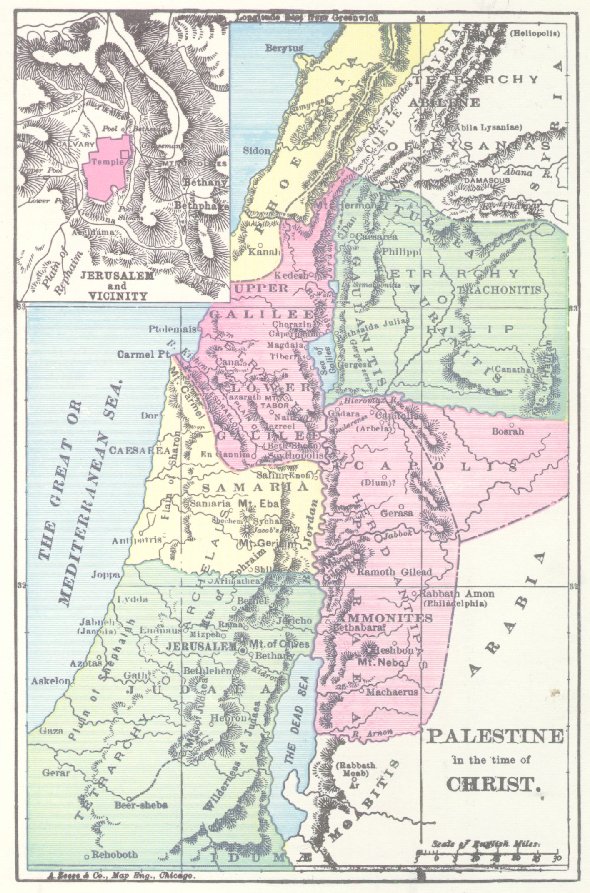
He turned south.
The Gospels speak of this decision in different ways. In Mark, Jesus simply begins to travel toward Jerusalem after a certain point, and the journey becomes the road story of the second half of the book. In Luke, the decision is named more explicitly: when the days drew near for him to be taken up, he set his face to go to Jerusalem. In Matthew, the journey is folded into the same overall shape as Mark's, with the same determination behind it. The reader should notice that all three Synoptics name the decision as deliberate, not as a drift. This was not a man who wandered toward Jerusalem because he had run out of things to do in Galilee. This was a man who chose to go, and chose at a specific moment.
The phrase in Luke — "he set his face" — is worth a moment of attention. The reader who knows only the English will hear a figure of speech about determination. The reader who knows something of the Jewish world will hear something slightly more specific. To set one's face toward a place, in the language of the Hebrew Bible and the Jewish world that grew from it, is to commit to a journey that has a destiny at the end of it. The prophets set their faces toward cities they were sent to confront. The Psalms speak of a person whose heart has set its face toward a vow made to God. The phrase carries the sense of a journey that is not just geographic but purposeful — a man going somewhere because something is waiting there for him to do, or to receive, or to become. The reader should carry that slightly heavier sense into the chapter, without the chapter having to argue for it. The sources give the phrase; the chapter should let it do its work.
The chapter will ask what that choice meant, and what he could reasonably have expected would happen when he got there.
The first thing the reader needs to understand is the calendar.
Passover was the festival of liberation. It was the anniversary, in the Jewish year, of the moment when God had acted decisively in history to free the Israelites from Egypt. The story was told at the meal, the meal was the celebration, and the celebration was a statement that the past act of God was not a one-time event but a pattern that could be expected again. Passover was the moment in the year when the hope that God would act again was most natural, most widespread, most at the centre of everyone's mind.
This matters because a man who believed the kingdom was near and that God was about to act would go to Jerusalem at Passover for the same reason a liberation movement would mark the anniversary of a liberation: because that was the moment when liberation was at the centre of the story everyone was telling, when the expectation of a renewed act of God was most natural, when the city was full of people who had come to remember the same thing. Passover was not a random date on a calendar. It was the moment.
The reader should not imagine this as a calendar choice in the modern sense, as if Jesus checked a schedule and picked the nearest available slot. It was deeper than that. Passover was the moment in the year when the story of liberation was being retold everywhere in the Jewish world. A man who believed God was about to act again would not need to think hard about when to go to Jerusalem. The calendar was telling him. He went when the city was remembering liberation, because that was the moment when the action of God was most expected and most visible.
The meal itself is worth a moment of attention, because it is part of what the reader needs to understand about the festival. Passover was not observed in a synagogue. It was observed at home, around a table, with a meal that remembered the exodus by retelling the story and eating the foods that stood for it. The Passover meal was a domestic act of remembrance, and the domestic act was also a political one, because the story being remembered was a story about liberation from an empire. Every year, in homes all over the Jewish world, families retold the story of how God had freed them from Egypt, and every year the story carried the implication that the present empire was not final either. The reader should understand that this is an ordinary thing in the life of a Jewish family, not a radical act in any single year, but that the ordinary repetition of the story is also the accumulation of an expectation — the expectation that liberation is a pattern in the life of God's people, and that the pattern may repeat. A man who expected the kingdom to be near would be carrying that expectation into the festival that was built around the same hope. The chapter should not overstate this. It should say that the Passover meal was part of the atmosphere in which the decision was made, and that the atmosphere was one of remembered liberation and expected repetition.
The second thing the reader needs to understand is the city.
Jerusalem at Passover was not the Jerusalem of any other time. The population multiplied. Pilgrims came from all over Judea and Galilee and beyond — from the villages where Jesus had been speaking, from the towns where his reputation had been spreading, from the countryside where people had heard about the man who healed and ate with the wrong people and argued with the Pharisees. The city filled with people who had come to remember liberation and who, in the year this book is reconstructing, may have been listening for it to happen again.
The Romans knew this. A prefect named Pilate, who had his normal base in Caesarea on the coast, would bring troops into Jerusalem for the festival. The empire did not treat Passover as a religious holiday. It treated it as a risk factor. The city was full of pilgrims who had come to remember an exodus, and any gathering that looked like it could turn into a disturbance was treated as a threat by the Roman state. Pilate's troops were on the porticoes, on the look-out, on the alert. The city was under surveillance in a way it was not at most other times of the year.
The Temple authorities were on high alert too. The high priest and the council that administered the Temple were responsible for keeping order, for ensuring that the festival did not turn into a riot, for managing the Roman presence, for keeping the peace between the people and the empire. This was one of the most delicate jobs in the Jewish world, and Passover was when it was hardest.
The reader should feel the density of the crowd, the surveillance, the atmosphere of a city that the empire treats as a festival risk. This is not a backdrop for Jesus' action. It is one of the things he was walking into. The next chapter will take up the city in more detail, but the reader needs the sense of it now, because it is what makes the decision legible.
The third thing the reader needs to understand is what the decision was not.
It was not a plan for armed revolt. There is no evidence that Jesus planned violence. The reader should not imagine him gathering a band, planning a seizure of the city, thinking about how to defeat the Roman garrison. There is nothing in the sources that suggests any of that. What the sources suggest is a man who had been saying things that disturbed the peace, who had a reputation, and who chose to go to Jerusalem at the most volatile moment of the year and do something that would be seen.
The reader who comes to this chapter with a picture of Jesus as a political revolutionary — a man with a programme for overthrowing the empire — should understand that the picture is not supported by the sources. Jesus was provocative, and his provocation had political consequences, but he was not a revolutionary in the sense a modern reader might mean. He did not have an army. He did not have a plan for power. He had a message about the kingdom of God, and he had an expectation that God was about to act, and he went to Jerusalem at Passover because that was the moment and the place where the message could be made public in the most consequential way.
It was also not a naive miscalculation. The reader should not imagine a man who walked into Jerusalem not knowing the risks. A man in Jesus' position — with his reputation, with the things he had been saying, with the followers he had gathered, with the controversies he had been involved in — knew that Jerusalem at Passover with Roman troops on the porticoes was a dangerous place to be. He knew the risks. The decision was not made in ignorance. It was made with the risks in view, which is part of what makes it significant. A man who knew the risks and went anyway is a man who thought something was worth the risk.
So what was the upside?
This is the question the brief asks, and the chapter should not dodge it by saying we cannot know. We cannot know exactly. But we can name the range of reasonable expectations, given what the previous chapter established about the apocalyptic frame.
If Jesus believed God was about to act, and Passover was the moment of liberation, and Jerusalem was the place where the Temple stood and the kingdom could be proclaimed — then going to Jerusalem at Passover was exactly what a man in his position would do. The upside was that this was the moment and the place where the kingdom could be enacted, where the prophetic sign could be made, where the confrontation with the present order could take its most public form.
The reader should understand that this is not a strategy document. It was not a plan worked out on paper. It was a man's decision in a specific moment, made from a specific expectation, with a specific understanding of what mattered. The chapter should present it that way, because only that presentation is honest.
What might he have expected would happen? The chapter should name the possibilities without choosing among them.
He may have expected a confrontation with the authorities that would serve as a prophetic sign — a demonstration that would proclaim the kingdom in the city where the Temple stood, in the context of the festival of liberation, in a way that would be seen by the crowd and by the authorities and by anyone watching. The entry into Jerusalem — the next chapter will describe it — is one version of this. A deliberate entry into the city that made a statement, followed by an action at the Temple that made a bigger statement, is the kind of thing a prophetic figure in the Jewish tradition might do, and the chapter should say that.
He may have expected the kingdom to arrive in some form — the decisive action of God, the Son of Man vindicated, the present order overturned. If Jesus believed God was about to act, then Jerusalem at Passover was the place to be when it happened. He may have understood himself as the figure through whom the action would be enacted, or as the figure who would witness it, or as the figure who would be part of it in some way the chapter cannot specify. The chapter should not try to specify. It should say that the expectation was real and the place was where the expectation could be most fully expressed.
He may have expected to be arrested, or even killed, as a consequence of what he was doing — and may have seen that as part of the story rather than a surprise. The apocalyptic frame allows for a sense that the suffering of the righteous is part of the pattern. A man who believed the kingdom was near and that he was part of its coming might well have understood that his own fate was not entirely in his hands and that what happened to him would be understood in the light of the larger story. The chapter should say this carefully, because readers may misread it as a claim that Jesus expected to be killed in a specific way for a specific reason. The chapter cannot show that. It can only say that the apocalyptic frame makes the possibility of arrest and death legible as part of the story rather than a surprise.
He may have expected the kingdom to come near in a way that did not depend on his own survival. If the kingdom was the action of God, then Jesus' own fate was not the whole of it. The reader from chapter nineteen should understand this. The chapter is about a man who expected God to act, and who may have believed that God's action would not be stopped by what happened to him.
The chapter should not choose among these possibilities, and it should say so plainly. What it can say is that the decision was legible. A reader who knows what Jesus seems to have expected — from chapter nineteen — would understand why he went to Jerusalem at Passover. The reader who does not know that would understand the decision less well. The chapter has spent two chapters building the reader's understanding of the apocalyptic frame for this reason. The decision to turn south only makes full sense in that frame.
The reader should understand, too, that the decision was not simply about Jesus. It was about the followers he had gathered. A man who had gathered twelve men around him and a larger group of disciples and a crowd of followers, who had women funding the movement, who had created a disturbance in his own region — that movement was moving toward Jerusalem and the Festival of Liberation. The decision was the movement's decision, and the chapter should say that without making it sound like a committee decision. Jesus seems to have been the one who made it, but he made it in the context of a movement he had gathered.
The chapter should also say something about what the decision meant for the people who had been following him. They knew he was going. They knew the risks. Some of them may have understood the apocalyptic frame better than the chapter presents it. Some of them may have understood it less well. Some of them may have expected him to be arrested and may have been afraid. Some of them may have expected the kingdom to arrive and may have been excited. The chapter cannot say which, because the sources do not say. It can say that the followers who had been with him through the healing of the leper and the eating with the tax collectors and the argument with the Pharisees and the redefinition of the family were about to watch what happened in Jerusalem, and that what happened would matter to them for the rest of their lives.
The chapter should end by handing off to the city itself. The reader has been told why Jesus turned south, and the reader has been told what the decision was and was not. The next chapter will take up the city he was walking into — Jerusalem at Passover, the crowd, the soldiers, the political temperature — and the reader should understand that the city is not a backdrop for what follows. It is a participant. The arrival, the entry, the Temple action — all of that happened in a specific city at a specific moment, and the chapter that follows will give the reader the city in the density it deserves.
A City at Festival
The reader has just been told, in the previous chapter, that Jesus made the decision to turn south and go to Jerusalem at Passover — and that the decision makes sense in the apocalyptic frame the chapter before established. The reader should now be told where he was going.
Jerusalem at Passover was not Jerusalem at any other time of year. The reader should understand this before the next chapter describes what happened there, because what happened depended on what the city was.
The first thing to understand is the crowd.
Pilgrims came to Jerusalem for the three great festivals — Passover, Shavuot, and Sukkot — and Passover was the biggest. People came from Judea, from Galilee, from the countryside and the villages, from the towns where Jesus had been speaking and the places where his reputation had reached. They came to remember the exodus, to eat the Passover meal with their families, to be in the city where the Temple stood. They came in such numbers that the city's population multiplied enormously.
How enormously, exactly, the sources do not say with any precision the reader can trust. Jerusalem's normal population is itself uncertain — somewhere in the neighbourhood of forty or fifty thousand, perhaps, though even that is an estimate rather than a fact. At Passover, with the pilgrims arriving, the number could rise sharply. Some writers have given larger figures, and some have given smaller ones, and the honest chapter does not choose among them with a confidence the sources do not support. What the chapter can say is that the crowding was extraordinary, that the city was fuller than it was at any other time of the year, and that the fullness was part of what made Passover a moment the Roman empire watched carefully. The reader does not need a specific number to feel the density. The reader needs the sense that the streets and the Temple precinct and the markets were crowded with people who had come for the same festival in the same week, and that the crowding could turn in a moment.
The pilgrimage itself is part of what the reader needs to understand. People did not fly to Jerusalem for the festival. They walked. They walked from the villages and the towns and the countryside, in groups, carrying what they needed for the journey and for the meal, and arriving in the city after days or weeks on the road. The journey was part of the festival — the pilgrimage was the act of coming to Jerusalem, and the act of coming was already a statement of devotion and a claim on the city. By the time the pilgrims arrived, they had already done something significant: they had travelled to the centre of the Jewish world for the festival that marked the anniversary of liberation. The reader should understand that the crowd arriving at Jerusalem at Passover was not an accidental collection of people. It was a pilgrim crowd, a crowd that had come on purpose, that had travelled for the festival, that had made the journey because the festival mattered. The crowd was already committed before it arrived.
The reader should also understand that the pilgrims were not a random crowd. They were people who had come to remember liberation. They had come to tell the story of the exodus again, to eat the meal that carried the story, to be in the city where the Temple — the centre of the Jewish world — stood. They had come carrying the same expectation that the previous chapter described: that the act of God in history might repeat, that the pattern might continue, that this year, perhaps, was the year. A city full of people who have come to remember liberation is a city full of people who are thinking, in one way or another, about liberation. The reader should carry that into the next chapter, because it is part of what makes the entry legible.
The second thing to understand is the soldiers.
The Roman prefect of Judea, Pilate, had his normal base in Caesarea on the coast. For the great festivals, he came to Jerusalem. He brought troops with him. The empire did not treat Passover as a religious holiday. It treated it as a risk factor. A festival that celebrated liberation from an empire was a festival that could, in the right circumstances, become the occasion for an attempt at liberation — and the Romans knew this. They brought soldiers into the city to watch the crowds, to look for trouble, to be ready if anything turned.
The reader should feel the surveillance. Roman soldiers on the porticoes, on the walls, on the look-out. A city under watch during its most crowded week, by a force that was there in part to manage the risk that the festival itself represented. This was not a city at peace in the ordinary sense. It was a city that the empire treated as a festival risk, and the risk was real. The reader should understand that Pilate's presence in the city at Passover was not a personal whim. It was standard practice, and the standard practice existed for a reason. The reason was that the empire knew what Passover was, and knew what a city full of pilgrims remembering liberation could become.
The standard picture of Roman provincial administration is of a small occupying force spread thin across a province, watching for trouble, responding to trouble, preferring not to make trouble unnecessarily because trouble was expensive. Judea was a province of that kind. The Romans governed through local structures — the Temple hierarchy, the Jewish council, the high priest — and they intervened when those structures failed to keep order. At Passover, the local structures were under maximum strain, because the crowd was maximum, because the festival was about liberation, because the crowd was full of people who might, in the right circumstances, decide to act on the festival's message. The Romans came to the city themselves, with their own troops, because that was the week when the local structures might not be enough. The reader should understand that the Roman presence at Passover was not a show of force against a happy crowd. It was a show of force against a crowd that the empire had reason to worry about.
This is one of the things that Fredriksen argues in the most important secondary source for this chapter: that Pilate's response to Jesus should be understood in the context of Roman concern about Passover crowds and anything that looked like it might turn. The reader does not need the secondary source's argument in full, but the reader should understand the background it depends on: that the Romans knew what Passover was, that they had reason to worry about it, that they came to the city with troops for that reason, and that the governor was watching for anything that might become a disturbance. What happens in the next chapter — the entry and the Temple action — lands in this context, and lands hard. The reader should understand the context before the chapter describes what happened, because what happened only makes sense in the context.
The reader who comes to this chapter with a picture of Roman rule as a calm, bureaucratic thing should have that picture corrected. Roman rule in Judea at Passover was not calm. It was watchful, tense, aware of its own insecurity. The governor came to the city for the festival because the festival was the moment when the insecurity was greatest. The troops on the porticoes were there because the empire had learned, over the course of a century of governing the province, that festivals of liberation were moments when trouble could start.
The third thing to understand is the Temple authorities.
The high priest at the time, and whatever council or group administered the Temple, was responsible for keeping order during the festival. This was one of the most difficult jobs in the Jewish world. The Temple was the centre of the celebration, and the Temple was also the place where the Romans had the most reason to watch. The high priest had to manage the crowd, manage the sacrifice, manage the pilgrimage, and manage the relation with the Roman governor and his troops — at the same moment, during the most volatile week of the year.
The reader should understand that the Temple authorities were under pressure from both sides. They were responsible to Rome for order, and they were responsible to the people for the festival. During Passover, those two responsibilities could come into conflict. The crowd wanted the festival. Rome wanted order. The high priest stood between them, trying to keep both satisfied, trying to keep the peace. The reader should not imagine the high priest as a villain — a man who betrayed his own people for Roman favour — or as a fool. The reader should imagine a man doing a difficult job in a difficult week, trying to keep a city full of pilgrims from turning into a riot while keeping the Roman soldiers from deciding that the city needed to be put down. And the reader should understand that this is the position the high priest was in when Jesus entered the city and then went to the Temple. Whatever the high priest thought of Jesus before the entry — and the sources do not tell us what he thought — the entry and the action that followed would have put him under immediate pressure from the Romans. The Romans would have seen the entry as a potential disturbance. The high priest would have been the man responsible for managing it. The reader should carry that into the next chapter, because it is part of why the Temple action that follows is so consequential: it landed on the high priest in the middle of the most difficult week of the year, when he was trying to keep the peace between the crowd and the empire.
This matters for what follows. The entry into Jerusalem and the action at the Temple — the next chapter — happened in this context. They happened in a city where the Temple authorities were trying to manage a dangerous week, where the Romans were watching for trouble, where the crowd was full of people remembering liberation. The entry and the action landed in the middle of all of that, and they landed hard. The reader should understand the context before the chapter describes what happened, because what happened only makes sense in the context.
The fourth thing to understand is the atmosphere.
Jerusalem at Passover was a loud city. The pilgrims were arriving, the markets were full, the Temple courts were full, the air was thick with the smell of the sacrifices and the dust of the roads and the sweat of the pilgrims walking in from the countryside. Passover is in the spring — late March or early April — and Jerusalem in that season is not cool. The city was warm, and crowded, and busy, and full of people who had come for the same reason and who knew they were all together for the same reason. There was a sense in the air of a city holding its breath — celebrating, but celebrating under watch, celebrating in a city where the empire had put soldiers on the walls.
The reader should feel this, because the next chapter describes a man entering this city. The entry made a statement, and the statement could only be read in the context of the city he was entering. A man walking into Jerusalem at Passover, in front of the crowd, in front of the soldiers, in front of the Temple authorities, was doing something the city would notice. The reader needs the city first.
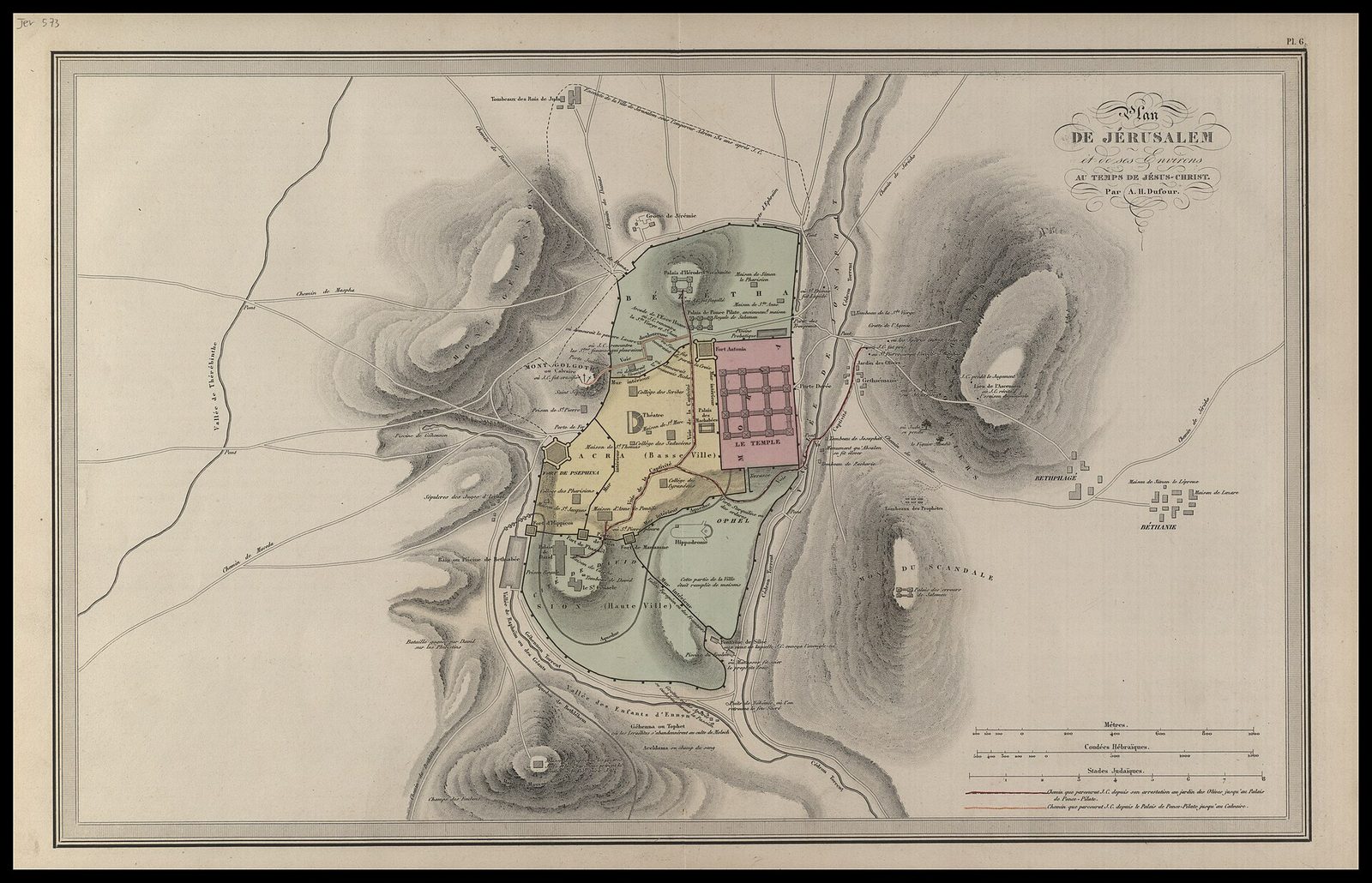
The geography helps the reader feel the city. Jerusalem sat on a ridge in the hills of Judea, with the Temple mount dominating the area around it. Pilgrims coming from the east, from the direction of the Mount of Olives, would approach the city across the Kidron valley and then climb into it. The entrance from that direction framed the city in a particular way — the rise from the valley, the view of the walls and the Temple, the descent into the streets. The entry that the next chapter will describe comes from that direction. The reader should understand the geography well enough to feel the approach, without the chapter having to give a full topographical survey. The point is to make the reader feel present in the city, not to describe every gate and street.
The geography also matters in a practical sense. Jerusalem in the first century was not a sprawling city; it was compact, and the walls and the Temple mount defined its shape. The walls gave the city its boundary and its sense of security; the Temple mount gave the city its religious centre and its political significance. A man entering the city from the east would see the walls first, then the Temple, then the streets below. The reader should have the sense that the city was a city you could enter and move through in a day, and that the key places — the Temple, the markets, the streets where a crowd could gather — were close together. The entry and the Temple action happened in a city where a man could walk from the gate to the Temple in a short time, and where whatever he did could be seen quickly. The geography made speed possible, and speed mattered. The reader should feel that.
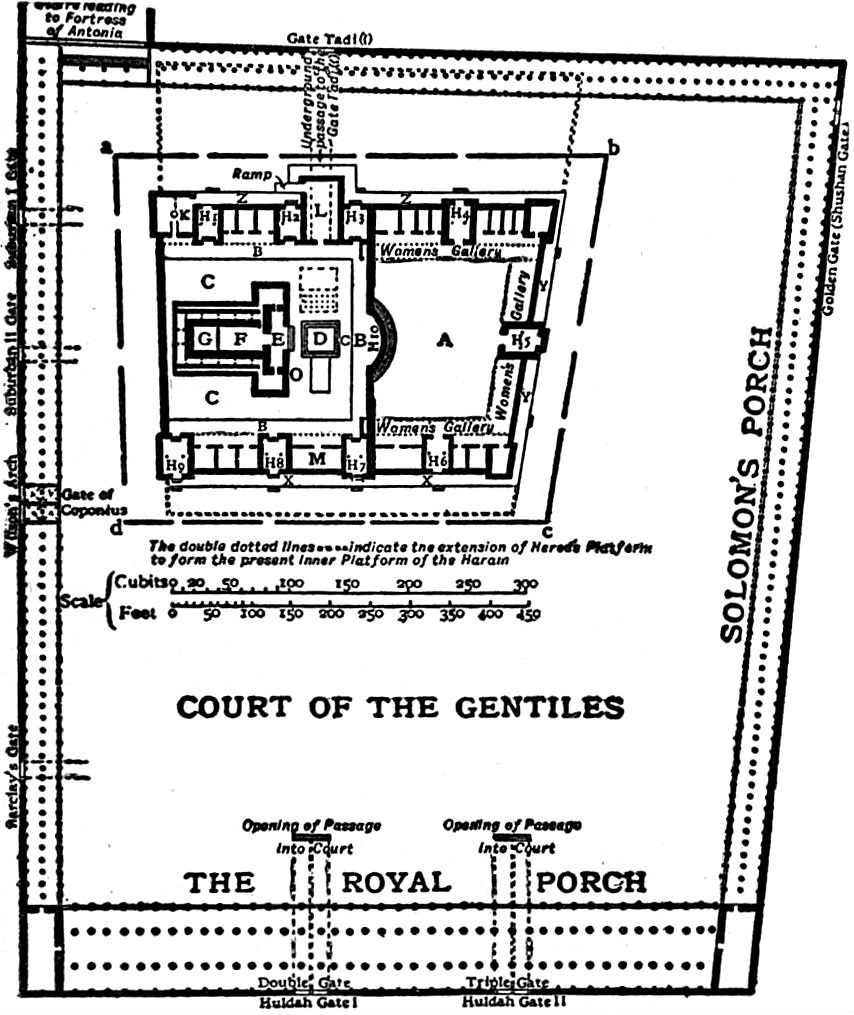
The Temple itself dominates the city's sense of itself. The Temple mount was enormous — the platform was one of the largest in the ancient world, and the Temple building on top of it was the centre of the Jewish world. Pilgrims coming to Jerusalem for Passover came above all to the Temple, because the Temple was where the presence of God was understood to dwell, and because the sacrifice of the Passover lambs was done at the Temple. The city at Passover was a city centred on the Temple, and the Temple was the first thing many pilgrims saw as they approached. The reader should understand the Temple's place in the city, because the action at the Temple that the next chapter describes will be an action at the centre of the centre.
The reader should leave the chapter with a clear sense of the city.
Jerusalem at Passover was a city at maximum population, maximum tension, maximum surveillance. It was a city full of pilgrims who had come to remember liberation. It was a city where the Roman prefect was present with his troops, watching the crowds on the porticoes. It was a city where the high priest and the Temple authorities were trying to manage a dangerous week, trying to keep the peace between the crowd and the empire. It was a city where the Temple dominated the skyline and the religious life and the political reality. It was a city where the atmosphere was thick with the feeling of a festival that celebrated liberation and where the empire knew that liberation was the subject of the festival.
This is the city Jesus was walking into. The next chapter will describe the entry and the action at the Temple — the thing that got him killed. But the reader should understand the city before the entry, because the entry only makes sense in the city. A man entering Jerusalem at Passover was entering a specific thing, and the chapter that follows should describe it as a specific thing, not as a generic city at a generic festival. The reader who feels the city will understand the entry better. The reader who does not feel the city will not.
The Demonstration
The reader has been told, in the previous chapter, where Jesus was going and what the city was. The reader has been told that Jerusalem at Passover was a city at maximum population, maximum tension, maximum surveillance. The reader has been told that Pilate was in the city with his troops, that the high priest was trying to keep the peace between the crowd and the empire, that the crowd was a pilgrim crowd that had walked to the centre of the Jewish world for the festival of liberation. The reader has been told that whatever happened next happened inside that city at that moment, and that what happened would only make sense in that context.
Now the reader is told what happened.
The entry into Jerusalem was not a parade in the modern sense. The reader should understand this before the chapter describes it, because the modern sense is the wrong sense. A modern parade is a celebration of something that has already happened — a victory, a holiday. A modern triumphal parade is a procession of a conqueror through a city, with the conquered watching, with the soldiers marching, with the spoils being carried. The reader should not imagine the entry into Jerusalem as a modern parade, and the reader should not imagine it as a modern triumphal parade either.
What the reader should imagine is a demonstration. A man arriving in a city with a following, making a public claim in the open, in front of a crowd that has come for the festival, in a city where the empire has put soldiers on the walls. A demonstration is a public act that says something and is meant to be seen. The entry into Jerusalem was a demonstration, and it was a demonstration that said something specific.
The Gospels describe the entry in similar but not identical terms. The Synoptics — Mark, Matthew, and Luke — describe a man arriving from the east, from the direction of the Mount of Olives, with a crowd, on an animal. John describes a crowd meeting a man who was coming into the city. The details differ, and the chapter will note them. But the basic shape is the same in all four Gospels: a man comes into Jerusalem in a public way, with a crowd, on an animal, and the crowd says something.
The reader should understand that the basic shape is the same because the event is the same. The Gospels agree on the main elements: Jesus comes into Jerusalem, in a public way, with a following, on a donkey or a colt, and the crowd acclaims him. The Gospels differ on the details — on the exact words of the crowd, on the exact route, on the exact animal, on the exact arrangement of the disciples — but they agree on the shape. The reader should understand that the shape is what matters for the historical reconstruction, and that the shape is enough to tell the reader what the event was.
The reader should also understand that the event is real — the Gospels agree on the shape because the event happened, and the event is not a later invention. The reader should understand that a man entering Jerusalem in a public way, with a following, on a donkey, at Passover, is not the kind of thing the later church would invent. The later church might invent a more glorious entry, or an entry with an army, or an entry that established Jesus as the king of the world. The later church would not invent an entry on a donkey, with a crowd shouting "Hosanna," in a city where the empire had soldiers on the walls. That is too awkward, too specific, too dangerous. The embarrassment principle applies here: the entry is the kind of thing that would not have been invented, and that is one of the reasons to think it is close to what happened.
The entry comes from the east. The reader should understand the geography, because the geography matters.
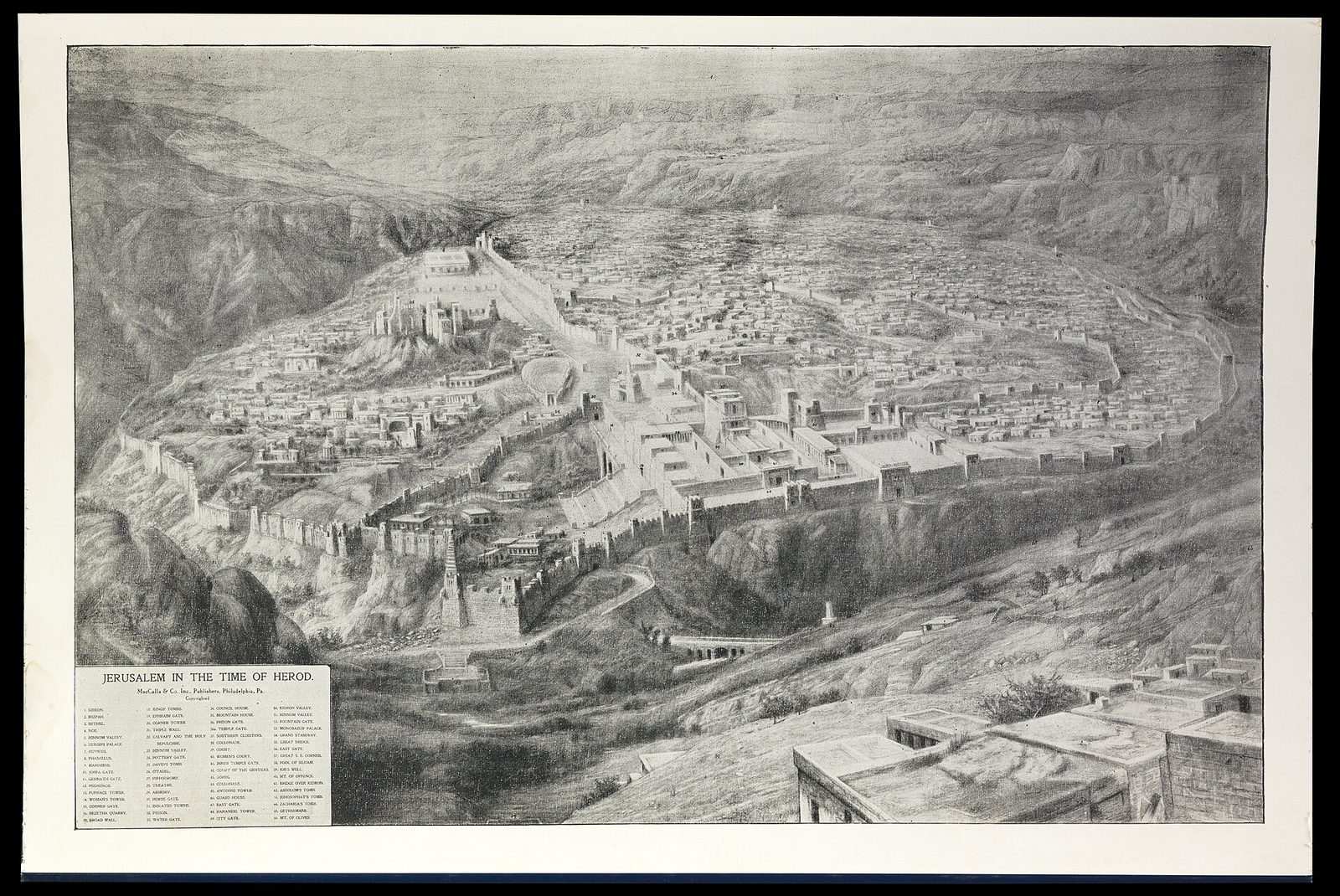
Pilgrims coming to Jerusalem for the festivals came from the east, from the direction of the Mount of Olives, across the Kidron valley, and then into the city. The approach from the east was the approach of the pilgrim, the approach of the person coming to the city for the festival. The entry of Jesus comes from the east, from the direction of the Mount of Olives, and the reader should understand that this is the pilgrim's approach — the approach of someone coming to the city for the festival. The entry is shaped by the geography of the pilgrim's approach.
The Gospels say that Jesus sent two disciples to find a colt or a donkey for him to ride. The Synoptics give the detail of the colt — a young donkey, the foal of a donkey. Matthew adds the detail that the disciples brought both a donkey and a colt, though the reader should not be too literal about this; the Gospels are not giving a precise veterinary account of the animals. The reader should understand that Jesus rode into Jerusalem on an animal — a donkey or a colt — and that the animal is significant, because the animal is part of the statement the entry is making.
The animal is a donkey, and the reader should understand why a donkey matters. A donkey is not a warhorse. A donkey is not a symbol of military power. A donkey is a humble animal, a beast of burden, the animal of a peasant or a traveller, not the animal of a king or a general. A man entering Jerusalem on a donkey is not making a military statement. He is making a different statement — a statement about the kind of king he is, or the kind of king the one coming is. The reader should understand that the donkey is part of the claim, and that the claim is about a different kind of power.
The reader should understand that the donkey is connected to a prophecy. Matthew and John both make explicit reference to Zechariah 9:9: "Lo, your king comes to you; triumphant and victorious is he, humble and riding on a donkey, on a colt, the foal of a donkey." The reader should understand that the entry is an enactment of this prophecy, and that the prophecy is about a king who comes in humility, not conquest. The reader should understand that the entry is saying, in the language of the Jewish scriptures, that the king who is coming is the humble king of Zechariah, not the warrior king of the empire.
The reader should also understand that the Zechariah prophecy is a political statement, not a religious statement in the modern sense. Zechariah 9 is about the king of Zion, the ruler who comes to Jerusalem. The prophecy is about the king of Israel, the king of the Jewish people. The entry is saying, in the language of the Jewish scriptures, that the king of Israel is coming, and that the king of Israel is the humble king of Zechariah. The reader should understand that this is a statement about the kind of kingdom Jesus is proclaiming, and that it is a statement that contrasts with the Roman imperial way of doing power — the emperor on a horse, the legions, the conquest.
The reader should understand that the entry is deliberately provocative in its context. A man entering Jerusalem at Passover, in front of a crowd, on a donkey, making a statement about kingship, with Roman soldiers on the walls — even if the statement is peaceful, even if the king comes on a donkey, the entry is a public claim in a city under military occupation. The Romans knew what a king entering a city meant. They did not need to be told. The entry was a demonstration, and demonstrations were dangerous.
The crowd that accompanied or met Jesus shouted. The reader should understand what the crowd shouted, because the words matter.
The Synoptics give the words. In Mark 11:9–10, the crowd that went ahead and the crowd that followed shouted: "Hosanna! Blessed is he who comes in the name of the Lord! Blessed is the coming kingdom of our father David! Hosanna in the highest!"
The reader should understand that these words are not a parade chant. The words are a statement, and the statement is a political and religious statement. "Hosanna" is a word of salvation, a cry for help — "save now" — a liturgical word from the Psalms. The crowd is not just cheering a man who has arrived. The crowd is making a statement about the kingdom of David — the kingdom of Israel, the kingdom of liberation. The words are not a generic acclamation. They are a specific acclamation, and they are a specific acclamation that would have been heard by the Roman soldiers on the walls and by the Temple authorities in the Temple.
The reader should understand that the phrase "the coming kingdom of our father David" is particularly significant. The crowd is not just acclaiming Jesus as a teacher or a healer. The crowd is acclaiming him as the bringer of the kingdom of David — the kingdom of Israel. The reader should understand that this is a statement about the kingdom, and that the statement is political, because the kingdom of David is a political kingdom, the kingdom of Israel. The reader should understand that the crowd is making a political claim, and that the political claim is being made in a city under military occupation, in front of Roman soldiers.
The reader should also understand that the Gospels may have shaped the words. The "Hosanna" cry is a liturgical formula from the Psalms, and the Gospels' use of it may reflect the later church's understanding of the entry. The reader should not assume that the exact words are what the crowd said. The reader should assume that the crowd said something that the Gospels have recorded and shaped, and that the something was an acclamation of Jesus as the one who comes in the name of the Lord and as the bringer of the kingdom of David.
The reader should also understand that John's Gospel gives a different version of the crowd. In John 12:12–19, the crowd that met Jesus was the crowd that had been at the raising of Lazarus — the crowd that had come to Bethany and then went to Jerusalem. The reader should not be confused by this difference. The reader should understand that the Gospels are giving different versions of the same basic event, and that the basic event is the same: a man comes into Jerusalem, and the crowd acclaims him.
The entry is not the end of the story. After the entry, Jesus goes to the Temple.
The reader should understand that the Temple is the next thing the reader needs to understand, because the Temple is where the next thing happens. The reader has been told, in the previous chapter, what the Temple is — the centre of the Jewish world, the place where the presence of God was understood to dwell, the place where the pilgrims came to offer sacrifices. The reader has been told that the Temple dominated the city, that the Temple was the first thing many pilgrims saw as they approached, that the Temple was the centre of the centre. The reader should carry that into this chapter, because the Temple action is an action at the Temple, and an action at the Temple is an action at the centre of the centre.
The Gospels describe the Temple action in similar terms. In Mark 11:15–19, Jesus enters the Temple and drives out those who were selling and buying. He overturned the tables of the money-changers and the seats of those who sold doves. He would not allow anyone to carry merchandise through the Temple. And he taught: "Is it not written, 'My house shall be called a house of prayer for all the nations'? But you have made it a den of robbers." (Mark 11:17, quoting Isaiah 56:7 and Jeremiah 7:11).
Matthew 21:12–17 gives a similar account, with additions — the healing of the blind and lame in the Temple, the children shouting "Hosanna to the Son of David." Luke 19:45–48 gives a similar account, with some differences in the language. John 2:13–22 gives a different account, set earlier in Jesus' ministry, but with the same basic elements — the cleansing of the Temple, the whip of cords, the saying about the temple of his body. The reader should understand that the Gospels give different versions of the Temple action, and that the chapter should rely on the Synoptics for the action at the end of Jesus' life, and should note John's version without getting confused by the chronological difference.
The reader should understand what the action was, practically. Pilgrims came to Jerusalem to offer sacrifices. They brought animals from their flocks, or they bought them in the Temple precinct. The Temple tax had to be paid in the Temple currency, so money had to be changed. The sellers and money-changers were doing business in the Temple courts, in the Court of the Gentiles — the outer court, the only part of the Temple where Gentiles could come. The action of Jesus was to overturn the tables and the seats and to object to what was happening in the Court of the Gentiles.
The reader should understand why the action is significant. The action is an action at the Temple — the centre of the centre. The action is an action at the Temple during Passover — the week when the Temple was busiest, when the pilgrims were offering their sacrifices, when the money-changers and the sellers were most active, when the Temple was at its most crowded and most watched. The action is a public act, and a public act at the Temple during Passover is a serious thing. The reader should understand that the action is not a simple protest against business in the Temple. It is an act of prophetic significance, and it is an act of political significance, and the two are not separable.
The reader should understand what the action was saying. Jesus' words quote two passages from the Jewish scriptures. Isaiah 56:7 says that the Temple will be "a house of prayer for all the nations." Jeremiah 7:11 asks whether the Temple has become "a den of robbers." The reader should understand that Jesus is quoting these two passages and making a claim: the Temple should be a house of prayer for all the nations, and it has become something else — a place where commerce is done, a place where the Gentiles are pushed out, a place that is not what it should be.
The reader should understand that the Isaiah citation is particularly significant. "A house of prayer for all the nations" is a vision of the Temple as inclusive — as a place where the Gentiles can pray. The action of Jesus is in the Court of the Gentiles, the only part of the Temple where Gentiles could come. The reader should understand that the action of Jesus is a statement about the inclusion of the Gentiles in the Temple — a statement that the Court of the Gentiles should be a place of prayer, not a market. This is a significant claim in the context of the first century, when the Temple was the centre of Jewish identity and the Gentiles were on the margins.
The reader should also understand that the action has a political dimension. The Temple was the centre of the Jewish world, and the Temple was under the control of the high priest and the Temple authorities, who were in turn under the control of Rome. An action at the Temple that disrupts the Temple commerce and challenges the Temple authorities is an action that the authorities cannot ignore. The reader should understand that the action is political in the sense that it challenges the authority of the people who ran the Temple, and that this challenge is the kind of thing that got Jesus killed — not because he was leading an armed revolt, but because he did something that the authorities could not allow to stand.
The reader should also understand that the action may be tied to the entry. The entry invoked the kingdom of David. The Temple action invoked the prophetic tradition and the vision of the Temple as a house of prayer for all nations. The reader should understand that the two belong together — the entry is about the kingdom, and the Temple action is about what the kingdom means for the Temple. The reader should understand that the pair of actions — the entry and the Temple action — is a deliberately provocative pair that said something about the kingdom and about the Temple and about who was in charge.
The reader should understand that the authorities could not leave it alone.
After the entry and the Temple action, the Synoptics describe the response of the authorities. In Mark 11:18, "the chief priests and the scribes and the elders" looked for a way to destroy Jesus. The reason is that "all the crowd was spellbound at his teaching." The reader should understand that the response is immediate and serious. The authorities cannot ignore the entry, because the entry was a public claim. They cannot ignore the Temple action, because the Temple action was a public challenge. They cannot ignore the crowd's response, because the crowd's response was a threat to their authority.
The reader should understand that the authorities' response is not cartoon villainy. The authorities are men doing their job, and their job is to keep order in a city under occupation during a volatile festival, and a man who enters the city in a way that looks like a king entering his city, and then goes to the Temple and overturns the tables and challenges the Temple commerce, is a man whose actions they cannot leave alone. The reader should understand that the authorities' response is shaped by the context — the Passover crowds, the Roman soldiers on the walls, the Temple authorities trying to keep the peace — and that the context makes the response more serious than it would be at another time.
The reader should also understand that the authorities' response is shaped by their own interests. The Temple authorities had a stake in the Temple commerce, and an action that disrupted the Temple commerce was a threat to their income and their authority. The reader should not make the Temple authorities into cartoon villains, but the reader should understand that they had a stake in what was happening, and that the stake made them more likely to respond seriously.
The reader should understand that the pair of actions — the entry and the Temple action — is the thing that got Jesus killed. Not because he was leading an armed revolt. Not because he was planning to overthrow the empire. But because he did something in the centre of the centre of the Jewish world at the most volatile week of the year, with Roman soldiers on the walls and the high priest trying to keep the peace, and the authorities could not ignore it.
The reader should carry this into the next chapter, which takes up the last meal. The last meal happened after the entry and the Temple action, in the context of the authorities looking for a way to destroy Jesus — part of the same story, the same story about a man who did something in the centre of the centre of the Jewish world at the most volatile week of the year, and who was killed for it.