Part Three: The Roads
On Foot
Paul is on foot for most of the known part of his life. This is not an opinion. It is the shape of the record. The letters mention journeys — he goes to Jerusalem, he goes to Damascus, he goes to Antioch, he goes to Macedonia, he goes to Greece, he goes to Jerusalem again, he is taken to Caesarea, he is sent to Rome. The journeys are mentioned in the letters as the substance of his life: "in journeying often, in danger from rivers, in danger from bandits, in danger from my own people, in danger from Gentiles, in danger in the city, in danger in the wilderness, in danger on the sea, in danger from false brothers, in toil and hardship, through many a sleepless night, in hunger and thirst, in fastings often, in cold and exposure." Most of that is being on foot. Most of it is walking.
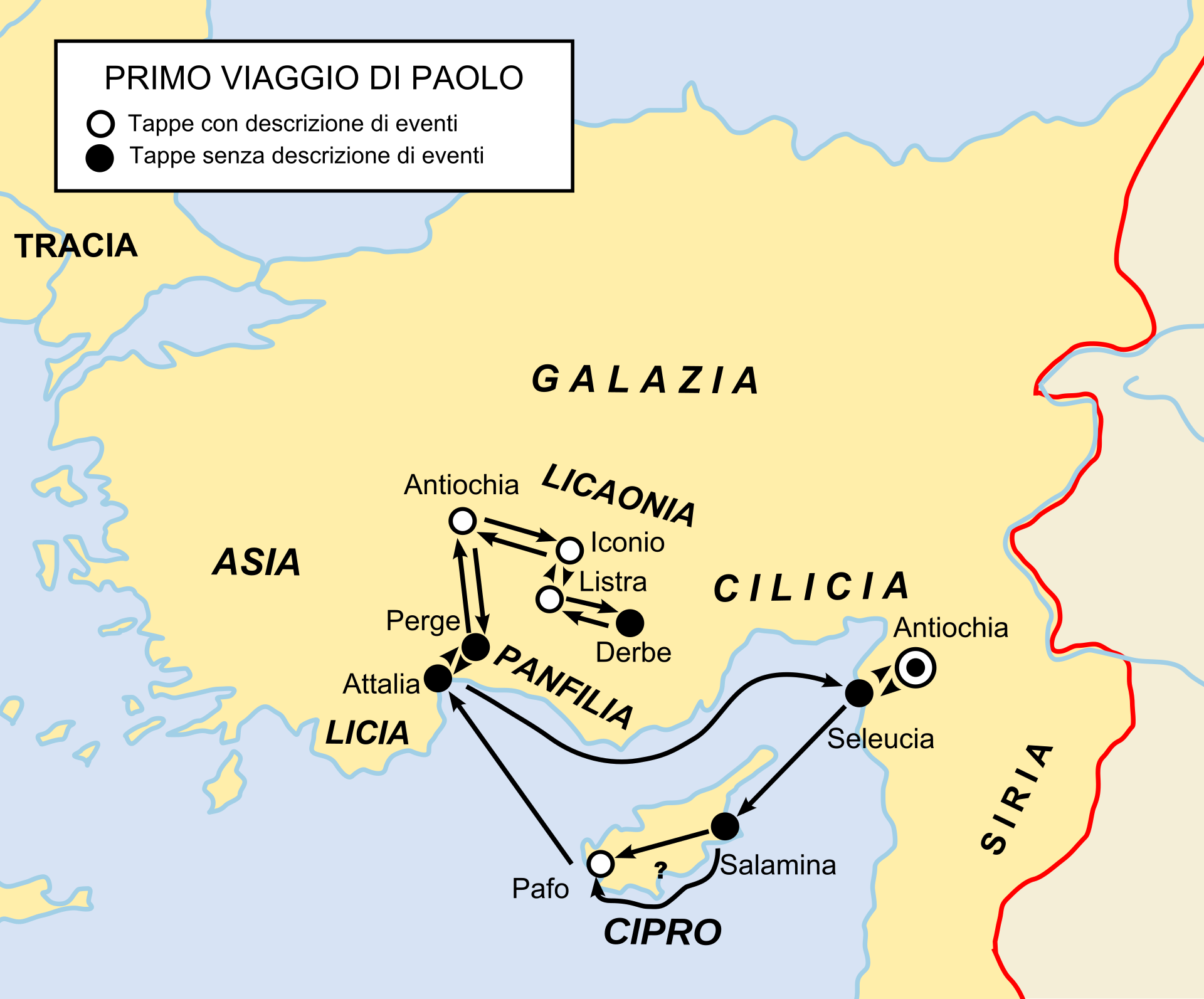
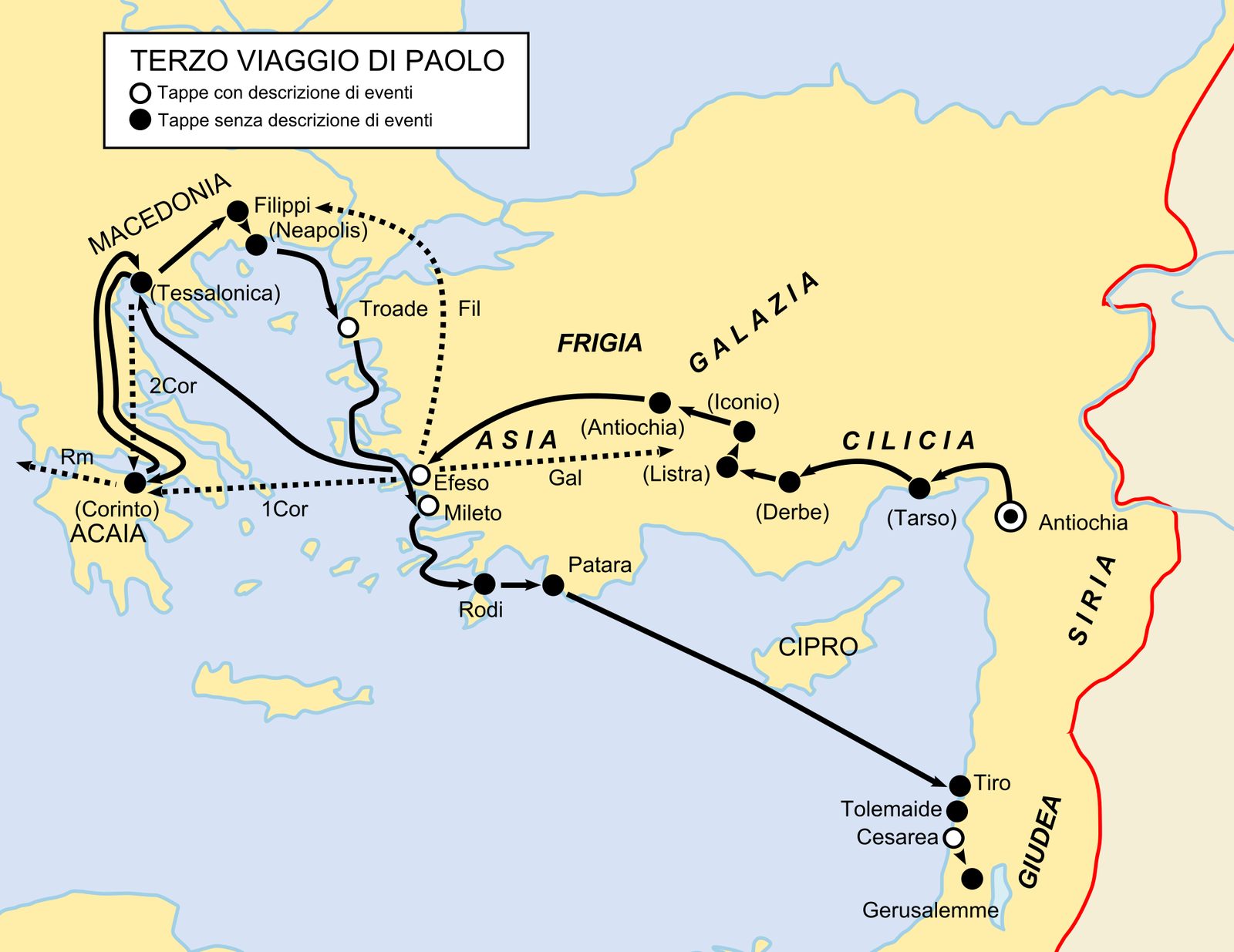
He walks because there is no alternative for long-distance movement in the eastern Mediterranean of the first century that does not require wealth or status or a reason to be on a ship. He walks because he is not rich. He walks because he is a man with a mission and the mission is done by moving from one place to another, and the moving is done by walking. The roads exist. They are Roman roads, or at least roads that have been made usable by Roman administration and the demand of the provinces for military movement. They go from one city to another. They go from Antioch to Tarsus, from Tarsus to Derbe, from Derbe to Lystra, from Lystra to Iconium, from Iconium to Pisidian Antioch, from Pisidian Antioch to Perga, from Perga to Attalia, from Attalia back to Antioch — a journey described in Acts 13 and 14, a journey that is part of Paul's life, a journey that can be traced on a map, a journey that took weeks and that was done by walking.
The distance is the first thing to think about, because the distance is the thing that determines the shape of the life. A day's walking in the eastern Mediterranean is not a modern day's walking. It is a day's walking by the distance of the Roman road system, which was built for the movement of troops and not for the comfort of travellers. The average day's march for a Roman army was twenty Roman miles — about eighteen kilometres — and that was for men carrying packs. A traveller on a civilian journey moved more slowly, or at least moved with less urgency and less load, and the Roman road system allowed a pace that was roughly fifteen to twenty miles a day, or twenty-four to thirty-two kilometres, for a person on foot moving with no extreme urgency. A journey of three hundred kilometres — the distance from Antioch to Tarsus — is about twelve to fourteen days of walking, with no days off. A journey of five hundred kilometres takes about twenty days. A journey of a thousand kilometres takes about forty.
Paul's journeys are not short. The journey from Antioch to Derbe is about three hundred kilometres. The journey from Derbe to Lystra is shorter, maybe eighty kilometres. Lystra to Iconium to Pisidian Antioch is another hundred and fifty or so. The total ground covered in the Paul chart in Acts 13 and 14 is perhaps eight hundred to a thousand kilometres of walking in a period that is measured in weeks and months. The journey described in Acts 20 and 21 — the journey from Macedonia down through Achaia, then across the Aegean to Asia, then from Asia to Jerusalem — is a much longer journey, and it is done partly on foot and partly by ship. The voyage to Rome at the end of the book is ship, and it is shipwreck and it is being driven by the winds, and it is not the kind of movement you do on foot. But most of the journeys in Paul's life are on foot, and the distance is such that the life is largely the life of a walker.
The roads are not abstract. They are Roman roads, which means they are built to a specification that was designed for the movement of the army. The roads are paved, or at least they have a paved surface in the best sections, with a foundation of rubble and sand and stones, with drainage, with a camber so that water runs off, with milestones that tell you how far you are from Rome or from some other point of reference. The roads are mostly east-west or north-south, built along the lines that the Roman empire needed for military and administrative movement, and they do not necessarily go where a pilgrim would want to go. They go from Antioch to the east, from Antioch to the north, from Tarsus to the west toward the coast. They go through passes and valleys and plains. They go through places that are defensible and places that are not.
The Roman road system is, in one sense, the reason the movement can travel at all. Without the roads, the distances are harder, the journeys take longer, the risk of banditry is higher because the alternative paths are worse. With the roads, there is a known route, there is some measure of safety on the main roads, there is the possibility of movement that is planned rather than improvised. The roads are a product of Roman empire, and they are one of the conditions of the possibility of the mission. The mission is done by moving from one place to another, and the moving is done on roads that exist because Rome has placed its authority on the ground in the form of infrastructure.
The roads are also dangerous. The letter to the Romans is the letter in which Paul lists the dangers of the journey, and the list is one of the most human documents in the letters. He is in the chapter that is about the collection, and he is trying to persuade the Roman church to receive him, and to help him on his way to Spain, and to support him in what he is about to do. And in the course of the argument, he tells them what the road has been. He tells them about the Jews and the Gentiles and the false brothers. He tells them about the rivers and the bandits. He tells them about the city and the wilderness. He tells them about the sea and the shipwrecks. He tells them about the toil and the hardship and the sleepless nights and the hunger and the thirst and the fastings and the cold and the exposure.
And he tells them it has been on the road that the danger has happened, not at the destination. The danger has not been in the city where he preaches. The danger has been in the getting there. The danger has been on the road. The danger has been in the places between the cities.
That is the thing the road tells you. The city is a place you arrive at. The road is a place you pass through. The city is a place of safety, or at least a place you hope is safe. The road is the place of danger — bandits, rivers, wolves, false brothers, the things that happen to people who are moving from one place to another and who are vulnerable in their movement. The road is the condition of the mission, and the road is the threat to the mission, and the two are the same thing.
The roads are Roman roads, but the people on them are not Roman. They are Jews and Gentiles and God-fearers, and they are moving for reasons that have nothing to do with Rome. A Jew in the Diaspora travels to a festival in Jerusalem, or to a friend's house in another city, or to a community that welcomes him. A Gentile traveller travels for trade, or for imperial service, or for pleasure, or for the kind of movement that depends on status. A Christian moves for the mission — to preach, to strengthen a community, to deliver a letter, to carry the collection, to escape a city that has become dangerous. The roads are the infrastructure of empire, but the people on them are using them for their own reasons, and the reasons are not the reasons of the empire.
That is one of the things the records tell you. The Roman road system is there because Rome has ruled the eastern Mediterranean for a century and a half, and the roads are the sign of Roman authority, and they are the thing that makes the movement possible. But the movement does not use the roads for Rome's purposes. It uses the roads for the mission. It uses the roads to get from Antioch to the Galatians, from the Galatians to Corinth, from Corinth to Ephesus, from Ephesus back to Jerusalem. It uses the roads to carry letters, to carry people, to carry the collection, to carry the gospel. The roads are Roman. The use of them is not.
The travel is also expensive, and that is one of the things the letters tell you directly. Paul raises money to travel. He does not travel as a man who can afford to go where he wants when he wants. He travels as a man who needs help — the collection is money for the Jerusalem church, but it is also money that will in part support his journey to Jerusalem and his continued work. The Roman church is asked to support him on his way to Spain. The churches in Macedonia and Achaia are asked to send money to Jerusalem, and Paul goes with them, and the journey to Jerusalem is part of the journey of the money.
The cost of travel is the reason Paul is not constantly on the move, or not constantly moving in the way a man with money would move. He stays in places. He works. He makes tents. He stays in the places where he has work and where he has friends, because staying is cheaper than moving and because the mission is not a tour — it is a series of stays in places where he has work to do. The movement is the movement of the letter carrier and the letter reader, the movement of the visit to strengthen a congregation, the movement that is necessitated by the crisis in a community or the need to go to Jerusalem and settle something that the letters have not settled.
The travel also has a shape that the map does not show. The map shows the roads. The map shows the distance. The map does not show the banditry. It does not show the cold and the exposure. It does not show the rivers. It does not show the sleepless nights. It does not show the false brothers. It does not show the fact that the road is the place where the danger happens, and the danger is the reason the letters are written — because the communities that Paul has left behind are places where the mission has to be defended against people who want to impose circumcision on the Gentiles, and Paul has to continue the argument from a distance, and the distance is the distance of the road, and the distance is the distance of the life.
The map shows a man moving from one city to another. The life is a man who is on the road most of the time, who is tired, who is in danger, who is writing letters from places where he has been forced to stop, who is building communities in places where he cannot stay, who is moving from place to place in a region where the travel is hard and the travel is dangerous, and where the travel is the condition of the whole thing.
The letters are occasional documents, and the travel is the context of the letters. The letter to the Thessalonians is written because the community in Thessalonica has been disturbed, and Paul has left abruptly, and he is writing from somewhere else — from Corinth, from somewhere in the region — and he is trying to continue the teaching he began and to answer the questions that have come up in his absence. The letter to the Galatians is written because the community in Galatia has been put under pressure by teachers who want the Gentiles circumcised, and Paul is writing from a distance, and the distance is the distance of the road. The letter to the Corinthians is written because Paul has left Corinth and the community there has been in trouble, and he is writing to settle things from a distance.
Every letter in the letter collection is a letter written from a distance. Every letter is a letter written from somewhere on the road or in a place the writer has reached after being on the road. The letters are the product of a life spent moving, and they are the product of the difficulty of the movement — the distance, the danger, the expense, the fact that the travel is the context of the letters and the condition of the letters.
The two-source method matters here in the way it always does. The record of the travel in Acts is mostly about the journeys, and the record of the travel is shaped by the purpose of Acts — to tell the story of the spread of the church. The record of the travel in the letters is mostly about the dangers and the hardship, and the record of the travel is shaped by the purpose of the letters — to persuade, to defend, to teach, to settle things from a distance. The two records are not the same. The letter to the Corinthians lists the dangers of the journey in a way that Acts does not do. The letter to the Romans lists the dangers of the journey in a way that Acts does not do. The list in 2 Corinthians 11 is one of the most human documents in the letters because it is a list of what the road has been, and the road has been the life.
The next chapter is about the work itself — the workshop, the trades, the tentmaking, the kind of work Paul does with his hands, and the place of that work in the life of the movement. The travel is one part of the life. The work is another.
The Workshop
Paul made tents. This is the only trade we can associate with him with any confidence, because the passage about tentmaking is brief and specific and leaves little room for disagreement. In Acts 18, after Paul arrives in Corinth and meets Aquila and Priscilla, who have recently come from Rome because Claudius had commanded all Jews to leave, the text says they were tentmakers by trade, and that Paul stayed with them and worked, because they had the same trade. The trade connects Paul to the workshop and the workshop to the life of ordinary work, and that connection is the ground of the chapter.
The word for tentmaker in the Greek is skēnopoios, and the word for the cloth from which tents were made is kilikion, a cloth made from the hair of goats. Cilicia, the province of which Tarsus was the capital, was known for its goat-hair cloth, which was used for making tents and sails and other things that needed to be light and strong and waterproof. Tarsus was a place where goat-hair cloth was made and sold, and a place where tentmakers worked, and it is plausible that Paul learned the trade there, in the city of his birth, as a young man, in the way that Jewish boys in the diaspora learned a trade — as something to do with their hands, as something that supported them, as something that was part of being a responsible man in the ordinary world. It is a guess, and a reasonable one, but it is a guess: the sources do not tell us that he learned the trade or when he learned it. What the sources tell us is that in Corinth, in the middle of his public life, he worked at the trade with a man and a woman who did the same trade.
The trade did not end with Paul's conversion. It continued in Damascus and Tarsus and Corinth and in the years when he was travelling and needed money and did not want to be dependent on the communities he preached to. It continued, in one sense, for the rest of his life — as a trade that he knew, as a way of making a living, as a thing he could do in any city and any workshop where there was goat-hair cloth and a frame and a need for a tent. The trade was not the mission, but it was the ground on which the mission's argument about itself was built.
The workshop is the place where the trade happened. It is not the factory — there was no factory in the first-century eastern Mediterranean — and it is not the office, because there was no office in the modern sense, and it is not the shop, because the workshop was not necessarily a public place but a place where work was done. The workshop was a room, or a set of rooms, in a building, and the building might be a house or might be part of a house. The workshop might be the place where the tentmaker worked and where he lived, or it might be separate from the place where he lived. The workshop was the place where the trade was done, and where the smell of goat-hair cloth and sweat and heat and the noise of the work filled the air.
The workshop was also the place where Paul met people. The passage in Acts says he stayed with Aquila and Priscilla and worked, because they had the same trade. That means the trade was the reason for the relationship: Paul did not arrive in Corinth and find Aquila and Priscilla by preaching in the synagogue or by chance or by divine intervention, but because he was looking for work and found people who worked at the same trade. A man comes to a city, he looks for work, he finds work, he meets the people who work with him, and in that meeting the mission begins — not in a synagogue or on a street corner or in a vision, but in a room where two men and a woman are cutting cloth and fitting frames and talking about the job and the city and the weather and the price of cloth. The workshop is a small thing, and the kind of small thing the sources do not record as small things, but it is the kind of small thing the mission was made of.
The workshop was not a building made for the purpose. It was a room that was already there, set into a house or a block, shared with the people who lived there or with the people who came and went, used in the day by the man who owned the trade and used in the evening or the morning or the middle of the day by the community that came together. The workshop was not clean, and not quiet, and not a place set apart for holy things. It was a place where work was done, and the work was hard, and the work was all day, and the work left marks on the room and on the hands and on the body. The workshop was the ordinary world, and the mission was the ordinary world, and the meeting of the two was the point.
The twelve-hour days are the shape of the life of a worker in the eastern Mediterranean of the first century. The workday began before dawn and ended after dusk, and the hours were counted by the sun and not by the clock. The worker worked from before the sun came up to after it went down, and the work was hard, and the work was all day, and the worker had little time that was not work, and little money, and little security, and little time that was his own. The day was the day of work, and the night was the night of rest and of whatever was left, and there was not much left. The worker woke with the light and went to bed with the dark, and between them was the day of work, and the day of work was the shape of the life.
The slaves worked longer hours, and the slaves had no choice and no time that was their own and no money and no security. The workers who were free had some choice and some money and some security and some time that was their own. But the free workers in the workshop also worked long hours, and had little money, and little security, and little time that was their own. The distinction between free worker and slave was real and important and the shape of the social world, but it was not a distinction that made the free worker's life easy or the free worker's work short or the free worker's body unbroken. The free worker worked long hours and had a body worn by the work and a life spent in the work.
The twelve-hour days are the shape of the life of a worker in the eastern Mediterranean of the first century, and they are the shape of the life of Paul in the workshop, and they are the shape of the life of the mission, because the mission is not done by people who have time that is not work and money that is not needed and security that is not uncertain. The mission is done by people who work, and who work hard, and who work all day, and who have little time that is not work, and who have little money, and who have little security, and who have little time that is their own. The mission is the life of the worker, and the life of the worker is the life of the mission, and the workshop is the place where both are done. The twelve-hour day was not a special difficulty for Paul. It was the ordinary difficulty of the ordinary man, and Paul was, in the workshop, an ordinary man.
The smell is the smell of goat-hair cloth and sweat and heat and the noise of the work, and it is the smell of the workshop and the smell of the trade and the smell of the life. The smell of goat-hair cloth is the smell of the cloth made from the hair of goats, and it clings to the cloth and to the hands and to the clothes and to the room and to the air. The smell of sweat is the smell of the work, and the smell of heat is the smell of the sun and the room and the work, and the smell of the noise is the smell of the work. The smell of the workshop is the smell of the trade, and the smell of the trade is the smell of the life. The smell is not a single smell but a combination, and the combination is the thing that stays in the memory after the work is done, the thing that marks the man who has worked and the man who has not, the thing that tells the room what has happened there.
The smell is not described in the sources, because the sources are about the mission and the letters and the communities and not about the detail of the workshop and the trade and the life. But the smell is the thing that gives the workshop its reality, and the trade, and the life, and the book should say what the smell is and what the workshop is, and not pretend that the detail of the workshop and the trade and the life is not there. The detail of any ordinary life is there, and the book should respect it. The sources do not mention the smell, but the smell is the reality of the thing the sources are about.
The social contempt for manual labour is the second thing the workshop tells you, and the thing that makes the insistence on paying his own way a theological argument rather than just a practical thing. In the Roman world, manual labour was the work of slaves and freedmen and the poor, and the free man of status did not work with his hands. The Roman ideal was the man who did not have to work, the man who lived off the labour of others, the man who had the time and the freedom and the authority that came from not working. Manual labour was a sign of lower status, and the work of the hands was the work of the lower orders, and the free man who worked with his hands was a man who had fallen from the ideal or had never achieved it. The Roman world had its own vocabulary for this, and the vocabulary told the story: the freedman, the slave, the worker, the artisan, the man who works with his hands — these were not the words for the man of status, and the man of status was the man for whom the words of the world were made.
The contempt was also a matter of the Jewish world, where the work of the hands was the work of the ordinary person, and the scholar and the teacher and the man of the law did not work with his hands. The rabbis of the later tradition would say that the study of the Torah was the most important thing, and that the work of the hands was secondary, and that the man who studied and did not work was the man who was living the ideal life. The Jewish world of the first century was not the world of the rabbis of the later tradition, but the suspicion of manual labour was there in the Jewish world as well, in the sense that the ideal was the life of the mind and the Torah, and the work of the hands was the work of the ordinary person who needed to support himself and his family. Paul, the learned Jew from Tarsus, could have been that kind of man. He did not become that kind of man.
The contempt is the reason the insistence on paying his own way is a theological argument, because the insistence on paying his own way is a refusal of the Roman and Jewish ideal of the man who does not work, and a claim that the mission does not depend on the money of others and does not require the status of the free man and does not require the separation from ordinary labour that the Roman and Jewish world considered the mark of the superior man. The insistence on paying his own way is a claim that the mission is the work of a man who works, and that the work is the mission, and that the two are not separate. It is a claim that the apostle — the man who carries the gospel to the nations — is also the man who cuts cloth and fits frames and earns his bread by the work of his hands, and that this is not a compromise or a necessity or a temporary arrangement but the shape of the thing itself.
The theological argument is the argument of 2 Corinthians 11 and 1 Thessalonians 2 and elsewhere, where Paul insists that he did not burden the communities he preached to, that he worked with his own hands, that he supported himself and those with him by the work of his hands. The argument is not simply that he was not a burden or that he was independent. The argument is that the mission is not the mission of a man who lives off the money of others, and that the mission is the mission of a man who works, and who works with his hands, and who supports himself and those with him by the work of his hands.
The argument is also against the people who did want to be supported by the communities, and who did want the status of the free man and the separation from ordinary labour. The letter to the Philippians is the letter in which Paul thanks the Philippian community for their generosity, and says that they were the only ones who shared with him in his trouble, and that they sent him money more than once, and that he was not a burden to them because he had learned to be content in whatever state he was in, in plenty and in want, in the state of being full and in the state of being hungry. But he was not always content in the state of being hungry, and the Philippian money was important.
The argument is not a perfect argument, and it is not an argument that holds together without strain. Paul had the right to support, and he argues for the right, and he refuses the right, and he refuses it for reasons that are theological and strategic and personal and not entirely consistent. He is not always hungry. He is sometimes in need, sometimes helped by the communities and sometimes by the Philippians, sometimes in prison and sometimes at large, sometimes with money and sometimes without. The argument is a statement of principle, and the principle is that the man who preaches the gospel should not be dependent on the people to whom he preaches, and that the gospel should not be compromised by the charge that it is a means of support. The principle is that the worker should keep his own pay, as he says in 1 Corinthians 9, and that the principle itself is the argument.
The principle is the principle of the ordinary man who is also the apostle, and the ordinary man who is also the author of the letters, and the ordinary man who is also the man who carries the gospel to the nations. The principle is the principle of the man who has not risen above the work but has carried the work with him into the mission, and who has made the work part of the argument of the mission.
The workshop is also the place where the theory of the letters meets the reality of the life, and the meeting is not a meeting of things that are separate but a meeting of things that are the same thing. The letters are the documents of the mission, and the mission is the work of a man who works, and the work is the tentmaking, and the trade is the trade of the workshop, and the workshop is the place where the trade is done, and the place where the trade is done is the place where the mission is done, and the place where the mission is done is the place where the life is lived. The theory of the letters — the argument that the mission is not the mission of a man who lives off the money of others, the argument that the mission is the work of a man who works, the argument that the work is the mission, the argument that the two are not separate — is the theory of the life, and the life is the work, and the work is the tentmaking, and the trade is the trade of the workshop.
The workshop is the place where the letters and the life meet, and the meeting is the meeting of the theory and the reality. The letters were not written in a study by a man who did not work, in a temple or a synagogue or a public building, by a man who had risen above the life of ordinary labour. They were written by a man who worked, who thought the letters in the middle of the work or after it or before it or in the hours that were not work, and who wrote them in the same voice as the man who worked. The letters are the letters of the workshop, and the workshop is the life of the letters.
The next chapter is about the house church, the place where the mission is done, the place where thirty people meet in a workshop or an insula flat, the place where the book uses Peter Oakes' reconstruction of the house church in Reading Romans in Pompeii. The workshop is the place where the trade is done, and the house church is the place where the community gathers, and the two are not separate — the workshop is the place where the trade is done in the day and the community gathers at another time, and the workshop is the place where the ordinary life of the city and the mission of the gospel are the same room.
The Front Room
The house church was a room in a house, or a workshop, or an insula flat. It was not a basilica or a chapel or a building made for worship, because there was no such building in the first-century eastern Mediterranean. The Christian community met in whatever space was available — a dining room, a reception room, a courtyard, a workshop where the owner worked by day and the community gathered by night, the upper room of an insula flat where the neighbours' footsteps could be heard through the floor. And it was thirty people at most.
That figure comes from Peter Oakes' reconstruction in Reading Romans in Pompeii. He takes the house of the Cupids in Pompeii, a modest dwelling in an insula block, and uses it to model the kind of space in which a Christian community would have met in the decade of the 50s. The point is not that every house church was the same size or the same shape. The point is that the space was small, that the community that met in it was limited by the space, and that the figure of thirty is a realistic estimate for the number of people who could gather in a private house or a workshop or an insula flat without the meeting becoming visible in a way that would draw attention from the neighbours or the authorities or the synagogue.
Thirty people is not a congregation in any modern sense. It is not a membership roll or an audience or a parish. It is the people who knew each other, who lived in the same building or the same block or the same neighbourhood, who shared the same space for the meeting. The community did not choose that space the way a church chooses a building; it used what was there, and the space became the space of the community simply because the people were in it.
The house church was not a service in the modern sense. There was no order of service, no liturgy, no sermon from a pulpit, no hymn book, no offering plate passed down the rows. The meeting was the gathering of the community itself — not a performance, not something done by a leader for an audience, but the people together.
Nor was it a congregation in the sense of the modern church — the church of the building made for worship, the service that is held, the preaching that is done, the offering that is taken, the announcements that are made, the fellowship that follows. The house church was not that.
The meal was part of the meeting, not a separate event from it. Eating together and gathering as the church were, in practice, the same occasion.
The house church was the church of people who had a name and a history and a life in the same city — it was not anonymous. The thirty people knew each other's names and histories. The leader was one of the thirty, and the teacher was one of the thirty, and the minister was one of the thirty; authority came from within the group, not from outside it.
The next chapter turns to Philippi and to Lydia, a dealer in purple cloth, a business owner, Paul's first known patron in Europe. The economics of the mission ran through women's money, and the house church in Philippi is a case study in exactly what that meant.
Philippi and Lydia
The road came first.
It was the Via Egnatia, the great Roman road that ran from the Adriatic coast at Dyrrachium — the modern Durrës in Albania — across the mountains of Macedonia and the plains of Thrace to the Bosphorus and Byzantium. It was the road the Romans built when they took Macedonia, a road for legions and couriers and trade, the road that tied the eastern Mediterranean together at a scale that had not existed before. It ran through Philippi, through the forum on two terraces on either side of the main street, through the city that had been refounded as a Roman colony after the battle in which the republic died.
The colony was called Colonia Augusta Iulia Philippensis. It had been refounded as a Roman colony after the battle of Philippi in 42 BCE, when the armies of Octavian and Antony defeated the forces of Brutus and Cassius on the plain west of the city. The veterans of the legions were settled there, and the city was given the status of ius Italicum — the legal fiction that treated it as if it were on Italian soil: Roman citizenship for its residents, self-government under Roman municipal law, exemption from the direct provincial taxes that the rest of Macedonia paid. Of the cities in the province of Macedonia, only five had this privilege, and Philippi was one of them. It was a small city, but it was a Roman city in a way that mattered for anyone who was passing through.
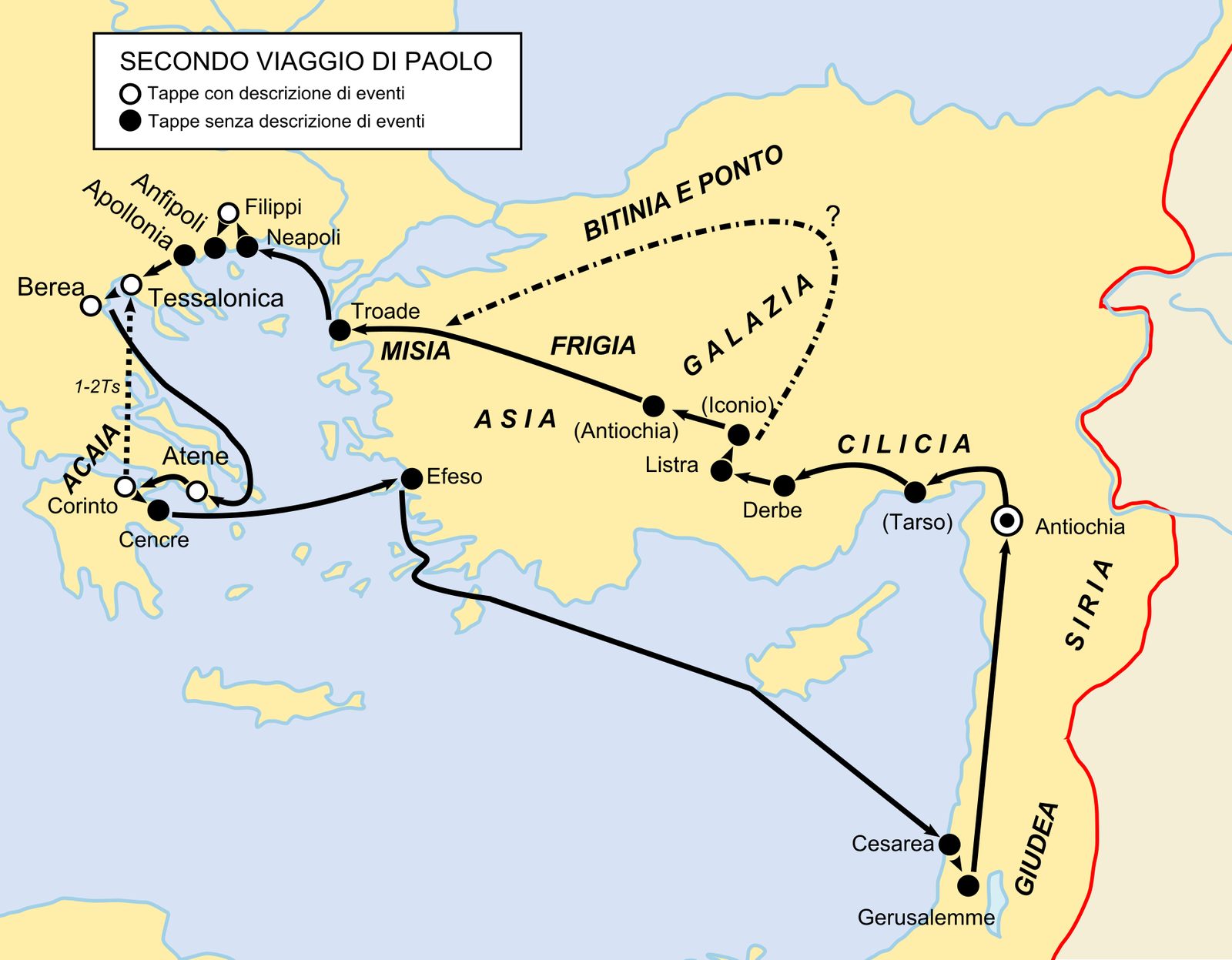
The colony had a port fourteen kilometres away, at Neapolis on the Aegean, and the road from the port climbed the Pangaion mountains to reach the plain. Ships from Asia Minor and the Aegean and Egypt came to Neapolis; goods moved over the mountain pass and along the colonnaded street and past the forum; the colony sat at the junction of the road that came from the east and the road that came from Thessalonica and the Adriatic, and the people who passed through Philippi were the people for whom the road existed. That is the setting.
The missionaries arrived on that road. Paul and Silas and Timothy, and possibly Luke — the "we" passage in Acts 16 begins here, and although the authorship question is one of the older and less productive arguments in New Testament studies, the pronoun itself is a marker that says something about the shape of the tradition, if not about Luke's physical presence. They crossed the Aegean from Troas to Neapolis in two days, according to the narrative, and walked up to Philippi. This was the first time the gospel crossed the sea into Europe, if Europe is the right word for the territory of Macedonia. The word did not mean in antiquity what it means now, and the boundary was drawn at the sea, not at a political concept, but the account in Acts marks the moment as a boundary crossing anyway. It is the first European convert.
The first European convert was a woman.
Her name was Lydia, and Acts tells us what it tells us about her and no more.
She was, the text says, a dealer in purple cloth. The Greek word is porphyropōlis — a merchant, a seller, not a dyer. The dyer was called porphyrobapha, and the distinction is the kind of small thing that tells you something: Lydia was not the person who produced the dye or operated the vats. She was the person who bought the cloth and sold it. She was a trader, and a trader in a product that had a market.
The product was purple, and the purple of the ancient world was not the colour purple we think of now. The famous purple was Tyrian purple, made from the murex sea snails — Bolinus brandaris, Hexaplex trunculus — that the Phoenicians had harvested for centuries from the coasts of the eastern Mediterranean. The production was violent and expensive: thousands of snails crushed to release the precursor chemical, the rot in the sun that turned the liquid from grey to the legendary deep colour, the smell that made the dyers' workshops something that cities placed downwind. A few grams of the dye cost more than its weight in gold. Purple was the colour of emperors, of senators, of the people who could command that kind of expense. A purple cloth on the market was a luxury good.
There was another purple, less expensive and more common, made from the madder root — Rubia tinctorum — which produced a reddish purple that was far easier to produce in quantity and far cheaper to sell. Thyatira, the city from which Lydia came, was famous for this. Strabo, describing the region of Lydia in his Geography, called Thyatira a centre of the dyers' guild. A first-century inscription from Thyatira lists the purple-dyers (βαφείς πορφύρας) as an organised collegium, and of the known inscriptions from the city, fifteen of them are connected to the purple-dyeing trade. Thyatira was a city of trades — wool-workers, linen-workers, garment-makers, dyers, leather-workers, tanners, potters, bakers, bronze-smiths — and its purple-dyers were the ones who had built the guild.
The traditional assumption was that Lydia's purple was madder root, because Thyatira was inland and murex purple came from the sea. A 2017 article by David E. Graves argued that the inland location did not necessarily preclude Thyatira's dyers from working with murex-derived dye — the trade networks of the eastern Mediterranean were well enough developed that purple could move inland, and the guild may have worked both kinds. This is not certain, and the reader does not need to know the chemical pathway of the murex dye to understand Lydia. She is not defined by whether her purple was Tyrian or Turkey red.
What is established, and established independently of Acts, is the connection between Thyatira and Philippi that the purple trade makes plausible. An inscription found at Philippi honours a purple-dye dealer from Thyatira who was a patron of a citizen there — CIL 3.664.1. The inscription is not about Lydia, and it does not mention her, but it establishes that people involved in the purple trade moved from Thyatira to Philippi and did so with enough means to be patrons. Lydia's occupation is not invented. The trade existed. The connection existed. The social position of a woman who moved between those two cities and had enough to live on and enough to host a group of strangers is plausible on the basis of the evidence, and the plausibility is not the same as the certainty, but it is enough.
The city she came from was Thyatira, and the city she lived in was Philippi.
She is not a local. She is from Thyatira, in the region of Lydia, and she has moved to a Roman colony in Macedonia. The name "Lydia" invites speculation. It may be a personal name — two first- and second-century inscriptions record women of high status named Lydia — or it may be an ethnicon, indicating origin from the region of Lydia, in which case it may be the kind of name given to a freedwoman. This is a guess. State it as a guess and move on.
Her religious status is a better-established detail. The text says she worshiped God — sebomenē ton theon, a God-fearer, the category of Gentile sympathiser with Judaism who attended the synagogue or prayed to the Jewish God without becoming a Jew. This is the language that Acts uses for the people who are on the edge of the Jewish community and who are the natural audience for the movement. It is the same language used for other individuals in Acts, and it tells you something about how the movement understood its own audience: the people who were already oriented toward the Jewish God were the first to hear the claim about Jesus.
Where she heard the claim is one of the small but significant details. Acts says they went to the place of prayer by the river, on the Sabbath, and spoke to the women who gathered there. The wording is careful. Luke does not say "synagogue." He says "place of prayer" — proseuchē — which is the word he uses for the less formal Jewish meeting places, and the choice of the word matters: Philippi was a Roman colony, and Roman colonies were not notable for their Jewish communities. A marble plaque found about a kilometre west of Philippi, inscribed Θεῷ Ὑψίστῳ — "to God Most High," the language of diaspora synagogues — confirms that there was some form of Jewish or monotheistic worship in the area, but the absence of a formal synagogue in the text is consistent with a community too small to sustain one. The place of prayer was by the river, outside the city gate. This is the kind of detail that is consistent with a small group of women — the text says they spoke to the women who gathered — and with a community that met informally because there was not enough of a community to fill a building.
The group of women at the Sabbath prayer in Philippi is one of the most significant silences in the early narrative, because it is the kind of detail that the modern reader expects to be otherwise and that the text simply does not adjust. The synagogue was the place where Jewish communities met, and the synagogue was, in most communities, dominated by men — the men were the ones who counted for the quorum, the men were the ones who read and interpreted the law, the men were the ones who held the office. A group of women meeting by a river on the Sabbath is a group that exists because the men are not there in the numbers that would make a formal synagogue, and that is a thing that happened in diaspora cities that were not Jewish. It is not invented for the story; it is consistent with what we know about the Jewish presence in Philippi.
The meeting with Lydia happened on the Sabbath, at the place of prayer, and the text tells us three things about it, two of which are the things that matter.
The first is that she heard Paul. The narrative says that Paul spoke, and that she heard, and that the Lord opened her heart to pay attention to what was said. The second is that she and her household were baptised. The third is that she insisted that Paul and his companions stay at her house.
The first of these is the most important, because it is the thing that the narrative is pointed toward. Paul spoke. Lydia heard. The Lord opened her heart. This is the conversion of the first European convert, and the conversion is described as something that happened to her, not something she did. She is the object of the action — she heard, her heart was opened, she was baptised, she invited — and the agency belongs to God. This is the pattern of conversion in Acts when the protagonist is a woman, and it is the pattern that the book should note without making it into a thesis about gender, because the pattern is the pattern of the narrative and not necessarily the pattern of the history.
The household baptism is the second thing, and it is the thing that is hardest to know. The text says "she was baptised, and her household." The household — oikos — in the ancient world was the extended family unit: the wife, the children, the servants, the slaves, the freedpersons, the business associates who lived in the house and were part of the household economy. Who exactly was baptised is not specified, and the book does not need to specify it, and the book should not pretend that it can. The baptism of the household is the kind of thing that later tradition built whole systems of doctrine on, and the book should not do that here. The household was baptised. The members of it were persons. What else is known about them is not known.
The third thing — the insistence on hospitality — is the thing that marks Lydia as someone who was not simply converted but who exercised power. She begged them to come into her house, and she persuaded them. The word is peisasa — she persuaded, she prevailed. The hospitality of a woman with a house and the resources to maintain it and the social standing to invite strangers in and make them stay is the kind of patronage that the mission depended on everywhere, and Philippi was the first European city where that kind of patronage was exercised. The house was the church, in the pattern that the previous chapter described: thirty people at most, in the available space, the community met in the ordinary space that was there. Lydia's house was that space, and the chapter on the front room applies here — the community met in Lydia's house, and Lydia's house was the community meeting place, and the community was the people who knew each other and shared the space.
What Acts does not say is as important as what it says.
Paul does not mention Lydia in his letters. He does not mention Philippi by name in any of the undisputed letters except the letter to the Philippians, and in that letter he does not mention Lydia by name. He writes to the church in Philippi — the church that he founded, or that the tradition says he founded — and in the letter he names others. He names Euodia and Syntyche in Philippians 4:2-3, describing them as women who contended at his side in the work of the gospel, and who had once been of help to him alongside Clement and the rest of Paul's co-workers. He does not name Lydia. He names other women. He names the co-workers. He names the church's generosity — "your partnership in the gospel from the first day" is the language of the letter — but he does not name the woman whose house was the place of meeting.
This is not a contradiction. It is not the kind of disagreement that the method is designed to resolve. It is simply the fact that Paul's letters and the Acts narrative are different kinds of documents, and that Lydia may have been someone Paul did not think to name in the letter he wrote to the church he founded, or she may have been someone whose name the later tradition preserved without Paul having given it. The book should not pretend to know which, and it should not pretend that the absence is significant in the same way that the citizenship silence or the Antioch disagreement is significant. It is simply a blank, and blanks are what the book leaves as blanks.
What is significant is the presence of the women — Euodia, Syntyche, the unnamed co-workers, the women who contended at Paul's side. The letter to the Philippians is one of the places where Paul names women as active participants in the mission, and the house church at Philippi is the place where women's economic power made the mission possible. Lydia was a trader in purple cloth. Purple cloth was a luxury product with a market. A trader in purple cloth who had moved from Thyatira to Philippi and had enough to own a house and host a team of missionaries was a woman of means. The economics of the mission ran through women's money in ways that the modern reader does not always notice — the patronage, the houses, the hospitality, the resources that the communities needed to exist — and Philippi is one of the places where that is visible in the record.
The brief identifies this as one of the three chapters in which women should be treated as structural rather than as an aside. Chapter 13 is the first of them. The structural thing is not simply that a woman named Lydia was the first European convert. It is that the mission in Europe began in the house of a woman who had the economic resources and the social standing to host it, and that the women named in the letter to the Philippians — Euodia, Syntyche, Clement, the rest of the co-workers — were part of the network that made the mission work, and that the economics of the mission ran through women's money in the same way that it ran through women's houses and women's hospitality everywhere else in the early movement.
This is not a campaign. It is not the assertion that Paul was a feminist or that the early church was egalitarian in any sense that a modern reader would recognise. It is the observation that the sources, read straightforwardly, show women as patrons, house-church hosts, and co-workers in a way that the secondary literature on the social world of the early church — Meeks, Hock, the work on patronage and the gift economy — makes visible, and that the reader should be told what the sources say before they are told what later tradition did with them.
The story from Acts that follows Lydia is the story of the slave girl with the spirit of divination, the story of the beating and the imprisonment, the story of the earthquake and the conversion of the jailer. It is a dramatic story, and it is a story that functions in Acts to move Paul from Philippi to Thessalonica to Berea to Athens to Corinth. Lydia does not appear again in the narrative except as the place where Paul returns before leaving Philippi — "He came to the house of Lydia and saw the brothers and encouraged them" (Acts 16:40). The narrative moves on. Lydia's house becomes the church. The chapter is over.
What Paul says about Philippi in his letters is compressed but real. The letter to the Philippians — almost certainly a letter written from confinement of some kind, possibly from Rome but possibly from Ephesus or somewhere else — thanks the church for their partnership in the gospel, for their generosity, for the support they had given him from the first day. He names the conflict between Euodia and Syntyche and asks the church to help them to agree. He says the church has sent gifts to him more than once. He does not tell the story of the founding of the church, and he does not name the woman who lent him her house. He writes to the church as a community that already exists and already has its own life and already has its own disagreements, and he writes as someone who is grateful for their support and anxious about their unity.
This is what the letters say about Philippi, and this is what the book should use. The founding narrative is in Acts, and the founding narrative gives the Lydias and the women at the river and the slave girl and the jailer. The ongoing life of the community is in the letter, and the letter gives the generosity and the co-workers and the conflict. The book reads them together, noting that the founding narrative is the narrative that Acts tells and that the ongoing life is the life that the letters show, and that the two are not the same kind of thing. This is the method applied, quietly, to a chapter that is mostly narrative from one source.
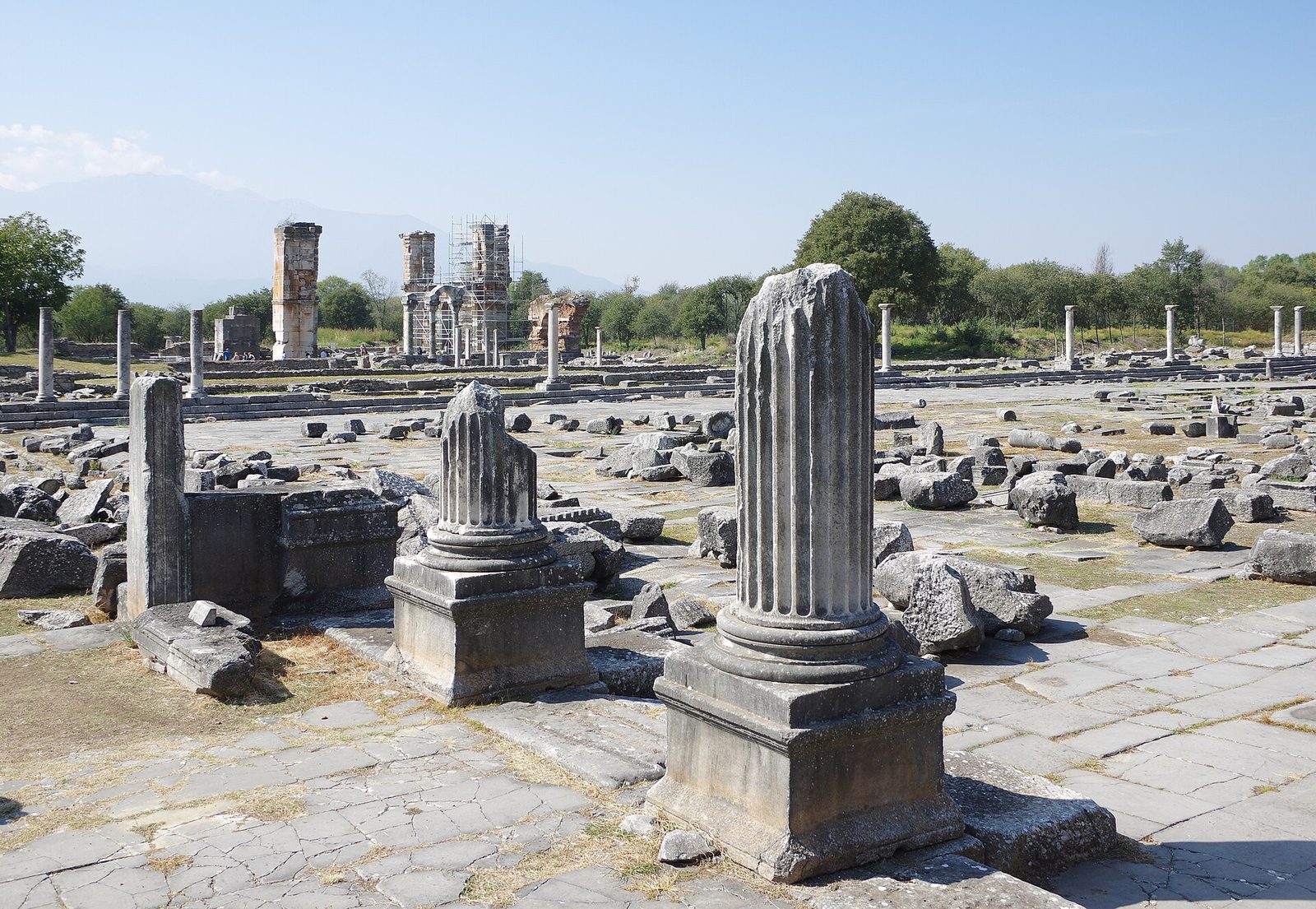
The purple cloth that Lydia sold is the thing that makes her visible. Without the occupation, the text would have given us simply another woman at the river. The occupation gives her a place in the economy of the Roman world, a profession that connected her to the dye guilds of Thyatira and to the luxury markets of the eastern Mediterranean. It gives her the means to own a house in a Roman colony. It gives her the standing to be the patron of a team of missionaries and the host of a house church. It is the one thing that Acts tells us about her that makes her more than the woman who heard Paul and believed. She was the dealer in purple, and the dealer in purple was the woman who opened her house.
Philippi was the city where the mission first went European, and the first European convert was a woman who sold purple cloth and owned a house and let the mission in. The next chapter turns to Corinth, the fractious port city and the most revealing community in the letters.
Corinth
Corinth sat on the isthmus — a neck of land about five kilometres across, where the Peloponnese was attached to mainland Greece. Ships from the Adriatic heading to Athens, or from Athens heading to the Levant, did not go around the Peloponnese when they could go across: they unloaded at one harbour, carried cargo overland on rollers, and loaded it onto ships at the other harbour. Corinth was the place where the sea came close to touching itself, and where movement from west to east could be made shorter by going across instead of around.
This was why the city had been important before the Romans destroyed it in 146 BCE, and why Julius Caesar refounded it as a colony in 44 BCE. The colony was settled with freedmen and veterans and migrants — a Roman city on Greek ground, capital of the province of Achaia. The forum was one of the largest in Greece, with the South Stoa running 164 metres along one side and the Bema — the speaker's platform where a proconsul would address the public — built on the terrace above. The Lechaion Road ran from the forum to the western harbour, and in Paul's time was an unpaved road of packed earth and gravel, twenty to twenty-five feet wide, with shops on either side.
The population is not known with any certainty — estimates range from fifty thousand to one hundred thousand, and all figures are guesses. Corinth had two harbours: Lechaion on the Corinthian Gulf on the west, and Kenchreai on the Saronic Gulf on the east. The eastern harbour was smaller, but it was the one from which Paul sailed when he left Corinth, and the port at which Phoebe — the woman who carried the letter to the Romans — was a deacon and a patron of many, including Paul himself. The city held the Isthmian Games, the athletic festival second only to the Olympics, every two years on the isthmus. Movement was what Corinth existed to serve.
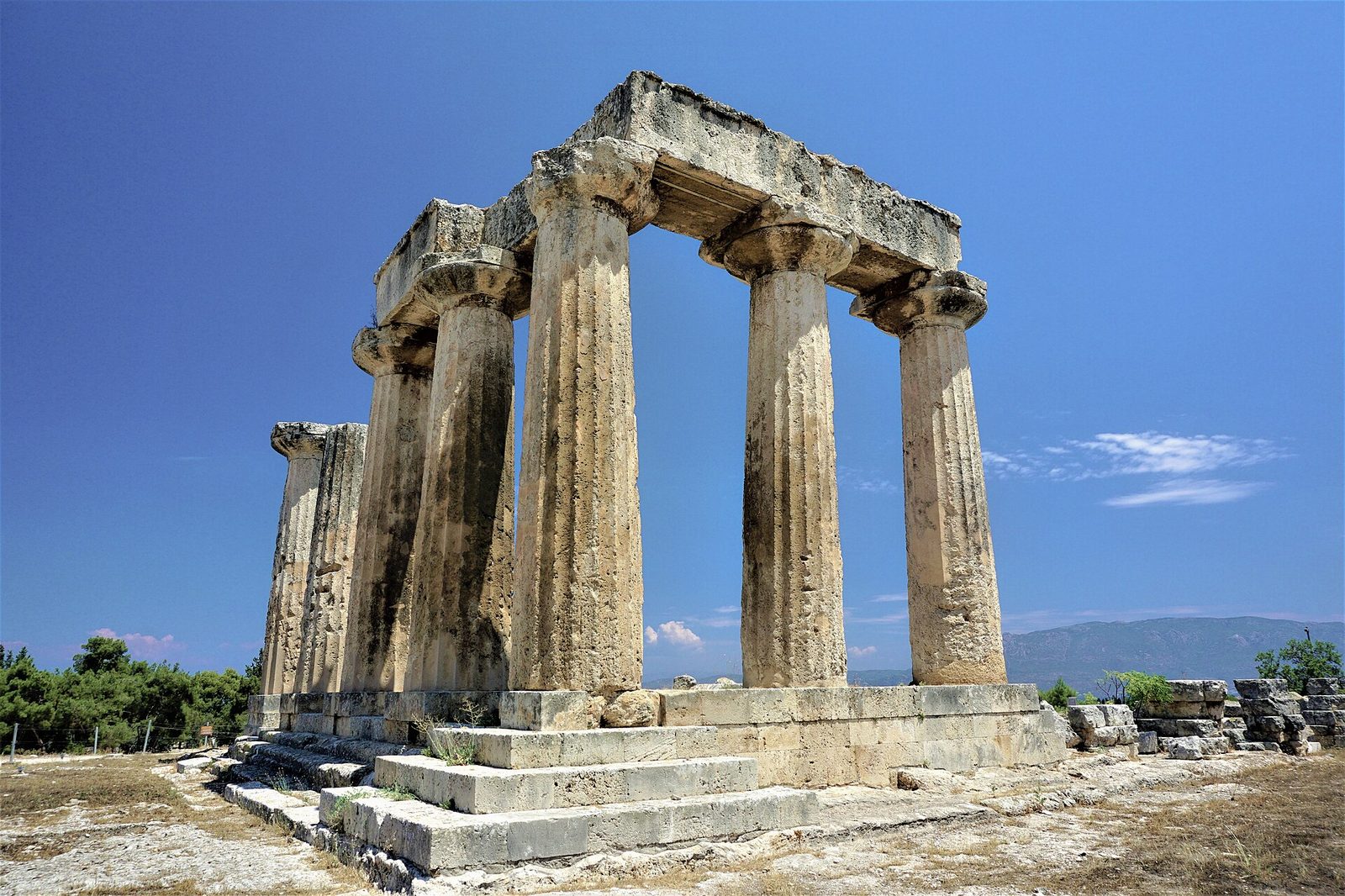
The religious life of the city was typical of a Roman city in the eastern empire: temples and shrines and cults and imperial honours. The temple of Apollo, the old Doric temple of the sixth century BCE with its seven surviving monolithic columns, stood on the acropolis and was the most conspicuous landmark. The West Forum terrace had a cluster of Roman temples — Temple D, identified as Tyche; Temple F, dedicated to Venus Victrix; Temple G, the imperial cult temple. Temple E, the largest and most prominent, has been argued to be the temple of Octavia or the Capitolium — and the argument continues, because the dedication is not recorded. At Kenchreai, the temple of Isis was real and excavated. The meat from the temple sacrifices went into the market, and the macellum — the meat market — is attested by two Latin inscriptions. Paul uses the word in 1 Corinthians 10:25 when he tells the Corinthians they can eat meat from the market without asking questions about it. The city was a city of meat and temples and markets; the Christian community was in it, and had to live in it.
Paul came to Corinth after leaving Athens, according to Acts, and came to a city that had a synagogue. He reasoned in the synagogue on the Sabbaths, and when they opposed and reviled him, he shook out his garments and said, "Your blood be on your own heads! I am innocent. From now on I will go to the Gentiles." He left the synagogue and went to the house of Titius Justus, a worshiper of God who lived next door, and Crispus, the ruler of the synagogue, believed in the Lord and was baptised, and his whole household, and many of the Corinthians who heard Paul believed and were baptised.
This is the story from Acts, with the shape of a turning point: the Jews oppose, Paul leaves the synagogue, the Gentiles receive, the synagogue leader converts, the community begins. The letters tell a slightly different thing: Paul himself, in 1 Corinthians, mentions that he baptised Crispus and the household of Stephanas and some others, but he does not mention Titius Justus, and he does not mention Sosthenes — the man who was beaten before Gallio's tribunal, according to Acts — even though Sosthenes appears in the opening verse of the letter as a co-sender with Paul. The letters know things that Acts does not record, and the letters are the primary source.
The eighteen months in Corinth are the longest stay Paul had in any city up to that point. The workshop chapter made the point that the mission was done by stays, not by tours. Corinth was the first city where Paul stayed for that long, and the letter he wrote later shows that the community he left was not settled but was already producing reports, arguments, and questions that would require another letter to answer. The letter is written from Ephesus, in response to a report that came to him through the household of Chloe, and a letter that the Corinthians sent to him asking specific questions. This is the kind of letter that the letter-writing chapter will describe later: written from a distance, in response to what has been heard, addressed to a community the writer is in tension with.
The community in Corinth was, by the evidence of the letter, not a poor community. Wayne Meeks, in The First Urban Christians, made the argument that the Pauline churches were not communities of the destitute and the marginalised but communities that drew from across the social spectrum — artisans and traders, freedpeople and slaves, and a few people of considerable means. The Corinthian community included Crispus, the former ruler of the synagogue, who was baptised with his household; Gaius, who hosted the whole church; Erastus, the city treasurer, whose name is on an inscription in the courtyard of the theatre at Corinth — the inscription says the pavement was laid at his expense, and whether this Erastus is the same man as the Erastus named in Romans 16:23 is debated, but the plausibility is there; Stephanas, the first convert in Achaia, whose household Paul baptised and whose family became a standing pattern of service to the saints.
The social mix is one of the reasons the community was fractious. Meeks called it "status inconsistency" — the condition of people who had high standing in some dimensions and low standing in others, who were wealthy in skills or connections but not wealthy in birth or legal status, and who found in the Christian community a place where the hierarchies of the city were not the hierarchies of the church. Gerd Theissen, in The Social Setting of Pauline Christianity, returned to the same material and argued that the specific conflicts in the letter — the Lord's Supper, the meat from the idol, the factions — could be explained by the socioeconomic divisions between the wealthier members and the poorer members. The book should present this as a strong scholarly reading and not as the only possible reading, and let the reader see what is in the letter and what the arguments about the letter are.
The first crisis in the letter is the factions. "It has been reported to me by Chloe's people," Paul says, "that there is rivalry among you. I mean that each of you says, 'I follow Paul,' or 'I follow Apollos,' or 'I follow Cephas,' or 'I follow Christ.'" The factions are named after teachers — Paul, who founded the community; Apollos, the eloquent Alexandrian Jew who had moved through the community after Paul left and was apparently a more polished speaker; Cephas, the Aramaic name of Peter, representing the connection to Jerusalem; and "Christ," which may be a party that claimed direct authority from Christ himself and may have been the same party Paul later describes as the party of the "super-apostles."
The factions are, in the social world of Corinth, a competition for status. Apollos was a rhetorician, and Corinth was a city that valued eloquence; Cephas had the authority of the Jerusalem church behind him; Paul was the founder, and the party that followed him had the authority of the founding gift. The community was arguing about who had the better teacher.
Paul's response is the argument of the cross — the argument that the message of the cross is foolishness to those who are perishing, but to those who are being saved it is the power of God, and that God's foolishness is wiser than human wisdom, and that God's weakness is stronger than human strength. It reorients the hierarchy: the wise in the world's way are not the wise in the way that leads to life; the powerful are not the powerful in the kingdom; the noble-born are not the chosen. "Not many of you were wise by human standards," Paul says, "not many were powerful, not many were of noble birth" — and the "not many" is important, because it means some of them were. The ones who weren't were the ones in the community competing for status, and Paul was telling them that the competition was the wrong thing to compete for.
The factions are worth dwelling on, because they reveal something about the social texture of the community that the rest of the letter only hints at. Apollos was, by Paul's own account in Acts, "an eloquent man, well-versed in the scriptures," and the Acts narrative says he "taught accurately the things concerning Jesus" and was "eloquent" — the Greek word is logios, the word for a cultivated speaker, a man of letters. In a city that valued eloquence, in a community that had heard Paul's long sermons and Paul's apparently thin speaking voice, the arrival of a man who could speak in the way that Corinth valued was an event. The community split. Some followed him, and some followed Paul, and some followed Cephas, and some followed Christ — and the followers of Apollos were not simply people who preferred eloquence to Peter's Aramaic roughness. They were people who were making a claim about what kind of community this was, and about who had the authority to define it. The authority that Apollos had was the authority of someone who could speak in the way that a Roman city expected its teachers to speak, and the authority that Paul had was the authority of someone who had founded the community and had, in the community's memory, been the one who brought the gospel in the first place.
The Corinthian community was not simply divided. It was divided in a way that reveals what the Corinthians valued — speech, eloquence, the person who could command the room — and Paul, by his own account, was not the kind of man who commanded rooms by speaking. The factions were not only about teachers. They were about the kind of authority the community recognized.
The second crisis is the sexual scandal. "It is actually reported that there is sexual immorality among you," Paul says, "and of a kind that does not occur even among pagans: a man is living with his father's wife." The man is living with his stepmother — forbidden by Jewish law, Roman law, and the standards of any Mediterranean society. The community's response was not to expel the man but to be proud of their tolerance. Paul's response is to tell them to hand the man over to Satan for the destruction of the flesh, so that his spirit may be saved on the day of the Lord, and to remove the wicked person from among them. "A little leaven leavens the whole batch."
The letter does not tell us what happened after Paul wrote this. It does not tell us whether the man was expelled, whether the community complied, whether the man repented. The silence is the kind of silence the book has learned to leave as silence. What the letter shows is that the community had mistaken the freedom of the gospel for permission, and had mistaken its own tolerance for virtue, and had tolerated something that was genuinely wrong.
The section on sexual issues is not only the incest case. It is also the teaching on the body as the temple of the Holy Spirit — "You are not your own; you were bought with a price. Therefore honour God with your body" — and the teaching on prostitution — "Flee from sexual immorality" — and the teaching on marriage and celibacy in chapter 7, where Paul responds to the question "Is it best for a man not to marry?" The chapter on marriage is the longest section of practical teaching, and it shows the apocalyptic frame that governs Paul's advice: the time is short, the present form of this world is passing away, and the question is not what is the best life in the world as it is, but what is the best position from which to meet the coming of the Lord. The advice to stay as you are — married, single, slave, free — is not a moral command. It is temporary instruction for a community that believes the world is ending soon, and the reason it has been read as a permanent command by later tradition is the kind of thing that the chapter on the pastoral letters will explain.
The question of food offered to idols is one of the most illuminating sections of the letter, because it shows the community in a city saturated with religious imagery and sacrificial meat, trying to figure out what it meant to be in the city without being of the city. The question came from the letter the Corinthians sent to Paul: "Is it lawful to eat food offered to idols?" The community was divided between the strong — who knew that an idol was nothing and the meat was just meat — and the weak — who were troubled by the connection to the temple.
Paul's answer is the one that defines the Christian ethic of the strong and the weak: "Knowledge puffs up, but love builds up." The strong are right in their knowledge — "An idol is nothing in the world. There is no God but one." But the strong are wrong in their application, because knowledge that is right in itself can be wrong in its effect on the person who does not share it. If a weak person sees a strong person eating in a temple, the weak person may be emboldened to eat food offered to idols, and the strong person who caused this is guilty of sinning against the weak person and against Christ.
"It is not about your rights. It is about the person who is weak." The workshop chapter made the same point about the tentmaker's refusal of support: Paul had the right to be supported, but he refused it for the sake of the community. The same principle appears here: Paul has the right to eat what he wants, but he refuses the right for the sake of the weak person, because the strong person's right is not more important than the weak person's conscience. The argument in chapter 10 is stronger: "You cannot drink the cup of the Lord and the cup of demons." This is addressed to the people who were actually going to the temple meals, not just buying meat in the market, and the answer is that participation in a pagan cult meal is incompatible with participation in the Lord's table. The boundary is about participation, not about meat.
This is the question that shows the community living in the city in the most concrete way. Corinth was a city of temples and sacrifices and meat markets, and every meal the community ate had the question built into it: was the meat on the table meat that had been offered to an idol, and if it was, did it matter, and if it mattered, what did it mean to eat it? The question was not an abstract question. It was the question that came up at every dinner, and the question that the community had to answer every day, and the question that Paul answers in the letter by telling the strong that they were right in their knowledge and wrong in their application of it, and by telling the weak that they were wrong in their fear and right in their concern, and by telling both of them that the community was a community in which the strong were supposed to give up their rights for the weak, and the weak were supposed to grow into the knowledge that the strong had already received.
The section on the Lord's Supper (chapter 11) is the earliest account of the Lord's Supper in the New Testament — earlier than any of the Gospels. Paul received it from the Lord and handed it on: "This is the body that is for you. Do this in remembrance of me." The tradition is the oldest thing in the letter, and the oldest thing in the New Testament about the meal the Christian community ate together.
The problem in Corinth was not the theology of the meal but the practice of the meal. "When you come together, it is not to eat the Lord's supper. For when the time comes to eat, each of you goes ahead with your own supper, and one goes hungry and another becomes drunk." The community was eating the Lord's Supper in the context of a real dinner — the agape feast — and the meal had become a place where the wealthier members ate early and ate well and drank the best wine, and the poorer members arrived later and found the food gone and the wine gone.
Gerd Theissen's analysis argues that the division was socioeconomic: the wealthier members arrived early and consumed the best food and wine; the poorer members arrived late and found little or nothing left. Paul found this intolerable: "Do you show contempt for the church of God and humiliate those who have nothing?" The Lord's Supper was not a ritual performed by a priest in a church building. It was a meal — a real dinner, with food and wine, eaten by the community together — and the rich members had made it a class meal, humiliating the poor. The later tradition turned the Lord's Supper into a ritual without a meal, and the division without the rich and the poor.
The section on spiritual gifts (chapters 12-14) shows the community intoxicated with ecstatic experience and treating the ecstatic experience as a measure of spiritual standing. The Corinthians were speaking in tongues, and some were treating the tongues as the highest gift, and the community was dividing itself into the pneumatikoi — the spiritual ones — and the people who did not have the tongues, who were therefore second-rate.
Paul's response is the body of Christ — the argument that the body is one and has many members, and that the eye cannot say to the hand, "I have no need of you," and that the members that seem to be weaker are indispensable. The love chapter (chapter 13) is the most famous section of the letter, and it is the section most often read out of context. It is not about romantic love. It is about the exercise of spiritual gifts. "If I speak in the tongues of men and of angels, but have not love," Paul says, "I am a noisy gong or a clanging cymbal." The love chapter corrects the community's misunderstanding of the spiritual gifts — the gifts were for building up the community, and the love that built up the community was superior to the gifts that impressed the individual. The love chapter is not a wedding reading.
The section on order in worship (chapter 14) contains the verses that are the most debated and the most important for the question of women in the early church. "Women should remain silent in the churches," Paul says in chapter 14:33-35. "They are not permitted to speak. They should be submissive. If they want to inquire about something, they should ask their own husbands at home."
These verses are, in the judgment of a significant number of scholars, a later interpolation. The argument is of two kinds. The first is the manuscript evidence: some manuscripts place the verses after verse 40, at the end of the section, rather than in the position they have in the standard text. The second is the internal argument: the verses contradict chapter 11, where Paul assumes that women are praying and prophesying in the church, and gives instructions for how they should pray and prophesy — "Every woman who prays or prophesies with her head uncovered dishonours her head" — and where the assumption is that women are speaking in the church. If women are praying and prophesying in chapter 11, they cannot be forbidden to speak in chapter 14.
The book should not decide the question for the reader. It should present the argument for the interpolation, and the fact that reasonable people land in different places, and then move on. This is the same approach the book takes to Romans 1 and sexuality. The chapter on the silencing of women in later tradition — the final chapter of the book — will return to this, because the interpolation question is part of the larger story of what happened to Paul's voice after he stopped writing. For now, the point is that the letter itself shows women praying and prophesying in the Christian assembly, and that the verses that forbid women to speak are the verses most seriously questioned by modern scholarship.
The final major section of the letter is the resurrection (chapter 15), the longest sustained theological argument in the New Testament outside the Gospels. The Corinthians, Paul says, were saying that there is no resurrection of the dead. The denial is not simply a denial of the resurrection of Jesus; it is a denial of the resurrection of the dead in general, and it is the kind of denial that came from the Greek philosophical tradition, which regarded the body as inferior to the soul and the resurrection of the body as absurd. Some Corinthians may have accepted the resurrection of Jesus as a spiritual event and denied the resurrection of the dead as a general future event.
Paul's response is the creed, which he received and handed on: "Christ died for our sins in accordance with the scriptures, was buried, was raised on the third day, and appeared to Cephas, then to the twelve, then to more than five hundred brothers at one time, then to James, then to all the apostles, and last of all, as to one born at the wrong time, he appeared to me." The creed is the oldest thing in the letter — older than the letter, older than Paul's mission, older than the community in Corinth. It is the thing Paul received and handed on, and the fact that it is the thing Paul received and handed on means that it is the thing that was handed on at the beginning, and that Paul was not the one who invented it.
The argument from the creed is that if there is no resurrection of the dead, then Christ was not raised, and if Christ was not raised, then the faith is futile and the readers are still in their sins, and if Christ was not raised, then the readers are of all people most to be pitied. The resurrection of Jesus is not optional. It is the thing that the faith stands or falls with.
The resurrection body is the thing Paul explains: "It is sown a physical body, it is raised a spiritual body." The body in the resurrection is not the same body that was buried — the analogy of the seed shows this: the seed that is sown is not the plant that grows, but the plant grows from the seed, and the plant is continuous with the seed and different from the seed. The resurrection body is continuous with the buried body and different from it, and it is a "spiritual body" — a body animated by the Spirit, not by the mere life-force of the living body, but by the Spirit of God. The end of the chapter is the apocalyptic promise: "We will not all die, but we will all be changed, in a moment, in the twinkling of an eye, at the last trumpet." The chapter shows the apocalyptic frame that governed Paul's thinking throughout the letter, and the future the community was living toward, and the thing the Corinthians had denied and the thing Paul could not let them deny.
The letter to the Corinthians is the most revealing document in the New Testament about how the early Christians actually lived — a letter written to a specific community about specific problems, with the most detail about the community of any New Testament letter. It shows a real community in the middle of a Roman city, living in houses, eating meals together, speaking in tongues, prophesying, arguing about meat from the idol and marriage and who had the better teacher, divided by wealth and poverty, knowledge and weakness, the spiritual ones and the non-spiritual ones. It shows a community Paul had to correct and teach and warn and encourage.
The letter is not a systematic theology or a constitution for the church. It is a letter written to a community in trouble, from a man in Ephesus, in response to reports and questions, in the apocalyptic frame the letter itself reveals. Paul wrote it for Corinth in the middle of the first century. What he did not write is the letter that later tradition used to build the rules for the church on women and slavery and spiritual gifts and the Lord's Supper — that letter is in the pastoral letters, written decades later by someone else, and the book will return to this at the end.
The next chapter is the chapter on Ephesus, the two or three years in the great port city of Asia, the riot, the imprisonment we can only infer, and possibly the lowest point of his life.
Ephesus
The city looked up the mountain to a temple that was the largest the Greeks ever built. The temple of Artemis at Ephesus was built on a platform 115 metres long and 55 metres wide, surrounded by a double row of 127 columns each 18 metres high, most of them carved with figures of the goddess and her procession. The temple burned once, in 356 BCE, by a man named Herostratus who wanted to be remembered; it was rebuilt, and in Paul's time it was still the largest building in the Greek world and one of the seven wonders. The city itself sat on a plain between the river Cayster and the Aegean, with the mountain of Panaeus behind it, and possessed a deep-water harbour that silted continuously and had to be dredged regularly, which the Romans paid for, which meant the harbour was always in the news, which meant the city never forgot that it was a port.
Ephesus was the capital of the province of Asia in Paul's day. It was not the largest city in the province — Sardis and Pergamum were larger — but it was the administrative centre and the commercial centre and the religious centre, and it was the city that the road from the east reached first and the city that the shipping lanes served. It was also the city that gave its name to the whole region in the popular usage of the time: "Asia" in Paul's day often meant the province, and the city of Ephesus was its heart. The population is guessed at somewhere between a quarter of a million and a third of a million — enormous by the standards of the ancient world, one of the largest cities in the Roman empire, and the city that Rome had chosen to be the administrative capital of the province. The city had a theatre that held 25,000 people, a amphitheatre, a stadium, a state archive, a bouleuterion, a library, a series of great processional ways and public squares, and a civic culture that took public life seriously. This is the city to which Paul came, according to Acts, at the end of his second missionary journey, after he had left Corinth — and it is the city where he stayed for the longest continuous period of his life.
The arrival is described in Acts 18:19 and Acts 19:1-7, and the account is more specific than most of the travel narrative in Acts. Paul arrives at the synagogue in Ephesus, reasons with the Jews, is invited to stay longer but declines, and leaves his companions Prisca and Aquila there while he returns to the synagogue on the next Sabbath. Then he goes into the lecture hall of Tyrannus — the text says he taught there day by day for two years — and the result was that "all the residents of Asia heard the word of the Lord, both Jews and Greeks." The two years are the most specific period Paul spends anywhere in the record, and they are the source of the chapter's argument about the time and the place and the effect.
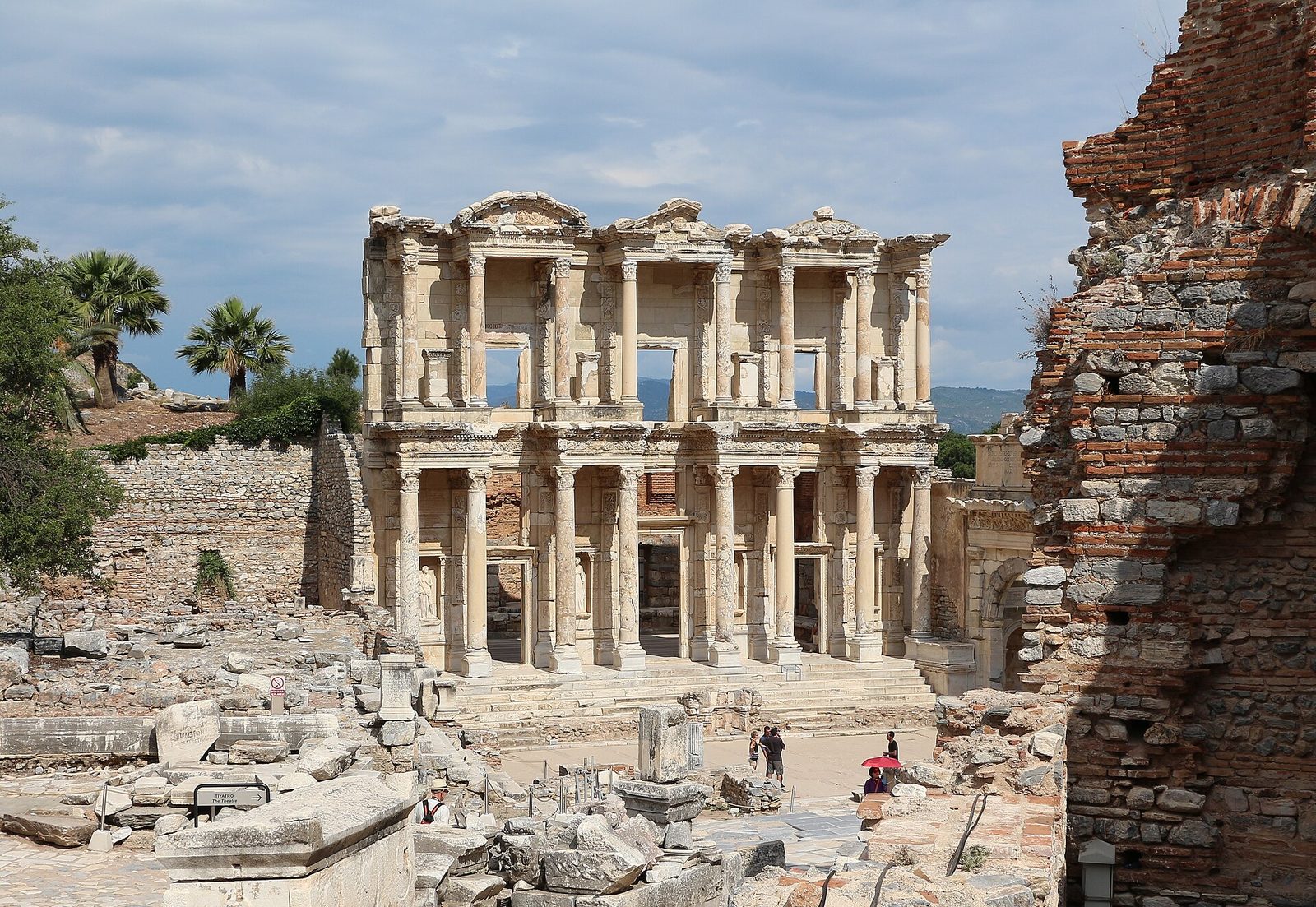
The lecture hall of Tyrannus is the first thing worth noticing. The Greek word is scholē, which meant a room used for instruction — a schoolroom, a place where a teacher held his classes. Tyrannus is named, which in itself is unusual in Acts, where teachers are usually unnamed. The school may have been a private school of rhetoric or philosophy, the kind of thing a city like Ephesus would have had, and Paul hired or borrowed the room for his daily teaching. The two-year teaching in a schoolroom, available to anyone who came, is the kind of detail that suggests an organized teaching operation, not a visit to a synagogue followed by house visits. This was the first time Paul had a base from which to teach a whole region, and he used it for two years, five days a week, from about noon to about dusk — the standard teaching hours of a school in the eastern Mediterranean in the Roman period.
The effect was regional. "All the residents of Asia heard the word of the Lord, both Jews and Greeks." This is the claim of Acts, and it is the most expansive claim Acts makes about any of Paul's missions. It may be the high note of the whole narrative before the riot and the decline. What it means in practice is not clear, but it means that the region of Asia — the province around Ephesus — became known to the Christian movement in a way that no region before had been. The letter to the Ephesians, if it is Paul's, later refers to the church as the body of Christ "which is his body, the fullness of him who fills all in all" — a statement of cosmic scope from a city that had been the place where all the residents of Asia heard the word. The connection between the claim of Acts and the claim of the letter is not something that can be demonstrated, but it is the kind of thing that makes the source difference matter.
The disciples who knew only John's baptism are one of the most carefully described early Christian groups in the record, and the account of them is the account that shows Paul at his most deliberate and careful. When Paul arrives in Ephesus, the narrative says, he finds some disciples, asks them whether they had received the Holy Spirit when they believed, and they say they had not even heard of the Holy Spirit. Paul asks what baptism they had received, and they say the baptism of John. Paul explains that John's baptism was a baptism of repentance, and that John had promised that someone would come after him, and that this someone was Jesus. They are baptised in the name of the Lord Jesus, Paul lays his hands on them, the Holy Spirit comes on them, and they speak in tongues and prophesy. There were about twelve of them.
This is the account of a group of people who had received some form of Christian teaching — the baptism of John, the promise of the one who was coming — without knowing that the one had come, and without knowing the full content of the message that Paul brought. It is the most specific group that Acts describes, and it is the most specific moment of Paul's carefulness about what the people in the movement actually believed. He did not assume that they were fine because they were baptised. He asked what they knew. He found they knew only the preparatory teaching. He explained what had happened. He gave them the full baptism. The twelve received the Spirit. This is Paul as teacher and pastor, not only as missionary and founder, and it is the kind of narrative detail that makes the Acts account worth reading alongside the letters.
The account is also the account that introduces the miracles. After the twelve receive the Spirit, Acts says, "God was doing extraordinary miracles by the hands of Paul," and reports that handkerchiefs and aprons that had touched Paul's skin were taken to the sick and the diseased and the evil spirits departed from them. The description is precise and uncommon — Paul's personal garments become vehicles of healing — and it is the gateway to the story of the sons of Sceva, the story that functions as a limit and a warning.
The sons of Sceva are the family of a Jewish chief priest whose seven sons tried to use the name of Jesus to cast out evil spirits and failed. The spirit answered, "Jesus I know, and Paul I know, but who are you?" The man who had the evil spirit jumped on them, overpowered them, and wounded them, and they ran out of the house naked and ashamed. The story spread, and the name of the Lord Jesus was held in high honour, and many who had believed came and confessed and revealed their practices. The story of the sons of Sceva is the story that shows the authority of the name of Jesus as something that was not transferable by technique, and the limits of the practice as specific to the authority of the person who carried it. Paul could do what Paul did. The sons of Sceva could not.
The immediate aftermath is the burning of the books. "A number of those who had practiced magical arts brought their books together and burned them in the sight of all. And they counted the value of them and found it came to fifty thousand pieces of silver." The books were not burned by order of a magistrate or by the action of the community as a group. They were burned by the people who had practised the magical arts themselves, which is a detail that should be noted: the conversion did not come from the outside as a result of a command, but from the inside, from the people who had done the practising and who were now repudiating the practice. The value — fifty thousand drachma or pieces of silver — was enormous, the equivalent of years of wages, which is the kind of detail that gives the account its scale. A large group of people, with significant resources, changed their behaviour in response to what had happened. This is the high-water mark of the Ephesus mission, the point just before the riot.
The riot is the story of the city turning against the movement, and the reason for the riot is the reason for the chapter's claim about the threat that the mission posed. The story is told in Acts 19:23-41, and it is one of the longest single episodes in Acts outside the Jerusalem narrative. A silversmith named Demetrius, who made silver shrines of Artemis, called the craftsmen together and addressed them with a speech that was both economic and religious. The economic point was that Paul had persuaded and turned away a large number of people, and that this would mean bad business for the silversmiths and for all the craftsmen who made their living from the temple trade. The religious point was that the temple of Artemis, who was worshipped throughout Asia and the world, was in danger of being counted as nothing, and that the goddess herself was in danger of being robbed of her majesty. The two points were not separate in the ancient world; the economic and the religious were the same point, because the livelihood of the craftsmen and the honour of the goddess were the same thing.
The speech was effective. The craftsmen were enraged, and the city was filled with confusion, and people rushed into the theatre — the great theatre of Ephesus, the one that held 25,000 people — crying, "Great is Artemis of the Ephesians!" The riot moved through the city, and Paul's companions Gaius and Aristarchus were seized and dragged into the theatre, and Paul wanted to go in to speak but the disciples would not let him. The riot was chaotic, with people shouting different things, most of whom did not know why they were shouting — "some were shouting one thing, some another, for the assembly was in confusion, and most of them did not know why they had come together." The town clerk calmed the crowd and dismissed them, with the argument that Ephesus was the guardian of the temple and that there was no real legal case against Paul and that the men should be defended in the courts if they had a case, and that the riot was unnecessary and dangerous. The crowd dispersed.
The riot at Ephesus is the most dramatic episode of Paul's public life in Acts, and it is the episode that most clearly shows the movement as a threat to the economic and religious structure of a Roman city. The temple of Artemis was the economic centre of the city's artisan class, and the movement that cast doubt on the goddess was a movement that directly threatened the livelihood of the craftsmen who depended on the temple. This was not a theoretical theological disagreement. It was a dispute over money and livelihood and the identity of the city, and the riot was the city's response. The town clerk's role is the role that the Roman administrative apparatus played in these situations: he was the person who had to manage the crowd and get it to disperse because the riot itself was a threat to public order, and the Roman peace depended on public order.
What Paul himself says about Ephesus in the letters is less dramatic and more heavy. In 1 Corinthians, written from Ephesus, he says he will stay in Ephesus until Pentecost because a wide door for effective work has opened for him, and there are many adversaries — the language of a man who knew that the work was hard and the opposition was real. In 2 Corinthians, he speaks of the "affliction in Asia" so severe that he despaired of life itself, the account of being so utterly burdened beyond his strength that he felt he had received the sentence of death, and learned to be content in whatever state he was in. The affliction is not named specifically, and the book does not name it specifically — it is part of the Paul who does not explain everything, and the reader should not try to name what Paul did not name. But the affliction is placed by the chronology of the letters in the Ephesus period, and it is one of the things that makes the Ephesus period more than the riot in Acts. Paul was in a city that threw a riot against him, and he was in distress of a kind that almost killed him, and he wrote about both of these things and did not explain either of them in the way that a modern reader would want.
The imprisonment that Paul suffered — or may have suffered — is not recorded in the letters directly. The letters describe distress, danger, persecution, the repeated near-death experiences. Acts describes the riot. The book of Acts describes no imprisonment in Ephesus, only the riot. The Ephesian imprisonment is a thing that tradition asserts and that historians infer, because if Paul was in Ephesus for two or three years teaching publicly, and the city threw a riot against him, and there was an artisan class that had lost money, and there was a governor of the province — the proconsul of Asia — who would have had to deal with the disturbance, then an imprisonment of some kind is a plausible and even likely inference. But plausibility is not the same as certainty, and the book should not present the inference as if it were a fact. Paul may have been arrested. He may have been held for a time. He may have been threatened with arrest. Or he may have simply been told to leave, and the riot was the mechanism by which the city told him to go. The letters do not say. Acts does not say. The inference is reasonable, but it is an inference, and the reader should be told what the sources say and what they do not say.
The imprisonment question is connected to the letter to the Philippians, which is almost certainly a letter written from confinement of some kind — "I am in prison" is the repeated language, and the letter names Epaphroditus, who came to him from Philippi and fell ill, and whom Paul sent back. The letter's setting is confinement. Whether that confinement was in Rome, in Ephesus, in Caesarea, or somewhere else, is one of the oldest questions in the secondary literature, and the book should not resolve it here. What it matters for this chapter is that the confinement is real and that the mood of the letter — gratitude mixed with anxiety, affection for the church that sent help, the naming of the conflict between Euodia and Syntyche — is the mood of a man who was in a difficult place and writing to people he loved and who had sent him help. The confinement may have been in Ephesus. If it was, the Philippian letter belongs to this period, and the emotional texture of the period is the texture of that letter.
The letter to the Ephesians, if it is Paul's, is different from the accounts in Acts in a way that matters for the source method. Acts 19 gives the riot and the teaching and the miracles. The letter to the Ephesians gives cosmic Christology, the church as the body, the mystery of the gentiles, the household of God built on the foundation of the apostles and the prophets with Christ as the cornerstone. The letter does not name Ephesus in a clear way — the opening verse says "to the saints who are in Ephesus" in some manuscripts, but many important manuscripts omit "who are in Ephesus," and the letter may have been a circular letter addressed to the churches of Asia in general, with Ephesus as the primary destination. The letter is the thing that makes Ephesus the city of cosmic Christology in the tradition, and the thing that connects the riot and the teaching to the theological claim that the church is the fullness of Christ and the body of which he is the head.
The authorship question should be stated but not dwelled on. The letter to the Ephesians has a vocabulary and syntax that differ from the undisputed letters in ways that trouble many scholars, and the letter may be from a later period, written by a disciple in Paul's name. The high cosmology of the letter and the absence of the specific Ephesian conflicts that the other letters describe suggest a letter written at a different time or in a different frame. The book should note the dispute and explain that the letter to the Ephesians is one of the disputed letters, and that its content is different from what the other letters say about Ephesus and about the region of Asia, and that the riot and the two years of teaching in the lecture hall are the primary source for the Ephesus story, and the letter to the Ephesians is the source that requires the most caution.
The two years in the lecture hall are the most specific period of Paul's life that the sources describe, and they are the period in which Ephesus became the place where the mission became a regional movement rather than a single community. Paul taught day by day in the schoolroom of Tyrannus for two years, and during that time the word spread throughout the region of Asia. This is the period that made Ephesus the centre of Pauline Christianity in the eastern Mediterranean, and the period that made Ephesus the city to which later tradition looked back as the place of the apostles' work. Paul afterwards sent Timothy to Ephesus to correct abuses in the church — a passage that may be part of the letter to the Ephesians or part of 1 Timothy, depending on who wrote the letter — and the church at Ephesus appears in Revelation as the church entrusted with a message from the risen Christ. The Ephesus mission was the mission that had the most visible results during Paul's lifetime, and it was the mission that left the biggest trace in the later tradition, and it was the mission that ended with a riot and probably a departure and probably a period of confinement, and it was the period that may have been the lowest point of his life and the period from which he recovered only partially before the next crisis arrived.
The riot at Ephesus is the thing that the book should remember as the shape of the movement's relationship to the Roman world: not a philosophical debate but a dispute over money and the honour of a goddess, and the city's response to a movement that threatened both. The movement that Paul had built up in two years of teaching in a schoolroom became a threat to the economic base of a section of the city's population, and the city responded with the theatre and the shouting and the violence, and the Roman administrative apparatus — the town clerk — had to manage it. This was the relationship between the Christian movement and the Roman world: not a conspiracy or a threat to the empire, but a nuisance and a local problem that the empire managed as it managed local problems, with the town clerk and the courts and the threat of legal action. The empire was not uniform in its response. It was local. It was specific to the city and the situation. And Ephesus was the place where the response was the most dramatic.
What remains after the riot and the possible imprisonment and the eventual departure is the Ephesus that Paul left behind — the community in the lecture hall, the twelve who had received the Spirit, the people who burned their books, the people who were part of the movement that had grown through the region of Asia. The city is the place where the next chapter's people were already at work — Prisca and Aquila had been there, Timothy was there, and the network that the next chapter describes was already in motion — and the community that Paul left in Ephesus was the community that he later sent Timothy to correct, and the community that appears in Revelation as one of the seven churches that received a letter from the risen Christ. The Ephesus mission was the mission that had the most visible success during Paul's lifetime, and it was also the mission that had the most dramatic opposition, and the combination of the two is the thing that makes Ephesus the city that occupies the middle of the book's second part and the city that the chapter about the people and the network will need to return to.
The network of people Paul worked with — the colleagues, the co-workers, the patrons, the couriers, the ones who carried the letters and the collection and the disputes — is the subject of the next chapter. Ephesus was the place where several of them were, and the place where that network began to take its final shape before the crises of the Jerusalem meeting, the collection, and the row at Antioch that the remaining chapters in this part will describe.
The People
The network is the thing. Paul's life was a series of letters sent to people, and the people who received them, and the people who carried them, and the people who opened them and read them aloud to rooms full of people who did not know Paul and were hearing him for the first time, and the people who answered them, and the people who argued about them, and the people who carried them back to Paul, and the people who argued with Paul, and the people who were his colleagues and his friends and his enemies and the people whose names he kept in his head and whose faces he could remember and whose churches he had founded and whose problems he was trying to solve. The network is the network — the body of people through which the mission moved and by whom it was sustained and who made it possible and who made it costly and who made it succeed and who made it fail, and who made it more than the life of a single man.
The chapter is the chapter the brief identifies as the second of the three where women should be treated as structural rather than as an aside, and the chapter should start with the structural fact that the people who made the mission work were not only the men who were the famous names in the tradition, but the women whose names appear in the letters and the Acts narrative and who carried the money and opened the houses and led the communities and spoke in the meetings and whose names are remembered or forgotten depending on what the later tradition did with them. The network is the network of people, and the people are both men and women, and the women are named and the women are unnamed and the women are patrons and the women are co-workers and the women are the ones whose names were written into the letters and the ones whose names were not written into the letters for reasons that are not known.
Prisca and Aquila are the couple who appear throughout the letters as a unit — Prisca always listed before Aquila, which in itself is a small but significant detail, because in the ancient world the husband was usually named first, and the habit of naming Prisca first is the kind of thing that tells you something about her standing in the partnership and in Paul's estimation. They appear in Romans 16:3-4, where Paul calls them his "fellow workers in Christ Jesus" and says that they "risked their necks" for his life, a phrase that suggests a danger they had faced and survived, the kind of danger that comes from being associated with a movement that the authorities did not like and from being in the same place as Paul when the authorities came for him. They appear in 1 Corinthians 16:19, where they are sending greetings to the Corinthians from their home in Ephesus — "Aquila and Prisca, together with the church in their house, send you their greetings" — which means that they had a house church, the kind of community that the previous chapter described, and that they hosted it in their house. They appear in 2 Timothy 4:19, in the disputed letter, where Paul sends greetings — the distancing of the name from the fact of the relationship is one of the reasons the letter is disputed, and the book should note the reason for the caution without making too much of it. They also appear in Acts 18, where they were the couple Paul met in Corinth, Jews exiled from Rome by the emperor Claudius's edict against the Jews, who shared Paul's trade of tentmaking and whose house Paul stayed in while he worked at his trade in Corinth.
The couple is the example of the kind of relationship that the mission was built on — a household that was also a workshop, a workshop that was also a church, a church that was also a host of strangers and a place where the mission happened. Prisca and Aquila were the ones who moved through the cities of the eastern Mediterranean with the kind of ease that the mission required — from Rome to Corinth to Ephesus to Rome again, following the exile, the work, the church, the letters that needed to be carried. They were the people who were always there, the ones who appear at the background of the letter-writing and the letter-carries and the house-church hosting and the workshop-work and the danger-taking, and who were never, as far as the letters say, in a position of superior authority over Paul, but who were his fellow workers in the sense that they shared the work and the risk and the life of the movement. This is the kind of relationship that the book should describe without making a thesis out of it, because the structural point is that the mission was worked in partnerships and households and workshops and that Prisca and Aquila were among the most visible of those partnerships and that the woman's name came first in the partnership more often than not.
The danger they "risked their necks" for — the Greek phrase is thyran tēs psyches, the threshold of their lives, the point of death — is the kind of phrase that Paul uses for people who faced real danger on his behalf. The danger may have been in Ephesus, in the riot over the temple of Artemis, or it may have been earlier, or later. The phrase does not specify the time or place, and the book should not specify the time or place if Paul did not. But the phrase is one of the things that shows that Prisca and Aquila were not simply host and hostess of a house church. They were people who faced danger for Paul's sake, and the danger was real and the risk was real, and the phrase is one of the things that makes the network of people the kind of thing it was — people who were at risk for the mission and who faced it.
Timothy is the person Paul chose as his delegate and sent to the places where Paul could not be, and the person Paul trusted with the correction of churches and the organisation and the letter-carrying and the dispute-resolution and the pastoral oversight. Timothy appears in Acts as the young man from Lystra, the son of a Jewish mother and a Greek father, circumcised by Paul so that he could enter the synagogues and preach to the Jews without obstacle — the decision that the brief identifies as the kind of thing that the circumcision chapter will return to, because the decision to circumcise Timothy was made by Paul, the same Paul who refused to have Titus circumcised, and the difference between the two decisions is the kind of thing that the book should describe carefully when it comes to the question that split everything. Timothy appears in the letters as the one to whom 1 and 2 Timothy are addressed — the two letters that are almost certainly not from Paul but from a later period, and that are addressed to Timothy as the one who was in Ephesus correcting abuses — and the two letters are the source that should be treated with extreme caution in this chapter, because they are the source that describes Timothy as the one responsible for the correction of the Ephesian church and the one whose task was to appoint elders and to teach and to hold the faith and to avoid the false teaching, and the book should note that this picture of Timothy is the picture from the disputed letters and should not simply be taken over without noting the problem.
The undisputed letters describe Timothy differently. In 1 Thessalonians, Paul sends Timothy to strengthen and encourage the Thessalonians in their faith, and to check on their situation because Paul could not bear to be away from them. Timothy returns with good news, and Paul writes the first letter in response to what Timothy brought back. In 2 Corinthians, Paul says he urged Titus and our brother to go to the Corinthians, and that he has confidence in them, and that they are teachers of the good news — Titus is a co-worker in the same kind of relationship as Timothy, and the two are the ones Paul delegates to. In Philippians, Paul says he hopes to send Timothy soon, and that he has no one else of the same kind, someone who genuinely cares for the welfare of the Philippians as Paul does — "for they all seek their own interests, not those of Jesus Christ. But you know Timothy's proven worth, how as a son with his father he served with me in the work of the gospel." The picture is of a young man who was genuinely faithful and genuinely devoted to Paul and to the churches, and who was credible enough that Paul could send him to correct a church that was in trouble and expect him to be able to handle the dispute.
Timothy is the example of the kind of person Paul depended on for the practical work of the mission — the letter-carrying, the visitation, the correction, the appointment of leaders, the representation of the apostle in places where the apostle could not be. The network of people included those who were in the position of doing this kind of work, and Timothy was the most prominent of those, and the ones who were younger and less established and still being trained in the work of the mission. The book should not turn Timothy into the model of the pastoral ideal that the later tradition does, because the later tradition — the pastoral letters and the institutional church — used Timothy and Titus as the models for the bishop and the elder and the pastor, and the book should refuse that reading and restore the picture of Timothy as the young delegate whose job was to do what Paul needed done in the places where Paul was not.
Titus is the person who has even less of a letter addressed to him, and the letter that bears his name — 2 Timothy is to Timothy, but the letter to Titus is the one addressed to Titus — is one of the disputed letters, and the book should note the problem and move on. In the undisputed letters, Titus appears in 2 Corinthians as the one who was sent to the Corinthians and who was the bearer of the letter of tears — the severe letter, the one that Paul wrote in his anguish and sent with Titus, and who returned with a report of the church's restoration and repentance and relief. Paul describes Titus as a brother, a partner in the work, a co-worker, the one who had been sent to collect the contribution for the Jerusalem church and who had been the one who had stirred up the Corinthians to give. Titus is the person who was the middleman of the collection, the one who gathered the money and carried it and organised the giving, and the person whose work made the collection possible in the specific way that the Corinthian church needed to be organized to give.
Titus is the person whose most important appearance is in the collection chapter — the chapter 22 that the book will write later — because the collection is the thing that required the network of people to work, and Titus was the person who did the practical work of making the collection happen. Before that, Titus appears in 2 Corinthians 7 and 8 as the one who came to Paul and comforted him with his news, and who was sent back to Corinth with a new letter to restore the relationship and to urge the Corinthians to complete the gift they had begun to give. Titus is the person who was trusted with the practical work of the mission and the practical work of the arguments and the practical work of the collection, and who was sent back and forth between the apostle and the communities, carrying the letters and the money and the arguments and the trust.
Titus is the example of the kind of person the network needed — not the famous teacher or the famous apostle, but the one who could move between the cities and the churches and the arguments and the money and the people, and who could represent the apostle and carry the apostle's authority and do the work that the apostle could not do personally because the apostle was in one place and the work was in another. The network of people included these practical intermediaries, and Titus was one of the most important of them, and the book should restore the picture of Titus as the practical broker rather than the model of the pastoral elder that the later tradition makes him.
Phoebe is the person who carried the letter to the Romans. She is the one named in Romans 16:1-2 as the deacon — the Greek word is diakonos, the same word used for "deacon" and "servant" and "minister" in the letters — of the church at Cenchreae, the eastern harbour of Corinth, and the patron of many, including Paul himself. She was the one to whom Paul entrusted the letter to the Romans, the letter that he wrote to a church he had never met, and the letter that he had to explain himself to and defend his gospel to, and the letter that he had to send to a church that had no idea who he was or what he believed or why he was writing. Phoebe carried this letter. She was the courier. The courier was the person who carried the letter from the apostle to the church, and who delivered it to the church, and who read it aloud to the church, and who answered the questions that the church had, and who explained the apostle's argument, and who represented the apostle in the absence of the apostle. The courier was the person who made the letter possible as a communication between two places that were not connected except by the letter and the courier.
Phoebe is the example of the kind of person the network needed for this role — a woman from Cenchreae, a deacon of the church there, a patron of many, someone Paul trusted to carry his most important letter and to represent him and to explain him and to answer the questions that the Romans would have. She is the woman whose name Paul remembers and whose role he names specifically — "receive her in the Lord in a way worthy of the saints, and help her in whatever she may need from you, for she has been a patron of many and of myself as well." The patron — the Greek word is prostatis, the female form of the word for patron, the protector, the benefactor — is the person who used her resources to support the mission and the people in it, and Paul names her specifically as the one who had supported him. The patron is the person whose economic role made the mission possible, and the woman who was the patron is the woman whose economic role Paul names and whose economic role the book should name, because the structural point is that women's economic power was part of the network that made the mission work, and Phoebe is one of the most visible of those women.
Phoebe is the person who connects the letter to the Romans to the network of people in the most direct way — she carried it. The letter that the next chapter — the chapter on Romans — will describe as the most careful and the most theological and the most important of Paul's letters, the letter that the book will argue is the point of the whole thing in chapters 9-11, was carried by Phoebe, the woman from Cenchreae. The letter that Paul wrote to a church he had never met was carried by a woman who was the patron of many and the deacon of the church at Cenchreae, and the book should restore the picture of the letter and the courier together, because the letter and the courier are the pair that the mission required — the argument and the person who carried it, and the person who explained it and the person who answered the questions.
Onesimus is the runaway slave who appears in the letter to Philemon, the letter that the book will describe as the one letter about slavery in the chapter on Philemon. In this chapter, Onesimus is the person who appears in the network as the runaway whom Paul met in prison — the letter says Paul met him in prison, and that Paul became his father in the Lord, and that Paul sends him back to Philemon, his master, with the letter asking Philemon to receive him as Paul would have him received, and not to receive him as a slave but as a brother. The letter is the argument about slavery that the book will deal with carefully, and the book should not resolve the question of what Paul says or does not say about slavery here, but should note that Onesimus is the person who appears in the network as the runaway, and as the brother in the Lord, and as the one whom Paul sends back to his master, and as the one who appears in the tradition later as the bishop of Ephesus — the tradition that is the kind of thing that the book should mention and then leave as the tradition, without making it into a fact if it is not a fact.
Onesimus is the example of the kind of person the network included at its most marginal and its most loaded — the runaway slave, the person who was a slave to the point that the law and the custom of the Roman world said he was a slave, and the person who was a brother in the Lord to the point that Paul sends him back as a brother and asks Philemon to receive him as Paul would have him received. The network of people included Onesimus, and the book should name him and describe him as the person in the network who is the most direct challenge to the status system of the Roman world, and who is the person whose story the book will return to in the chapter on Philemon, and who is the person whose name the tradition remembered later as the bishop of Ephesus — the story that is the kind of thing the book should mention and leave as the tradition.
Junia is the person whose name appears in Romans 16:7, where Paul sends greetings to "Andronicus and Junia, my kinsmen and my fellow prisoners — they are well known to the apostles, and they are outstanding among the apostles." The name is Junia — the female form — in the manuscripts, and the name has been the subject of the longest and most contested argument in modern Pauline scholarship about a single name, because the question is whether Paul is naming a woman who was outstanding among the apostles, or whether the name is a man named Junias, the male form, which most modern scholars have insisted on for the better part of a century, and which modern scholarship has mostly abandoned in the face of the manuscript evidence and the linguistic evidence and the fact that the same name was a known woman's name in the Roman period. The book should describe the argument briefly and honestly and then resolve it in the direction of the woman, because the manuscript evidence is on the side of the woman, and because the woman is the reading that makes the most sense in the context of the network of women who appear in Romans 16 and in the other letters, and because the woman is the reading that the book is committed to restoring.
Junia is the person who is "outstanding among the apostles" — the Greek is episēmos tēs apostolōn, the phrase that caused the trouble, the phrase that the later tradition wanted to read as a man, and the phrase that the book reads as a woman. The phrase has been read as a description of Andronicus and Junia as being prominent among the apostles — not as apostles themselves but as known to the apostles and well regarded by them — and the alternative reading has been read as "they are well known to the apostles, and they are outstanding among the apostles" as two statements about the same two people. The difference between the readings is not large in Greek, but it is large in what it implies, because if Junia is outstanding among the apostles, and Junia is a woman, then Paul is naming a woman who is outstanding among the apostles, and the woman who is outstanding among the apostles is part of the network of people who made the mission work, and the woman who is outstanding among the apostles is one of the people the chapter is about. The name Junia is the name that the book reads as Junia the woman, and the name that the book reads as the woman who was outstanding among the apostles, and the name that the book reads as the woman who was part of the network that carried the mission, and the name that the book reads as the name that the later tradition tried to suppress by turning the woman into a man — the kind of thing that the book should describe carefully and move on, because the point of the network chapter is not the Junia controversy but the network of women and men who made the mission work.
The network includes Junia, the woman who was outstanding among the apostles. The network includes Andronicus, her kinsman. The network includes the two who were fellow prisoners — the phrase Paul uses about them, the same phrase he uses about himself and about others, the formula of shared suffering and shared risk. The network includes them in the list of greetings in Romans 16, the list that is the most visible inventory of the network in the letters, and the letter that opens with thanksgiving for the people and the network and the churches that exist in the house, and the letter that names Phoebe and Prisca and Aquila and Andronicus and Junia and Ampliatus and Urbanus and Stachys and Apelles and the household of Aristobulus and the household of Narcissus and Tryphaena and Tryphosa and Persis and Rufus and his mother and Asyncritus and Phlegon and Hermes and Patrobas and Hermas and the brothers with them and Philologus and Julia and Nereus and his sisters and Olympas and the saints with them — twenty-six named people in the first sixteen verses, a list that is the catalogue of the network, the catalogue of the women and the men, the catalogue of the people who made the mission possible and who made it risky and who made it succeed and who made it fail and who made it more than the life of a single man. The list is the list that the book should return to in the chapter on the silencing of women, because the list is the principal source for the argument that women ran the Pauline churches and that the women's names were in the letter and in the church and in the network, and that the later tradition removed them from the centre and put them in the margins and used the pastoral letters and the household codes to argue that women should be silent and subordinate, when Paul named them as fellow workers and patrons and outstanding among the apostles and co-workers in the work of the gospel. The book should describe the list and then note that the list is the list that the later tradition would silence.
The network is the thing the book has been tracing through the city chapters — the people who hosted the house churches, the people who carried the letters, the people who brought the money, the people who debated the questions, the people who were Timothy and Titus and Phoebe and Prisca and Aquila and Lydia and Junia and Andronicus and Euodia and Syntyche and the unnamed ones and the women at the river in Philippi and the women who prophesied in Corinth and the women who co-worked in the gospel and the people who risked their necks and the people who ran the workshops and the people who opened their houses and the people who did the work that made the mission possible. The network is not a side of the story. It is the story. The mission was not a movement of one man and his ideas. It was a movement of people and their houses and their workshops and their money and their risk and their arguments and their letters and their couriers and their corrections and their collection and their disputes and their departures and their returns, and the book has been tracing that network through the chapters on the cities and the roads and the workshop and the front room and Philippi and Corinth and Ephesus, and the next chapter — the chapter on the question that split everything — will describe the network in its most heated form, the network of people who disagreed about circumcision and food law and table fellowship and the question of whether the non-Jews had to become Jews first, and the network of people who argued about it and who wrote letters about it and who sent delegates about it and who collected money about it and who confronted each other about it, and the network that made the argument of the book the argument it is — the argument about the cost of being right, alone, and unwelcome almost everywhere, and the argument about the people who made the cost possible and the people who made the mission more than the life of a single man.